Unser Christus
 62
62

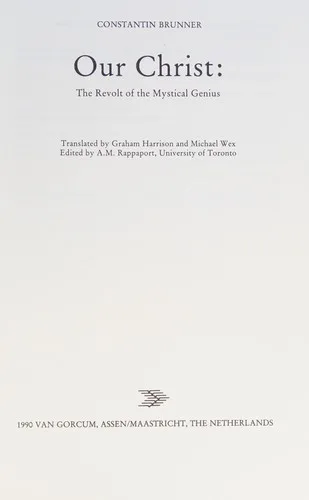
Unser Christus


Marcus Thorne (Esoteric Sciences Reviewer) — Constantin Brunner's 'Unser Christus' is a revelation for students of comparative mysticism and esoteric Christianity. It masterfully bridges the chasm between Jewish thought and Christian theology, offering a Christology rooted in Kabbalistic principles and rabbinic interpretations. Brunner’s profound intellect illuminates the symbolic language of scripture, revealing a Christ figure as an embodiment of spiritual evolution and universal consciousness. The work’s strength lies in its audacious yet meticulously argued re-contextualization, providing invaluable insights for scholars and practitioners alike who seek a more unified understanding of the spiritual path. A cornerstone for any serious occult library.
📝 Description
62
Constantin Brunner published 'Unser Christus' in 1921, offering a Jewish mystical reinterpretation of Christianity.
Constantin Brunner's 'Unser Christus' examines Christian concepts through a Jewish mystical framework. He argues that Christ should be understood not just as a historical person but as an archetype of divine consciousness. Brunner draws heavily on Kabbalistic thought and ancient Hebrew wisdom to build his argument. The book aims for a rigorous philosophical approach while engaging with mystical traditions. Brunner seeks to bridge faith and philosophy, presenting a unified view of the divine. This work is intended for readers seriously interested in theological and philosophical inquiry, rather than a superficial engagement.
Published in 1921, 'Unser Christus' belongs to the intellectual currents of early 20th-century European esoteric thought, which often sought to synthesize disparate religious and philosophical traditions. Brunner's work specifically engages with Jewish mysticism, or Kabbalah, to reframe core Christian doctrines. This period saw many thinkers attempt to find universal truths by connecting Western Christianity with Eastern philosophies or, in Brunner's case, with the Hebraic roots of Christianity itself, viewed through a mystical lens. His approach is characteristic of esoteric scholarship that prioritizes symbolic and allegorical understanding over literal or historical dogma.
💡 Why Read This Book?
Unlock a revolutionary perspective on Christology by exploring its profound Jewish mystical roots. 'Unser Christus' offers a unique synthesis of philosophy and esoteric tradition, revealing hidden symbolic meanings and fostering a deeper, more integrated understanding of spiritual truths. Ideal for seekers of gnosis, scholars of comparative religion, and practitioners of Kabbalah seeking to expand their conceptual horizons.
⭐ Reader Reviews
Honest opinions from readers who have explored this book.
❓ Frequently Asked Questions
What is the primary focus of 'Unser Christus'?
The book's primary focus is a profound reinterpretation of Christ and Christian doctrine through the lens of Jewish mysticism, particularly Kabbalah, revealing a deeper, symbolic, and philosophical meaning.
Who is Constantin Brunner?
Constantin Brunner was a German-Jewish philosopher and theologian known for his unique synthesis of Jewish thought, philosophy, and mysticism, seeking to bridge seemingly disparate spiritual traditions.
Is this book suitable for beginners in Kabbalah?
While challenging, 'Unser Christus' can be approached by dedicated beginners with a strong philosophical inclination. Prior familiarity with basic Kabbalistic concepts would enhance understanding.
What makes this interpretation of Christ unique?
Its uniqueness lies in Brunner's method of viewing Christ not solely within a Christian framework, but as an archetypal manifestation of divine consciousness deeply rooted in Jewish symbolic and philosophical traditions.
What kind of impact does this book aim to have on the reader?
The book aims to provoke a transformative shift in perception, encouraging readers to see the interconnectedness of spiritual traditions and to uncover deeper, more universal truths about existence and divinity.
🔮 Key Themes & Symbolism
The Archetypal Christ
Brunner posits Christ as more than a historical figure, but as an eternal, archetypal emanation of divine consciousness. This theme looks at how this archetype is understood through the esoteric principles of Kabbalah, transcending specific religious dogma. It explores the universal spiritual potential inherent within humanity, symbolized and articulated through the figure of Christ, understood through the symbolic language of the Sephirot and other Kabbalistic concepts, offering a useful insights into spiritual realization.
Kabbalistic Christology
This central theme examines the profound congruence Brunner identifies between the teachings and symbolism surrounding Christ and the ancient wisdom of Kabbalah. It explores how concepts like the Ein Sof, the divine spark, and the process of creation as described in Jewish mysticism provide a framework for understanding Christ's role and nature. The book uncovers intricate parallels, suggesting a unified spiritual lineage and offering a radical re-evaluation of Christ's significance within a broader esoteric context.
The Synthesis of Jewish and Christian Thought
Brunner's work is a monumental effort to bridge the perceived divide between Jewish and Christian spiritual traditions. This theme focuses on his philosophical and mystical methodology for achieving this synthesis. It highlights how he draws upon rabbinic interpretations, mystical exegesis, and philosophical reasoning to demonstrate an underlying unity of purpose and truth. The book advocates for a holistic spiritual understanding, moving beyond sectarianism towards a universal Gnosis.
💬 Memorable Quotes
Direct passages from the work, attributed to the author.
“Christ is the key that unlocks the hidden chambers of the human spirit.”
— Here, Christ is presented as a symbolic representation of spiritual awakening and the potential for self-realization, a guide to accessing deeper levels of consciousness.
“Wisdom is the light that banishes the shadows of ignorance.”
— This aphorism speaks to the transformative power of knowledge and understanding, particularly esoteric knowledge, in useful the path to truth and dispelling illusion.
“The Torah and the Gospel are but two rivers flowing from the same eternal spring.”
— This profound statement underscores Brunner's core thesis: the fundamental unity of spiritual revelations, suggesting that different religious traditions are expressions of a singular, divine source.
“To know oneself is to know the Divine.”
— This reflects the ancient maxim 'Know Thyself,' linking self-awareness and introspection to the ultimate understanding of the divine nature of reality.
💡 Key Ideas
Editorial paraphrase of the work's core concepts — not direct quotes.
The Divine is not found in dogma, but in the silent depths of the soul.
This quote emphasizes the esoteric principle that true spiritual understanding comes from inner contemplation and direct experience, rather than adherence to external religious structures.
🌙 Esoteric Significance
Tradition
This work is deeply entrenched in the Western Esoteric Tradition, with a profound emphasis on Jewish mysticism, particularly Kabbalah. It draws extensively from the Zohar and other Kabbalistic texts, reinterpreting their symbolism and cosmology to shed light on Christian figures and concepts. Brunner's approach aligns with the Gnostic pursuit of hidden knowledge and the Hermetic ideal of 'as above, so below,' seeking to reveal the divine blueprint within the human experience.
Symbolism
The book is rich with esoteric symbolism, drawing heavily from Kabbalistic Tree of Life imagery, gematria, and the allegorical interpretations of biblical narratives. Brunner re-contextualizes Christian symbols, such as the cross and the resurrection, within a framework of spiritual ascent, divine emanation, and the unfolding of consciousness. He explores the symbolic meaning of Christ's life and teachings as a map for the soul's journey towards reunification with the Divine Source.
Modern Relevance
In an age of increasing spiritual pluralism and seeking for integrated worldviews, 'Unser Christus' offers a timely and potent message. It provides a model for interfaith dialogue and understanding, demonstrating how profound spiritual truths can be found in the synthesis of diverse traditions. For contemporary seekers, it offers a pathway to a more holistic and deeply personal spiritual practice, revealing the universal archetypes that lie at the heart of human religious experience.
👥 Who Should Read This Book
This important work is essential for scholars of comparative religion, Jewish mysticism, and esoteric Christianity. It is highly recommended for practitioners of Kabbalah seeking to expand their understanding of its application beyond traditional Jewish contexts. Advanced students of philosophy interested in unique synthesis of thought will find it useful. Furthermore, it is a vital read for any spiritual seeker who yearns for a deeper, more integrated understanding of Christ and the divine, transcending conventional religious boundaries and embracing the esoteric wisdom that connects all traditions.
📜 Historical Context
Published in the early 20th century, Constantin Brunner's 'Unser Christus' emerged during a period of intense intellectual and spiritual ferment across Europe. This era witnessed a surge of interest in mysticism, occultism, and comparative religion, as thinkers grappled with the perceived limitations of rationalism and sought new frameworks for understanding existence. Brunner's work is a proof of this intellectual climate, offering a bold attempt to reconcile seemingly disparate religious traditions through a philosophical and mystical lens. His unique perspective, deeply rooted in his Jewish heritage yet engaging critically with Christian theology, reflects the broader European intellectual discourse on spirituality, identity, and the search for universal truth in a rapidly changing world.
📔 Journal Prompts
How does Brunner's Kabbalistic interpretation of Christ challenge your preconceived notions of divinity?
In what ways can the symbolic language of the Kabbalah be applied to understand spiritual figures in other traditions?
Reflect on the concept of Christ as an 'archetypal emanation.' How does this resonate with your personal spiritual journey?
What parallels do you observe between the mystical concepts presented in 'Unser Christus' and your own spiritual experiences?
Consider the idea of 'two rivers from the same spring.' How does this perspective influence your view of religious diversity?
🗂️ Glossary
Ein Sof
The Kabbalistic concept of the Infinite, Unknowable Godhead, the primordial source of all existence before any manifestation or emanation.
Sephirot
The ten divine emanations or attributes of God in Kabbalah, forming the structure of the Tree of Life, through which the Infinite manifests in the created world.
Gnosis
A Greek term for knowledge, particularly spiritual or esoteric knowledge, that leads to salvation or enlightenment, often implying direct, intuitive understanding of divine mysteries.
Christology
The branch of Christian theology that deals with the nature, person, and work of Jesus Christ, particularly his divinity and humanity.
Archetype
In a psychological or philosophical context, an original model or prototype from which other similar things are derived. In this context, an eternal spiritual pattern or essence.
This book appears in 1 collection
🔮 Readers Also Liked
Browse all →








More by Constantin Brunner
All books →
From the “Kabbalah” Collection
View all →





More Free Kabbalah & Jewish Mysticism Books
View all →