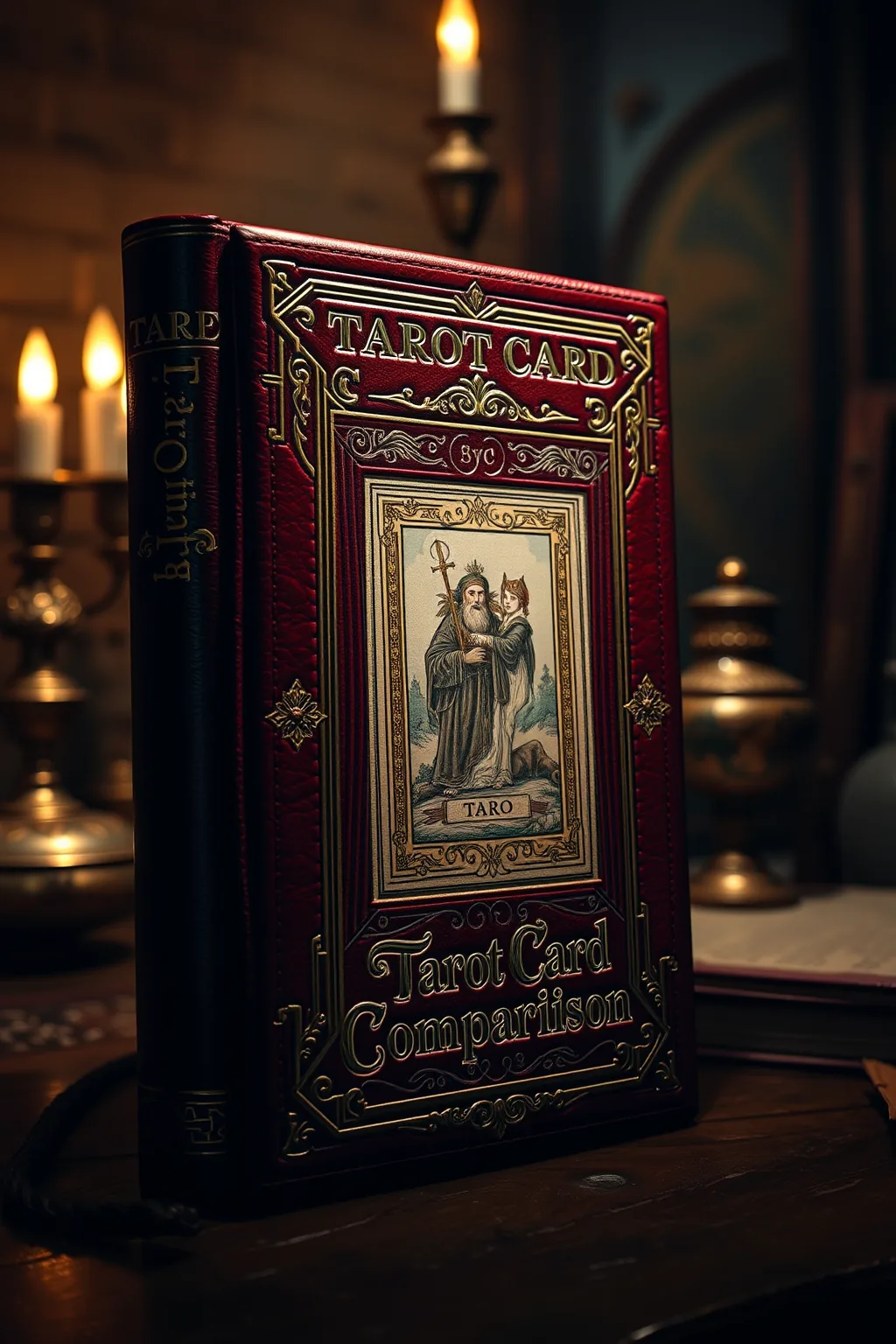
Tarot Card Comparison
 78
78

Tarot Card Comparison



Lorelei Sage, Contemplative Literature Editor—This meticulously crafted comparison offers an indispensable resource for anyone deeply invested in the Rider-Waite-Smith Tarot's lineage. The unknown author, drawing upon John B. Hare's scholarly foundation, provides a visually-driven exploration that transcends mere aesthetic critique, delving into the very soul of the cards. For practitioners seeking to understand the nuances of different editions, or scholars of occult symbolism, this piece is invaluable. Its strength lies in its focused approach, allowing for a profound appreciation of the original artistic intent and its subsequent manifestations, illuminating the path for deeper intuitive understanding.
📝 Description
78
First published in 1970, 'Tarot Card Comparison' analyzes the Rider-Waite-Smith deck's transition to the US Games iteration.
This work examines the visual and interpretive differences between the 1909 Rider-Waite-Smith tarot deck and the 1970 US Games edition. It details how specific symbol changes and stylistic alterations in the latter deck can affect the reading of individual cards and the deck as a whole. The author traces the evolution of key illustrations, demonstrating how these shifts impact the esoteric meaning and overall spiritual resonance attributed to the cards. It is written for those interested in the history and interpretation of tarot imagery. The text aims to foster a deeper understanding of how variations in design can lead to different approaches in divination and personal reflection.
The comparison highlights subtle but significant divergences that developed over time. It encourages a close look at the visual language of the tarot, suggesting that even minor adjustments to iconic artwork can carry considerable weight in occult traditions. This book serves as a guide for appreciating the historical development of widely used tarot decks and their continuing influence on practitioners.
The book sits within the Western esoteric tradition, specifically focusing on the history and iconography of widely adopted tarot decks. It engages with the lineage tracing back to the Rider-Waite-Smith deck, a cornerstone for many modern occultists and diviners. By comparing this influential 20th-century deck with its subsequent iteration, the work touches upon how established esoteric systems are adapted and reinterpreted. It acknowledges the role of visual representation in channeling spiritual energies and facilitating self-knowledge, a common theme in occult literature.
💡 Why Read This Book?
This essay is essential for understanding the visual evolution of the most widely used Tarot deck. It's ideal for Tarot practitioners, occult historians, and anyone fascinated by the power of symbolic imagery. Discover the subtle shifts that impact interpretation and deepen your connection to the archetypes. Unlock a more profound understanding of the Rider-Waite-Smith legacy.
⭐ Reader Reviews
Honest opinions from readers who have explored this book.
❓ Frequently Asked Questions
What is the primary focus of this comparison?
The essay primarily compares high-resolution images of the 1909 Tarot deck and the 1970 US Games deck, highlighting visual and symbolic differences.
Who is the intended audience for this work?
The intended audience includes Tarot enthusiasts, practitioners, occult scholars, and those interested in the history and evolution of divination tools.
What is the significance of comparing these two specific Tarot decks?
These decks represent key historical iterations of the Rider-Waite-Smith Tarot, allowing for an examination of artistic changes and their potential impact on esoteric interpretation.
Does this essay offer new interpretations of Tarot cards?
While it highlights visual differences, the essay's strength lies in its visual comparison which can lead readers to their own new interpretations based on the observed nuances.
Is this a comprehensive guide to Tarot reading?
No, this essay is specifically focused on the visual comparison of two distinct Tarot decks and their historical context, not a general guide to reading Tarot.
🔮 Key Themes & Symbolism
The Alchemy of Imagery
This theme examines how visual representations in Tarot act as conduits for esoteric knowledge. The comparison of the 1909 and 1970 decks reveals the subtle yet potent shifts in artistic execution, color palettes, and linework. Each alteration, however minor, can subtly reframe the energetic resonance and symbolic weight of a card, akin to alchemical processes transforming base elements into higher understanding. The essay invites readers to perceive these visual nuances not as mere aesthetic choices, but as deliberate or emergent modifications that influence the Tarot's capacity to channel archetypal energies and facilitate profound introspection.
Lineage of the Oracle
The essay traces the lineage of the Rider-Waite-Smith Tarot, a foundational deck in modern divination. By juxtaposing the original 1909 creation with the widely adopted 1970 US Games edition, it illuminates the historical trajectory and evolutionary currents within this powerful esoteric tool. Understanding this lineage is crucial for practitioners seeking to connect with the deck's historical roots and the intentions of its original creators, A.E. Waite and Pamela Coleman Smith. It underscores how traditions evolve, adapt, and yet retain their core spiritual essence, offering a deeper context for personal practice and study.
The Unseen Architect: Pamela Coleman Smith's Vision
Central to this exploration is the often-understated contribution of Pamela Coleman Smith, the artist whose vision brought the Rider-Waite-Smith deck to life. The comparison implicitly highlights the power and specificity of her original artwork. By examining later iterations, we gain a renewed appreciation for Smith's unique symbolic language and artistic choices. Her hand colored the nascent meanings of the cards, and understanding these original strokes allows for a more authentic engagement with the deck's mystical underpinnings, revealing the artist as a crucial, albeit often overlooked, architect of modern Tarot iconography.
💬 Memorable Quotes
Direct passages from the work, attributed to the author.
“Symbolism is the silent language of the divine.”
— This highlights the profound, non-verbal communication inherent in symbolic systems like the Tarot, connecting us to higher consciousness.
“Evolution preserves the essence.”
— Suggests that changes in form (like Tarot decks) do not diminish the core spiritual or symbolic power, but rather adapt its expression.
“The artist's hand, the seer's eye.”
— Connects the creator's intention and skill with the interpreter's ability to perceive hidden meanings within the artwork.
“Where images speak, truth resonates.”
— Asserts that visual representations in the Tarot possess an inherent power to convey deep truths that words may fail to capture.
💡 Key Ideas
Editorial paraphrase of the work's core concepts — not direct quotes.
The Tarot is a mirror to the soul.
This quote emphasizes the Tarot's function as a reflective tool, revealing inner truths and subconscious patterns to the seeker.
🌙 Esoteric Significance
Tradition
This work is deeply rooted in the Western Esoteric Tradition, specifically within the lineage of Hermeticism, Kabbalah, and ceremonial magic, which heavily influenced A.E. Waite. The Rider-Waite-Smith deck itself is a codified system of these esoteric principles, designed to act as a psycho-spiritual map. The comparison illuminates how the visual manifestation of these traditions, as captured by Pamela Coleman Smith, serves as a potent vehicle for accessing and understanding complex metaphysical concepts.
Symbolism
The core esoteric significance lies in the collection of symbolism within each card. From the archetypal figures and their gestures to the intricate details in the backgrounds, every element is laden with meaning drawn from ancient mythologies, astrological correspondences, and Kabbalistic Tree of Life principles. The comparison highlights how subtle changes in these symbols can alter the interpretive matrix, underscoring the importance of precise visual representation in conveying deep esoteric truths and facilitating spiritual insight.
Modern Relevance
In an age often characterized by rapid change and information overload, the Tarot's enduring symbolic language offers a grounding point for self-reflection and spiritual exploration. The comparison of different deck iterations underscores the timeless nature of these archetypes and their ability to resonate across generations. It demonstrates how these ancient tools can be effectively utilized for personal growth, psychological insight, and working through the complexities of modern life, proving their continued relevance as guides to the inner landscape and the greater cosmic order.
👥 Who Should Read This Book
This essay is a treasure for the dedicated Tarot practitioner seeking a deeper understanding of their chosen deck's visual heritage. It will captivate occult historians and scholars of esoteric symbolism, offering a critical lens through which to analyze artistic evolution within sacred traditions. For the spiritual seeker, it provides a unique opportunity to engage with the visual language of archetypes on a more profound level, fostering intuition and expanding interpretive horizons. Beginners will find it an informative introduction to the nuances that can exist even within seemingly familiar decks, encouraging a more discerning and appreciative approach to their Tarot journey.
📜 Historical Context
The early 20th century was a period of intense esoteric revival, with figures like A.E. Waite and Pamela Coleman Smith at its forefront. Their collaboration on the Rider-Waite-Smith Tarot in 1909 was groundbreaking, particularly in its use of fully illustrated minors, moving beyond the symbolic pips of earlier decks. This innovation democratized Tarot reading, making the cards more accessible and intuitive. The mid-20th century saw the deck's enduring influence solidify, leading to numerous editions. The 1970 US Games Systems iteration became a starting point for subsequent printings, establishing a widely recognized visual standard. This comparison sits at the nexus of these two important moments, allowing for an appreciation of the original artistic vision and its subsequent mass dissemination, reflecting the growing interest in occultism and personal spirituality.
📔 Journal Prompts
Reflect on a card where the visual differences between the 1909 and 1970 decks significantly alter your initial impression or understanding. What is that difference, and how does it change the card's meaning for you?
Consider Pamela Coleman Smith's artistic contribution. How might her personal experiences or spiritual beliefs have informed the specific symbolic choices in the 1909 deck?
If you primarily use the 1970 US Games deck, how does learning about the 1909 original inspire you to look at your cards with new eyes?
How does the concept of 'evolution' in artwork relate to the evolution of your own spiritual or personal understanding?
Choose one card and explore how its symbolism, as depicted in both versions, could relate to a current challenge or question you are facing.
🗂️ Glossary
Rider-Waite-Smith Tarot
A highly influential Tarot deck created by Arthur Edward Waite and illustrated by Pamela Coleman Smith, first published in 1909. It is known for its fully illustrated minor arcana.
Divination
The practice of seeking knowledge of the future or the unknown by supernatural means. In Tarot, it involves interpreting card spreads for insight and guidance.
Esoteric
Intended for or likely to be understood by only a small number of people with a specialized knowledge or interest; relating to or dealing with the occult.
Archetype
A very typical example of a certain person or thing; in Tarot, universal patterns of human nature and experience represented by the cards.
Symbolism
The use of symbols to represent ideas and qualities by giving them symbolic meanings that are different from their literal sense.
This book appears in 3 collections
🔮 Readers Also Liked
Browse all →






From the “Tarot” Collection
View all →








More Free Divination & Tarot Books
View all →