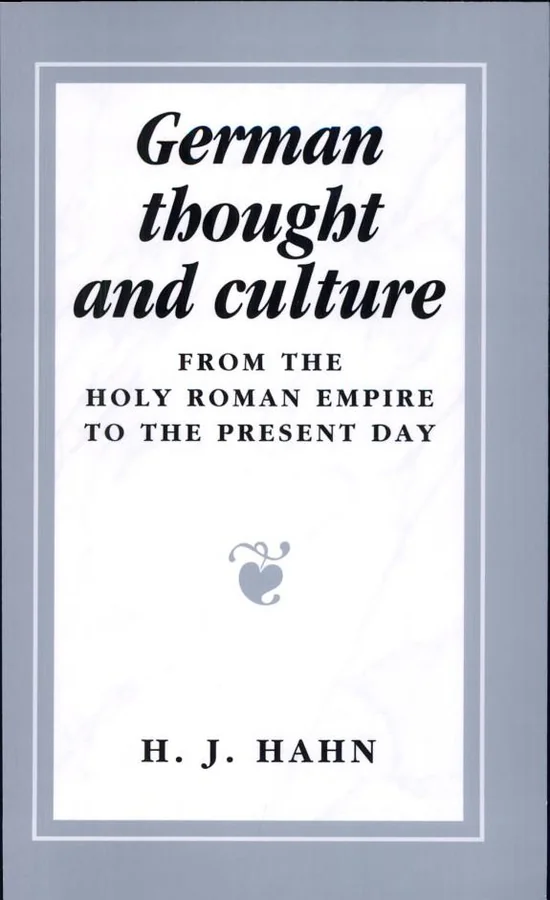
German Thought and Culture
 73
73

German Thought and Culture
Hans Joachim Hahn's "German Thought and Culture" (while the provided blurb is about Liverpool) presents a dense, yet rewarding, examination of intellectual currents shaping Germany from the Enlightenment through the early 20th century. The work eschews broad generalizations, instead focusing on specific thinkers and movements, such as the reception of Kantian philosophy and the rise of nationalist ideologies. One particular strength lies in its detailed analysis of the philosophical underpinnings of German Romanticism, tracing its lineage back to earlier German Enlightenment figures. However, the book's relentless academic focus, with its extensive footnotes and specialized vocabulary, may prove a barrier for readers not already immersed in German intellectual history. A passage discussing the influence of Fichte's concept of the 'self' on later nationalist thought is particularly illuminating, though its complexity requires careful attention. For those seeking a rigorous, scholarly exploration of the subject, this work offers substantial depth.
📝 Description
73
Hans Joachim Hahn's 2001 German Thought and Culture examines the esoteric dimensions of German intellectual history.
This collection of essays, published in 2001, looks at the esoteric currents within German thought and culture. Hahn investigates how ideas often considered outside the mainstream, such as mysticism, occultism, and alternative philosophies, interacted with and influenced more widely recognized intellectual movements. The book traces these less visible threads from the Enlightenment through the 20th century, showing their persistent presence and impact on German cultural identity.
Hahn moves beyond simple categorization, demonstrating how these esoteric traditions were not isolated phenomena but were often interwoven with political, social, and artistic developments. He considers figures and movements that challenged conventional rationalism, exploring their engagement with ideas of hidden knowledge, spiritual transformation, and alternative realities. The essays aim to illuminate a significant, yet often marginalized, aspect of German intellectual life.
Hans Joachim Hahn's work situates esoteric thought not as a fringe curiosity, but as an integral, albeit often hidden, component of German intellectual and cultural history. It acknowledges a tradition that extends from medieval mysticism through figures like Boehme and Baader, and into 19th and 20th-century movements concerned with the spiritual, the occult, and alternative forms of knowledge. The book recognizes that these currents, though frequently dismissed by mainstream scholarship, have consistently informed and sometimes challenged dominant philosophical, political, and artistic expressions within German culture.
💡 Why Read This Book?
• Gain specific insights into the philosophical roots of German Romanticism, tracing its connections to Enlightenment thinkers like Kant, a crucial step in understanding its esoteric and cultural impact. • Understand the intellectual climate surrounding the rise of German nationalism in the late 19th century, as detailed through the analysis of key figures and their concepts. • Discover the nuanced interplay between philosophical discourse and cultural movements in Germany, offering a deeper appreciation for how ideas shape national identity and historical trajectories.
⭐ Reader Reviews
Honest opinions from readers who have explored this book.
❓ Frequently Asked Questions
What specific philosophical concepts does Hahn explore in relation to German thought?
The work extensively explores concepts such as Kantian idealism, Fichte's subjective idealism, and the philosophical underpinnings of German Romanticism, examining their evolution and influence on later intellectual and cultural movements.
Which historical periods are most thoroughly covered in 'German Thought and Culture'?
The book primarily focuses on the period from the late 18th century (the Enlightenment and early Romanticism) through the 19th century and into the early 20th century, detailing the development of key intellectual traditions.
Is 'German Thought and Culture' accessible to a general reader?
While comprehensive, the book's dense academic style, extensive use of specialized terminology, and deep dives into philosophical minutiae make it more suitable for students and scholars of intellectual history rather than a casual reader.
Who were some of the key thinkers discussed in the book?
Key figures include Immanuel Kant, Johann Gottlieb Fichte, and prominent Romantic era philosophers and writers, whose ideas are analyzed for their contribution to German intellectual traditions.
Does the book discuss the reception of German thought outside of Germany?
The focus is predominantly on the internal development and evolution of German thought and culture. While external influences might be touched upon, the primary emphasis remains on the intellectual currents within Germany itself.
What is the significance of the early 20th century in Hahn's analysis?
The early 20th century is significant as it marks the culmination of many 19th-century intellectual trends discussed, including the consolidation of nationalist ideologies and the philosophical precursors to significant political and social shifts in Germany.
🔮 Key Themes & Symbolism
Kantian Legacy
The work meticulously traces the lasting impact of Immanuel Kant's philosophy, particularly his epistemological and ethical frameworks, on subsequent German intellectual discourse. It examines how Kant's ideas were interpreted, adapted, and sometimes radically transformed by thinkers like Fichte and the Romantics, setting the stage for various metaphysical and idealist schools of thought that would shape German culture.
Romanticism's Philosophical Roots
Hahn examines the esoteric and philosophical underpinnings of German Romanticism, illustrating how its emphasis on subjectivity, nature, and the spiritual realm was not merely an artistic movement but a deeply philosophical one. It connects Romantic ideals to earlier Enlightenment rationalism and idealist philosophies, showing a complex lineage that often sought transcendence through immanent experience.
National Identity Formation
A significant theme is the role of intellectual currents in forging a distinct German national identity, particularly in the 19th century. The book analyzes how philosophical concepts, literary movements, and historical narratives were employed to articulate a sense of 'Germanness,' often in dialogue with or in opposition to other European traditions, leading to complex ideological formations.
Idealism and Subjectivity
The pervasive influence of German Idealism, with its focus on consciousness, the self, and the active role of the mind in constructing reality, is a central thread. Hahn explores how this emphasis on subjectivity permeated various fields, from philosophy and theology to art and political thought, contributing to unique metaphysical perspectives.
💬 Memorable Quotes
Direct passages from the work, attributed to the author.
“The reception of Kantian categories into Romantic thought.”
— This highlights how abstract philosophical concepts, initially developed within a rationalist framework, were reinterpreted through the lens of Romanticism's emphasis on emotion, intuition, and the sublime.
“Fichte's assertion of the 'I' as the origin of all reality.”
— This points to the radical subjective turn in German Idealism, where the self is not merely a perceiver but an active creator of the phenomenal world, a concept with far-reaching implications.
“The esoteric dimensions of German Romantic poetry.”
— This suggests that beyond aesthetic appeal, Romantic literature contained deeper, often mystical or philosophical, explorations of existence, consciousness, and the divine, requiring careful interpretive approaches.
“The dialectic between Enlightenment reason and Romantic spirit.”
— This frames the intellectual history not as a simple progression, but as a dynamic interplay of opposing yet interconnected forces, where one tendency often emerged in response to, or in synthesis with, another.
“The philosophical groundwork for nationalist sentiment.”
— This indicates that the emergence of German nationalism was not solely a political or social phenomenon, but was deeply rooted in, and fueled by, specific philosophical ideas about culture, history, and collective identity.
🌙 Esoteric Significance
Tradition
While primarily an intellectual history, "German Thought and Culture" touches upon traditions that resonate with esoteric thought, particularly German Idealism and Romanticism. These movements often explored concepts of the Absolute, the divine immanent in nature, and the power of human consciousness, aligning with certain Hermetic and Neoplatonic undercurrents. The work's focus on subjective experience and the search for transcendent meaning connects it to mystical philosophies that prioritize inner knowledge.
Symbolism
The book implicitly engages with symbols of nature, the self, and the Absolute, central to Romantic and Idealist thought. The concept of the 'Absolute' itself functions symbolically, representing an ultimate, unified reality often sought through philosophical or spiritual means. Nature, particularly in Romanticism, is often depicted as a living entity or a manifestation of the divine, carrying symbolic weight beyond its literal interpretation.
Modern Relevance
Contemporary thinkers interested in the philosophy of consciousness, existentialism, and critical theory often draw upon the legacy of German Idealism and Romanticism explored in this book. Its detailed analysis of how philosophical ideas shape cultural and national identity remains relevant for understanding modern ideological formations and the enduring influence of these historical intellectual currents on contemporary thought and practice.
👥 Who Should Read This Book
• Students of philosophy and intellectual history seeking a comprehensive overview of German Idealism and Romanticism. • Scholars interested in the historical development of concepts like the Absolute, the Self, and national identity in German thought. • Readers with a background in metaphysics and epistemology who wish to understand the philosophical underpinnings of German cultural movements.
📜 Historical Context
Published in 1995, Hans Joachim Hahn's "German Thought and Culture" emerged in an era of renewed interest in German intellectual history, particularly in the wake of German reunification. The late 20th century saw a flourishing of post-structuralist and deconstructionist approaches to cultural analysis, which often engaged with the complex legacy of German Idealism and its perceived role in nationalistic ideologies. Hahn's work, while deeply rooted in traditional scholarship, implicitly engages with these contemporary debates by providing a rigorous examination of the philosophical foundations. Key contemporaries whose works were influential in this field include historians of philosophy and intellectual history like Louis Dupré and Frederick Beiser, who were also exploring the contours of German Idealism and its ramifications. The book's detailed focus on specific thinkers and movements, rather than broad strokes, positions it as a scholarly contribution aimed at refining understanding rather than making grand, sweeping pronouncements, thus avoiding the pitfalls of earlier, more ideologically charged, interpretations of German intellectual history.
📔 Journal Prompts
The influence of Kantian categories on Romantic ideals.
Fichte's concept of the self and its implications for subjective experience.
The philosophical roots of German nationalism.
The esoteric interpretations of nature in German Romanticism.
Tracing the development of Idealism from Kant to Hegel.
🗂️ Glossary
Kantianism
The philosophical system developed by Immanuel Kant, emphasizing reason, epistemology, ethics, and the structure of the mind in understanding reality. It forms a crucial foundation for German Idealism.
German Idealism
A philosophical movement originating in Germany in the late 18th century, emphasizing the primacy of mind or spirit in constituting reality. Key figures include Fichte, Schelling, and Hegel.
Romanticism
An artistic, literary, musical, and intellectual movement originating in Europe toward the end of the 18th century, characterized by its emphasis on emotion, individualism, glorification of the past and nature, and often, a mystical or spiritual sensibility.
Absolute
In Hegelian philosophy, the ultimate reality or totality, often conceived as a dynamic, self-developing process of Spirit or Idea that encompasses all of existence.
Subjectivity
The quality of being based on or influenced by personal feelings, tastes, or opinions. In German Idealism, it refers to the active role of consciousness in shaping perceived reality.
Transcendence
Existence or experience beyond the normal or physical level. In philosophy and religion, it often refers to that which is beyond the material world or ordinary human understanding.
Epistemology
The branch of philosophy concerned with the theory of knowledge, investigating its nature, scope, and limitations, and the basis of certainty in knowledge.
This book appears in 1 collection
🔮 Readers Also Liked
Browse all →







From the “Enlightenment” Collection
View all →






More Free Esoteric History & Biography Books
View all →