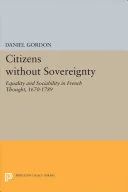
Citizens Without Sovereignty
 80
80

Citizens Without Sovereignty
Gordon's "Citizens Without Sovereignty" offers a necessary corrective to simplistic accounts of the Enlightenment. His meticulous examination of the period 1670-1789 reveals a more nuanced intellectual ecosystem than commonly portrayed. A particular strength lies in his analysis of how concepts of liberty were not solely the domain of radical philosophers but were embedded within broader cultural and theological discourses. For instance, his discussion of how moral philosophy sustained a sense of dignity under Louis XIV's regime is particularly illuminating. However, the sheer breadth of the material covered, spanning theology to economics, can occasionally feel diffuse, making it challenging to grasp a singular thread without significant reader effort. Gordon’s argument that an "ethos" of liberty was invented within absolutist constraints is persuasive, though the precise mechanisms of its transmission could be further elaborated. Ultimately, the book provides a valuable, if demanding, revisionist perspective on a pivotal era.
📝 Description
80
Daniel Gordon's 2008 book reassesses French intellectual life between 1670 and 1789.
Daniel Gordon's "Citizens Without Sovereignty" re-evaluates French intellectual life from 1670 to 1789. Instead of portraying a unified Enlightenment, Gordon shows how thinkers within an authoritarian state developed ideas of liberty and dignity. The book examines literature, moral philosophy, theology, and political theory, revealing a complex intellectual environment resistant to simple definitions.
Gordon challenges common views that exaggerate either the radicalism of Enlightenment thinkers or the absolute power of the French monarchy. He argues that a strong sense of freedom and self-respect developed through various cultural and intellectual means, despite the pressures of absolutism. This viewpoint moves past a simple opposition between oppression and resistance.
The book traces how this specific ethos was created and spread across different writing styles and academic fields. It highlights contributions from concepts of universal history and economics, alongside moral discussions and theological arguments, all fostering a shared sense of personal agency. The study demonstrates an intellectual tradition that actively created meaning and value within its societal limitations.
While not strictly an esoteric text in the sense of occult traditions, "Citizens Without Sovereignty" engages with the intellectual currents that informed later esoteric thought. It examines how concepts of individual worth, reason, and the articulation of personal freedom were developed in public discourse, even under conditions of state control. The book's focus on the construction of meaning and agency within constraints provides a historical backdrop for understanding how individuals sought autonomy and self-definition, which are recurring concerns in many esoteric traditions that explore inner sovereignty and resistance to external dogma.
💡 Why Read This Book?
• Understand how liberty was conceptualized within the rigid structures of French absolutism by examining Gordon's analysis of 17th and 18th-century theological debates, offering a unique perspective on agency under authority. • Discover the specific intellectual currents that fostered dignity between 1670 and 1789, moving beyond the common narrative of pure Enlightenment radicalism or state control. • Gain insight into the role of diverse fields like the literature of manners and universal history in shaping individual self-perception, as detailed in Gordon's exploration of these lesser-discussed influences.
⭐ Reader Reviews
Honest opinions from readers who have explored this book.
❓ Frequently Asked Questions
What period does Daniel Gordon's "Citizens Without Sovereignty" primarily cover?
The book focuses on French thought during the significant period spanning from 1670 to 1789, encompassing the latter years of Louis XIV's reign through the lead-up to the French Revolution.
How does Gordon challenge traditional views of the Enlightenment?
Gordon critiques interpretations that exaggerate either the radicalism of Enlightenment thinkers or the absolute power of the French state. He argues for a more complex intellectual landscape where liberty and dignity were sustained within authoritarian structures.
What types of literature and thought does Gordon analyze?
He examines a wide range, including the literature of manners, moral philosophy, theology, political theory, universal history, and economics, to illustrate how thinkers articulated a sense of liberty.
What is the central argument regarding the invention of an ethos?
Gordon posits that French thinkers actively 'invented' an ethos that sustained a sense of liberty and dignity, rather than simply reacting against or conforming to the absolutist regime.
Who is Daniel Gordon, and when was "Citizens Without Sovereignty" first published?
Daniel Gordon is the author of "Citizens Without Sovereignty," which was first published on February 21, 2017.
What specific historical context does the book engage with?
The book engages with the intellectual and political climate of France under absolutism, particularly the period leading up to the French Revolution, examining how ideas of liberty persisted.
🔮 Key Themes & Symbolism
Liberty Under Absolutism
This theme examines how concepts of liberty and personal dignity were articulated and maintained within the rigid framework of French absolutism between 1670 and 1789. Gordon demonstrates that freedom of thought and a sense of individual worth were not solely products of revolutionary upheaval but were actively cultivated through various intellectual and cultural channels. The work explores how theological discourse, moral philosophy, and even literary conventions provided spaces for affirming human agency, challenging the notion that the absolutist state entirely suppressed such ideals.
The Invention of Ethos
Gordon argues that a specific ethos—a guiding spirit or character—was actively 'invented' by French thinkers to sustain liberty and dignity. This wasn't merely a passive reception of existing ideas but a creative construction of values and perspectives. The book illustrates how diverse fields, from universal history to economics, contributed to this ongoing project of defining selfhood and ethical comportment, even under the constraints of a powerful monarchy.
Critique of Enlightenment Narratives
The work offers a critical re-evaluation of common interpretations of the Enlightenment. It pushes back against narratives that either overemphasize the radical nature of Enlightenment philosophy or portray the absolutist state as all-controlling. By analyzing a broad spectrum of texts, Gordon reveals a more complex intellectual history where ideas of freedom and dignity were negotiated, adapted, and sustained in ways that defy simplistic categorization, providing a nuanced view of intellectual history.
Discourse of Manners and Morality
A significant aspect of the book involves the analysis of the 'literature of manners' and moral philosophy. Gordon shows how these seemingly less political or radical fields played a central role in shaping an ethos of civility, self-respect, and individual conscience. These texts provided practical guidance and conceptual frameworks for individuals to navigate social structures while retaining a sense of personal dignity and moral autonomy, offering a unique lens on the period's intellectual currents.
💬 Memorable Quotes
Direct passages from the work, attributed to the author.
“French thinkers sustained a sense of liberty and dignity within an authoritarian regime.”
— This core assertion highlights Gordon's central thesis: that intellectual and personal freedom were not absent but actively preserved and articulated even under the strictures of French absolutism before the Revolution.
“The invention of an ethos that sustained liberty and dignity.”
— This phrase captures the active, creative process Gordon identifies, suggesting that French thinkers didn't just react to their political environment but consciously built a framework of values and self-understanding.
“A penetrating critique of those who exaggerate either the radicalism of the Enlightenment or the hegemony of the absolutist state.”
— This points to Gordon's methodological approach, aiming to provide a balanced perspective that avoids common historiographical extremes regarding both revolutionary ideas and state power.
“The work takes us through the literature of manners and moral philosophy, theology and political theory, universal history and economics.”
— This demonstrates the broad interdisciplinary scope of Gordon's research, emphasizing that the cultivation of liberty and dignity involved a wide array of intellectual and cultural domains, not just radical philosophy.
“Gordon explores French thought in the years 1670-1789.”
— This specific timeframe is crucial, covering the height of French absolutism and the intellectual ferment leading directly into the French Revolution, setting the stage for the book's central arguments.
🌙 Esoteric Significance
Tradition
While "Citizens Without Sovereignty" is primarily a work of intellectual history, its exploration of sustaining dignity and liberty within rigid structures can be viewed through an esoteric lens. It touches upon themes of inner freedom and the cultivation of a resilient self, which are central to many esoteric traditions. The work doesn't align with a specific lineage like Hermeticism or Kabbalah but rather examines the psychological and philosophical means by which individuals maintained a sense of sovereignty over their inner lives, a concept resonant with traditions emphasizing self-mastery and hidden knowledge.
Symbolism
The book itself doesn't focus on explicit esoteric symbols in the traditional sense. However, the 'ethos' Gordon describes can be seen as a symbolic construct—a shared understanding and practice that allows individuals to navigate oppressive systems. The concept of 'sovereignty' itself, even when lacking external political power, becomes a symbolic representation of internal autonomy and self-governance, mirroring esoteric pursuits of spiritual independence.
Modern Relevance
Contemporary thinkers and practitioners interested in existentialism, critical theory, and resilience studies might find resonance in Gordon's work. The examination of how individuals construct meaning and maintain dignity under systemic constraints offers valuable insights for understanding psychological endurance and the pursuit of inner freedom in modern, often bureaucratic or authoritarian, social landscapes. It speaks to the ongoing human endeavor to find personal agency amidst external limitations.
👥 Who Should Read This Book
• Students of intellectual history and the Enlightenment seeking a nuanced understanding beyond standard revolutionary narratives. • Readers interested in the philosophical and cultural underpinnings of liberty and dignity, particularly in contexts of political constraint. • Scholars of French history and culture looking for detailed analysis of the period 1670-1789 from a critical historiographical perspective.
📜 Historical Context
Daniel Gordon's "Citizens Without Sovereignty" is situated within the intellectual milieu of late 17th and 18th-century France, a period dominated by the absolutist monarchy of Louis XIV and his successors, culminating in the French Revolution of 1789. This era saw the flourishing of the Enlightenment, marked by figures like Voltaire and Rousseau whose ideas often challenged established authority. However, Gordon's work specifically interrogates the extent to which intellectual freedom and a sense of personal dignity could be sustained *within* the existing authoritarian structures, rather than solely through overt opposition. He engages with a spectrum of thought, from theological debates to economic theories, offering a counterpoint to narratives that focus exclusively on radical philosophical critiques. The book implicitly addresses intellectual currents that might be seen as precursors to later revolutionary thought, but its primary focus is on the persistence of certain values under less than ideal conditions. The reception of such nuanced historical arguments in the early 21st century reflects ongoing scholarly debates about the nature and impact of Enlightenment thought and state power.
📔 Journal Prompts
The invention of an ethos: How might one consciously cultivate a personal ethos today?
Liberty and dignity under constraint: Reflect on a historical or personal instance where these were asserted.
The literature of manners: How do contemporary social norms shape our sense of self?
Critique of dominant narratives: Identify a modern narrative that benefits from a more nuanced perspective.
Sustaining inner sovereignty: What practices can bolster personal autonomy in external systems?
🗂️ Glossary
Absolutism
A political doctrine and practice where a monarchical ruler possesses supreme, autocratic authority, not restricted by written laws, legislature, or unwritten customs. The French monarchy during the period 1670-1789 exemplified this system.
Ethos
The characteristic spirit, guiding beliefs, or ideals that pervade and distinguish a community, nation, or system of thought. In Gordon's work, it refers to the actively constructed sense of liberty and dignity.
Enlightenment
An 18th-century intellectual and cultural movement emphasizing reason, individualism, and skepticism towards traditional authority, which profoundly influenced Western thought and politics.
Literature of Manners
Texts, often didactic, concerned with social etiquette, decorum, and the proper conduct of individuals within a specific social hierarchy. These works reveal societal values and expectations.
Moral Philosophy
The branch of philosophy that involves systematizing, defending, and recommending concepts of right and wrong conduct. It explores ethical principles and values.
Universal History
A genre of historical writing that attempts to describe the history of the world, or at least a significant portion of it, from a single, overarching perspective, often seeking patterns or divine purpose.
Hegemony
The dominance of one group, class, or state over others. In political theory, it refers to the pervasive influence and control exerted, often through cultural and ideological means.
This book appears in 1 collection
🔮 Readers Also Liked
Browse all →






From the “Enlightenment” Collection
View all →








More Free Esoteric History & Biography Books
View all →