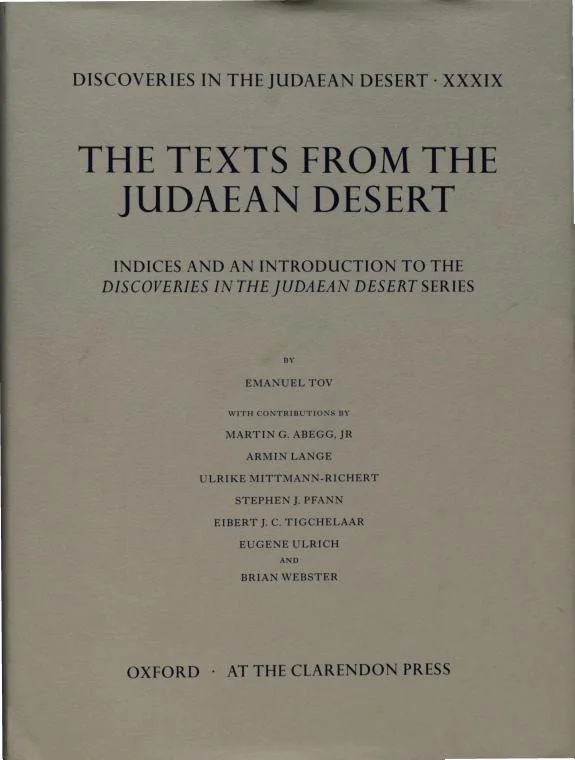
The Texts from the Judaean Desert
 76
76

The Texts from the Judaean Desert
Martin G. Abegg’s "The Texts from the Judaean Desert" offers a necessary, if somewhat dry, gateway to one of the most significant archaeological and textual undertakings of the 20th century. Its primary strength lies in its clear exposition of the editorial framework that underpins the vast "Discoveries in the Judaean Desert" series. The meticulous indexes, particularly the lists of textual overlaps, are a scholar’s dream, providing immediate access to comparative material. However, for the esoteric reader seeking mystical pronouncements, the book's academic rigor can feel like a barrier. The detailed discussion of editorial principles, while essential for scholarly accuracy, lacks the narrative flair one might associate with texts of deep spiritual import. A passage detailing the complex process of reconstructing a single scroll from hundreds of fragments, for instance, highlights the scholarly achievement but might leave those looking for direct esoteric transmission wanting more. Ultimately, it serves as an indispensable scholarly tool rather than a devotional text.
📝 Description
76
Published in 2002, Martin G. Abegg's book serves as an overview for the thirty-eight-part 'Discoveries in the Judaean Desert' series.
This volume is an introduction to the extensive "Discoveries in the Judaean Desert" publication project. It consolidates the editorial principles and findings from that major scholarly effort. The book details the corpus of scrolls found and explains the methods used in their study.
It is a suitable starting point for understanding the scholarship around the Judaean Desert discoveries. Students and researchers of early Jewish literature, Second Temple Judaism, and early Christianity will find it particularly useful. Those new to the "Discoveries" series will benefit from its organized presentation of the texts and editorial guidelines.
The discoveries, beginning in 1947 near Qumran, significantly changed the study of ancient Judaism and Christian origins. The "Discoveries in the Judaean Desert" series became the main venue for publishing these materials. Abegg's companion volume offers an accessible entry to decades of textual analysis and debate, often referencing scholars like Józef Milik.
While not a primary source of esoteric doctrine itself, this book contextualizes texts that have become central to certain esoteric traditions, particularly Gnosticism. The Judaean Desert scrolls include early Jewish writings that predate or are contemporary with the emergence of Gnostic thought. Their study has illuminated the diverse religious currents of the Second Temple period, a milieu from which many esoteric ideas later developed. Understanding the textual variations, scribal practices, and historical context of these discoveries is therefore important for tracing the development and influences within esoteric lineages that look to these ancient texts for their origins.
💡 Why Read This Book?
• You will learn the specific editorial principles governing the publication of the "Discoveries in the Judaean Desert" series, understanding how scholars from 1951 onwards approached the collation and presentation of fragmented ancient texts. • You will gain an overview of the various categories of texts found in the Judaean desert, including their identification and initial classification, providing a structured understanding of this diverse textual corpus. • You will discover the practical methods for identifying internal overlaps and textual parallels between different manuscript fragments, a crucial skill for reconstructing and interpreting these ancient documents.
⭐ Reader Reviews
Honest opinions from readers who have explored this book.
❓ Frequently Asked Questions
What is the "Discoveries in the Judaean Desert" series?
The "Discoveries in the Judaean Desert" (DJD) series is the official, multi-volume publication of manuscripts found in caves near Qumran and other sites in the Judaean Desert, beginning with discoveries in 1947.
When was "The Texts from the Judaean Desert" first published?
"The Texts from the Judaean Desert" was first published in 2002 as a companion and guide to the extensive DJD series.
Who is Martin G. Abegg?
Martin G. Abegg is a scholar associated with the editorial process and publication of the "Discoveries in the Judaean Desert" series, contributing this overview volume.
What kind of texts are included in the Judaean Desert discoveries?
The texts include biblical manuscripts, sectarian documents (like those associated with the Qumran community), and other Jewish writings from the Second Temple period, dating roughly from the 3rd century BCE to the 1st century CE.
Is this book a translation of the scrolls?
No, "The Texts from the Judaean Desert" is an introduction and overview to the series that publishes these scrolls. It describes the texts and the editorial process, rather than being a direct translation of the discovered manuscripts themselves.
What is the significance of the scribal notations mentioned?
Scribal notations are marks or comments made by ancient scribes in the margins or on the documents. Their study, detailed in the book, helps scholars understand textual variants, scribal practices, and the transmission history of ancient texts.
🔮 Key Themes & Symbolism
Editorial Principles
This volume meticulously details the editorial conventions established for the "Discoveries in the Judaean Desert" series. It explains the rigorous methodology employed by scholars, starting from the initial cataloging of fragments found in caves near Qumran and other Judaean sites. Readers learn about the systems for transliteration, transcription, and textual commentary, ensuring consistency across the thirty-eight published volumes. This focus underscores the commitment to scholarly accuracy in presenting these ancient Hebrew, Aramaic, and Greek texts discovered from 1947 onwards.
Textual Cataloging and Classification
A core function of this work is to provide a comprehensive catalog of the Judaean Desert texts. It outlines the different categories into which these discovered manuscripts fall, ranging from biblical books to sectarian writings and other Jewish literature from the Second Temple period. The book offers lists and descriptions that help readers orient themselves within the vast collection, identifying key texts and their general content.
Manuscript Reconstruction
The challenge of reconstructing ancient manuscripts from numerous small fragments is a central theme. "The Texts from the Judaean Desert" illuminates the painstaking process of identifying internal overlaps and textual parallels between disparate pieces. This analytical approach is crucial for scholars aiming to piece together coherent texts and understand variations in scribal hands and textual traditions that emerged during the period spanning the 3rd century BCE to the 1st century CE.
Scholarly Apparatus
Beyond the texts themselves, the volume emphasizes the scholarly tools and annotations that accompany them. It discusses the significance of scribal notations, critical apparatus, and the various indexes compiled to aid researchers. This highlights how the publication of the "Discoveries in the Judaean Desert" series evolved over decades, building a robust framework for the academic study of these important ancient documents.
💬 Memorable Quotes
Direct passages from the work, attributed to the author.
“The volume contains general descriptions of the series and its editorial principles.”
— This statement directly addresses the book's function as an introductory guide. It highlights that the core purpose is to explain the methodology and scope of the larger "Discoveries in the Judaean Desert" project, rather than presenting the ancient texts themselves.
“Several lists of the texts found in the Judaean desert.”
— This points to the practical, cataloging function of the book. It serves as a reference tool, providing readers with structured inventories of the discovered manuscripts, aiding in navigation and research.
“A list of scribal notations.”
— This indicates the book's attention to the finer details of textual analysis. Understanding scribal notations is key to deciphering the history and transmission of ancient texts, offering insights into the work of ancient copyists.
“Annotated lists of internal overlaps and parallels.”
— This highlights the comparative and reconstructive aspect of the scholarship discussed. Identifying connections between manuscript fragments is essential for piecing together damaged texts and understanding textual relationships.
“The editorial process for the thirty-eight volumes of the Discoveries in the Judaean Desert series.”
— This emphasizes the scale and complexity of the scholarly undertaking. The book acts as a key to understanding the decades-long effort involved in preparing these significant ancient documents for publication.
🌙 Esoteric Significance
Tradition
While not overtly a text of a specific esoteric tradition like Kabbalah or Hermeticism, "The Texts from the Judaean Desert" provides access to primary source materials that have profoundly influenced modern esoteric thought, particularly within Messianic, Gnostic-adjacent, and early Christian mystical studies. Its significance lies in presenting the raw data that scholars and esotericists alike analyze to reconstruct early Jewish and proto-Christian beliefs, often touching upon themes of dualism, ritual purity, and apocalyptic expectation.
Symbolism
The texts cataloged and discussed within this volume often contain rich symbolic language. For instance, concepts like the 'Sons of Light' versus the 'Sons of Darkness' found in some Qumran sectarian texts carry dualistic symbolic weight, representing cosmic spiritual warfare. The symbolic significance of purity laws and ritual meals, as detailed in various community rules, also points to deeper esoteric interpretations concerning spiritual transformation and communal identity within nascent spiritual movements.
Modern Relevance
Contemporary esoteric scholars and practitioners frequently engage with the Judaean Desert texts to understand the historical and conceptual roots of various mystical traditions. Movements exploring early Christian esotericism, Gnostic studies, and comparative mysticism often cite findings from the DJD series. Thinkers like Elaine Pagels, whose work bridges academic and popular understanding of these texts, demonstrate the ongoing relevance for those seeking to understand the diverse spiritual currents of antiquity.
👥 Who Should Read This Book
• Researchers of Second Temple Judaism: Gain a structured overview of the primary textual evidence, including biblical manuscripts and sectarian documents, crucial for understanding this important historical period. • Students of early Christianity: Access essential background material on Jewish beliefs and practices contemporary with Jesus, aiding in the contextualization of New Testament studies. • Paleographers and textual critics: Understand the established editorial principles and methodologies used to reconstruct and present ancient manuscripts from the Judaean Desert.
📜 Historical Context
The discovery of manuscripts in the Judaean Desert caves, beginning in 1947, occurred during a period of intense scholarly interest in the origins of biblical texts and the historical milieu of early Christianity. The "Discoveries in the Judaean Desert" (DJD) series, initiated by Roland de Vaux, became the authoritative platform for publishing these finds, commencing with Volume I in 1955. This academic endeavor was crucial for textual criticism and the study of Second Temple Judaism, offering a counterpoint to the prevailing textual traditions. Martin G. Abegg's 2002 volume emerged decades into this project, serving as a vital consolidation and introduction. It contextualizes the immense scholarly effort, referencing the work of key figures involved in the decades-long publication process, many of whom were engaged in debates surrounding the identification and interpretation of these unique documents.
📔 Journal Prompts
The systematic presentation of editorial principles in the "Discoveries in the Judaean Desert" series.
The cataloging of texts found in the Judaean desert and their implications.
The methodology for identifying scribal notations and their significance.
The process of analyzing internal overlaps and parallels between manuscript fragments.
The historical development and scholarly reception of the "Discoveries in the Judaean Desert" series.
🗂️ Glossary
Judaean Desert
A desert region west of the Dead Sea, known for the numerous caves where significant ancient manuscripts, including the Dead Sea Scrolls, were discovered starting in 1947.
Discoveries in the Judaean Desert (DJD) series
The official, multi-volume academic publication project by Oxford University Press responsible for releasing the manuscripts found in the Judaean Desert caves.
Editorial Principles
The set of rules and conventions established by scholars for the transcription, translation, and critical annotation of ancient texts within a specific publication series.
Scribal Notations
Marks, symbols, or brief comments made by ancient scribes on manuscripts, often indicating textual variants, errors, or instructions for copying.
Internal Overlaps
Instances where fragments of the same manuscript, found separately, can be pieced together or identified as belonging to the same textual unit based on continuity of content.
Textual Parallels
Sections of text within different manuscripts that share similar content or wording, used for comparative analysis and understanding textual transmission.
Second Temple Period
The historical era in Judaism spanning from the rebuilding of the Second Temple (c. 516 BCE) to its destruction by the Romans (70 CE).
This book appears in 1 collection
🔮 Readers Also Liked
Browse all →





From the “Dead Sea Scrolls” Collection
View all →






More Free Esoteric History & Biography Books
View all →