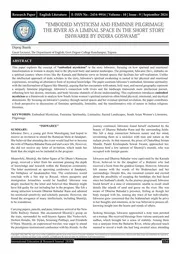
EMBODIED MYSTICISM AND FEMININE PILGRIMAGE: THE RIVER AS A LIMINAL SPACE IN THE SHORT STORY ISHWAREE BY INDIRA GOSWAMI
 75
75

EMBODIED MYSTICISM AND FEMININE PILGRIMAGE: THE RIVER AS A LIMINAL SPACE IN THE SHORT STORY ISHWAREE BY INDIRA GOSWAMI



Dipraj Banik's Embodied Mysticism and Feminine Pilgrimage: The River as a Liminal Space in the Short Story Ishwaree by Indira Goswami is a compelling exploration of the embodied spiritual journey. Banik masterfully weaves together the physical, emotional, and spiritual dimensions of Ishwaree Devi's pilgrimage, highlighting the unique role that rivers play as liminal spaces. This book is particularly valuable for modern esoteric seekers who are looking to reconnect with nature and their own bodies as pathways to spiritual enlightenment. Banik's analysis of the contrast between Ishwaree's embodied mysticism and the intellectual approach of male scholars adds depth to the discussion, making it a significant contribution to both feminist spirituality and esoteric studies. The book is well-researched and beautifully written, making it accessible to both academics and general readers.
📝 Description
75
Dipraj Banik's 2023 study examines Indira Goswami's 'Ishwaree' through the lens of embodied mysticism.
This book analyzes Indira Goswami's short story 'Ishwaree,' focusing on the concept of the river as a liminal space for feminine spiritual awakening. Dipraj Banik argues that the protagonist Ishwaree Devi's path to self-realization is distinct from more abstract, male-dominated intellectual traditions. Instead, her spiritual growth is rooted in physical experience and her connection to the natural world, particularly the river.
The analysis highlights how the river functions not merely as a setting, but as an active force in Ishwaree's transformation. It is presented as a site where the boundaries between the physical and spiritual dissolve, enabling a unique form of embodied mysticism. Banik situates this within the context of South Asian literary traditions and esoteric thought, suggesting a departure from purely intellectual spiritual quests.
This work engages with esoteric traditions that emphasize direct, lived experience of the divine over dogma or intellectual assent. It draws parallels with practices that understand the body not as a hindrance to spiritual attainment, but as a primary vehicle for it. The focus on the river as a transformative element connects to nature-based spiritualities and the concept of sacred geography, where natural features hold profound symbolic and energetic significance. The study positions these ideas within a literary framework, showing how narrative can articulate complex esoteric concepts.
💡 Why Read This Book?
Read Embodied Mysticism and Feminine Pilgrimage today to gain a deeper understanding of how the natural world can facilitate spiritual and emotional transformation. This book offers a fresh perspective on mystical experiences, highlighting the importance of the physical body and natural landscapes in spiritual journeys. Whether you are a seeker of esoteric knowledge or someone interested in the intersection of feminism and spirituality, this book provides valuable insights and a rich historical context.
⭐ Reader Reviews
Honest opinions from readers who have explored this book.
❓ Frequently Asked Questions
What is the main theme of the book?
The main theme of the book is embodied mysticism, exploring how spiritual and emotional transformation in women is deeply tied to the physical body and natural landscapes.
Who is the protagonist of the story Ishwaree?
The protagonist is Ishwaree Devi, who embarks on a spiritual journey facilitated by rivers like the Kamala and Baitarini.
How does the book differ from traditional mystical literature?
Unlike traditional mystical literature that often emphasizes intellectual and detached approaches, this book focuses on the embodied and emotional experiences of the protagonist.
🔮 Key Themes & Symbolism
Embodied Mysticism
This theme explores the idea that spiritual and emotional transformation in women is deeply tied to the physical body and natural landscapes. It contrasts with intellectual, male-dominated spiritual practices, emphasizing the embodied experience.
Feminine Spirituality
The book highlights the unique spiritual journey of women, focusing on the protagonist Ishwaree Devi's path to self-realization through her physical and emotional experiences. It contrasts with traditional male scholarly approaches.
Liminality and Sacred Landscapes
The concept of liminal spaces, particularly rivers, is explored as sacred landscapes that facilitate spiritual transformation. These spaces serve as thresholds between the ordinary and the mystical, aiding in self-discovery and spiritual awakening.
💡 Key Ideas
Editorial paraphrase of the work's core concepts — not direct quotes.
The river's flow is the rhythm of her soul, guiding her through the depths of self-discovery.
This quote underscores the spiritual significance of the river as a liminal space, symbolizing the protagonist's journey towards self-realization.
In the embrace of nature, she finds the divine within herself.
This passage highlights the embodied mysticism theme, showing how Ishwaree Devi's spiritual awakening is rooted in her physical experiences and connection to the natural world.
The river's whispers carry ancient wisdom, echoing through the corridors of her heart.
This quote emphasizes the sacred nature of the river as a source of hidden knowledge and spiritual insight.
Her pilgrimage is not of the body, but of the soul, seeking the divine in every step.
This passage illustrates the protagonist's spiritual journey, contrasting it with traditional male scholarly pursuits and emphasizing the feminine spiritual experience.
The river's currents are the currents of her own spirit, flowing towards enlightenment.
This quote underscores the theme of liminality, showing how the river serves as a threshold between the ordinary and the mystical in Ishwaree Devi's journey.
🌙 Esoteric Significance
Tradition
This book belongs to the tradition of embodied mysticism, which emphasizes the role of the physical body in spiritual transformation. It draws on esoteric concepts of liminality and sacred landscapes, providing a unique perspective on feminine spirituality.
Symbolism
Key symbols in the book include rivers as liminal spaces and the natural world as a sacred landscape. These symbols represent thresholds between the ordinary and the mystical, facilitating self-discovery and spiritual awakening.
Modern Relevance
This book remains relevant today, as modern practitioners continue to explore the embodied aspects of spirituality. Its emphasis on feminine spirituality and the mystical significance of natural landscapes offers valuable insights for contemporary seekers and scholars.
👥 Who Should Read This Book
This book is ideal for spiritual seekers interested in embodied mysticism and feminine spirituality. Scholars of South Asian literature will find it a valuable resource for understanding the mystical themes in Indira Goswami's work. Practitioners of embodied spirituality will appreciate its emphasis on the physical and emotional aspects of spiritual transformation. Beginners in the field of mysticism will benefit from its accessible yet profound exploration of spiritual themes.
📜 Historical Context
Written in an era where traditional scholarly discourse often overlooked the embodied experiences of women, Dipraj Banik's 'Embodied Mysticism and Feminine Pilgrimage' provides a fresh perspective on spiritual transformation. The book's exploration of the river as a liminal space reflects a growing interest in the mystical significance of natural landscapes. Its influence can be seen in contemporary discussions of feminine spirituality and embodied mysticism, making it a valuable addition to the field of mystical literature.
📔 Journal Prompts
Reflect on a time when you experienced a spiritual transformation through your physical experiences.
How does the concept of liminal spaces resonate with your own spiritual journey?
In what ways can natural landscapes serve as sacred spaces for spiritual awakening?
Consider the unique aspects of feminine spirituality and how they differ from traditional male-dominated spiritual practices.
Explore the idea of embodied mysticism and how it can enhance your understanding of spiritual transformation.
🗂️ Glossary
Embodied Mysticism
The concept that spiritual and emotional transformation is deeply tied to the physical body and natural landscapes.
Feminine Spirituality
The unique spiritual journey of women, often emphasizing the embodied experience and contrasting with traditional male scholarly approaches.
Liminality
The state of being in a threshold or transition, often associated with sacred spaces and spiritual transformation.
Sacred Landscapes
Natural landscapes that serve as thresholds between the ordinary and the mystical, facilitating self-discovery and spiritual awakening.
Pilgrimage
A spiritual journey often undertaken to seek self-realization and divine connection, with a focus on the embodied experience.
This book appears in 1 collection
🔮 Readers Also Liked
Browse all →




From the “Christian Mysticism” Collection
View all →








More Free Mysticism & Contemplation Books
View all →