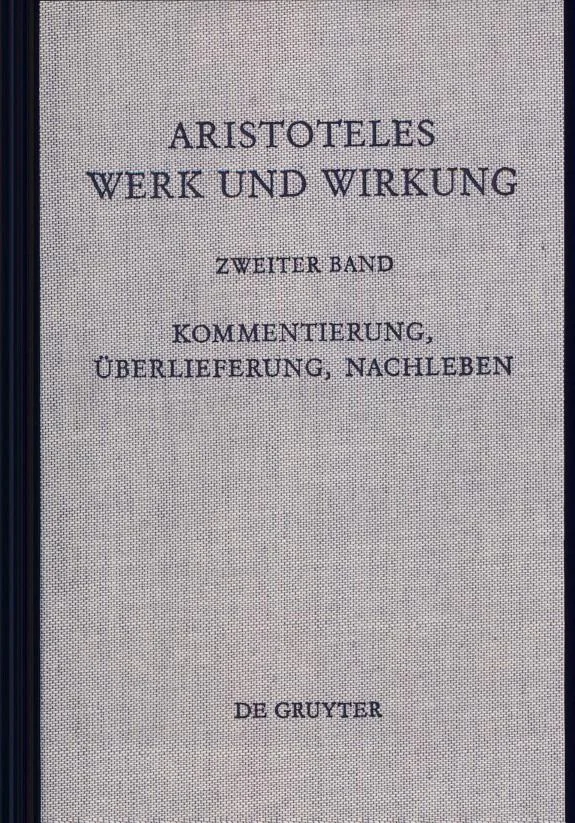
Aristoteles, Werk und Wirkung
 75
75

Aristoteles, Werk und Wirkung
Jürgen Wiesner's *Aristoteles, Werk und Wirkung* offers a rigorous account of how Aristotelian thought was disseminated and interpreted. Its strength lies in its detailed tracing of the commentary tradition, demonstrating the active engagement with Aristotle's texts across millennia. The work excels in detailing specific instances of reception, such as the influence of Arabic commentators on medieval European scholarship. A limitation, however, is its academic density, which may deter readers not already steeped in the history of philosophy. The exploration of Aristotle's reception during the 12th-century Renaissance of the 12th century, for example, is meticulously researched but demands significant prior knowledge. Ultimately, this is an indispensable resource for specialists focused on the historical trajectory of Aristotelian ideas.
📝 Description
75
Jürgen Wiesner's 1985 study examines Aristotle's influence beyond his original texts.
Aristoteles, Werk und Wirkung, published in 1985, is a scholarly analysis of Aristotle's broad legacy and its subsequent impact. The book does not function as a biography or a direct explanation of Aristotle's core ethical or metaphysical doctrines. Instead, it concentrates on how Aristotle's thought was transmitted, interpreted, and how it shaped subsequent historical eras.
This volume is aimed at academics, graduate students, and serious independent researchers in classical philosophy, the history of ideas, and the study of ancient texts. Readers interested in how philosophical ideas change, are preserved, or are adapted over centuries will find it valuable. It is especially pertinent for those studying medieval philosophy, the Renaissance, and the early modern period, times when Aristotle's writings underwent significant reevaluation and integration.
Wiesner's work places Aristotle's influence within the context of Western intellectual history. The analysis likely covers periods when Aristotle's texts were rediscovered and reinterpreted, such as the Islamic Golden Age and their reintroduction to Western Europe in the 12th and 13th centuries. The book may also discuss the philosophical arguments that arose from these receptions, contrasting Aristotelianism with other schools of thought.
While this book focuses on the scholarly reception of Aristotle, its placement within an 'esoteric' category suggests an interest in the less common or more specialized pathways of philosophical influence. This might include how Aristotelian concepts were adapted or transformed in ways that diverged from mainstream academic interpretation, potentially touching upon Neoplatonism, Hermeticism, or later mystical traditions that engaged with his corpus. The study's examination of commentary traditions and the 'afterlife' of ideas could reveal how certain Aristotelian ideas were selectively preserved or reinterpreted to fit esoteric frameworks, even if not explicitly stated as such within Wiesner's text.
💡 Why Read This Book?
• Understand the specific challenges and methods involved in the textual transmission of Aristotle's works from antiquity to the Renaissance, gaining insight into the preservation of ancient knowledge. • Analyze the role of key medieval commentators, such as Averroes and Thomas Aquinas, in shaping the interpretation of Aristotelian logic and metaphysics for subsequent European scholarship. • Grasp the concept of philosophical Nachleben (afterlife) by examining how Aristotle's ideas were debated and integrated into distinct intellectual currents during the 12th-century Renaissance and beyond.
⭐ Reader Reviews
Honest opinions from readers who have explored this book.
❓ Frequently Asked Questions
What is the primary focus of Jürgen Wiesner's Aristoteles, Werk und Wirkung?
The book primarily focuses on the transmission, commentary, and subsequent influence of Aristotle's philosophical works throughout history, rather than a direct exposition of his philosophy.
When was Aristoteles, Werk und Wirkung first published?
Aristoteles, Werk und Wirkung was first published in 1985.
Which historical periods are particularly relevant to the book's subject matter?
The book is highly relevant to periods of significant Aristotelian reception, including the Islamic Golden Age, the 12th-century Renaissance, the medieval Scholastic period, and the Renaissance.
Does the book offer a new interpretation of Aristotle's philosophy itself?
No, the book's focus is on the history of how Aristotle's works were received, interpreted, and transmitted, rather than presenting novel philosophical interpretations of his original texts.
Who would benefit most from reading this work?
Academics, graduate students, and researchers specializing in classical philosophy, the history of ideas, and the reception of ancient texts would find this volume most beneficial.
What does the term 'Nachleben' refer to in the context of this book?
'Nachleben' translates to 'afterlife' and refers to the continuing influence and evolution of Aristotle's philosophical ideas and texts through commentary and reception in later historical periods.
🔮 Key Themes & Symbolism
Textual Transmission and Corruption
This theme explores the arduous journey of Aristotle's texts from ancient Greece through various cultures and epochs. It examines the challenges of accurate copying, translation, and the potential for textual drift or deliberate alteration over centuries. The work likely details how different versions of key Aristotelian treatises emerged and were preserved, influencing subsequent interpretations by scholars across diverse linguistic and intellectual traditions, from Arabic to Latin.
Commentary Traditions
A central focus is the evolution of commentary on Aristotle's works. Wiesner analyzes how thinkers like Averroes in the Islamic world and Thomas Aquinas in medieval Europe engaged with Aristotle, not merely as expositors but as active philosophical participants. These commentaries were crucial for making Aristotle accessible and relevant to their own times, often shaping the very understanding of his concepts, from logic to metaphysics.
Philosophical Reception and Influence
This theme addresses the broader impact of Aristotle's thought on Western intellectual history. It investigates how his ideas were adopted, adapted, or contested by different schools of thought, from Scholasticism to Renaissance humanism. The 'Nachleben' or afterlife of Aristotle's philosophy is examined, showing how his frameworks for understanding the natural world, ethics, and logic became foundational, even when challenged or superseded.
Aristotle's Organon
The book likely dedicates significant attention to the *Organon*, Aristotle's collection of works on logic and reasoning. Its transmission and interpretation were particularly vital, as Aristotelian logic formed the backbone of medieval scholastic method. The study would trace how this logical framework was understood, applied, and debated by commentators, influencing philosophical discourse for centuries.
💬 Memorable Quotes
Direct passages from the work, attributed to the author.
“The commentary tradition is the primary vehicle for the Nachleben of philosophical texts.”
— This statement highlights how subsequent generations engage with foundational thinkers not by reading the original texts in isolation, but through the lens of scholars who have already interpreted and contextualized them for their own era.
“Aristotle's reception in the 12th century marked a central shift in Western European thought.”
— This suggests that the reintroduction and integration of Aristotle's rediscovered works during this period fundamentally altered the intellectual landscape, introducing new methods of inquiry and philosophical concepts.
“The faithful transmission of Aristotle's logical works, the Organon, underpinned medieval scholasticism.”
— This emphasizes the critical role of Aristotle's writings on logic in forming the intellectual structure and methods of medieval philosophy, underscoring the importance of accurate textual preservation.
“Averroes's commentaries provided a crucial bridge for Aristotelian thought into Latin Europe.”
— This points to the significant role of Islamic scholars like Averroes in preserving, translating, and elaborating upon Aristotle's works, facilitating their re-emergence and influence in Western intellectual traditions.
“The interpretation of Aristotle's Metaphysics evolved significantly from antiquity through the medieval period.”
— This indicates that the understanding of Aristotle's complex metaphysical concepts was not static but underwent substantial transformation as different thinkers and eras grappled with these abstract ideas.
🌙 Esoteric Significance
Tradition
While primarily a work of historical and philosophical scholarship, *Aristoteles, Werk und Wirkung* touches upon the esoteric by examining how philosophical systems, often foundational to later esoteric traditions, were transmitted and interpreted. Aristotle's logical and metaphysical frameworks, though rationalist, became intertwined with mystical and Gnostic thought during periods of syncretism. The book's focus on commentary and reception implicitly explores how concepts were adapted, sometimes imbuing them with meanings beyond their original philosophical intent, a process common in esoteric lineages.
Symbolism
The book's focus is less on overt symbolism and more on conceptual frameworks. However, Aristotle's cosmological models, particularly his concept of the Unmoved Mover, served as a philosophical anchor for later Neoplatonic and Hermetic interpretations of divine principles and cosmic order. The structure of his logic, the *Organon*, could be seen analogously as a symbolic representation of ordered thought necessary for accessing higher truths, a concept valued in various mystical traditions.
Modern Relevance
Contemporary thinkers in Western Esotericism, particularly those engaged with Hermeticism and traditionalist philosophy, often revisit Aristotelian logic and metaphysics as foundational elements of Western rational thought. While often critiquing its perceived limitations for spiritual insight, understanding Aristotle's framework, as detailed by Wiesner, is crucial for comprehending the historical development of philosophical ideas that later informed or were reacted against by esoteric movements. The study of transmission remains vital for understanding how esoteric ideas are preserved and evolve.
👥 Who Should Read This Book
• Graduate students of philosophy and intellectual history seeking to understand the detailed historical pathways of classical ideas. • Researchers in comparative religion and medieval studies interested in the cross-cultural transmission of philosophical texts, particularly from Greek to Arabic to Latin. • Scholars of Western Esotericism looking to contextualize the philosophical underpinnings and historical reception of concepts that later influenced esoteric movements.
📜 Historical Context
Published in 1985, Jürgen Wiesner's *Aristoteles, Werk und Wirkung* emerged during a period of sustained scholarly interest in the history of philosophy and the reception of classical texts. The late 20th century saw significant work on the transmission of Greek and Roman thought, particularly through Arabic and Latin translations. Wiesner's study situates itself within this tradition, likely engaging with the intellectual currents that shaped the medieval university system and the Renaissance rediscovery of ancient sources. Key contemporaries in the field of classical reception studies include scholars like Paul Oskar Kristeller and Anthony Grafton. The book's focus on commentary traditions inherently addresses the Scholastic movement, which heavily relied on Aristotle, often in dialogue with or opposition to Neoplatonism, a competing school of thought that dominated earlier Christian philosophy.
📔 Journal Prompts
The concept of Nachleben in Aristotelian scholarship.
The role of Averroes in transmitting Aristotle's works.
How the Organon's transmission shaped medieval logic.
The significance of Aristotle's reception during the 12th-century Renaissance.
Tracing the evolution of Aristotelian metaphysics through commentary.
🗂️ Glossary
Organon
The collection of Aristotle's works on logic, including Categories, On Interpretation, Prior Analytics, Posterior Analytics, and Topics. Its transmission and interpretation were vital for medieval philosophy.
Nachleben
German for 'afterlife,' referring to the continued influence, reception, and evolution of a philosopher's work and ideas through subsequent historical periods and interpretations.
Commentary Tradition
The historical practice of scholars writing extensive explanations and interpretations of foundational texts, crucial for their preservation, understanding, and adaptation across different eras.
Scholasticism
The dominant philosophical system of medieval European universities, heavily influenced by Aristotle, characterized by rigorous dialectical reasoning and a focus on reconciling faith and reason.
12th-Century Renaissance
A period of significant intellectual and cultural revival in medieval Europe, marked by the rediscovery and translation of classical texts, including many of Aristotle's works.
Transmission
The process by which texts, ideas, and knowledge are passed down from one generation, culture, or language to another over time.
Metaphysics
A branch of philosophy concerned with the fundamental nature of reality, including abstract concepts such as being, existence, causality, and substance, as explored in Aristotle's key work.
This book appears in 1 collection
🔮 Readers Also Liked
Browse all →







From the “Neoplatonism” Collection
View all →









More Free Esoteric History & Biography Books
View all →