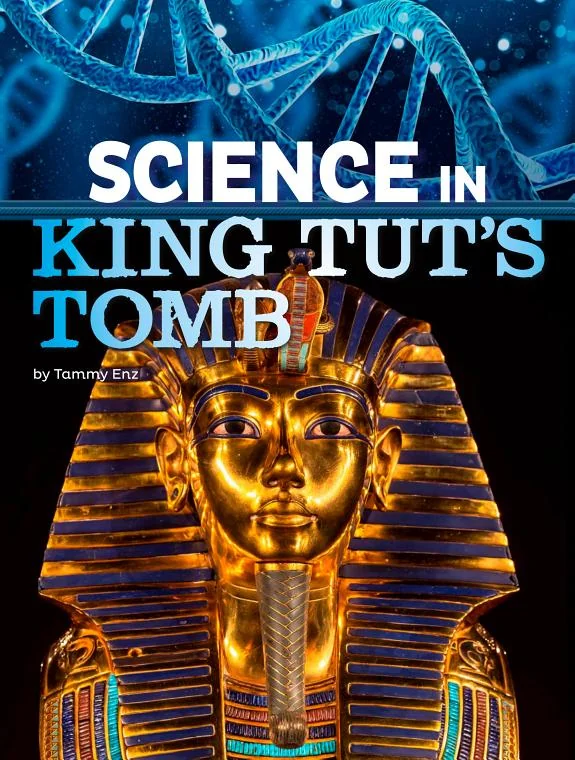
Science in King Tut's Tomb
 74
74

Science in King Tut's Tomb
Tammy Enz’s "Science in King Tut's Tomb" offers a welcome counterpoint to purely mystical interpretations of ancient Egypt. The author effectively grounds the awe-inspiring achievements of Egyptian civilization in discernible scientific and engineering principles. A particular strength lies in the clear explanation of mummification, detailing the chemical and physical processes involved without resorting to sensationalism. The narrative occasionally feels geared towards a younger audience, which can simplify some of the more nuanced historical debates. However, the section on how modern imaging techniques reveal details about Tutankhamun’s health and lineage provides a concrete example of scientific inquiry extending across millennia. The book successfully bridges the gap between historical wonder and empirical investigation, presenting a solid overview of applied knowledge in the ancient world.
📝 Description
74
Tammy Enz's 2021 book, Science in King Tut's Tomb, questions the divide between ancient Egyptian practice and scientific understanding.
Published in 2021, Tammy Enz's Science in King Tut's Tomb examines the practical knowledge of ancient Egyptians, focusing on the era of Tutankhamun. It moves past common portrayals of the period to look at the engineering behind pyramid construction and the scientific reasoning that shaped mummification. The book also discusses how modern tools like CT scans and DNA analysis shed light on the pharaoh's life and death.
The work places ancient Egyptian achievements in a wider historical context, comparing their empirical methods with later scientific developments. It mentions Tutankhamun's reign (around 1332–1323 BCE), a time of change after the Amarna period. Enz shows how Egyptian society, with its unique worldview, used advanced knowledge of materials, astronomy, and anatomy for building and burial practices, preceding Greek scientific thought.
Central to the book is the idea of 'applied science' in ancient times. It demonstrates that Egyptians had and used practical knowledge for building, medicine, and rituals. The science of preserving the mummy, including chemical methods and anatomical understanding, is also covered.
This book engages with esoteric traditions by challenging the conventional separation between empirical science and the spiritual or ritualistic practices of ancient cultures. It suggests that ancient Egyptians, often seen through a mystical lens, actually employed sophisticated, practical knowledge in their monumental architecture and mortuary rituals. By framing these practices as 'applied science,' Enz invites a reevaluation of ancient worldviews, proposing that a deep understanding of natural laws underpinned their spiritual and societal structures, a perspective that resonates with esoteric thought's emphasis on hidden or misunderstood universal principles.
💡 Why Read This Book?
• Understand the empirical basis of Egyptian pyramid construction, learning about the specific engineering techniques and material sciences utilized by ancient builders, as detailed in the sections on engineering. • Gain clarity on the scientific processes behind mummification, discovering the chemical and anatomical knowledge employed to preserve bodies for the afterlife, as explained in the book's discussion of the mummy. • Appreciate how modern technology like CT scanning and DNA analysis is actively reconstructing Tutankhamun's life and death, offering a tangible connection between ancient history and contemporary scientific discovery.
⭐ Reader Reviews
Honest opinions from readers who have explored this book.
❓ Frequently Asked Questions
What specific scientific principles were used in building the pyramids?
The book explores principles such as geometry for precise alignment, leverage for moving heavy stones, and an understanding of materials science for quarrying and construction, all applied with remarkable engineering skill during the pyramid-building era.
How did ancient Egyptians understand anatomy for mummification?
Ancient Egyptians developed a practical understanding of human anatomy through embalming processes, learning to identify and remove organs while preserving the body’s structure for religious and ritualistic purposes.
What does modern technology reveal about King Tut's mummy?
Modern technologies, including CT scans, reveal details about Tutankhamun's physical condition, potential causes of death, and lineage, offering insights into his health and the medical practices of his time.
Was science separate from religion in ancient Egypt?
The book suggests that science and religion were intertwined, with practical knowledge often serving religious or ritualistic aims, rather than being viewed as entirely separate disciplines.
When was King Tutankhamun's tomb discovered?
King Tutankhamun's tomb (KV62) was discovered in the Valley of the Kings by Howard Carter in 1922, sparking immense global interest in ancient Egypt.
What was the significance of King Tut's mummy?
King Tut's mummy is significant not only for its historical context but also as a subject of intense scientific study, providing invaluable data on ancient Egyptian burial practices and royal health.
🔮 Key Themes & Symbolism
Applied Ancient Engineering
This theme examines the practical application of scientific and mathematical principles in ancient Egypt, focusing on the construction of monumental structures like the pyramids. It details how Egyptians utilized knowledge of geometry, physics, and material science to achieve feats of engineering that continue to impress. The work moves beyond mere speculation to explore the logical, empirical methods employed, suggesting a sophisticated understanding of mechanics and logistics.
The Science of Mummification
The book dissects the complex process of mummification, treating it as an advanced form of applied chemistry and anatomy. It details the selection and use of natron, the removal of organs, and the bandaging techniques, highlighting the empirical knowledge gained over centuries of practice. This theme explores how ancient Egyptians developed sophisticated methods for preservation, driven by religious beliefs but executed with demonstrable scientific understanding.
Modern Technological Revelations
This theme focuses on how contemporary scientific tools, such as CT scanning, X-rays, and DNA analysis, are used to study ancient artifacts and remains, particularly King Tutankhamun's mummy. It demonstrates the ongoing dialogue between historical discovery and modern scientific inquiry, revealing new facets of ancient lives, health conditions, and genetic lineages. The work underscores the power of technology to unlock secrets previously lost to time.
Egyptology and Empirical Inquiry
The book positions the study of ancient Egypt, or Egyptology, as a field that benefits immensely from empirical investigation. It showcases how archaeological findings are enhanced by scientific analysis, moving beyond textual interpretation to physical evidence. This theme emphasizes the value of interdisciplinary approaches, integrating scientific methods with historical and archaeological research to build a more complete picture of the past.
💬 Memorable Quotes
Direct passages from the work, attributed to the author.
“Egyptian pyramids were engineered with precise measurements and astronomical alignments.”
— This points to the sophisticated mathematical and astronomical knowledge applied by ancient Egyptian builders, suggesting deliberate planning rather than accidental construction.
“The process of mummification involved a detailed understanding of the human body.”
— This highlights the anatomical knowledge Egyptians possessed, enabling them to systematically remove organs and preserve the body's form for millennia.
“Modern technology allows us to 'see' inside King Tut's mummy without damage.”
— This emphasizes the non-invasive diagnostic capabilities of contemporary science, offering new perspectives on ancient remains and historical figures.
“Ancient Egyptian society utilized practical knowledge for construction and preservation.”
— This concept frames ancient Egyptian achievements not solely as divine acts but as the result of applied, empirical understanding and skilled craftsmanship.
“The study of King Tut's life and death continues with advanced scientific tools.”
— This illustrates the dynamic nature of historical research, where ongoing scientific advancements constantly refine and expand our understanding of the past.
🌙 Esoteric Significance
Tradition
While not strictly a Hermetic text, the book touches upon the Hermetic principle of 'As Above, So Below' by examining how cosmological understanding informed earthly practices like pyramid alignment and mortuary rituals. It bridges the gap between the empirical and the symbolic, exploring how scientific knowledge served spiritual and cosmological aims within the ancient Egyptian worldview, a common theme in esoteric traditions that seek to unify the material and immaterial.
Symbolism
The book implicitly engages with the symbolism of the pyramid as a structure representing cosmic order, ascent, and stability, understood through its geometric precision and orientation. It also touches upon the symbolism of the mummy, representing not just death but a transformed state of being, achieved through meticulously applied physical and chemical processes that mirror a spiritual purification. The sun, central to Egyptian cosmology, is also indirectly referenced through astronomical alignments in construction.
Modern Relevance
Contemporary esoteric practitioners and scholars of ancient religions find value in works like this for understanding the material basis of ancient spiritual practices. It informs modern interpretations of Hermeticism and ancient Egyptian magic by grounding them in observable phenomena and applied knowledge. Thinkers interested in archaeoastronomy and the history of science within religious contexts draw on such analyses to explore the integration of empirical observation and metaphysical belief systems.
👥 Who Should Read This Book
• Aspiring Egyptologists and archaeology students seeking a foundational understanding of the scientific basis behind ancient Egyptian achievements. • General readers curious about the practical ingenuity of past civilizations and how science was applied in non-Western contexts. • Educators looking for accessible resources to teach about ancient Egyptian engineering, mummification, and the history of science.
📜 Historical Context
Published in 2021, Tammy Enz's "Science in King Tut's Tomb" enters a field already rich with archaeological and historical scholarship on ancient Egypt. Its approach, however, distinguishes itself by focusing specifically on the scientific and engineering underpinnings of Egyptian civilization during the New Kingdom, a period marked by Tutankhamun's reign (c. 1332–1323 BCE). This era followed the religious upheaval of the Amarna Period under Akhenaten. While scholars like Flinders Petrie had long emphasized the precision of Egyptian measurement and construction, Enz's work aims for a broader accessibility, connecting these ancient practices to modern scientific understanding. The book implicitly contrasts ancient Egyptian empirical methods with later Greek philosophical approaches to science, demonstrating a continuous thread of human inquiry. Its reception is part of a broader contemporary interest in applying advanced imaging and analytical techniques to ancient history, a trend exemplified by ongoing research into royal mummies.
📔 Journal Prompts
The engineering principles behind pyramid construction in ancient Egypt.
Reflect on the scientific understanding of anatomy evident in the mummification process.
Consider the role of modern technology in deciphering King Tut's life and death.
Analyze how empirical knowledge served religious and ritualistic purposes in ancient Egypt.
Compare the applied science of ancient Egypt with contemporary scientific methodologies.
🗂️ Glossary
Natron
A naturally occurring mixture of sodium carbonate decahydrate and sodium bicarbonate, used by ancient Egyptians as a drying agent in the mummification process to desiccate the body.
CT Scan
Computed Tomography scan, a medical imaging technique that uses X-rays and computer processing to create detailed cross-sectional images of the body, widely used in modern Egyptology.
Amarna Period
A historical period in ancient Egypt (roughly 1353–1336 BCE) during the reign of Pharaoh Akhenaten, known for its radical religious reforms and distinct artistic style.
Valley of the Kings
A valley in Egypt where, for nearly 500 years from the 16th to 11th century BC, tombs were constructed for pharaohs and powerful nobles of the New Kingdom.
Tutankhamun
An Egyptian pharaoh of the 18th Dynasty, who ruled from c. 1332 to 1323 BCE. He is famous for his nearly intact tomb discovered by Howard Carter in 1922.
Egyptology
The academic study of ancient Egypt, encompassing its history, language, literature, religion, architecture, and art.
Engineering
The application of scientific and mathematical principles to design, build, and maintain structures, machines, systems, and processes.
This book appears in 1 collection
🔮 Readers Also Liked
Browse all →








From the “Pyramids” Collection
View all →

![" A Self Powered Psychotronic Generator"...rch [ Vol. 35, No. 2, March April 1979]](/img/thumb/a-self-powered-psychotronic-generator-rch-vol-35-no-2-march-april-1979.webp)



More Free Esoteric History & Biography Books
View all →