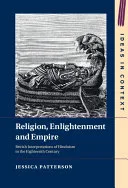
Religion, Enlightenment and Empire
 84
84

Religion, Enlightenment and Empire
Jessica Patterson’s Religion, Enlightenment and Empire offers a sharp, critical lens on the East India Company's intellectual engagement with Hinduism. The work is particularly strong in its detailed explication of how colonial administrators and scholars selectively interpreted Hindu texts and practices to align with European Enlightenment ideals of rationality and order. Patterson avoids romanticizing either the colonizer or the colonized, presenting a sober account of appropriation and misunderstanding. A notable strength is the analysis of figures like Warren Hastings and his advisors, illustrating their attempts to legitimize rule through a curated understanding of Indian religion. However, the book’s dense academic prose, while precise, can sometimes obscure the narrative flow, making certain passages require considerable concentration. The exploration of how 'enlightenment' itself was a fluid, often self-serving concept for the British is a particularly compelling thread. Patterson’s scholarly examination provides a vital corrective to simplistic narratives of colonial encounter.
📝 Description
84
Jessica Patterson's 2023 book examines the East India Company's influence on Hindu traditions in 18th-century Bengal.
Religion, Enlightenment and Empire by Jessica Patterson analyzes the complex relationship between British imperial aims and the interpretation of Hindu traditions as the East India Company gained power in Bengal. Patterson details how religious ideas were reshaped and sometimes used to support colonial goals, particularly around the mid-1700s. The book goes beyond accounts of conquest to consider the intellectual and theological exchanges that influenced British perceptions and the religious lives of Bengalis.
The study is set during a crucial period in British India, specifically when the East India Company evolved from a commercial enterprise into a ruling power in Bengal after events like the 1757 Battle of Plassey. This time saw increased British efforts to understand, classify, and often manage local societies and their religious practices. Patterson places these efforts within the wider Enlightenment discussions about reason, progress, and the perceived differences of non-Western cultures. The book's central idea is the manifestation of 'orientalism' in religious studies and colonial rule, showing how British figures created specific versions of Hinduism to align with their preconceptions or justify intervention.
This work engages with the historical study of how Western intellectual traditions, particularly the Enlightenment, interacted with and often reinterpreted non-Western religious systems. It touches upon the colonial project's role in shaping perceptions of Eastern religions, a process that often involved the selective emphasis or distortion of practices and beliefs to fit European frameworks. While not an esoteric text itself, it examines the historical roots of how certain interpretations of Eastern traditions became prominent in the West, influencing later esoteric movements that drew upon these mediated understandings.
💡 Why Read This Book?
• Gain insight into the specific ways British Enlightenment thought influenced colonial interpretations of Hinduism, moving beyond general discussions of Orientalism. • Understand the role of figures like Warren Hastings in shaping early British perceptions of Indian religions through his patronage of translations and scholarship in the late 18th century. • Grasp the nuanced relationship between religious discourse and imperial expansion, particularly concerning the East India Company's strategies in Bengal after 1757.
⭐ Reader Reviews
Honest opinions from readers who have explored this book.
❓ Frequently Asked Questions
What is the primary focus of Religion, Enlightenment and Empire?
The book primarily focuses on how British colonial powers, specifically the East India Company, interpreted and utilized Hindu religious concepts during their conquest of Bengal, particularly in the 18th century.
When was Religion, Enlightenment and Empire first published?
Religion, Enlightenment and Empire was first published on December 16, 2021.
Which historical period does the book predominantly cover?
The book predominantly covers the period of the East India Company's increasing control over Bengal, roughly from the mid-18th century onwards, a time marked by significant intellectual and political shifts.
What historical events are central to the book's context?
Key events include the East India Company's military and political expansion in Bengal, such as the aftermath of the Battle of Plassey (1757), and the subsequent efforts to administer and understand the region.
Who is the author of Religion, Enlightenment and Empire?
The author is Jessica Patterson.
What is the connection between 'Enlightenment' and 'Empire' in the book's title?
The title highlights how British notions of Enlightenment – emphasizing reason, progress, and universalism – were applied, often selectively and self-servingly, to justify and manage imperial expansion and colonial rule in India.
🔮 Key Themes & Symbolism
Colonial Hermeneutics
This theme examines the specific methods and biases through which British scholars and administrators approached Hindu texts and practices. It scrutinizes how concepts like Brahmanical authority or Indic philosophies were translated and reinterpreted to fit European intellectual frameworks, often serving to legitimize colonial governance. The work highlights the power inherent in defining another culture's religion, especially when that definition is used to justify subjugation.
The East India Company's Religious Policy
The book details how the East India Company navigated, manipulated, and sometimes actively shaped religious landscapes in Bengal to consolidate its power. It moves beyond simple accounts of religious tolerance or intolerance, illustrating a more complex strategy where understanding and 'preserving' certain aspects of Hinduism were intertwined with mechanisms of control and governance, particularly in the late 18th century.
Orientalism and Enlightenment
Patterson critically analyzes how the European Enlightenment's emphasis on reason and universalism was applied to the study of non-Western cultures. The work demonstrates how this intellectual current led to the construction of an 'Orient,' including a particularized view of Hinduism, which often served to highlight European superiority and the perceived necessity of imperial intervention and 'civilizing missions'.
Translation and Misinterpretation
A crucial aspect explored is the role of translation in shaping colonial understanding of Hinduism. The book identifies how the very act of rendering Sanskrit or vernacular texts into English, often by intermediaries with their own agendas, introduced inherent biases and misunderstandings. This process distorted original meanings and facilitated the creation of colonial-era religious typologies.
💬 Memorable Quotes
Direct passages from the work, attributed to the author.
“British interpretations of Hinduism often reflected European Enlightenment preoccupations more than accurate representations of Indian religious life.”
— This highlights the central argument that colonial religious scholarship was not neutral but was heavily influenced by the intellectual and cultural milieu of the colonizing power, serving its own ideological needs.
“Translating Hindu texts into English was an act of both cultural encounter and imperial assertion.”
— This suggests that the process of translation was inherently political, shaping perceptions and asserting dominance by framing Indian religious traditions within a Western conceptual structure.
“Warren Hastings's patronage fostered specific scholarly projects that framed Hinduism for a British audience.”
— This points to the role of key individuals in the colonial administration, like Hastings, in actively directing and shaping the discourse around Indian religions during the late 18th century.
“The pursuit of 'enlightenment' by the British in India was often a justification for imperial dominion.”
— This interpretation critiques the self-proclaimed enlightened mission of the colonizers, framing it as a rationalization for the subjugation and control of indigenous populations and their cultures.
💡 Key Ideas
Editorial paraphrase of the work's core concepts — not direct quotes.
The East India Company's engagement with religion was instrumental in its administrative and judicial strategies.
This paraphrased concept emphasizes how religious knowledge and its manipulation were not merely academic pursuits but practical tools for colonial governance and control in Bengal.
🌙 Esoteric Significance
Tradition
While not strictly an esoteric text itself, the work operates within the historical analysis of how esoteric and philosophical concepts from Indic traditions were perceived and appropriated by Western scholars influenced by Enlightenment rationalism. It engages with the historical roots of Western interest in Eastern spirituality, tracing how concepts were extracted, translated, and often recontextualized within European intellectual frameworks, laying groundwork for later Theosophical and New Age interpretations.
Symbolism
The book implicitly touches upon the interpretation of symbols and motifs within Hinduism as understood by the British. For instance, the concept of Brahman, often abstracted into philosophical oneness, or the figure of the ascetic yogi, were frequently re-framed through a Western lens. These symbols were often decontextualized from their lived religious practice and fitted into narratives of ancient wisdom or perceived universal spiritual truths.
Modern Relevance
Contemporary scholars of postcolonial studies, comparative religion, and the history of ideas continue to draw on the analytical frameworks established by works examining colonial encounters with religion. Patterson's research informs ongoing discussions about cultural appropriation, the politics of knowledge production, and the lasting impact of colonial-era religious classifications on modern understandings of Hinduism and other Eastern traditions.
👥 Who Should Read This Book
• Scholars of Colonial History and the British Raj: Will find detailed analysis of how religious discourse shaped imperial policy and administration in Bengal. • Students of Religious Studies and Comparative Religion: Can explore the complex historical interactions and interpretations between Western and Indic religious traditions. • Researchers interested in the History of Ideas: Offers insight into how Enlightenment philosophies influenced colonial encounters and the study of non-Western cultures.
📜 Historical Context
Religion, Enlightenment and Empire is set against the backdrop of the late 18th century, an important era for the East India Company’s consolidation of power in Bengal following the Battle of Plassey in 1757. This period was characterized by the burgeoning influence of the European Enlightenment, which promoted ideas of reason, progress, and universalism. British intellectuals and administrators grappled with understanding and categorizing non-Western societies, often through a lens shaped by their own philosophical assumptions. The work engages with the intellectual currents of the time, where figures like Sir William Jones were actively involved in translating Sanskrit texts, attempting to reconcile Indian traditions with European scholarly frameworks. Patterson’s study implicitly contrasts with earlier, more overtly missionary or purely administrative approaches, offering a nuanced analysis of how Enlightenment ideals became entangled with imperial ambition. While not a direct engagement with a competing school of thought, it implicitly challenges simplistic Orientalist views by demonstrating the agency and complexity within Indian religious practices themselves, even as they were filtered through colonial perception.
📔 Journal Prompts
The colonial construction of Brahmanical authority: how did British interpretations differ from indigenous understandings?
Analyze the role of translation in the East India Company's engagement with Hindu scriptures.
Reflect on the 'civilizing mission' concept as applied to religious practices in 18th-century Bengal.
Consider the influence of Enlightenment thought on figures like Warren Hastings's scholarly pursuits.
Examine the power dynamics inherent in defining another culture's religious symbols.
🗂️ Glossary
East India Company
A British joint-stock company established in 1600 that was granted a royal charter to engage in trade in the East Indies, eventually becoming a de facto ruling power in large parts of India.
Bengal
A historical and geographical region in South Asia, now divided between Bangladesh and the Indian state of West Bengal. It was a key center of East India Company power and administration.
Enlightenment
An intellectual and cultural movement in Europe during the 17th and 18th centuries that emphasized reason, individualism, and skepticism towards traditional authority, profoundly influencing Western thought and colonial ideologies.
Orientalism
A term popularized by Edward Said, referring to the way Western cultures perceive and depict Eastern cultures, often in ways that are stereotypical, exoticizing, and serve to reinforce Western superiority and dominance.
Brahmanical
Relating to or characteristic of the Brahmins, the priestly and scholarly caste in traditional Hindu society, often associated with the interpretation and preservation of religious texts and rituals.
Battle of Plassey
A decisive victory for the British East India Company over the Nawab of Bengal in 1757, marking a significant turning point in the Company's military and political ascendancy in India.
Asceticism
A lifestyle characterized by abstinence from sensual pleasures, often for the purpose of pursuing spiritual goals or discipline.