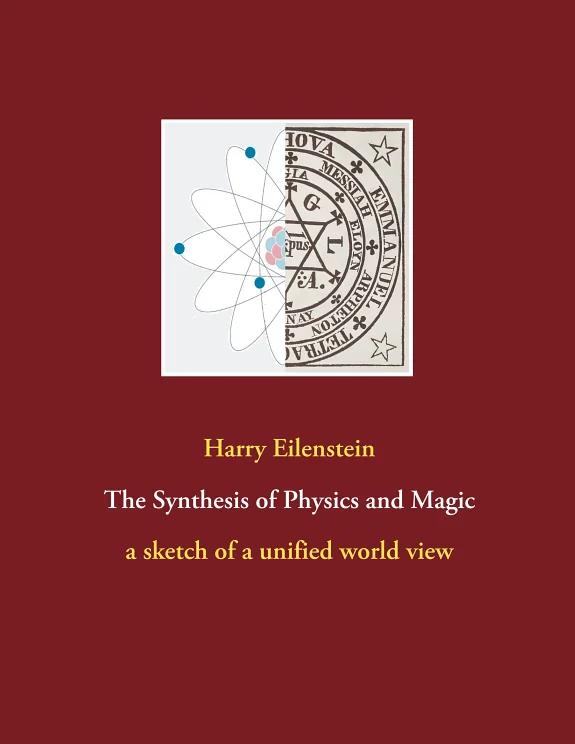
The Synthesis of Physics and Magic
 74
74

The Synthesis of Physics and Magic
Harry Eilenstein's 'The Synthesis of Physics and Magic' is an ambitious attempt to bridge the chasm between empirical science and esoteric traditions. The author posits that physics, with its focus on temporal evolution and quantitative correlations, and magic, with its emphasis on simultaneity and qualitative correspondences, are not mutually exclusive but rather complementary modes of apprehending reality. Eilenstein's core argument that physics finds formulas through 'quantity-equalities' while magic finds analogies through 'quality-equalities' is a particularly sharp distinction that cuts through much of the usual obfuscation surrounding these topics. The work's strength lies in its clear articulation of these differing epistemologies. However, the book occasionally falters in its execution, particularly when attempting to provide concrete examples of this synthesis. While the conceptual framework is compelling, the practical application or detailed exploration of specific magical practices alongside their physical counterparts could have been more robustly developed. The section discussing the 'unity of consciousness' as magic's domain, while philosophically intriguing, remains somewhat abstract without deeper illustration. Despite this, Eilenstein offers a valuable perspective for those seeking to reconcile seemingly irreconcilable worldviews.
📝 Description
74
Harry Eilenstein's 2021 book proposes a unified framework for physics and magic.
Harry Eilenstein's The Synthesis of Physics and Magic, published in 2021, argues against the common separation of empirical science and esoteric practice. He suggests that physics and magic can be seen as complementary ways of understanding reality. Physics, he writes, deals with linear time and quantitative measures, looking for universal laws in observable phenomena. Magic, on the other hand, focuses on simultaneity and qualitative connections, drawing insight from analogical thought and the unified nature of consciousness. The book attempts to bridge the divide between objective, measurable data and subjective human experience.
This work is for readers who question the sharp distinction between the material world and metaphysical concepts. It will interest those who study the philosophy of science, consciousness, and anyone looking to combine scientific knowledge with intuitive or occult perspectives. Physicists who ponder the limits of their theories, practitioners of magic seeking a theoretical basis for their work, and students of symbolism and synchronicity will find value here. It is for the intellectually curious ready to consider new frameworks and the possibility of a unified worldview.
Published in 2021, Eilenstein's synthesis arrives at a time when the lines between scientific inquiry and metaphysical exploration are being re-examined. While mid-20th century thought often marginalized esoteric traditions, contemporary scientific developments, such as quantum mechanics and consciousness studies, have created space for more speculative ideas. Eilenstein's work connects with a long-standing esoteric interest in hidden correspondences and the idea that consciousness plays a role in shaping reality, echoing traditions that seek symbolic and analogical understanding alongside empirical observation.
💡 Why Read This Book?
• Gain a new framework for understanding reality by distinguishing between physics' 'quantity-equalities' and magic's 'quality-equalities,' as outlined in the book's core conceptual division. • Explore the potential for a unified worldview by examining how the scientific observation of temporal evolution and the esoteric recognition of simultaneities can coexist. • Discover how consciousness is posited to play a role in perceiving both the deterministic laws of physics and the analogical connections found in magic, offering a fresh perspective on mind-matter interaction.
⭐ Reader Reviews
Honest opinions from readers who have explored this book.
❓ Frequently Asked Questions
What is the primary distinction Harry Eilenstein makes between physics and magic?
Eilenstein differentiates physics by its focus on 'quantity-equalities' and temporal evolution, seeking universal formulas. Magic, conversely, is characterized by 'quality-equalities' and the exploration of simultaneities, leading to analogical understanding.
When was 'The Synthesis of Physics and Magic' first published?
The book was first published on April 18, 2021.
Does the book offer practical exercises for synthesizing physics and magic?
While the book lays a strong theoretical foundation for synthesis, it primarily focuses on conceptual frameworks rather than providing step-by-step practical exercises for immediate application.
What kind of reader would benefit most from this book?
Readers interested in comparative philosophy, consciousness studies, and those seeking to bridge scientific and esoteric perspectives will find this book particularly relevant.
What does Eilenstein suggest about the multiplicity of the world versus its unity?
Eilenstein suggests physics addresses the multiplicity of the world to find determinate outer events, while magic addresses the underlying unity of consciousness to find qualitative correlations.
Is 'The Synthesis of Physics and Magic' a recent publication?
Yes, the book was first published relatively recently, on April 18, 2021, positioning it within contemporary discussions on consciousness and science.
🔮 Key Themes & Symbolism
Quantity vs. Quality
This theme forms the bedrock of Eilenstein's argument, contrasting the methodologies of physics and magic. Physics, as presented, seeks to establish universal laws through the measurement and correlation of quantities, focusing on how things change over time. It identifies patterns of sameness in numerical value. Magic, in contrast, operates on the principle of qualitative sameness, recognizing profound connections and resemblances between disparate phenomena based on their symbolic nature or inherent essence. This involves identifying patterns of sameness in character or meaning, forming the basis for analogical reasoning and sympathetic magic.
Time-Ray Evolution vs. Simultaneities
Eilenstein posits that physics primarily examines phenomena as they unfold along a linear 'time-ray,' seeking causal relationships and predictable sequences. This perspective emphasizes process and change. Magic, however, is characterized by its focus on 'simultaneities' – the interconnectedness of events and patterns that exist concurrently, irrespective of linear time. This viewpoint allows for the recognition of synchronicities and meaningful coincidences, suggesting that reality can be understood not just as a sequence of events, but as a web of interconnected moments and potentials that exist together.
Multiplicity and Unity
The book explores two fundamental ways of perceiving reality: through its apparent multiplicity and through its underlying unity. Physics, by analyzing the vast array of observable phenomena, aims to find order and determinacy within this multiplicity, reducing complexity to fundamental laws. Magic, conversely, seeks to apprehend the 'unity of consciousness' that underlies all individual experiences and material forms. This perspective emphasizes interconnectedness and the idea that apparent separation is an illusion, with the true nature of reality being a singular, unified field of awareness or being.
Determinacy and Analogy
This theme highlights the different modes of knowing presented by physics and magic. Physics strives for 'perfect determinacy of all outer events,' aiming to predict outcomes with absolute certainty based on established laws and initial conditions. It seeks absolute truth through empirical verification. Magic, on the other hand, finds its power in 'analogies.' Rather than seeking exact predictions, it draws connections between different levels of reality based on shared characteristics or symbolic resonance. This analogical approach allows for a more fluid and intuitive understanding of the world, one that embraces mystery and subjective experience.
💬 Memorable Quotes
Direct passages from the work, attributed to the author.
“Physics looks at evolution along the time-ray and finds quantitative correlations.”
— This statement captures Eilenstein's view of physics as a discipline focused on measurable change over time, seeking numerical relationships to explain phenomena.
“Magic looks at simultaneities and finds qualitative correlations.”
— Here, the author contrasts magic's focus on interconnectedness and meaning across events, regardless of temporal sequence, emphasizing symbolic or essential resemblances.
“Physics considers quantity-equalities and finds formulas by it.”
— This highlights physics' method of identifying sameness in numerical value to construct universal laws and predictive models of the physical world.
“Magic considers quality-equalities and finds analogies by it.”
— This explains magic's approach of recognizing similarity in essence or symbolic nature, using these connections to understand deeper patterns and relationships.
💡 Key Ideas
Editorial paraphrase of the work's core concepts — not direct quotes.
Physics considers the multiplicity of the world and finds the perfect determinacy of all outer events.
This paraphrase points to physics' goal of explaining the complex, diverse world through predictable, determined outcomes based on its observations.
🌙 Esoteric Significance
Tradition
Eilenstein's work appears to draw from a broad synthesis of Western esoteric thought, particularly Hermeticism and Neoplatonism, which emphasize correspondence and the unity of all things. It attempts to bridge these traditions with modern scientific understanding, a characteristic of many 20th and 21st-century esoteric movements seeking to demonstrate the validity or relevance of ancient wisdom in a contemporary context. It departs from purely dogmatic interpretations by grounding its esoteric claims in philosophical distinctions applicable to scientific methodology, aiming for a more universal appeal.
Symbolism
While the book's primary focus is conceptual, the underlying symbolism relates to the duality of number (quantity) and essence (quality). The 'time-ray' can be seen as a symbol of linear progression and causality, central to physicalist views, while 'simultaneities' symbolize the interconnected, timeless web of existence that magic explores. The multiplicity of the world represents the phenomenal realm perceived by the senses, whereas the 'unity of consciousness' symbolizes the fundamental, undifferentiated ground of being from which all phenomena arise.
Modern Relevance
Contemporary thinkers and practitioners in fields like consciousness research, quantum mysticism, and integral theory often explore similar concepts of interconnectedness and the limitations of purely materialistic worldviews. Eilenstein's work offers a conceptual tool for those seeking to articulate how subjective experience and objective measurement might arise from a common source. It appeals to modern psychological approaches that integrate spiritual dimensions and with scientific inquiry into the nature of reality that questions classical assumptions about space, time, and causality.
👥 Who Should Read This Book
• Students of comparative philosophy and the history of science: To understand how differing epistemologies (quantitative vs. qualitative) have shaped distinct fields of inquiry. • Practitioners of esoteric traditions: To gain a conceptual framework that legitimizes analogical reasoning and the study of simultaneities alongside empirical observation. • Intellectual explorers questioning materialism: For individuals seeking to reconcile scientific understanding with intuitive or metaphysical perspectives on reality and consciousness.
📜 Historical Context
Harry Eilenstein's 'The Synthesis of Physics and Magic,' published in 2021, arrives in an intellectual climate increasingly open to interdisciplinary approaches that challenge rigid materialistic paradigms. While the mid-20th century was dominated by logical positivism and a strict separation of science and spirituality, the late 20th and early 21st centuries have seen a resurgence of interest in consciousness studies and quantum physics interpretations that hint at a more integrated reality. Eilenstein's work can be seen as a contemporary echo of thinkers like Carl Jung, who explored archetypes and synchronicity as bridges between the psyche and the material world, or even earlier figures like Helena Blavatsky and the Theosophical Society, who sought to synthesize scientific, philosophical, and religious doctrines. Unlike strictly empirical approaches, Eilenstein engages with the analogical reasoning central to Hermeticism and other esoteric traditions. The book's publication coincides with a growing dissatisfaction with purely reductionist scientific models, prompting a search for frameworks that can accommodate subjective experience and non-material dimensions.
📔 Journal Prompts
The distinction between 'quantity-equalities' and 'quality-equalities' in understanding reality.
Reflecting on the 'time-ray' versus 'simultaneities' in personal experience.
How does the 'unity of consciousness' relate to the 'multiplicity of the world' you observe?
Exploring the role of 'analogy' in your own understanding of complex systems.
Consider the 'perfect determinacy' sought by physics versus the analogical insights of magic.
🗂️ Glossary
Quantity-equalities
Refers to correlations and equalities based on measurable numerical values, characteristic of the scientific method in physics. It seeks to find identical measurements across different phenomena.
Quality-equalities
Refers to correlations and equalities based on the essential nature, symbolic meaning, or inherent characteristics of phenomena, central to magical and analogical reasoning.
Time-ray
A conceptualization of linear time as a progression, along which events unfold sequentially and cause-and-effect relationships are observed, as typically studied in physics.
Simultaneities
Events, patterns, or connections that exist concurrently or are perceived as meaningfully related, irrespective of their linear temporal order, a key focus in magical or synchronistic understanding.
Unity of consciousness
The concept that consciousness is not fragmented or individual but part of a single, overarching field or essence that underlies all subjective experiences and phenomena.
Multiplicity of the world
The apparent diversity, complexity, and vast number of individual phenomena and events that constitute the observable universe, which physics seeks to explain through unifying laws.
Perfect determinacy
The idea, often associated with classical physics, that all future events are precisely predictable given complete knowledge of the present state and the governing laws of nature.
This book appears in 1 collection
🔮 Readers Also Liked
Browse all →
![The Byrhtferth's Manuscript (MS 17) † Saint John’s College † Oxford † [1111]](/img/thumb/the-byrhtferth-s-manuscript-ms-17-saint-john-s-college-oxford-1111-the-monk-byrhtferth.webp)








From the “Consciousness Expansion” Collection
View all →








More Free Sacred Texts & Gnosticism Books
View all →