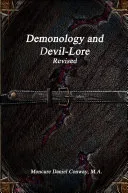
Demonology and Devil-Lore Revised
 78
78

Demonology and Devil-Lore Revised
Moncure Daniel Conway’s *Demonology and Devil-Lore Revised* offers a dense, scholarly examination of Western demonology, tracing its roots from ancient Mesopotamian cosmogonies through to the medieval and early modern periods. Conway’s strength lies in his exhaustive cataloging of source material; he cites extensively from Babylonian tablets, Greek tragedies, and, crucially, the complex allegorical landscape of Goethe’s *Faust*. The ambition is to forge a cohesive historical narrative, a feat Conway largely achieves by meticulously linking disparate cultural expressions of the infernal. However, the work occasionally falters under its own weight. Conway’s effort to synthesize can sometimes feel more like a compilation than a fully integrated argument, particularly when dealing with the theological intricacies of later Christian demonology. His interpretation of the *Faust* legend, while detailed, might strike some readers as overly allegorical. Despite these minor reservations, the revised edition’s larger print is a welcome practical improvement for engaging with this substantial contribution to the study of ancient and Western esotericism. It remains a valuable, if demanding, resource for understanding the historical construction of evil.
📝 Description
78
Moncure Daniel Conway's 1879 work traces the historical lineage of demonic figures across Western civilization.
Demonology and Devil-Lore Revised offers a historical survey of how Western civilization has conceived of demons and devilish entities. Conway meticulously follows the development of these figures, referencing a wide range of ancient and medieval texts. The book examines mythological and religious narratives, including Babylonian creation stories, the Hebrew Bible, Greek drama, and the philosophical bases of European folklore.
This study aims to build a concrete historical line for supernatural beings as they appear in modern understanding. It is intended for students of religious history, comparative mythology, and Western esotericism. Readers interested in the origins of theological ideas, the connection between folklore and religious doctrine, and the historical making of evil personified will find ample material. The book provides a structured way into a subject often presented sensationally or in fragments. The revised edition features larger print for easier reading.
Conway's study emerged in the late 19th century, a period of intense interest in the comparative study of religion and mythology. This intellectual climate, shared by figures like Sir James Frazer, sought to understand the roots of belief systems. Conway positioned his work within a broader academic trend that examined the psychology and sociology of religion. While the era often aimed to demythologize religious origins, Conway's book cataloged and analyzed the vast spectrum of human belief concerning infernal beings.
💡 Why Read This Book?
• Gain a structured historical understanding of demonology, learning how concepts evolved from Babylonian mythology and Greek *daimons* to later European folklore, a trajectory not easily found in fragmented occult lore. • Explore the specific textual influences, such as the role of ancient Near Eastern myths and the dramatic interpretations in Greek tragedies, providing concrete examples of early demonological thought. • Understand the symbolic and theological shifts, particularly Conway's engagement with Goethe’s *Faust*, offering insight into how literary and philosophical movements shaped perceptions of the infernal in the 19th century.
⭐ Reader Reviews
Honest opinions from readers who have explored this book.
❓ Frequently Asked Questions
What historical periods does Moncure Daniel Conway cover in Demonology and Devil-Lore?
The work spans from ancient civilizations, including Babylonian and Greek cultures, through the development of Christian demonology and into the literary and philosophical discussions of the 18th and 19th centuries, notably referencing Goethe's *Faust*.
Are there references to non-Western demonology in the book?
While the primary focus is Western demonology, Conway draws heavily on ancient Near Eastern and Middle Eastern mythology, particularly Babylonian creation myths, to establish foundational concepts that influenced later Western thought.
What is the significance of Faust in Conway's analysis?
Goethe's epic play *Faust* is used as a key example of later literary and philosophical interpretations of demonic figures and pacts, representing a significant evolution in how the concept of the devil was understood and depicted in the modern era.
Is this book suitable for beginners in esoteric studies?
While comprehensive, the book is scholarly and assumes a certain level of academic interest in history and religion. Beginners might find it dense, but its detailed approach to historical evolution is invaluable for serious study.
What makes the 'Revised' edition different from the original publication?
The 'Revised' edition primarily features larger print, making the extensive text more accessible and comfortable for readers undertaking in-depth study of this historical and esoteric subject matter.
Does Conway present his own theories on demonology?
Conway attempts to synthesize existing historical and mythological threads into a cohesive argument about the development of demonological concepts. While he logically analyzes, his primary aim is historical exposition rather than presenting novel speculative theories.
🔮 Key Themes & Symbolism
The Evolution of the Infernal
This theme traces the metamorphosis of demonic figures from ancient Mesopotamian spirits and Greek *daimons* into the more defined antagonist of Christian theology. Conway charts how these entities were integrated into mythologies, philosophical systems, and later, dramatic works. He analyzes textual evidence and cultural contexts that shaped perceptions, distinguishing between early, less anthropomorphized spiritual forces and later, more personified representations of evil. The work synthesizes these diverse threads into a coherent historical progression, illustrating the persistent human engagement with concepts of the other and the infernal.
Mythological and Literary Roots
Conway meticulously examines the foundational narratives that inform Western demonology. This includes extensive references to ancient Babylonian texts, the mythological frameworks of Greek tragedies, and the philosophical underpinnings of later European folklore. A significant focus is placed on the epic play *Faust*, which serves as an important example of how literary and intellectual currents in the modern era reinterpreted and synthesized older ideas about pacts with the devil and demonic influence.
Historical Synthesis of Belief
The book's central endeavor is to construct a tangible history of demons as understood in the West. Conway brings together disparate lines of thought, acknowledging that some conclusions might be logically debated. He aims to present a cohesive argument by linking ancient cosmogonies, biblical narratives, classical mythology, and later theological and philosophical developments. This synthesis provides a structured overview of how perceptions of supernatural malevolence have been shaped and recorded throughout Western history.
The Concept of Evil Personified
A core element explored is the human tendency to personify abstract concepts of evil and malevolence. Conway examines how societal fears, religious doctrines, and cultural anxieties coalesced into distinct figures of demons and the Devil. The work investigates the psychological and cultural functions these figures served, from explaining misfortune to providing moral frameworks. By examining diverse historical representations, the book illustrates the enduring power of personified evil in shaping human thought and behavior across millennia.
💬 Memorable Quotes
Direct passages from the work, attributed to the author.
“Many works from ancient Babylon, Greek tragedies and the epic play Faust are used to form together a tangible history of demons in the present day.”
— This highlights Conway's methodological approach, emphasizing his use of diverse primary sources across millennia to construct a continuous historical narrative of demonological concepts.
“An in depth look at demonology throughout western history that includes a good deal of Biblical and Middle Eastern references and mythology.”
— This statement underscores the book's broad scope, indicating its intent to provide a thorough examination of demonology by integrating Judeo-Christian scripture with earlier Near Eastern traditions.
“Although many conclusions can logically be found to be erroneous, the author makes a good attempt to bring together different lines of thought into one cohesive argument.”
— This interpretation acknowledges the critical perspective needed when studying ancient beliefs, suggesting Conway's effort to reconcile potentially flawed ancient logic with a unified historical perspective.
“The revised edition's larger print makes it more accessible for extended study.”
— This practical observation points to a key feature of the revised edition, signaling its improved readability and suitability for readers who intend to engage deeply with the text's extensive historical content.
💡 Key Ideas
Editorial paraphrase of the work's core concepts — not direct quotes.
The work explores the origins and development of theological concepts, the interplay between folklore and religious doctrine.
This paraphrased concept emphasizes the book's academic rigor, focusing on how Conway connects abstract theological ideas with the practical expressions found in folk traditions and beliefs.
🌙 Esoteric Significance
Tradition
While not strictly adhering to a single esoteric lineage like Hermeticism or Kabbalah, Conway's work is foundational for understanding the historical underpinnings of many Western esoteric traditions. It provides essential context for practitioners and scholars seeking to grasp the evolution of concepts concerning spiritual hierarchies, dualistic forces, and the symbolic representation of the shadow self within the Western psyche. It serves as a crucial bridge between historical religious studies and the more speculative explorations found in occult literature.
Symbolism
Key symbols explored include the *daimon* in Greek thought, representing a spiritual or guiding force that could be positive or negative, and its later transformation into the Christian demon. The figure of Faust represents the ultimate pact with infernal powers, symbolizing humanity's struggle with temptation, ambition, and the consequences of seeking forbidden knowledge. Conway analyzes how these archetypes function across different cultural and historical contexts, revealing their enduring presence in the Western symbolic landscape.
Modern Relevance
Contemporary practitioners of Western esotericism, particularly those interested in shadow work, comparative demonology, and the historical development of magical and occult systems, find Conway's work invaluable. Thinkers and groups exploring the psychological aspects of demonology, such as Jungian analysts or certain occult revival movements, draw upon his detailed historical surveys. The book provides a critical scholarly foundation for understanding the cultural narratives that inform modern occult symbolism and practice.
👥 Who Should Read This Book
• Academic researchers in religious studies and comparative mythology seeking a comprehensive historical overview of Western demonological concepts and their textual origins. • Students of Western esotericism interested in the historical development of occult symbolism, spiritual hierarchies, and the cultural construction of evil. • Readers fascinated by the intersection of mythology, religion, and literature, particularly those wishing to understand the evolution of figures like the demon through ancient texts and canonical works like *Faust*.
📜 Historical Context
Moncure Daniel Conway's *Demonology and Devil-Lore* emerged in the late 19th century, a period characterized by burgeoning comparative mythology and religious studies. Scholars like Sir James Frazer were dissecting ancient beliefs through anthropological lenses, seeking universal patterns in human superstition. Conway’s work fits within this intellectual current, aiming to provide a systematic historical account of demonology, drawing from sources as varied as Babylonian creation myths and the philosophical debates surrounding Goethe’s *Faust*. This era often viewed religious phenomena through evolutionary or sociological frameworks, a contrast to earlier theological treatises. While not explicitly censored, such works sometimes faced scrutiny for their critical or unconventional interpretations of scripture and tradition. Conway’s contemporaries, such as Helena Blavatsky and the emerging Theosophical movement, were also exploring spiritual hierarchies and esoteric traditions, though Conway’s approach remained more grounded in historical textual analysis.
📔 Journal Prompts
The transformation of the Greek *daimon* into the Christian demon.
The symbolic weight of pacts with infernal powers as depicted in *Faust*.
Conway's synthesis of Babylonian mythology and Western demonology.
The historical function of personified evil in Western thought.
The influence of Biblical narratives on early demonological concepts.
🗂️ Glossary
Demonology
The study of demons or beliefs about demons. It encompasses the examination of their nature, origins, hierarchies, and influence within various religious, mythological, and cultural systems.
Daimon
In ancient Greek religion and philosophy, a supernatural being of a nature between gods and humans. It could be a guiding spirit, a messenger, or a force influencing human destiny, later often conflated with demonic entities.
Babylonian Mythology
The collection of myths and religious beliefs of the ancient civilization of Babylonia. Key elements include creation myths, epic poems like Gilgamesh, and pantheons of gods and spirits that influenced subsequent Near Eastern and Western thought.
Faust
A legendary German scholar who, according to folklore, made a pact with the Devil, exchanging his soul for unlimited knowledge and worldly pleasures. Goethe's dramatic play is a seminal literary exploration of this theme.
Esotericism
A category of esoteric or mystical traditions. Esotericism involves practices, beliefs, and teachings intended only for a select group of initiates, often concerning hidden knowledge or spiritual transformation.
Hellenistic Period
A period in history of the ancient Mediterranean and Near East, typically dated from the death of Alexander the Great in 323 BC to the emergence of the Roman Empire. It was a time of cultural exchange and syncretism.
Theodicy
An attempt to reconcile the existence of evil and suffering in the world with the concept of an omnipotent, omniscient, and benevolent God. This relates directly to the problem of demons and their role.