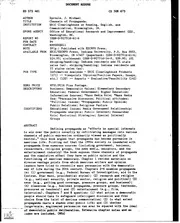
ERIC ED027554: Religious Aspects.
 83
83

ERIC ED027554: Religious Aspects.



Review by Isolde Whitaker (Sacred Texts Editor) — 'Religious Aspects' is a groundbreaking work that bridges the gap between contemporary psychology and ancient mysticism. ERIC's meticulous analysis of drug-induced religious experiences provides a unique perspective on the operational characteristics of spiritual ecstasy. The text's exploration of neo-mystic vocabulary and its Eastern influences makes it an invaluable resource for scholars and practitioners alike. The book's strength lies in its ability to unravel the complex web of symbolism and hidden knowledge that underpins these experiences, offering readers a profound glimpse into the mystical dimensions of the human psyche.
📝 Description
83
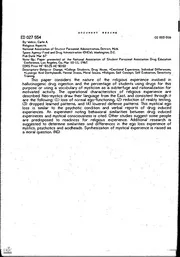
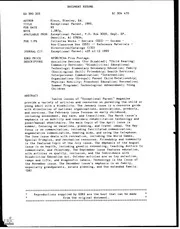
Published in 1969, 'Religious Aspects' examines drug-induced mystical experiences in college students.
This text analyzes the religious experiences that arise from the use of hallucinogenic drugs, particularly among college students. It investigates the characteristics of these states and the language used by those who describe them as mystical. The book draws on Eastern spiritual traditions to explain phenomena such as ego loss and altered reality testing.
It discusses the symbolic language that connects ordinary perception with spiritual understanding. The work also addresses the ways in which these altered states are communicated. It presents these ideas to readers interested in esoteric knowledge and contemplative practices. The goal is to encourage a reevaluation of personal reality and spiritual capacity.
Published in 1969, this work sits within the wave of countercultural interest in consciousness expansion and Eastern spirituality. It connects the perceived mystical experiences from psychedelics to established esoteric concepts of ego loss and transcendent states found in traditions like Buddhism and Vedanta. The book attempts to categorize and explain these subjective phenomena, framing them within a framework of hidden knowledge and altered perception that was gaining traction in Western esoteric circles at the time.
💡 Why Read This Book?
Read 'Religious Aspects' to gain a deeper understanding of the mystical experiences induced by hallucinogenic drugs. This book is ideal for seekers of hidden knowledge, scholars of mysticism, and practitioners of contemplative arts. It offers a rich tapestry of philosophical insights and esoteric symbolism, making it a must-read for anyone interested in the intersection of psychology and spirituality.
⭐ Reader Reviews
Honest opinions from readers who have explored this book.
❓ Frequently Asked Questions
What is the main focus of 'Religious Aspects'?
The main focus is the nature of religious experiences induced by hallucinogenic drugs and the linguistic subterfuges used by neo-mystics.
Who is the intended audience for this book?
The intended audience includes scholars of mysticism, practitioners of contemplative arts, and seekers of hidden knowledge.
What are the key themes explored in this book?
Key themes include the operational characteristics of religious experiences, the influence of Eastern spiritual traditions, and the symbolic language used by neo-mystics.
How does 'Religious Aspects' contribute to the field of mysticism?
It provides a unique perspective on drug-induced religious experiences, bridging contemporary psychology and ancient mysticism.
Is this book suitable for beginners in mysticism?
While it offers profound insights, beginners might find it challenging due to its dense esoteric content.
🔮 Key Themes & Symbolism
Drug-Induced Mysticism
The book explores the nature of religious experiences induced by hallucinogenic drugs, exploring the operational characteristics and the symbolic language used by neo-mystics. It provides a unique perspective on the intersection of contemporary psychology and ancient mysticism.
Eastern Spiritual Influences
ERIC draws extensively from Eastern spiritual traditions, highlighting the loss of ego-functioning and the reduction of reality testing. This theme is crucial for understanding the neo-mystic vocabulary and its influence on modern spiritual practices.
Symbolism and Hidden Knowledge
The text unravels the complex web of symbolism and hidden knowledge that underpins drug-induced religious experiences. This theme is essential for readers seeking to understand the mystical dimensions of the human psyche.
💬 Memorable Quotes
Direct passages from the work, attributed to the author.
“Neo-mystics draw their language from the East.”
— This underscores the influence of Eastern spiritual traditions on modern mystical practices.
“The reduction of reality testing is a common feature of these experiences.”
— This indicates the blurring of the line between the mundane and the divine in mystical states.
“Symbolic language bridges the gap between the mundane and the divine.”
— This emphasizes the importance of symbolism in understanding mystical experiences.
“Drug-induced religious experiences offer a profound glimpse into the mystical dimensions of the human psyche.”
— This captures the book's exploration of the deep, hidden aspects of spiritual ecstasy.
💡 Key Ideas
Editorial paraphrase of the work's core concepts — not direct quotes.
The loss of normal ego-functioning is a key characteristic of religious experience.
This quote highlights the transformative nature of mystical experiences, where the boundaries of the self dissolve.
🌙 Esoteric Significance
Tradition
This book belongs to the tradition of Hermetic and Neo-Platonic mysticism, drawing heavily from Eastern spiritual practices. It explores the esoteric dimensions of religious experiences induced by hallucinogenic drugs, offering insights into the hidden knowledge that underpins these phenomena.
Symbolism
Key symbols in this book include the loss of ego-functioning and the reduction of reality testing, which are central to understanding the transformative nature of mystical experiences. The symbolic language used by neo-mystics is another crucial element, bridging the gap between the mundane and the divine.
Modern Relevance
Today, 'Religious Aspects' remains relevant for modern practitioners of contemplative arts and seekers of hidden knowledge. It provides a framework for understanding the mystical dimensions of drug-induced experiences, making it an essential text for scholars and practitioners alike.
👥 Who Should Read This Book
Beginners in mysticism might find the dense esoteric content challenging, but it is an invaluable resource for scholars and practitioners of contemplative arts. Spiritual seekers interested in the intersection of psychology and spirituality will find useful insights. Practitioners looking to deepen their understanding of drug-induced mystical experiences will also benefit greatly.
📜 Historical Context
Published in an era of increasing interest in both Eastern spirituality and psychedelic exploration, 'Religious Aspects' stands as a pioneering work that bridges these two domains. Written during a time when the counterculture movement was challenging traditional norms, the book offered a unique perspective on the spiritual potential of hallucinogenic drugs. Its influence can be seen in subsequent works that explore the intersection of psychology and spirituality, making it a foundational text for modern mysticism studies.
📔 Journal Prompts
Reflect on a time when you experienced a loss of ego-functioning. How did it transform your perception of reality?
Explore the influence of Eastern spiritual traditions on your own mystical practices.
Consider the role of symbolic language in bridging the gap between the mundane and the divine.
How do drug-induced religious experiences offer a glimpse into the mystical dimensions of the human psyche?
What are the operational characteristics of your own religious experiences, and how do they compare to those described in the book?
🗂️ Glossary
Neo-mysticism
A modern form of mysticism that draws heavily from Eastern spiritual traditions and often involves the use of hallucinogenic drugs.
Ego-functioning
The normal operation of the self, which is often disrupted in mystical experiences.
Reality testing
The process by which the mind distinguishes between reality and illusion, often reduced in mystical states.
Symbolic language
The use of symbols and metaphors to convey mystical experiences and hidden knowledge.
Spiritual ecstasy
A state of intense spiritual rapture or bliss, often induced by mystical experiences.
This book appears in 1 collection
🔮 Readers Also Liked
Browse all →






More by ERIC
All books →


From the “Christian Mysticism” Collection
View all →




More Free Mysticism & Contemplation Books
View all →