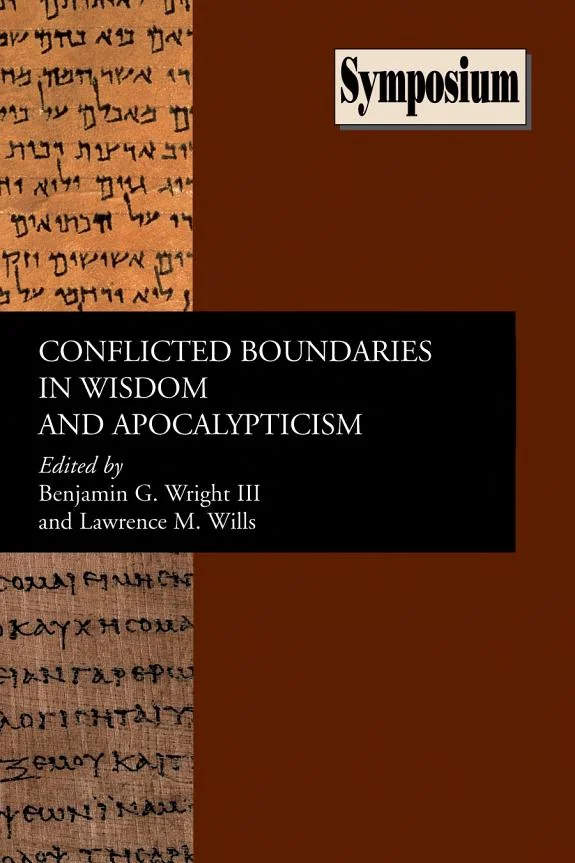
Conflicted Boundaries in Wisdom and Apocalypticism
 81
81

Conflicted Boundaries in Wisdom and Apocalypticism
The scholarly consensus that wisdom and apocalyptic literature are mutually exclusive categories is forcefully interrogated in Conflicted Boundaries in Wisdom and Apocalypticism. The essays assembled here, originating from a Society of Biblical Literature group, demonstrate a keen awareness of how academic frameworks can sometimes obscure the lived realities of ancient texts. A particular strength lies in its examination of the social locations that produced these literatures, revealing how genre definitions can be influenced by interpretive biases. While the collection is densely academic, its consistent challenge to established categories is its most valuable contribution. A limitation might be the assumption of familiarity with complex scholarly debates, making it less accessible to neophytes. The exploration of how texts like Daniel or certain sapiential sayings might exhibit traits of both genres is particularly compelling. This volume offers a necessary corrective to overly neat categorizations of ancient biblical literature.
📝 Description
81
Published in 2005, Conflicted Boundaries in Wisdom and Apocalypticism questions the separation of two ancient literary genres.
This volume, a product of the Society of Biblical Literature's Wisdom and Apocalypticism Group, challenges the traditional view that wisdom and apocalyptic literature in early Jewish and Christian texts were separate and opposing categories. The essays examine how scholars have historically categorized these writings, particularly the intellectual trends that created rigid distinctions between them. The book considers the social contexts that produced these literatures and the academic lenses used to understand them.
The core idea investigates the supposed split between wisdom literature, which offers practical advice and moral instruction, and apocalyptic literature, which deals with divine visions, end times, and cosmic struggles. The authors suggest that in ancient times, these categories were less defined and frequently merged, showing a more fluid reality than previously assumed. This approach encourages a reevaluation of how we understand these important ancient texts.
While not strictly gnostic, this book engages with traditions that often intertwine sapiential and revelatory elements. Early Jewish wisdom texts, like Proverbs or Sirach, focus on practical ethics and divine order, while apocalyptic works, such as Daniel or 1 Enoch, reveal hidden divine plans and future events. The book's inquiry into the boundaries between these traditions speaks to the broader historical context of how esoteric ideas about divine knowledge, cosmic struggle, and ethical living were expressed and understood within ancient Judaism and early Christianity.
💡 Why Read This Book?
• Gain a nuanced understanding of genre fluidity in early Jewish and Christian texts, challenging the rigid separation of wisdom and apocalyptic literature as exemplified in essays discussing the 2005 publication context. • Analyze how social locations and scholarly constructions impact the interpretation of ancient religious literature, moving beyond simplistic genre definitions. • Discover how ancient authors themselves may have employed overlapping literary strategies, as evidenced by the work's exploration of porous categories in early biblical writings.
⭐ Reader Reviews
Honest opinions from readers who have explored this book.
❓ Frequently Asked Questions
What is the main argument of Conflicted Boundaries in Wisdom and Apocalypticism?
The book argues against the notion that wisdom and apocalyptic literature in early Jewish and Christian texts are fundamentally separate genres and worldviews. It proposes that ancient categories were more fluid and overlapping than commonly assumed by modern scholarship.
Who organized the essays in this volume?
The essays were contributed by members of the Wisdom and Apocalypticism Group of the Society of Biblical Literature, a prominent academic organization.
When was Conflicted Boundaries in Wisdom and Apocalypticism first published?
The book was first published in 2005, reflecting scholarship from that period on early Jewish and Christian literature.
What does the book mean by 'social locations' of literature?
'Social locations' refers to the specific communities, contexts, and circumstances in which ancient texts were produced and received. Understanding these locations helps explain the content and form of the literature.
How does this book challenge existing scholarship?
It challenges the prevailing view that wisdom and apocalyptic literature are mutually exclusive categories by demonstrating their historical overlap and shared characteristics in early Jewish and Christian writings.
What type of literature is discussed in the book?
The book focuses on early Jewish and Christian literature, specifically examining texts traditionally categorized as 'wisdom literature' (e.g., Proverbs, Ecclesiastes) and 'apocalyptic literature' (e.g., Daniel, Revelation).
🔮 Key Themes & Symbolism
Genre Fluidity
The central theme is the challenge to strict genre classifications, particularly the separation of wisdom and apocalyptic literature. The essays explore how ancient texts often blended elements traditionally assigned to one category or the other. This perspective encourages readers to see early Jewish and Christian writings not as neatly compartmentalized but as exhibiting a more dynamic and overlapping literary landscape, reflecting a reality where these categories were not always distinct in their production or reception.
Scholarly Constructions
This theme addresses how modern academic frameworks have shaped our understanding of ancient literature. The volume critiques the tendency to impose rigid categories onto texts that may not have conformed to them. It examines how the 'Wisdom and Apocalypticism Group' itself works to deconstruct these established scholarly constructions, urging a re-evaluation of how academic disciplines define and interpret religious texts from antiquity.
Social Locations of Texts
The essays emphasize the importance of understanding the social, historical, and cultural contexts in which early Jewish and Christian texts were created. By examining the 'social locations' of these literatures, the book reveals how societal factors influenced their content and form. This approach moves beyond purely textual analysis to consider the real-world environments that shaped these important religious writings.
Challenging Dichotomies
Fundamentally, the book seeks to dismantle the perceived dichotomy between wisdom and apocalyptic worldviews. It suggests that these two seemingly opposed perspectives often coexisted, influenced each other, and were expressed within the same literary works or traditions. This challenges readers to reconsider the fundamental nature of early religious thought and expression.
💬 Memorable Quotes
Direct passages from the work, attributed to the author.
“The notion that wisdom and apocalypticism represent fundamentally different and mutually exclusive categories persists in current scholarship.”
— This statement captures the core problem the book addresses: the academic tendency to oversimplify and rigidly divide early religious literature, ignoring the historical reality of its more interconnected nature.
“The essays in this volume challenge that generally held view as they explore the social locations and scholarly constructions of these literatures.”
— This highlights the methodology employed by the contributors, emphasizing a dual focus on the original contexts of the texts and the academic frameworks used to interpret them, aiming for a more accurate historical understanding.
“discover an ancient reality of more porous categories”
— This phrase suggests that the ancient world did not adhere to the strict genre distinctions that later scholars imposed, implying a more fluid and integrated approach to wisdom and apocalyptic themes.
“wisdom and apocalypticism represent fundamentally different and mutually exclusive categories of genre and worldview”
— This represents the common scholarly assumption that the book actively seeks to dismantle, setting the stage for its re-examination of early Jewish and Christian texts.
“The work explores the social locations and scholarly constructions of these literatures.”
— This points to the analytical lens of the contributors, who examine both the original societal contexts of the texts and the academic methods used to study them, advocating for a more integrated approach.
🌙 Esoteric Significance
Tradition
While not explicitly aligned with a single esoteric lineage, this work significantly impacts the study of Western esoteric traditions that draw heavily on biblical symbolism. It provides a critical academic lens for understanding the foundational texts and concepts that inform Hermeticism, Gnosticism, and Kabbalah, particularly in their engagement with themes of divine wisdom and cosmic revelation found in Jewish and Christian scriptures.
Symbolism
The book implicitly engages with symbols of hidden knowledge and divine communication central to esoteric thought. Wisdom itself can be seen as a symbolic conduit to the divine or ultimate reality, while apocalyptic visions often employ complex symbolic language (e.g., beasts, celestial events) to represent spiritual truths and future destinies, which are frequently reinterpreted in esoteric circles.
Modern Relevance
Contemporary esoteric scholars and practitioners who engage with biblical texts—such as those exploring Kabbalistic interpretations of Old Testament wisdom or Gnostic readings of apocalyptic narratives—benefit from this volume's challenge to monolithic genre definitions. It encourages a more flexible and context-aware approach to understanding the symbolic and mystical dimensions of these ancient scriptures.
👥 Who Should Read This Book
• Academics and graduate students in biblical studies, Second Temple Judaism, and early Christian literature seeking to refine their understanding of genre and worldview in ancient texts. • Comparative religion scholars interested in the historical development and intersection of sapiential and eschatological thought across different traditions. • Researchers focused on the social and historical contexts of religious literature who wish to understand how interpretive frameworks shape our view of antiquity.
📜 Historical Context
Published in 2005, Conflicted Boundaries emerged within a range of biblical scholarship that, while increasingly nuanced, still often relied on established genre distinctions for early Jewish and Christian literature. The Society of Biblical Literature's Wisdom and Apocalypticism Group, comprising the volume's contributors, aimed to push back against the prevailing scholarly tendency to treat wisdom traditions (often seen as practical, ethical, and earthly-focused) and apocalyptic traditions (characterized by divine revelation, eschatology, and cosmic conflict) as inherently separate. This was a period where scholars like John J. Collins were influential in defining apocalyptic literature, yet there was a growing awareness of overlaps and shared concerns across different textual corpora. The volume sought to address how 'social locations' and the very 'scholarly constructions' of these texts had contributed to the perceived divide, advocating for a more integrated understanding of ancient religious thought.
📔 Journal Prompts
The 'porous categories' in early Jewish and Christian literature, as discussed in the 2005 volume.
The interplay between 'wisdom' and 'apocalypticism' in a specific biblical text.
The influence of 'scholarly constructions' on interpreting ancient religious texts.
Reflecting on the 'social locations' that might have shaped texts from the Second Temple period.
How the perceived dichotomy between wisdom and apocalyptic literature impacts modern theological understanding.
🗂️ Glossary
Wisdom Literature
A genre of ancient literature, primarily in the Hebrew Bible and related traditions, characterized by ethical teachings, practical advice, and reflections on life, often attributed to figures like Solomon (e.g., Proverbs, Ecclesiastes, Job).
Apocalyptic Literature
A genre characterized by visions, divine revelation, symbolic language, and eschatological themes, often concerning the end times, cosmic conflict, and divine judgment (e.g., Daniel, Revelation, parts of Isaiah).
Genre
A category of artistic composition, characterized by similarities in form, style, or subject matter. In biblical studies, genre helps scholars classify and interpret texts.
Worldview
A particular philosophy of life or conception of the universe held by an individual or group; the lens through which reality is perceived and understood.
Social Location
The specific social, cultural, economic, and political context in which a text is produced and received, influencing its content and interpretation.
Scholarly Construction
The way in which academic frameworks, theories, and definitions are used to categorize, analyze, and understand a particular subject, in this case, ancient religious texts.
Porous Categories
Refers to classifications or divisions that are not rigid or impermeable, allowing for overlap, blending, and interaction between different types or groups.
This book appears in 1 collection
🔮 Readers Also Liked
Browse all →







From the “Apocrypha” Collection
View all →



More Free Sacred Texts & Gnosticism Books
View all →