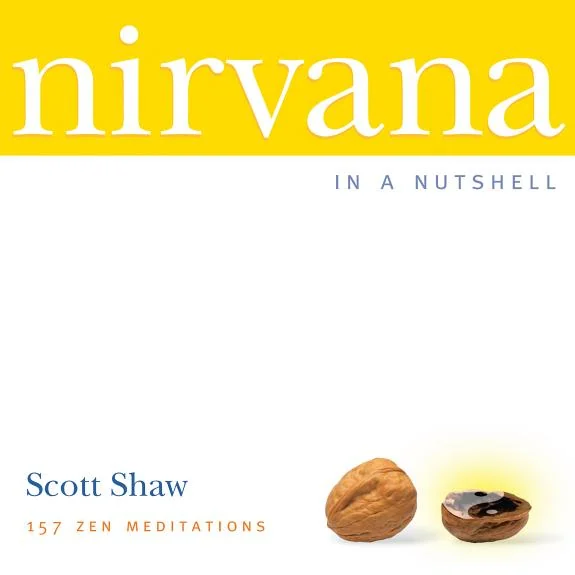
Nirvana in a Nutshell
 77
77

Nirvana in a Nutshell
Scott Shaw’s "Nirvana in a Nutshell" is not for the casual dabbler. It cuts straight to the often-uncomfortable core of why spiritual pursuits can lead to frustration rather than freedom. The book’s strength lies in its direct, almost confrontational, approach to self-deception in spiritual seeking. Shaw posits that the very act of *trying* to be enlightened is the barrier, a concept he revisits through numerous short meditations. One particularly striking point is the notion that "seeking to obtain happiness… keeps them out of reach," a concise articulation of the paradox many practitioners encounter. However, the sheer volume of brief exercises, while intended to be accessible, can sometimes feel repetitive, and the text lacks in-depth exploration of the philosophical underpinnings that inform this perspective. It’s a tool for immediate application, not a comprehensive treatise. Ultimately, "Nirvana in a Nutshell" offers a bracingly direct, if occasionally stark, path to recognizing one's own internal blockages.
📝 Description
77
Scott Shaw's 2002 book, Nirvana in a Nutshell, argues that seeking happiness is the main obstacle to peace.
Nirvana in a Nutshell presents over 150 Zen meditations and exercises designed to challenge common ideas about enlightenment. Shaw suggests that the active pursuit of happiness and peace can paradoxically prevent their realization. He posits that unconscious self-sabotage often blocks individuals from recognizing their natural state of inner quiet.
This book is for anyone looking to understand the subtle factors that interfere with inner peace and spiritual growth. It suits those who have practiced meditation without seeing expected results or who are interested in the psychological barriers to enlightenment. The work speaks to practitioners frustrated by the fleeting nature of tranquility.
Shaw's central idea is that "Nirvana is." This concept suggests an inherent state of being, not a destination. The book examines how attachment to results, overthinking spiritual ideas, and constant external validation create mental distraction that obscures this basic reality. It advocates for a transition from active striving to a state of simple existence.
Published in 2002, Nirvana in a Nutshell entered Western discourse during a time of growing interest in Eastern thought. While Zen Buddhism had a presence for years, Shaw's book offered a direct, personal application method distinct from more academic or structured introductions. It provided a way for individuals to engage with Zen principles for immediate personal use, aiming to cut through intellectualization and promote direct experience of inner quiet.
💡 Why Read This Book?
• You will learn to identify personal "sabotage" patterns hindering inner peace, a practical outcome directly addressed by the book's 150+ Zen meditations. • Gain a concrete understanding of the paradox of seeking enlightenment, a core concept Shaw presents as the very impediment to achieving it, as outlined in the 2002 publication. • Discover how over-analysis and attachment to desired outcomes obstruct present-moment awareness, a key theme explored throughout the work's practical exercises.
⭐ Reader Reviews
Honest opinions from readers who have explored this book.
❓ Frequently Asked Questions
What is the core message of Scott Shaw's "Nirvana in a Nutshell"?
The book's central message, first published in 2002, is that Nirvana is an inherent state of being, not a goal to be achieved. The act of seeking happiness or enlightenment can paradoxically keep these states out of reach by creating mental obstacles.
How does "Nirvana in a Nutshell" differ from other meditation guides?
Unlike guides that focus on accumulating hours of practice, Shaw's 2002 work emphasizes recognizing and releasing self-sabotaging behaviors that prevent inner peace. It offers over 150 short meditations designed for immediate insight into these patterns.
What does the book suggest about the role of desire in spiritual practice?
Shaw argues that the fulfillment of endless desires, and even the desire for enlightenment itself, is counterproductive. The pursuit of these desires creates attachments that obscure the natural state of peace and awareness.
Who is Scott Shaw?
Scott Shaw is an author known for his works on Zen, meditation, and Eastern philosophy. "Nirvana in a Nutshell" is one of his notable contributions, originally published in 2002, offering accessible techniques for spiritual practitioners.
What kind of exercises can I expect in this book?
The book contains over 150 short Zen meditations and practical exercises. These are designed to help readers observe their own mental habits and identify behaviors that impede their progress toward inner peace and enlightenment.
Is this book suitable for beginners in meditation?
Yes, its concise format and direct approach make it suitable for beginners, especially those who feel overwhelmed by more complex texts or lengthy meditation requirements. The book aims to provide immediate practical insights.
🔮 Key Themes & Symbolism
The Paradox of Seeking
The central theme is the inherent paradox in spiritual seeking: the very act of striving for enlightenment, happiness, or peace can become the primary obstacle. Shaw argues that the desire for these states creates an attachment that prevents their realization. This concept challenges conventional wisdom, suggesting that peace is not something to be acquired but a fundamental state to be uncovered by ceasing the active pursuit. The book's meditations are designed to highlight how this seeking behavior manifests in daily life.
Self-Sabotage of Enlightenment
Shaw posits that individuals often unconsciously "sabotage" their own path to inner peace. This involves mental habits, thought patterns, and attachments that create internal resistance. The book encourages readers to become aware of these subtle mechanisms—overthinking, attachment to outcomes, and the need for external validation—that obstruct the realization of Nirvana. The 150+ exercises serve as tools for self-observation and the dismantling of these internal barriers.
Inherent State of Being
The book's title, "Nirvana in a Nutshell," reflects the idea that Nirvana is an intrinsic quality of existence, not an external attainment. It suggests that enlightenment is a natural state that is merely obscured by the mind's conditioning and distractions. The emphasis is on recognizing this inherent reality rather than working towards an imagined future state. This perspective encourages a shift from a goal-oriented practice to a state of present-moment awareness and acceptance.
Direct Experience Over Intellect
Shaw critiques the tendency to over-analyze spiritual concepts or rely solely on intellectual understanding. He advocates for direct, experiential realization. The meditations are crafted to bypass excessive rumination and encourage immediate insight. The book prioritizes doing and being over prolonged study, aiming to foster a visceral understanding of the principles discussed, moving beyond mere theoretical knowledge.
💬 Memorable Quotes
Direct passages from the work, attributed to the author.
“Nirvana is. You are. Be enlightenment.”
— This opening statement expresses the book's core philosophy: enlightenment is not a destination but a present reality inherent in one's being. It asserts that the state of Nirvana is already accessible and encourages the reader to embody this truth.
“Nirvana is not to be found in the fulfillment of endless desires, the analysis of profound thoughts, or even hours, days, or years of meditative contemplation.”
— This challenges traditional views of spiritual progress. It suggests that conventional methods, including prolonged meditation or intellectual study, can become distractions if they are pursued with the goal of attainment, rather than as means to recognize what is already present.
“In fact, it is the very act of seeking to obtain happiness, peace, and enlightenment that keeps them out of reach.”
— This highlights the central paradox. The active pursuit of these states creates attachment and striving, which are antithetical to the effortless state of being that Nirvana represents. The desire itself becomes the barrier.
“Discover what you might be doing (or not doing) in your life to sabotage your goal of reaching inner peace.”
— This points to the practical application of the book's teachings. It encourages self-inquiry into one's own behaviors and mental patterns, identifying the subtle ways one might be hindering their own progress toward tranquility.
“Be enlightenment.”
— A direct imperative suggesting that enlightenment is not an achievement but an identity to be recognized and lived. It implies that the reader already possesses this quality and needs only to embody it.
🌙 Esoteric Significance
Tradition
While rooted in Zen Buddhist principles, "Nirvana in a Nutshell" functions within a broader esoteric framework by focusing on the direct, experiential realization of a non-dual state, akin to Gnostic gnosis or Hermetic attainment. It bypasses rigid dogma, emphasizing inner recognition over external adherence. The tradition it draws from is Zen, but its application of recognizing inherent awareness and releasing mental constructs aligns with perennialist philosophies common in esoteric circles.
Symbolism
The "Nutshell" itself can be seen as a symbol of containment and essence – the infinite (Nirvana) reduced to its fundamental, accessible core. The book's numerous short meditations symbolize the "seeds" of awareness that, when planted and observed without expectation, can grow into profound understanding. The concept of "sabotage" functions symbolically, representing the internal "demons" or "karmic obstacles" that esoteric traditions often address.
Modern Relevance
Shaw's work remains relevant in contemporary mindfulness and wellness movements, which increasingly acknowledge the psychological barriers to well-being. Thinkers and practitioners in secular mindfulness, positive psychology, and even some streams of Western esoteric thought utilize its principles to address burnout and the "tyranny of striving." Its directness appeals to a modern audience seeking practical, immediate tools for mental clarity.
👥 Who Should Read This Book
• Individuals feeling stuck in their spiritual or meditative practice: Those who have spent years meditating or studying esoteric texts without achieving lasting peace will find Shaw's direct approach to identifying self-sabotage particularly useful. • Skeptics of conventional self-help: Readers looking for a no-nonsense, direct method to understand their internal blocks, rather than affirmations or goal-setting, will appreciate the book's focus on recognizing inherent obstacles. • Busy practitioners seeking concise guidance: Those with limited time who desire practical, actionable exercises rather than lengthy theoretical discourse will benefit from the over 150 short Zen meditations offered.
📜 Historical Context
Published in 2002, "Nirvana in a Nutshell" arrived during a period of significant Western engagement with Eastern spiritual traditions, particularly Zen Buddhism and mindfulness. While figures like Alan Watts and D.T. Suzuki had introduced Zen concepts to Western audiences decades earlier, Shaw's work emerged in a landscape saturated with self-help and spiritual-seeking literature. It offered a more direct, practice-oriented approach compared to some of the more academic or philosophical explorations common at the time. The book's emphasis on recognizing self-sabotage and the paradoxical nature of seeking enlightenment can be seen as a response to the potential for spiritual materialism—the accumulation of spiritual knowledge or practices without genuine inner transformation. It provided a counterpoint to the often-complex theoretical frameworks, focusing instead on immediate, practical application through its 150+ meditations.
📔 Journal Prompts
The paradox of seeking: How has your active pursuit of peace inadvertently created distance from it?
Identify a specific instance of "sabotage" in your daily life that hinders your inner peace.
Reflect on the statement "Nirvana is." What does this imply about your current state of being?
Analyze a "profound thought" you've held onto; how might it be obscuring direct experience?
Consider the "fulfillment of endless desires"; which desire, if released, might bring you closer to stillness?
🗂️ Glossary
Nirvana
In Buddhist tradition, the ultimate state of liberation and peace, characterized by the cessation of suffering and the cycle of rebirth. Shaw interprets it as an inherent state of being rather than an attained goal.
Enlightenment
A state of profound spiritual understanding and liberation. In the context of the book, it refers to the realization of one's true nature, free from illusion and suffering, and is presented as an inherent quality.
Zen Meditation
A practice within Zen Buddhism that emphasizes direct experience and insight, often through focused attention (like breath awareness) or open awareness (shikantaza). Shaw uses short, specific meditations to highlight psychological patterns.
Self-Sabotage
Unconscious behaviors or thought patterns that hinder one's own progress or goals. In this book, it refers to mental habits that prevent the realization of inner peace and enlightenment.
Attachment
A strong emotional connection or clinging to people, things, ideas, or outcomes. Shaw suggests that attachment, including attachment to the idea of enlightenment, is a primary obstacle to peace.
Seeking
The act of pursuing or searching for something, particularly happiness, peace, or enlightenment. Shaw argues that the act of seeking can be counterproductive to finding these states.
Inner Peace
A state of mental and emotional calm, free from disturbance and turmoil. The book suggests this is an innate quality that can be uncovered by releasing mental obstructions.
This book appears in 1 collection
🔮 Readers Also Liked
Browse all →









From the “Nirvana” Collection
View all →








More Free Sacred Texts & Gnosticism Books
View all →