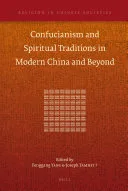
Confucianism and Spiritual Traditions in Modern China and Beyond
 81
81

Confucianism and Spiritual Traditions in Modern China and Beyond
Fenggang Yang and Joseph Tamney's edited volume, "Confucianism and Spiritual Traditions in Modern China and Beyond," provides a much-needed scholarly dissection of a complex religious and philosophical landscape. The strength of this work lies in its diverse disciplinary approaches; the inclusion of sociological and anthropological fieldwork alongside philosophical exegesis offers a robust, multi-faceted understanding. For instance, the empirical studies detailing the revival of Confucian rituals in rural China offer concrete evidence often missing in purely theoretical treatments. However, the collection occasionally suffers from a degree of academic unevenness, with some contributions feeling more substantial than others. The initial blurb's promise of "philosophical and theological articulations" is met, but the depth varies. Despite this, the volume successfully captures the dynamic interplay between tradition and modernity. It is a valuable resource for understanding the evolving spiritual consciousness in China and its global ripples.
📝 Description
81
Published in 2011, this volume examines Confucianism's resurgence and its interactions with other spiritual currents in contemporary China.
This collection, published in 2011, offers a multidisciplinary look at the renewed presence of Confucianism within modern China and its diaspora. Scholars from philosophy, theology, history, sociology, and anthropology contribute to a view that goes beyond simple descriptions. The book considers the philosophical ideas and actual practices of spiritual life as China engages with the wider world.
The book is for academics, researchers, and students of religion, sociology, and East Asian studies. It will interest those studying the sociology of religion, how globalization affects belief systems, and Confucianism's role in China and places like America. Readers who want both empirical data and theoretical analysis of religious and philosophical trends will find it valuable.
The early 21st century saw a notable revival of Confucianism in China, a shift studied here within the context of state policies and societal changes. This occurred as Buddhism, Taoism, and Christian communities also continued to exert influence. The book's 2011 publication date marks a moment of growing academic interest in how these varied spiritual traditions adapted and persisted in a rapidly modernizing and globally connected China, a contrast to earlier periods of suppression and revival.
💡 Why Read This Book?
• Gain insight into the reinterpretation of Confucian concepts like filial piety (xiao) and ritual propriety (li) as detailed in the empirical studies, offering a practical understanding of their modern application beyond abstract philosophy. • Understand the specific historical context of the early 21st century's Confucian revival in China, appreciating how it interacts with other traditions like Buddhism and Taoism, as discussed in the historical analyses. • Explore the sociological and anthropological perspectives on the spread of Confucianism to America, providing concrete examples of its reception and adaptation in a new cultural milieu, as presented by the contributing authors.
⭐ Reader Reviews
Honest opinions from readers who have explored this book.
❓ Frequently Asked Questions
When was "Confucianism and Spiritual Traditions in Modern China and Beyond" first published?
The book "Confucianism and Spiritual Traditions in Modern China and Beyond" was first published on November 11, 2011. This date situates its analysis within the early 21st century's specific socio-religious trends.
What academic disciplines are represented in this book?
The volume draws from a multidisciplinary approach, featuring contributions from philosophers, theologians, historians, sociologists, and anthropologists, offering a broad spectrum of analytical perspectives.
Does the book focus solely on Confucianism in mainland China?
No, the book examines Confucianism and other spiritual traditions not only within modern China but also its presence and development in regions such as America, reflecting its globalizing influence.
What is a key theme regarding Confucianism's revival?
A key theme is the revival and reinterpretation of Confucian principles, such as filial piety (xiao) and ritual propriety (li), to address contemporary social and ethical challenges in a globalized world.
Who are the primary editors of this work?
The primary editors of "Confucianism and Spiritual Traditions in Modern China and Beyond" are Fenggang Yang and Joseph Tamney.
What kind of studies does the book include on Confucianism?
It includes both philosophical and theological articulations of Confucianism and other traditions, as well as empirical studies and analytical reflections from historical, sociological, and anthropological viewpoints.
🔮 Key Themes & Symbolism
Confucian Revival and Modernity
The resurgence of Confucianism in the early 21st century is examined not as a static return to the past, but as a dynamic adaptation to modern challenges. The work explores how core tenets like the cultivation of virtue and the importance of social harmony are being recontextualized within contemporary Chinese society and its global diaspora. This involves analyzing how traditional structures and values interact with secularizing forces and globalization, demonstrating Confucianism's capacity for evolution and resilience in a rapidly changing world.
Syncretism in Chinese Spirituality
This volume examines the complex reality of spiritual syncretism in China, where Confucianism often coexists and blends with other traditions like Buddhism, Taoism, and even Christianity. It moves beyond identifying isolated practices to analyzing the underlying motivations and societal factors that foster this blending. The work highlights how individuals may draw from multiple spiritual resources, creating personalized belief systems that reflect the many-sided nature of modern Chinese religious life and its resistance to rigid categorization.
Globalization of Confucian Thought
The book addresses the outward movement of Confucian ideas and practices, particularly its spread to America. It critically assesses how Confucianism is perceived and adopted in Western contexts, exploring both the potential for genuine spiritual engagement and the risks of superficial appropriation. This theme probes the challenges of maintaining the integrity of tradition while adapting to new cultural environments and the implications for both the source culture and the receiving societies.
Spiritual Traditions Beyond Orthodoxy
The collection emphasizes that spiritual life in modern China and beyond is not confined to established religious institutions or orthodox doctrines. It examines the diverse, often informal, ways individuals and communities engage with meaning, ethics, and transcendence. This includes exploring folk religious practices, philosophical explorations outside formal religious structures, and the personal spiritual quests that characterize contemporary society, underscoring the fluidity and personal nature of belief in the modern era.
💬 Memorable Quotes
Direct passages from the work, attributed to the author.
“Confucianism is reviving in China and spreading in America.”
— This statement, appearing in the original blurb, serves as a foundational observation for the entire volume, setting the stage for its multidisciplinary exploration of this significant socio-religious trend.
“The work includes philosophical and theological articulations of Confucianism and other spiritual traditions.”
— This highlights the intellectual depth of the collection, indicating that it engages with the abstract principles and doctrines of various traditions, not just their social manifestations.
“Empirical studies of and analytical reflections on Confucianism and other traditions in Chinese societies.”
— This points to the volume's methodological breadth, assuring readers that the book offers both data-driven research and critical theoretical analysis grounded in the specific context of Chinese societies.
“Scholars from history, sociology, and anthropology contribute.”
— This underscores the multidisciplinary nature of the book, promising diverse perspectives that go beyond theology or philosophy to examine the social and cultural dimensions of spiritual traditions.
“The volume addresses the modern and globalizing world.”
— This emphasizes the contemporary relevance of the collected works, indicating that they are not merely historical accounts but analyses of living traditions adapting to current global and societal forces.
🌙 Esoteric Significance
Tradition
While Confucianism is primarily known as a philosophical and ethical system, its emphasis on self-cultivation, ritual propriety (li), and the harmonious integration of the individual within the cosmos can be seen as containing esoteric dimensions. These relate to achieving inner alignment and participating in a perfected social and cosmic order, akin to certain Hermetic or Neoplatonic ideals of spiritual ascent and universal order. The volume explores these aspects within a modern context, moving beyond purely secular interpretations.
Symbolism
Key symbolic elements explored include the concept of *Tian* (Heaven) as a cosmic moral order, representing a transcendent yet immanent principle guiding human conduct. The practice of *li* (ritual propriety) functions symbolically, serving as the visible manifestation of inner virtue (*de*) and the means by which individuals align themselves with the cosmic Way (*Dao*). The ideal of the *Junzi* (noble person) symbolizes the perfected human being, embodying ethical excellence and spiritual maturity.
Modern Relevance
Contemporary thinkers and movements focused on virtue ethics, communitarianism, and the philosophy of education often draw upon Confucian thought. Scholars and practitioners seeking to understand the spiritual underpinnings of East Asian societies, or those interested in non-Western models of ethical development and social harmony, find this work highly relevant. It speaks to ongoing discussions about the role of tradition in globalized societies and provides a framework for analyzing the complex interplay of belief systems today.
👥 Who Should Read This Book
• Scholars of Comparative Religion and East Asian Studies: Those researching the evolving religious field of China and its diaspora will find detailed analyses and empirical data. • Students of Philosophy and Ethics: Individuals interested in virtue ethics, social philosophy, and the application of classical thought to modern dilemmas will benefit from the philosophical articulations. • Sociologists and Anthropologists of Religion: Researchers examining religious revival, globalization's impact on belief, and lived religion in contemporary societies will find valuable case studies and theoretical reflections.
📜 Historical Context
Published in 2011, "Confucianism and Spiritual Traditions in Modern China and Beyond" emerged during a period of significant academic and public interest in the resurgence of religion in China. This era followed decades of suppression under Mao Zedong, with the late 20th and early 21st centuries witnessing a complex revival of Confucianism, Buddhism, Taoism, and a growing Christian presence. The work engaged with ongoing debates about the role of religion in post-Mao China, particularly concerning state-sanctioned religious bodies versus unregistered groups. Key intellectual currents included discussions on modernization theory, secularization, and the potential for civilizational resurgence. Contemporaries like Tu Weiming were already influential in advocating for a Confucian revival. The book's multidisciplinary approach offered a counterpoint to purely philosophical or historical analyses, providing sociological and anthropological data on how these traditions were lived and practiced in real communities, both within China and in diaspora settings.
📔 Journal Prompts
The modern reinterpretation of Confucian filial piety (xiao): how does it differ from classical understandings?
Analyze the concept of ritual propriety (li) as a means of spiritual alignment in contemporary practice.
Reflect on the challenges of maintaining ethical integrity when spiritual traditions spread across cultures.
Consider the role of *Tian* (Heaven) as a guiding moral order in secularizing societies.
How do the empirical studies of Confucian revival challenge or support theoretical models of secularization?
🗂️ Glossary
Confucianism
An ancient Chinese ethical and philosophical system emphasizing personal and governmental morality, correctness of social relationships, justice, kindness, and sincerity. It became the basis of the Chinese state examination system and profoundly influenced East Asian culture.
Xiao (孝)
Filial piety; a virtue central to Confucianism, emphasizing respect, obedience, and care for one's parents and elders, extending to ancestors. It is seen as the root of all other virtues.
Li (禮)
Ritual propriety, etiquette, ceremony, and custom. It encompasses the norms of social conduct, religious rites, and the proper way to behave in different social situations, aiming for social harmony and personal cultivation.
Tian (天)
Heaven; a concept representing a cosmic moral order or the supreme deity in traditional Chinese thought. It is seen as the source of morality and the ultimate arbiter of destiny.
Junzi (君子)
The noble person or gentleman; the ideal moral character in Confucianism, achieved through self-cultivation, education, and adherence to ethical principles.
Syncretism
The merging of different religions, cultures, or schools of thought. In the context of the book, it refers to the blending of Confucianism with Buddhism, Taoism, Christianity, and other beliefs in China and beyond.
Diaspora
The dispersion or spread of people from their original homeland. In this context, it refers to Chinese communities and their spiritual traditions living outside of mainland China, particularly in America.