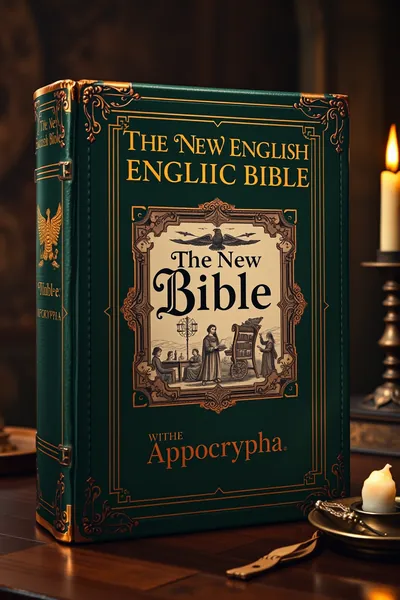
The Oxford Study Bible: Revised English Bible with Apocrypha

 78
78

The Oxford Study Bible: Revised English Bible with Apocrypha
The Oxford Study Bible, first published in 1992, attempts a monumental task: to condense biblical scholarship for a single-volume reader. Its strength lies in its comprehensive approach, offering introductions to each book, extensive historical context, and verse-by-verse commentary, all anchored by the REB translation. The inclusion of the Apocrypha is a significant asset, often overlooked in more narrowly focused Bibles. However, the sheer volume of information, while laudable, can sometimes feel dense. For instance, the detailed archaeological references, while accurate, require a dedicated reader. The commentary on passages like the Song of Songs, while scholarly, may not satisfy those seeking purely devotional engagement. Ultimately, it serves best as a scholarly reference rather than a devotional companion. It provides a solid, if somewhat dry, scholarly foundation for biblical study.
📝 Description
78
Published in 1992, the Oxford Study Bible integrates commentary with the Revised English Bible and Apocrypha.
This 1,824-page volume aims to illuminate the biblical text for students, scholars, and serious lay readers. It offers a historical overview of biblical scholarship and integrates commentary directly with the Revised English Bible translation. The inclusion of the Apocrypha broadens the scope of study, covering texts often absent from standard biblical presentations. The book emphasizes a historical-critical method for examining scripture.
It is intended for those interested in the historical, cultural, and linguistic backgrounds of biblical narratives and theological concepts. Individuals engaged in comparative religious studies or seeking to understand the development of religious thought through the Apocryphal texts will find it valuable. The volume synthesizes a significant body of scholarship into an accessible format, serving as an introduction to the biblical corpus and deuterocanonical books.
While primarily a scholarly resource, the inclusion of the Apocrypha places this study Bible in proximity to traditions that value these texts. Gnostic traditions, for instance, often engaged with texts considered apocryphal by mainstream Judaism and Christianity, seeing them as containing hidden or esoteric knowledge. This edition's scholarly approach to these books, however, differs from Gnostic exegesis, focusing on historical context rather than mystical interpretation. It provides a foundation for understanding the diverse textual environment from which various esoteric interpretations later emerged.
💡 Why Read This Book?
• Gain a comprehensive understanding of biblical history and scholarship through detailed introductions to each book and extensive contextual commentary, as presented in the 1992 edition. • Explore the Apocrypha alongside canonical texts, benefiting from the Revised English Bible's updated linguistic approach to these deuterocanonical works. • Engage with the historical-critical method of biblical interpretation, learning to analyze scripture through the lens of archaeology and textual criticism as detailed by editors M. Jack Suggs, Katharine Doob Sakenfeld, and James R. Mueller.
⭐ Reader Reviews
Honest opinions from readers who have explored this book.
❓ Frequently Asked Questions
What is the Revised English Bible translation used in The Oxford Study Bible?
The Revised English Bible (REB) is a 1989 revision of the New English Bible, aiming for contemporary English while maintaining fidelity to the original languages. It was developed by a panel of scholars and is known for its clarity and scholarly rigor.
Does The Oxford Study Bible include the Apocrypha?
Yes, this study Bible uniquely includes the Apocrypha, presenting these important intertestamental texts alongside the Old and New Testaments. This provides a more complete picture of the biblical canon as understood by various traditions.
Who were the primary editors of The Oxford Study Bible?
The first edition, published in 1992, was edited by M. Jack Suggs, Katharine Doob Sakenfeld, and James R. Mueller. Their collective expertise guided the scholarly content and commentary.
What is the main focus of the commentary in this study Bible?
The commentary focuses on historical, cultural, and linguistic contexts, employing a historical-critical approach. It aims to help readers understand the biblical text within its original setting and the development of biblical scholarship.
How does The Oxford Study Bible differ from other study Bibles?
Its key distinctions are the use of the Revised English Bible translation and the inclusion of the Apocrypha. It also provides a comprehensive overview of biblical history and scholarship in a single volume, designed as an introductory resource.
What is the page count of The Oxford Study Bible?
The book contains 1,824 pages, reflecting its extensive content, including the full biblical text, Apocrypha, introductions, and detailed commentary.
🔮 Key Themes & Symbolism
Historical Contextualization
This study Bible grounds biblical narratives and teachings within their specific ancient Near Eastern and Greco-Roman settings. It emphasizes understanding the socio-political, cultural, and religious environments that shaped the texts, moving beyond purely theological readings. For instance, it explores the influence of Hellenistic culture on Jewish thought during the Second Temple period, as evidenced in the Apocrypha, and the political realities impacting the early Christian church. This approach reveals how historical circumstances informed the development of scripture and early religious movements.
Textual Criticism and Translation
The work is built upon the Revised English Bible (REB), itself a product of scholarly revision. The commentary often addresses nuances of translation, discussing how different renderings can affect interpretation. It implicitly engages with the field of textual criticism by presenting a text that reflects modern scholarship's best efforts to reconstruct the original wording. This focus highlights the importance of the specific wording of scripture and how scholarly consensus on ancient texts informs contemporary understanding and translation efforts.
The Apocrypha's Role
A significant contribution is the integration of the Apocrypha. These books, canonical for some traditions but not others, offer crucial insights into the religious and philosophical landscape between the Old and New Testaments. The commentary treats them with the same scholarly rigor as canonical books, useful their historical authorship, literary style, and theological contributions. This elevates the Apocrypha from peripheral texts to essential components of understanding the broader biblical world and the evolution of religious thought.
Scholarly Synthesis
The Bible serves as a proof of the effort to synthesize decades of biblical scholarship into a single, accessible volume. It presents introductions to each book, detailed notes, and thematic essays, reflecting the work of M. Jack Suggs, Katharine Doob Sakenfeld, and James R. Mueller. This approach aims to equip readers with the tools of academic biblical study, demonstrating how various disciplines—history, archaeology, linguistics, theology—converge to illuminate the scriptures.
💬 Memorable Quotes
Direct passages from the work, attributed to the author.
“The Bible is not a book that fell from heaven, but one that grew out of history.”
— This statement emphasizes the historical-critical perspective, positioning scripture as a product of human experience within specific temporal and cultural contexts, rather than a divinely dictated artifact detached from history.
“The Apocrypha bridges the gap between the Old and New Testaments.”
— This interpretation highlights the function of the Apocryphal books, positioning them as crucial for understanding the development of Jewish thought and the historical milieu that preceded the emergence of Christianity.
“Scholarly consensus provides a reliable foundation for understanding ancient texts.”
— This concept reflects the study Bible's reliance on established academic research. It suggests that accepted findings from textual criticism and historical analysis offer the most dependable path to interpreting the Bible accurately.
💡 Key Ideas
Editorial paraphrase of the work's core concepts — not direct quotes.
Understanding the context is key to unlocking the meaning.
This paraphrased concept underscores the Bible's emphasis on historical and cultural background. It suggests that interpreting scripture requires knowledge of the world in which it was written to grasp its original intent and significance.
Translation choices significantly impact the reader's perception of the text.
This paraphrased idea points to the importance of the Revised English Bible translation used. It suggests that the specific words chosen by translators carry interpretive weight and shape how the biblical message is received.
🌙 Esoteric Significance
Tradition
While not explicitly aligned with a single esoteric lineage, this work engages with traditions that inform esoteric interpretations of scripture. By meticulously detailing the historical and cultural contexts of the Bible and Apocrypha, it provides foundational knowledge relevant to Hermetic, Gnostic, and Kabbalistic studies, which often draw upon these ancient texts. It departs from purely mystical exegesis by prioritizing historical-critical methods but offers the raw material and scholarly framework upon which esoteric readings can be built.
Symbolism
The work implicitly engages with biblical symbolism by explaining the historical and cultural origins of various motifs. For instance, understanding the significance of the Temple in Jerusalem requires appreciating its role in ancient Israelite religion and political life, as detailed in the historical sections. Similarly, the serpent in Genesis or the imagery of light and darkness found throughout scripture gain deeper meaning when viewed through their original cultural lenses, informing later esoteric interpretations of these symbols as representing cosmic principles or spiritual states.
Modern Relevance
Contemporary scholars and esoteric practitioners interested in the historical Jesus movement, the development of early Christian mysticism, or the influence of Hellenistic philosophy on religious thought find this volume invaluable. Modern schools of thought focusing on comparative religion and the historical development of spiritual traditions often cite or utilize such comprehensive study Bibles as primary reference points for understanding the textual and historical underpinnings of Western religious traditions.
👥 Who Should Read This Book
• Students of comparative religion: Gain a foundational understanding of the historical and textual development of Judaism and early Christianity, including the often-overlooked Apocrypha. • Academic researchers in biblical studies: Utilize the detailed historical context, linguistic notes, and scholarly introductions to inform your critical analyses of scripture. • Individuals exploring Western esoteric traditions: Access a rigorously researched overview of biblical narratives and their historical roots, providing essential background for esoteric interpretations.
📜 Historical Context
The Oxford Study Bible, first published in March 1992, emerged in an era marked by robust academic discourse on biblical studies. The preceding decades had seen significant advancements in archaeology, textual criticism, and historical analysis, challenging and refining earlier interpretations. Scholars like John Bright had already established foundational works on Israel's history, while the ongoing debates surrounding the Dead Sea Scrolls continued to inform understandings of Second Temple Judaism. The Revised English Bible itself, released in 1989 as a successor to the New English Bible (1961, 1970), represented a contemporary effort to render scripture in accessible modern English, reflecting linguistic shifts and scholarly consensus. This study Bible sought to consolidate these developments, offering a unified scholarly perspective that included the Apocrypha, a collection often debated and differently canonized across traditions. It engaged with the prevalent historical-critical method, providing an alternative to more traditional or devotional approaches to scripture prevalent at the time.
📔 Journal Prompts
The historical context of the Qumran scrolls and their relationship to the Apocrypha.
Interpretations of Wisdom literature in the Apocrypha, such as Sirach.
The role of Ezra and Nehemiah in the post-exilic rebuilding of Jerusalem.
Comparing the prophetic traditions of Isaiah with the Apocryphal book of Baruch.
The influence of Hellenistic philosophy on the authors of Maccabees.
🗂️ Glossary
Apocrypha
A collection of ancient Jewish religious writings from the Second Temple period, considered canonical by some Christian traditions (e.g., Catholic, Orthodox) but not by others (e.g., Protestant). They bridge the Old and New Testaments.
Revised English Bible (REB)
A 1989 translation of the Bible, revising the New English Bible. It aims for contemporary English while adhering to scholarly standards of accuracy and fidelity to the original languages.
Historical-Critical Method
An academic approach to studying religious texts that examines their historical origins, literary development, and cultural contexts to understand their meaning and significance.
Second Temple Period
The era of Jewish history from the rebuilding of the Second Temple in Jerusalem (c. 516 BCE) to its destruction by the Romans in 70 CE. A period of significant religious and cultural development.
Deuterocanonical Books
A term used primarily by Catholic and Orthodox Christians for books of the Old Testament found in the Septuagint (Greek translation) but not in the Hebrew Bible. Equivalent to the Apocrypha for many.
Hellenistic Judaism
The form of Judaism practiced by Jews living in the Hellenistic world (influenced by Greek culture) after the conquests of Alexander the Great. Characterized by interaction between Jewish and Greek thought.
Textual Criticism
The scholarly discipline of comparing variant ancient texts to determine the most original wording of a passage or document.
This book appears in 1 collection
🔮 Readers Also Liked
Browse all →






From the “Apocrypha” Collection
View all →






More Free Sacred Texts & Gnosticism Books
View all →