Hinduism a Scientific Religion
 76
76

Hinduism a Scientific Religion
Pon Kulendiren’s "Hinduism: A Scientific Religion" offers a compelling re-framing of Hindu philosophy, moving it from the realm of dogma to that of universal, observable principles. The author's insistence on Hinduism’s non-sectarian and founder-less nature is a strong opening gambit, challenging common perceptions. The integration of concepts like 'Cosmic Energy' and its distribution, especially when visualized, provides a tangible link for those approaching the subject from a scientific or empirical mindset. The reference to Lord Shiva as the Cosmic Dancer serves as a potent example of abstract cosmic processes made manifest. However, the work occasionally leans into assertive declarations without fully detailing the scientific methodology or evidence supporting its claims, which might leave some readers seeking more rigorous substantiation. Despite this, the book succeeds in presenting a coherent argument for the scientific and universal underpinnings of Hindu thought. It's a valuable perspective for anyone looking to understand Hinduism beyond its traditional religious boundaries.
📝 Description
76
In 2012, Pon Kulendiren's "Hinduism: A Scientific Religion" proposed Hinduism as a system of cosmic truths.
Pon Kulendiren's 2012 book, "Hinduism: A Scientific Religion," argues that Hinduism is not a religion in the conventional sense, but rather a fundamental truth connected to universal principles. The author suggests its non-denominational and universal character has been shaped by Rishis and Saints across ages. This work is for those interested in the scientific basis of spiritual systems, especially how energy, nature, and consciousness interconnect.
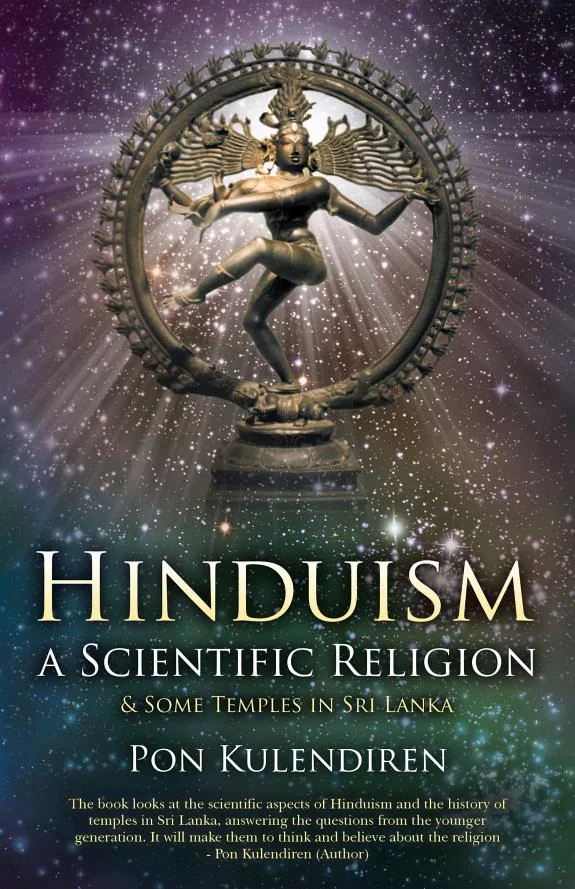
It suits individuals who question standard religious frameworks and seek a more universal, scientifically compatible view of existence. Kulendiren's text belongs to a tradition of thinkers who attempt to align ancient spiritual ideas with contemporary scientific thought. The book emphasizes concepts like 'Cosmic Energy' and its dissemination, using diagrams to connect Hindu practices and culture with natural occurrences. It highlights how Hindu traditions symbolically depict cosmic events, such as Shiva as the Cosmic Dancer.
This book emerges from a tradition that seeks to harmonize ancient yogic and Vedic philosophies with modern scientific understanding. It positions Hindu cosmology and practices as explorations of natural laws and energetic principles, akin to proto-scientific inquiries. The author engages with the idea that spiritual disciplines offer empirical insights into the nature of reality, a perspective shared by various philosophical and mystical movements that seek universal truths beyond dogma.
💡 Why Read This Book?
• Gain a framework for understanding Hindu traditions as rooted in observable Cosmic Energy, as detailed in the book's diagrams, offering a unique lens beyond typical religious studies. • Explore the concept of Hinduism as a non-denominational, universal truth, providing a fresh perspective for comparative religion enthusiasts and philosophical inquirers. • Appreciate the connection between Hindu culture and nature, as articulated by the author’s interpretation of ancient Rishis’ wisdom, offering practical insights into ancient ecological awareness.
⭐ Reader Reviews
Honest opinions from readers who have explored this book.
❓ Frequently Asked Questions
What is the main argument of 'Hinduism: A Scientific Religion'?
The book argues that Hinduism is not a man-made religion or sect, but a universal truth intrinsically linked to Cosmic Energy and natural laws, as nurtured by ancient Rishis and Saints.
Who is the author of 'Hinduism: A Scientific Religion'?
The author is Pon Kulendiren. The book was first published on October 11, 2012.
What specific concepts are explored in the book regarding Cosmic Energy?
The work explores the distribution of Cosmic Energy and provides a diagram to illustrate it, linking this concept to Hindu traditions, culture, and the symbolic representation of Lord Shiva as the Cosmic Dancer.
Is Hinduism presented as a religion with a founder in this book?
No, the book explicitly states that Hinduism's founder is unknown and that its truth is non-denominational and universal, rather than a sect or man-made religion.
What is the relationship between Hindu traditions and nature according to the book?
The book posits that Hindu traditions and culture are directly linked to nature, reflecting a deep understanding and integration of natural phenomena.
What is the significance of Lord Shiva in 'Hinduism: A Scientific Religion'?
Lord Shiva is presented as the Cosmic Dancer, a symbolic representation of cosmic processes and energy within the framework of Hinduism as a scientific truth.
🔮 Key Themes & Symbolism
Cosmic Energy as Universal Truth
The book posits that the core of Hinduism is not a creed but a fundamental truth tied to 'Cosmic Energy.' It suggests this energy is universally present and its distribution can be understood, illustrated with diagrams. This perspective reframes religious concepts as explorations of natural, energetic laws, aligning ancient wisdom with scientific inquiry and offering a non-denominational view.
Hinduism as Founder-less and Non-Sectarian
A central tenet is Hinduism's lack of a known founder and its non-sectarian nature. The work emphasizes that its wisdom was nurtured and revived by Rishis and Saints over time, positioning it as an eternal truth rather than a historical religion. This viewpoint challenges conventional classifications and highlights its universal applicability across cultures and belief systems.
Nature and Tradition Integration
Kulendiren links Hindu traditions and culture directly to nature. This theme explores how ancient practices and societal structures were deeply interwoven with natural cycles and phenomena. The book suggests that this connection is not merely symbolic but reflects a profound, scientific understanding of the environment and humanity's place within it.
Symbolism of Cosmic Dance
The figure of Lord Shiva as the Cosmic Dancer is presented as a key illustration of Hindu cosmology. This symbolism represents the dynamic, energetic nature of the universe and the perpetual cycles of creation and destruction. It serves as a metaphor for the underlying scientific principles that govern existence, translating abstract concepts into relatable imagery.
💬 Memorable Quotes
Direct passages from the work, attributed to the author.
“Hinduism, the Truth is not a sect of a faith or a man-made religion.”
— This statement challenges the conventional categorization of Hinduism, asserting its status as a fundamental, universal truth rather than a man-constructed belief system or a specific religious denomination.
“The Cosmic Truth of Hinduism is non denominational and universal and its founder is unknown.”
— This highlights the inclusive and timeless nature of Hindu wisdom, suggesting its principles apply universally and were not originated by a single individual, distinguishing it from many other world religions.
“ancient Rishis and Saints have nurtured and revived it into what it is today.”
— This acknowledges the historical transmission and preservation of Hindu knowledge, attributing its current form to the dedicated efforts of spiritual practitioners over generations.
“Hinduisms basic concept is unique with its link to Cosmic Energy , its traditions and culture is also linked to nature.”
— This points to the foundational principles of Hinduism, emphasizing its unique connection to universal energy and its deep integration with the natural world, suggesting a scientific basis for its practices.
“Lord Shiva is the Cosmic dancer.”
— This iconic representation of Shiva symbolizes the perpetual motion, creation, and destruction inherent in the universe, serving as a powerful metaphor for the dynamic cosmic forces discussed in the book.
🌙 Esoteric Significance
Tradition
This work aligns with the modern esoteric movement's attempt to synthesize Eastern philosophies with Western scientific and metaphysical frameworks. It draws implicitly from the Theosophical tradition's efforts to present Hinduism as a universal, ancient wisdom, while also engaging with broader New Age concepts of cosmic energy and consciousness. It departs from purely academic religious studies by framing its subject as a verifiable, scientific reality.
Symbolism
The central symbol of Lord Shiva as the Cosmic Dancer is interpreted as a representation of the universe's dynamic, energetic processes—creation, preservation, and destruction. The concept of 'Cosmic Energy' itself functions as a symbolic representation of the fundamental force or consciousness underlying existence, linking the physical and metaphysical realms.
Modern Relevance
Contemporary thinkers exploring consciousness studies, quantum physics' philosophical implications, and integrated spirituality may find resonance here. Practices focused on energy healing, mindfulness, and the interconnectedness of all things can draw parallels to the book's emphasis on Cosmic Energy and nature. It speaks to a modern audience seeking holistic, scientifically-informed spiritual perspectives.
👥 Who Should Read This Book
• Students of comparative religion seeking to understand Hinduism beyond traditional dogma, particularly those interested in its philosophical and energetic underpinnings. • Individuals exploring the intersection of science and spirituality who are looking for frameworks that bridge these domains. • Seekers interested in universal truths and non-denominational spiritual philosophies that emphasize cosmic principles and natural connections.
📜 Historical Context
Published in 2012, Pon Kulendiren's "Hinduism: A Scientific Religion" arrives in an era characterized by renewed interest in Eastern philosophies and their potential alignment with Western scientific thought, a trend amplified by figures like Fritjof Capra and his important work "The Tao of Physics" (1975). This book engages with a long-standing tradition of interpreting Vedic and Hindu concepts through a rational or scientific lens, a practice seen in the works of Swami Vivekananda in the late 19th century and later in the writings of the Theosophical Society. Kulendiren's approach, focusing on 'Cosmic Energy' and universal truths, positions it within a discourse seeking to demonstrate the empirical and logical underpinnings of spiritual traditions. The work implicitly responds to a need for spiritual frameworks that can coexist with a scientific worldview, offering a perspective that bypasses sectarian dogma to present Hinduism as a 'Cosmic Truth.' The reception of such works often falls into two camps: those who find validation for their spiritual beliefs in scientific parallels, and critics who argue for the separation of scientific methodology from spiritual interpretation.
📔 Journal Prompts
The concept of 'Cosmic Energy' as presented in the book: how does it relate to your understanding of the universe?
Reflect on the idea of Hinduism as a non-denominational truth: what does this imply for spiritual practice?
Consider the link between Hindu traditions and nature: what ancient practices reflect this connection?
Analyze the symbolism of Lord Shiva as the Cosmic Dancer: what does this metaphor reveal about universal cycles?
How does the unknown founder of Hinduism influence its perception as a universal truth?
🗂️ Glossary
Cosmic Energy
The fundamental, pervasive energy believed to underlie and animate the universe, presented in the book as a scientific concept central to Hinduism.
Rishis
Ancient sages or seers in Hinduism credited with divine knowledge and the composition of Vedic hymns, seen in this context as custodians of universal truth.
Saints
Revered spiritual figures who, alongside Rishis, are credited with nurturing and reviving Hindu wisdom over time.
Non-denominational
Not affiliated with or limited to a specific religious sect or denomination; universal in scope.
Universal Truth
Principles or realities that are considered to be true for all people, at all times, and in all places, independent of cultural or religious specificities.
Cosmic Dancer
A metaphor, specifically referring to Lord Shiva, representing the dynamic, cyclical, and energetic nature of the cosmos and existence.
Traditions
Established customs, beliefs, and practices passed down through generations, viewed in the book as intrinsically linked to natural laws.