Ashtavakra Gita
 80
80

Ashtavakra Gita
Swami Chinmayananda’s translation and commentary on the Ashtavakra Gita offer a lucid entry point into this dense philosophical dialogue. The strength lies in Chinmayananda’s ability to render the original Sanskrit into clear, accessible English, preserving the text’s directness. He avoids overly academic jargon, making the core teachings understandable. For instance, his explanation of the concept of *akasha* (space) as analogous to pure consciousness is particularly illuminating. However, the commentary, while helpful, sometimes leans towards a more devotional interpretation that may not fully satisfy those seeking a purely philosophical or empirical analysis of non-duality. The limitation lies in the inherent challenge of translating a text that speaks of ultimate reality beyond conceptualization. The passage describing the sage as one who sees the world as an illusion, yet acts within it without attachment, vividly illustrates this tension. Ultimately, Chinmayananda’s rendition is a valuable tool for those embarking on the path of self-inquiry through the lens of Advaita Vedanta.
📝 Description
80
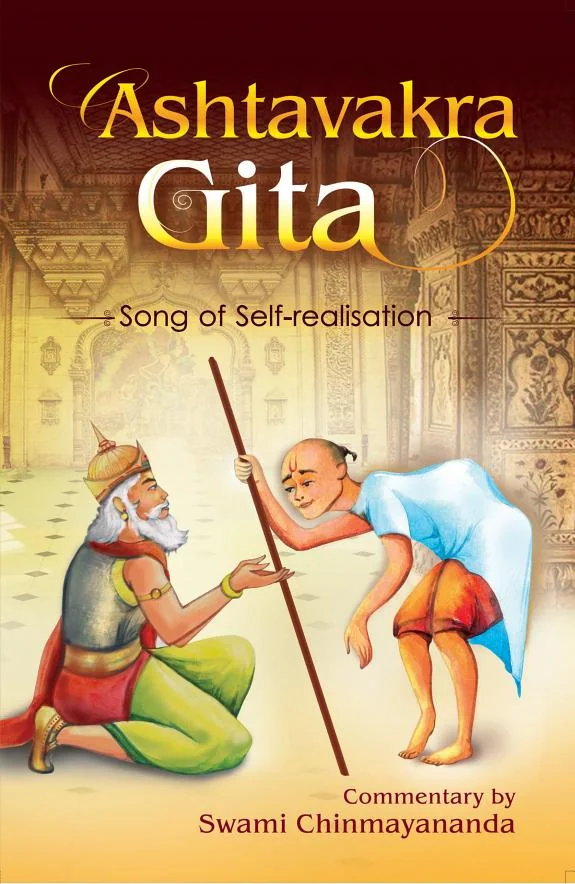
The Ashtavakra Gita presents a stark dialogue on non-dual reality between sage Ashtavakra and King Janaka.
This scripture details a conversation where the sage Ashtavakra instructs King Janaka on the nature of the self and the world. It is considered a central text in Advaita Vedanta, explaining non-dual existence directly. The book is structured as a dialogue, with Ashtavakra conveying deep spiritual understanding to Janaka, who symbolizes a seeker ready for ultimate spiritual insight.
The Ashtavakra Gita addresses advanced practitioners of meditation and those seeking liberation who have completed initial spiritual work. It speaks to individuals with a strong background in philosophical thought, prepared to examine the self and reality. The dialogue's intensity and directness are suited for a mind ready for self-inquiry and disengagement from worldly views.
Attributed to the sage Ashtavakra, the text originates from ancient India, likely from the Vedic or early Upanishadic era, though its exact dating is uncertain. It arose within a philosophical environment that also produced the Bhagavad Gita and the Upanishads, offering a unique perspective on Brahman and Atman. Its ideas influenced various Vedanta schools and later mystics focused on non-dualism.
The Ashtavakra Gita is a significant scripture within the Advaita Vedanta tradition of Hinduism. It articulates a philosophy of non-duality, asserting that consciousness (Brahman) is the only reality and is identical with the individual self (Atman). The text emphasizes that liberation comes through direct knowledge of this truth, not through actions or devotion alone. Its direct, uncompromising approach to self inquiry and the dismantling of perceived reality places it among texts that challenge conventional understanding of existence.
💡 Why Read This Book?
• Gain a direct confrontation with the non-dual nature of reality as presented in the Ashtavakra Gita, moving beyond conceptual understanding to experiential realization, particularly through the dialogue between Ashtavakra and King Janaka. • Understand the Advaita Vedanta concept of *Brahman* and *Atman* as elucidated in this ancient scripture, learning how the text argues for their identity and the implications for the perceived self. • Explore the practice of detachment and the dissolution of ego as detailed in the Ashtavakra Gita, offering methods to recognize the illusory nature of the phenomenal world and achieve inner freedom.
⭐ Reader Reviews
Honest opinions from readers who have explored this book.
❓ Frequently Asked Questions
When was the Ashtavakra Gita first published in Swami Chinmayananda's translation?
Swami Chinmayananda's edition of the Ashtavakra Gita was first published on March 21, 2018. This edition aims to make the ancient wisdom accessible to a contemporary audience interested in Advaita Vedanta.
Who are the main characters in the Ashtavakra Gita?
The primary figures are the sage Ashtavakra, who imparts spiritual wisdom, and King Janaka, the disciple who receives this knowledge. Their dialogue forms the core of the scripture.
What is the central philosophy of the Ashtavakra Gita?
The central philosophy is Advaita Vedanta, emphasizing non-duality, meaning that all existence is ultimately one reality (Brahman), and the individual self (Atman) is identical to this ultimate reality.
Is the Ashtavakra Gita a religious text or a philosophical one?
It is deeply rooted in the spiritual traditions of India and can be considered both a religious and a philosophical text. It presents metaphysical truths from a spiritual perspective, aiming for liberation.
What does the name 'Ashtavakra' mean?
Ashtavakra literally translates to 'eight bends' or 'eight deformities', referring to the sage's physical condition due to a curse, symbolizing the transcendence of the physical form in spiritual realization.
How does the Ashtavakra Gita differ from the Bhagavad Gita?
While both are seminal Hindu scriptures, the Ashtavakra Gita is more direct and aphoristic in its presentation of non-dualism, focusing solely on the nature of reality and liberation, whereas the Bhagavad Gita includes more discussion on duty and action.
🔮 Key Themes & Symbolism
The Nature of Reality
The text posits that reality is singular, unchanging consciousness, referred to as Brahman. The perceived universe of multiplicity and change is deemed illusory, a projection onto this singular, absolute existence. The dialogue systematically deconstructs the illusion of the separate self and the external world, guiding the reader toward the direct apprehension of this fundamental unity. This theme is central to understanding the Advaita Vedanta perspective presented.
The Liberated State
A core theme is the description of the *jivanmukta*, the one who is liberated while still living. This state is characterized by profound peace, equanimity, and freedom from the dictates of the mind and ego. The text portrays the liberated individual as one who perceives the world as a play, acting without attachment or aversion, fully established in the knowledge of their true, non-dual nature.
The Illusion of Ego
The Ashtavakra Gita relentlessly attacks the concept of the ego as a fundamental misunderstanding of the self. It argues that the 'I' we identify with—the doer, experiencer, and owner—is a construct superimposed upon the pure consciousness. By recognizing the ego as a transient phenomenon, the text aims to dismantle the root cause of suffering and bondage.
Detachment and Renunciation
While not advocating for physical renunciation in all cases, the text emphasizes mental detachment from worldly objects, experiences, and outcomes. True renunciation, as presented, is an inner state of non-identification with the transient phenomena of existence. This detachment is presented as the direct path to inner freedom and lasting bliss, irrespective of external circumstances.
💬 Memorable Quotes
Direct passages from the work, attributed to the author.
“The world is a projection of the mind.”
— This statement captures the text's view of Maya, suggesting that our perception of reality is shaped by our mental constructs and conditioning, implying that liberation involves transcending these mental frameworks.
“Know thyself to be pure consciousness, unbound and free.”
— This is a direct instruction to realize one's true nature as Atman, identical to Brahman. It signifies a state beyond the limitations of the body, mind, and ego, emphasizing inherent freedom.
“Attachment is the cause of suffering; detachment is the cause of liberation.”
— This highlights the practical application of the non-dual philosophy, positing that clinging to transient experiences and possessions leads to distress, while non-attachment opens the door to freedom.
“The sage sees the world as an illusion, yet acts within it.”
— This describes the paradox of the liberated individual, who understands the ultimate unreality of the phenomenal world but continues to function within its framework with equanimity and wisdom.
“Peace is found within, not in external circumstances.”
— This emphasizes the internal locus of happiness and contentment, directing the seeker away from the pursuit of external validation or possessions towards the realization of inner stillness.
🌙 Esoteric Significance
Tradition
The Ashtavakra Gita is a cornerstone text of Advaita Vedanta, a major school within the broader Vedic and Hindu traditions. It expounds the principle of non-duality (Advaita) with exceptional clarity and directness. While firmly rooted in Vedic philosophy, its radical emphasis on direct realization and the illusory nature of the manifest world positions it as a profound esoteric scripture, guiding seekers towards an experiential understanding of ultimate truth beyond dogma.
Symbolism
The sage Ashtavakra himself, with his eight physical deformities, symbolizes the transcendence of the physical form. The dialogue structure represents the seeker's journey from ignorance to knowledge. King Janaka, a royal ascetic, embodies the ideal practitioner who can integrate spiritual wisdom into worldly life without being bound by it. The concept of *akasha* (space) is often used analogously to pure consciousness, vast, formless, and all-pervading, yet unaffected by what it contains.
Modern Relevance
Contemporary Advaita Vedanta teachers and practitioners frequently reference the Ashtavakra Gita as a primary source for understanding non-dual awareness. It influences modern mindfulness and meditation movements that explore consciousness and the nature of self. Thinkers in consciousness studies and comparative philosophy also engage with its metaphysical claims regarding the relationship between mind and reality, finding resonance with certain strands of Western philosophy and psychology.
👥 Who Should Read This Book
• Advanced students of Advaita Vedanta seeking to deepen their understanding of non-dual reality through direct scriptural exposition. • Practitioners of meditation and self-inquiry who are ready to confront the nature of ego and illusion as presented in ancient Indian philosophy. • Scholars of comparative religion and philosophy interested in foundational texts that explore consciousness, metaphysics, and liberation.
📜 Historical Context
The Ashtavakra Gita emerged from the vibrant intellectual field of ancient India, a period rich with philosophical inquiry that also produced the Upanishads and the Bhagavad Gita. While exact dating is elusive, its teachings align closely with the development of Advaita Vedanta, a non-dualistic school of thought. It was likely composed during the period when concepts of Brahman and Atman were being rigorously debated and systematized. The text presents a stark, uncompromising vision of non-duality, perhaps in contrast to more ritualistic or karma-centric perspectives prevalent at the time. Its influence can be traced through various Vedanta lineages, and it served as a significant text for later ascetics and scholars exploring the nature of ultimate reality. It stands as a proof of the deep philosophical currents that sought to understand consciousness and existence.
📔 Journal Prompts
The concept of the world as a mind-projection: How does this relate to your personal experiences of reality?
Ashtavakra's description of the liberated sage: What qualities stand out, and how might they be cultivated?
The ego as an illusion: Explore moments where you strongly identified with your ego and analyze the underlying assumptions.
The practice of detachment: How can observing phenomena without attachment be applied to a specific challenging situation in your life?
The realization of pure consciousness: Reflect on any experiences, however fleeting, that hint at a reality beyond the individual self.
🗂️ Glossary
Advaita Vedanta
A school of Hindu philosophy that emphasizes the oneness (Advaita) of the individual soul (Atman) and the ultimate reality (Brahman), asserting that all existence is ultimately non-dual.
Brahman
The ultimate, unchanging reality or cosmic consciousness that underlies all existence; the absolute principle.
Atman
The individual self or soul, which, according to Advaita Vedanta, is identical to Brahman.
Maya
The cosmic illusion that obscures the true nature of reality, causing the perception of multiplicity and individuality where only unity exists.
Jivanmukta
One who has attained liberation (moksha) while still living in the physical body; a liberated sage.
Akasha
Literally 'space' or 'ether'. In philosophical contexts, it can refer to the primordial substance from which all things arise or, analogously, to pure consciousness.
Ego
The sense of individual selfhood, the 'I'-ness, which the text identifies as a construct and the root of bondage and suffering.
This book appears in 1 collection
🔮 Readers Also Liked
Browse all →







From the “Vedanta” Collection
View all →






More Free Sacred Texts & Gnosticism Books
View all →