The Dark Night of the Soul

 77
77

The Dark Night of the Soul
Saint John of the Cross’s treatise offers a starkly honest depiction of the spiritual path. The central metaphor of the "dark night" is powerfully rendered, moving beyond simple metaphor to describe a lived, often agonizing, process of divine purification. The book’s strength lies in its unvarnished portrayal of spiritual desolation as a necessary precursor to union with the Divine. However, its dense theological language and the specific context of 16th-century Carmelite reform can present a significant barrier for modern readers unfamiliar with scholastic theology. The passage describing the "night of the spirit" as a "privation of all sensible and spiritual goods" effectively captures the book's challenging yet rewarding nature. It is a demanding but essential text for serious contemplatives.
📝 Description
77
Saint John of the Cross wrote "The Dark Night of the Soul" around 1578, detailing a spiritual purification process.
This text by Saint John of the Cross, a 16th-century Spanish Carmelite friar, outlines a theological and mystical path toward divine union. It describes a rigorous process of purification, marked by distinct stages. The book is not a narrative but a guide, explaining the soul's difficult yet ultimately fulfilling passage through periods of spiritual desolation and detachment. It is an important work for understanding Christian mysticism and its contemplative practices.
Individuals engaged in deep spiritual inquiry, especially within Christian contemplative traditions, will find this book relevant. It is suited for those seeking to comprehend the challenging phases of spiritual growth, often referred to as periods of dryness or doubt. Readers should be prepared to confront internal struggles and commit to a disciplined inner life. Scholars of religious history, theology, and esoteric philosophy will also find value here.
Saint John of the Cross wrote "The Dark Night of the Soul" during Spain's Counter-Reformation, a time of significant religious and political change. He co-founded the Discalced Carmelites with Teresa of Ávila. His writings, including this one, were often composed under difficult conditions, sometimes while imprisoned. The work appeared within a strong tradition of Spanish mystical literature, though it also faced scrutiny from religious authorities, leading to its posthumous publication and eventual wide recognition.
💡 Why Read This Book?
• Learn about the "night of the senses," a specific purification process detailed by Saint John of the Cross, which helps identify and detach from worldly dependencies. • Understand the "night of the spirit," a more advanced stage of spiritual trial where the intellect and will are surrendered, offering a unique perspective on faith beyond intellectual certainty. • Gain insight into the Carmelite spiritual tradition, as Saint John of the Cross, a co-founder of the Discalced Carmelites, articulates a path toward divine union distinct from other mystical approaches.
⭐ Reader Reviews
Honest opinions from readers who have explored this book.
❓ Frequently Asked Questions
When was The Dark Night of the Soul first published?
While Saint John of the Cross lived in the 16th century, The Dark Night of the Soul was first published posthumously in 1618, several decades after his death in 1591.
What is the primary purpose of the "dark night" as described by St. John of the Cross?
The "dark night" is described as a necessary process of purification, designed to detach the soul from imperfections and prepare it for union with God by purging sensory and spiritual attachments.
Who was Saint John of the Cross and what was his role in the Carmelite Order?
Saint John of the Cross was a Spanish mystic and Carmelite friar who, along with Teresa of Ávila, initiated the reform of the Carmelite Order, leading to the establishment of the Discalced Carmelites.
Does The Dark Night of the Soul offer practical exercises for spiritual growth?
While primarily a theological and mystical exposition, the book's descriptions of purification imply practical disciplines of detachment, contemplative prayer, and surrender, guiding the reader's inner work.
Is The Dark Night of the Soul considered part of Christian mysticism?
Yes, it is a foundational text within Christian mysticism, particularly for the Spanish school of mystics in the 16th century, and is widely studied for its systematic approach to the contemplative life.
What is the relationship between St. John of the Cross and Teresa of Ávila?
Saint John of the Cross and Teresa of Ávila were key figures in the 16th-century reform of the Carmelite Order. They collaborated closely on establishing the Discalced Carmelites and influenced each other's spiritual writings.
🔮 Key Themes & Symbolism
The Two Dark Nights
The work meticulously details two distinct phases of spiritual purification. The first, the "night of the senses," involves actively weaning the soul away from reliance on sensory experiences and worldly comforts. This stage prepares the ground for deeper spiritual work. The second, the "night of the spirit," is a more passive, often harrowing phase where the soul must surrender its intellectual faculties and will, enduring a profound sense of God's absence to achieve a more complete and unconditional union.
Divine Union and Love
At the heart of the text lies the pursuit of unitive love, a state of profound communion with the Divine. Saint John of the Cross frames the arduous journey through the dark nights not as an end in itself, but as the essential crucible through which the soul is refined and made capable of receiving God's transformative love. This union is depicted as the ultimate fulfillment of the soul's deepest longing, achieved through complete surrender and a love that transcends all earthly understanding.
Detachment and Surrender
Central to the spiritual path described is the concept of detachment from all created things, including one's own spiritual consolations and intellectual certainties. This is not nihilism, but a radical reorientation of the will towards God alone. The "surrender" mentioned is a profound act of faith, trusting in God's hidden work even when the soul experiences profound emptiness or dryness. This active letting go is seen as the key to unlocking deeper spiritual realities.
The Role of Faith and Hope
The dark nights fundamentally test and refine the theological virtues of faith and hope. In the absence of sensory or spiritual consolations, the soul must rely solely on faith in God's unseen presence and promises. Hope is sustained not by expectation of immediate relief, but by an unwavering trust in God's ultimate plan for union. The work explores how these virtues are strengthened through trials, becoming the bedrock of the soul's journey towards the Divine.
💬 Memorable Quotes
Direct passages from the work, attributed to the author.
“To come to the enjoyment of all, desire the enjoyment of none.”
— This aphorism captures the essence of detachment central to the "night of the senses." It suggests that by relinquishing the pursuit of specific gratifications, one opens oneself to a more universal, divine fulfillment.
“The soul that is attached to anything, however much, cannot advance.”
— This statement directly addresses the necessity of detachment for spiritual progress. It implies that any form of attachment, whether to material possessions, relationships, or even spiritual experiences, acts as an impediment to deeper union with God.
“The dark night is a purification of the soul.”
— This concise interpretation defines the core function of the dark night. It frames these difficult spiritual periods not as punishment, but as a divinely ordained process essential for cleansing the soul.
“God's love is the motive of the whole spiritual journey.”
— This highlights the foundational role of Divine Love. It posits that the entire endeavor of spiritual growth, including the challenging phases, is ultimately initiated and sustained by God's own loving desire for union with the soul.
💡 Key Ideas
Editorial paraphrase of the work's core concepts — not direct quotes.
In the evening of life, I shall be judged on my love.
This quote highlights the ultimate criterion for spiritual evaluation. It emphasizes that the quality and depth of one's love for God and neighbor, cultivated throughout life's journey, is the primary measure of spiritual progress.
🌙 Esoteric Significance
Tradition
While rooted in Catholic theology, The Dark Night of the Soul is a central to Christian mysticism and profoundly influential in broader Western esoteric traditions. It provides a systematic, albeit severe, map for the initiatory path toward divine union. Its emphasis on the purgative way and the soul's active cooperation with divine grace aligns with alchemical principles of purification and transformation, presenting a spiritual alchemy of the soul rather than the material.
Symbolism
The central symbol is the "dark night," representing the soul's journey through spiritual desolation and purification. It symbolizes a descent into the unknown, mirroring alchemical processes of dissolution and mortification, where the ego and sensory attachments are broken down. Another motif is the "naked soul," stripped of all supports and comforts, signifying radical trust and surrender, essential for spiritual transformation and union.
Modern Relevance
Contemporary seekers in various contemplative and psychological fields draw upon St. John's work. Psychospiritual therapists and mindfulness practitioners often reference the "dark night" to describe periods of existential crisis or spiritual dryness. Esoteric schools, particularly those focused on inner transformation and the rigorous pursuit of consciousness, find value in its unflinching portrayal of the challenges inherent in spiritual development and the necessity of profound inner work.
👥 Who Should Read This Book
• Dedicated practitioners of Christian contemplative prayer seeking to understand and navigate phases of spiritual desolation and purification. • Students of comparative mysticism interested in the rigorous paths to divine union found within Western traditions. • Advanced seekers of inner transformation who are prepared for a challenging, textually dense exploration of detachment and surrender.
📜 Historical Context
Written in the latter half of the 16th century, Saint John of the Cross's The Dark Night of the Soul emerged during Spain's Counter-Reformation, a period marked by intense Catholic reform and intellectual rigor. He was a central figure in the Discalced Carmelite reform, initiated alongside Teresa of Ávila, which sought a return to a more austere and contemplative form of religious life. This movement ran counter to established interests, leading to internal conflict and even imprisonment for John himself. His writings, including this treatise, were composed within a vibrant Spanish mystical tradition that included contemporaries like Luis de Granada. However, the radical nature of his ascetic theology and emphasis on divine union through profound detachment attracted scrutiny, leading to its posthumous publication in 1618, after his death in 1591.
📔 Journal Prompts
The "night of the senses" as a concept for evaluating personal attachments.
Reflecting on the potential spiritual value of experiencing God's perceived absence.
The soul's capacity for "surrender" beyond intellectual understanding.
Identifying personal "attachments" that hinder spiritual progress.
The role of "divine union" as the ultimate aim of spiritual discipline.
🗂️ Glossary
Night of the Senses
The initial stage of spiritual purification where the soul detaches from sensory pleasures, worldly attachments, and the habitual reliance on the senses for spiritual experience.
Night of the Spirit
A more advanced and profound stage of purification involving the detachment of the spirit from intellectual concepts, spiritual consolations, and the will's own desires, leading to a passive union with God.
Divine Union
The ultimate goal of the spiritual life, described as a profound communion and transformation where the soul's will is perfectly aligned with God's will.
Detachment
The voluntary renunciation of attachment to created things, including one's own spiritual comforts and intellectual understandings, in favor of seeking God alone.
Spiritual Nullity
A state experienced during the dark night, characterized by a profound sense of emptiness, dryness, and the apparent absence of God's presence or spiritual consolation.
Theological Virtues
Faith, Hope, and Charity (Love), which are seen as divinely infused qualities essential for the soul's journey toward God and perfected through spiritual trials.
Discalced Carmelites
A reformed branch of the Carmelite Order, founded by Saint Teresa of Ávila and Saint John of the Cross, emphasizing austerity and contemplative prayer.
This book appears in 1 collection
🔮 Readers Also Liked
Browse all →




From the “Dark Night of the Soul” Collection
View all →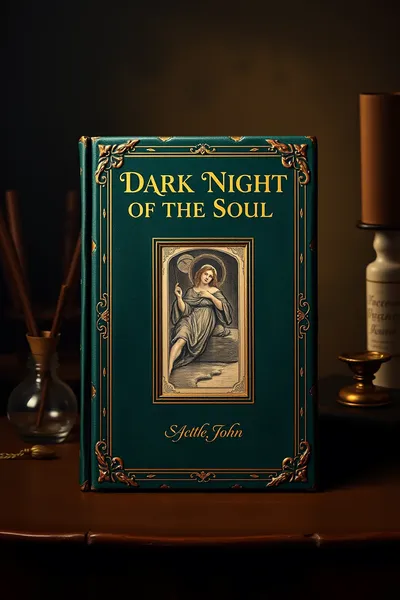








More Free Sacred Texts & Gnosticism Books
View all →