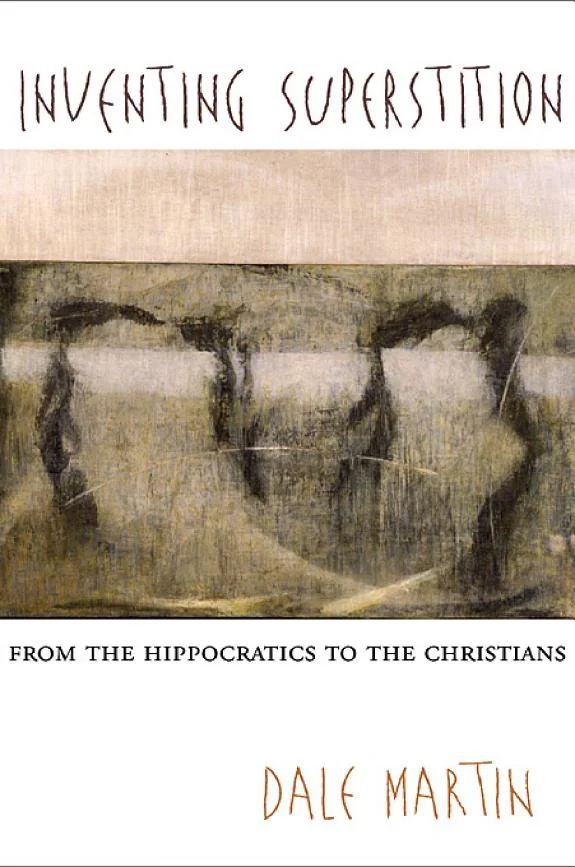
Inventing Superstition
 82
82

Inventing Superstition
Dale B. Martin’s *Inventing Superstition* is a rigorous examination of how a word came to define a category of belief. The book excels in its meticulous tracking of the term 'superstition' from its classical Latin roots, particularly its use by figures like Cicero, to its later appropriation and redefinition within Christian discourse. Martin effectively demonstrates that 'superstition' was not an inherent quality of a belief but a label applied by those in power to distinguish their own accepted practices from those of others. A notable strength is the analysis of how Christian authors, such as Lactantius, utilized the existing terminology to condemn pagan rites. If there's a limitation, it's that the focus remains primarily on the linguistic and conceptual history, with less emphasis on the lived experience of those labeled as superstitious. Nevertheless, the work provides a crucial intellectual genealogy for understanding how religious difference has been historically policed through labeling.
📝 Description
82
Dale B. Martin's Inventing Superstition traces the concept of 'superstition' from antiquity to the 4th century C.E.
Dale B. Martin's Inventing Superstition examines how the very idea of 'superstition' came to be defined and used. The book follows the term's journey from its first appearances in classical Greece and Rome, through its adaptation and transformation in the Christianized Roman Empire. Martin focuses on the period from the Roman Republic up to the 4th century C.E., a time of dramatic change in religious and philosophical outlooks.
The study pays close attention to the shifting meanings of Greek and Latin words such as 'deisidaimonia' and 'superstitio.' It shows how these terms were employed to label and dismiss certain religious practices, thereby helping to establish dominant beliefs. This historical analysis reveals how anxieties surrounding different belief systems were shaped and passed down through generations.
While not strictly an esoteric text itself, Inventing Superstition engages with the historical construction of what counts as 'superstition.' This is relevant to esoteric traditions that have often been labeled as such by dominant religious or philosophical systems. By examining how terms of belief and practice were historically categorized and condemned, the book sheds light on the social and intellectual mechanisms that have historically excluded alternative spiritual or intellectual paths.
💡 Why Read This Book?
• Understand how the label 'superstition' originated and evolved, particularly its transition from classical usage to Christian polemics, offering a critical lens on religious categorization. • Gain insight into the intellectual landscape of the Roman Empire up to the 4th century C.E., specifically how figures like Cicero and Lactantius debated and defined religious practices. • Learn how cultural anxieties and the establishment of religious orthodoxy shaped the very vocabulary used to describe belief systems, challenging simplistic notions of what constitutes 'superstition'.
⭐ Reader Reviews
Honest opinions from readers who have explored this book.
❓ Frequently Asked Questions
When was Dale B. Martin's Inventing Superstition first published?
Dale B. Martin's *Inventing Superstition* was first published on July 1, 2009. It provides a detailed history of the concept of superstition over eight centuries.
What is the primary focus of Inventing Superstition?
The book's primary focus is the genealogy of the idea of superstition, tracing its historical development from classical Greece to the Christianized Roman Empire of the fourth century C.E.
Which historical periods does Inventing Superstition cover?
The work covers a span of eight centuries, from classical Greece and the Roman Republic through to the Christianized Roman Empire of the fourth century C.E.
What ancient Greek or Roman terms does the book analyze?
The book analyzes terms like 'deisidaimonia' (Greek) and 'superstitio' (Latin), exploring their semantic shifts and how they were used to categorize beliefs.
Who would benefit from reading Inventing Superstition?
Scholars of ancient religion, classical studies, the history of ideas, and anyone interested in how religious beliefs are historically categorized and marginalized would benefit.
Does the book discuss specific religious practices labeled as superstition?
Yes, the book discusses how classical and later Christian authors used the term 'superstition' to marginalize certain religious practices, particularly those outside their own accepted norms.
🔮 Key Themes & Symbolism
The Shifting Meaning of 'Superstition'
This work meticulously unpacks how the very concept of 'superstition' is a historical construct. Martin demonstrates that the term was not static but evolved significantly, particularly as it moved from the philosophical discourse of classical Greece and Rome into the theological debates of the emerging Christian empire. The book highlights how 'superstition' often served as a tool to differentiate accepted religious practice from perceived deviance, a label applied by dominant groups to minority or older beliefs.
Classical Roots of Religious Critique
Martin traces the origins of classifying certain beliefs as problematic back to classical antiquity. He examines how Greek and Roman thinkers discussed 'deisidaimonia' and 'superstitio,' often in relation to excessive or inappropriate religious observance. This section provides the foundational understanding for how later Christian authors would inherit and adapt this critical framework, setting the stage for centuries of theological polemic and the marginalization of non-normative religious expressions.
Christianization and Labeling
A crucial aspect of the book is its exploration of the fourth century C.E., a period marked by the increasing influence and eventual dominance of Christianity within the Roman Empire. Martin shows how Christian writers adopted and repurposed classical terminology to condemn pagan rites and establish their own theological boundaries. This process of labeling became instrumental in solidifying Christian orthodoxy by defining what fell outside its acceptable parameters, effectively inventing 'superstition' as a category of the other.
The Social Function of Belief Labels
Beyond mere etymology, *Inventing Superstition* reveals the social and political functions of labeling beliefs. The term 'superstition' was not neutral; it carried implications of error, irrationality, and even danger. By analyzing how these labels were applied, the book sheds light on the mechanisms of power and control in religious history, demonstrating how defining what is 'superstitious' is intrinsically linked to establishing and maintaining religious authority.
💬 Memorable Quotes
Direct passages from the work, attributed to the author.
“The term 'superstition' was often used to criticize beliefs and practices deemed excessive or misdirected.”
— This interpretation highlights how the label 'superstition' historically functioned not as an objective descriptor but as a critical judgment, often applied to religious expressions that deviated from perceived norms or were seen as overly zealous.
“Christian authors adapted classical terms to define and reject pagan religious practices.”
— This interpretation captures the essence of how early Christian writers engaged with existing Greco-Roman vocabulary to construct their own theological boundaries, effectively using inherited language to marginalize competing religious traditions.
“The categorization of beliefs as 'superstitious' served to establish the legitimacy of dominant religious frameworks.”
— This concept emphasizes the power dynamics inherent in religious discourse. By labeling certain beliefs as superstitious, dominant religious groups solidified their own legitimacy and delineated the boundaries of acceptable faith.
💡 Key Ideas
Editorial paraphrase of the work's core concepts — not direct quotes.
The meaning of 'superstitio' shifted from concerns about oath-breaking and ill omens in earlier Roman thought.
This paraphrased concept points to the semantic evolution of the term 'superstitio,' indicating that its early Roman usage was tied to specific anxieties about divine retribution and omens, distinct from its later, broader application.
The study traces the concept from classical Greece to the 4th-century Christian Roman Empire.
This paraphrased concept provides a clear chronological and geographical scope for the book's central argument, outlining the historical trajectory of the idea of superstition across key cultural and religious transitions.
🌙 Esoteric Significance
Tradition
While *Inventing Superstition* is primarily a work of historical and religious studies, its examination of how belief systems are categorized and marginalized holds relevance for esoteric traditions. Esoteric paths often operate outside dominant religious orthodoxies and have themselves historically been labeled as superstitious or heretical. The book provides a framework for understanding the historical mechanisms used to delegitimize alternative spiritualities, offering a critical lens for practitioners to understand their own historical positioning.
Symbolism
The book does not focus on overt esoteric symbolism but rather on the symbolic weight of language itself. The terms 'deisidaimonia' and 'superstitio' function as potent symbols of otherness and deviance within religious discourse. Their evolution represents the symbolic power of labels to construct and deconstruct religious identities, marking boundaries between accepted practice and that which is deemed erroneous or dangerous.
Modern Relevance
Contemporary thinkers and practitioners in fields ranging from comparative religion to critical theory can draw on Martin's work. Those involved in studying New Age movements, modern paganism, or alternative spiritualities can use the book's insights to analyze how contemporary beliefs are similarly categorized or dismissed. The work's genealogical approach offers a methodological tool for deconstructing the historical roots of present-day religious prejudice and labeling.
👥 Who Should Read This Book
• Scholars of Classics and Ancient History: Gain a precise understanding of how terms like 'superstitio' functioned in Roman discourse and how their meanings were transformed by Christian writers. • Students of Religious Studies: Develop a critical framework for analyzing the historical construction of religious categories and the power dynamics inherent in labeling beliefs. • Researchers of Western Esotericism: Understand the historical precedents for marginalized spiritual paths being labeled as 'superstitious,' providing context for their own traditions.
📜 Historical Context
Dale B. Martin's *Inventing Superstition* emerged in 2009, a time when the history of religions and the study of ancient worldviews were increasingly focused on nuanced analyses of power, categorization, and cultural exchange. The book engages with the intellectual currents of classical studies and the history of Christianity, building upon scholarship that examined the formation of religious identities in the Roman Empire. Key contemporaries in the study of Roman religion and early Christianity, such as Ramsay MacMullen and Peter Brown, explored the social and cultural shifts of this period, though Martin's specific focus on the genealogy of 'superstition' offered a distinct linguistic and conceptual history. The work's detailed tracing of 'deisidaimonia' and 'superstitio' provides a crucial counterpoint to studies that might assume these categories were stable or universally understood throughout antiquity.
📔 Journal Prompts
The classical origins of 'deisidaimonia' and its implications for early Christian thought.
The semantic evolution of 'superstitio' from Roman antiquity to the 4th century C.E.
How Christian authors like Lactantius employed existing terminology to define orthodoxy.
The social function of labeling beliefs as 'superstitious' in historical contexts.
Analyzing modern instances where belief systems are critically labeled using similar historical mechanisms.
🗂️ Glossary
Deisidaimonia
A Greek term often translated as 'fear of the gods' or 'superstition.' It carried a range of connotations in ancient Greek thought, from excessive fear to misplaced reverence.
Superstitio
A Latin term that evolved in meaning. Initially related to awe or excessive fear of the gods, it later became a more pejorative label for beliefs and practices considered erroneous or irrational.
Genealogy
In this context, the study of the origin and historical development of a concept or idea, tracing its lineage and transformations over time, as opposed to a simple definition.
Orthodoxy
The formally accepted body of beliefs and doctrines within a particular religion or school of thought. The book examines how 'superstition' was used to define and police orthodoxy.
Paganism
A broad term used historically, particularly by Christians, to refer to polytheistic or indigenous religions of peoples outside the major monotheistic traditions. The book discusses how these were often labeled as superstitious.
Semantic Shift
The change in the meaning of a word or phrase over time. The book details significant semantic shifts in terms related to superstition.
Polemic
A strong verbal or written attack on someone or something. The book analyzes religious polemics where 'superstition' was a key term of denigration.
This book appears in 1 collection
🔮 Readers Also Liked
Browse all →









From the “Superstition” Collection
View all →







More Free Sacred Texts & Gnosticism Books
View all →