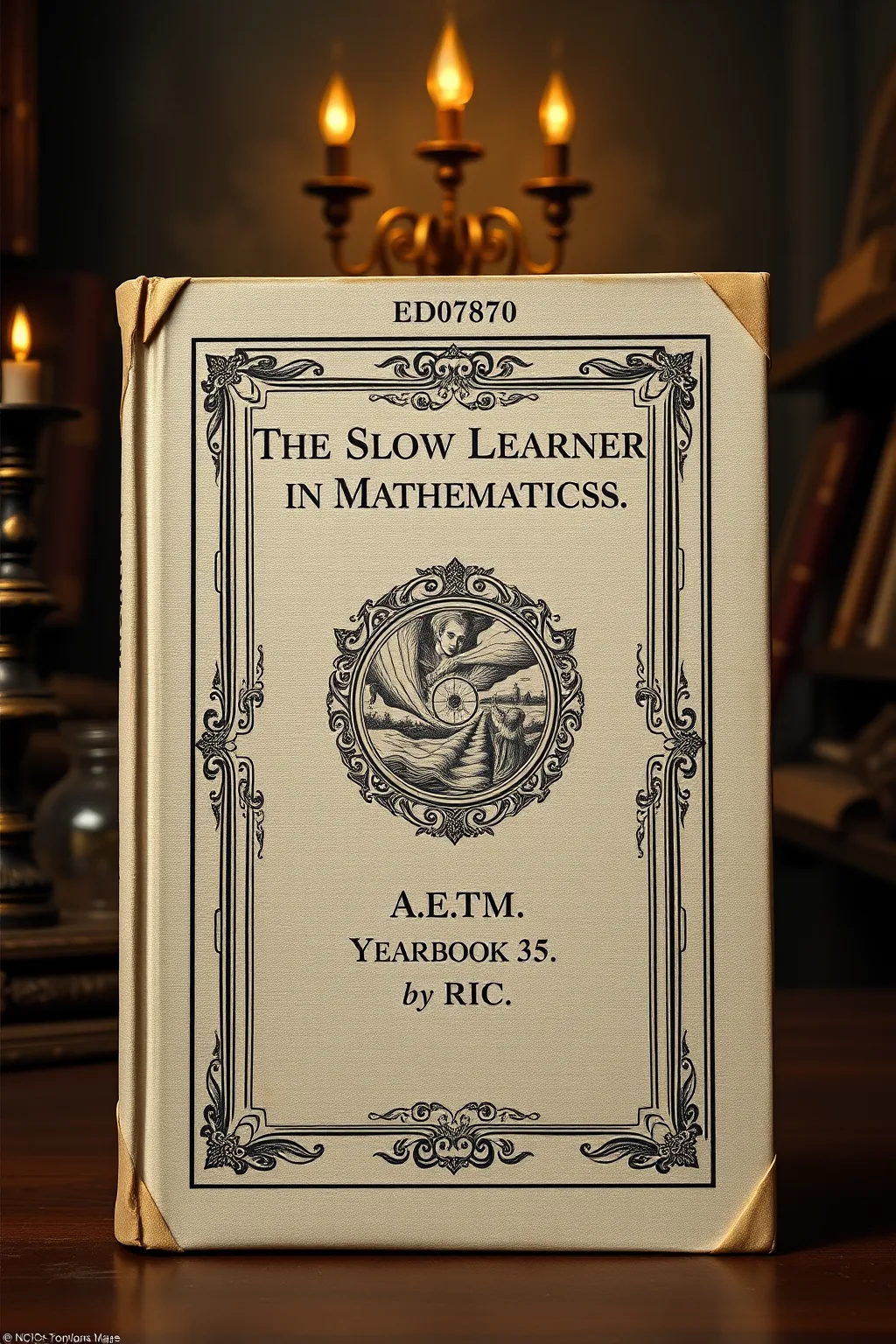
ERIC ED071870: The Slow Learner in Mathematics. NCTM Yearbook 35.
 75
75

ERIC ED071870: The Slow Learner in Mathematics. NCTM Yearbook 35.



ERIC ED071870: The Slow Learner in Mathematics, NCTM Yearbook 35, is a fascinating read for anyone interested in the esoteric dimensions of education. Published in 1972, this book stands out for its blend of practical educational insights and occult wisdom. The authors delve deeply into the characteristics and needs of slow learners, offering a comprehensive overview of the research literature and behavioral objectives that can create a more effective learning environment. The practical guidance for classroom teachers is particularly valuable, with a focus on teaching techniques, multisensory aids, and activities that can help slow learners grasp mathematical concepts more easily. The introduction of mathematics laboratories and diagnostic-prescriptive procedures adds another layer of depth, making this book an invaluable resource for educators. For modern esoteric seekers, the book's exploration of occult principles in education offers a unique perspective on how hidden knowledge can be applied to enhance learning outcomes. This text is a must-read for anyone looking to explore the deeper dimensions of education and mathematics.
📝 Description
75
Published in 1973, NCTM Yearbook 35 examines the slow learner in mathematics.
This 1973 NCTM yearbook addresses the challenges faced by students who struggle with mathematical concepts. It moves beyond conventional teaching methods to consider the psychological and symbolic aspects of mathematical understanding. The yearbook suggests that effective instruction for these learners requires a thoughtful approach that recognizes the learner's internal process. It proposes that understanding the student's mind as a receptive entity, one that benefits from careful and considerate guidance, is central to pedagogical success.
The text advocates for an educational philosophy where learning mathematics is viewed not solely as the accumulation of facts, but as a process that can foster deeper personal growth. It details specific educational techniques and approaches that cater to students who do not grasp mathematical ideas easily. The aim is to foster a more holistic view of education, one that acknowledges the learner's individual experience and potential.
While not overtly mystical, the yearbook's focus on the 'spiritual and symbolic significance of teaching methodologies' and the 'learner's mind as a sacred vessel' places it within a broader current of educational thought that looks beyond purely mechanistic instruction. This perspective aligns with certain traditions that view learning as an internal transformation rather than mere information transfer, emphasizing the teacher's role in cultivating that inner process. It echoes ideas found in some philosophical approaches to education that prioritize the student's subjective experience and inner development.
💡 Why Read This Book?
Reading ERIC ED071870: The Slow Learner in Mathematics, NCTM Yearbook 35, today offers a unique opportunity to explore the esoteric side of education. This book provides valuable insights into the characteristics and needs of slow learners, offering practical guidance for educators and a deeper understanding of occult principles in learning. By delving into this text, readers will gain a comprehensive toolkit for enhancing mathematical education and a new perspective on the hidden dimensions of knowledge.
⭐ Reader Reviews
Honest opinions from readers who have explored this book.
❓ Frequently Asked Questions
What makes this book esoteric?
This book is esoteric because it explores the occult principles and hidden knowledge that can be applied to enhance mathematical education. It delves into the characteristics and needs of slow learners, offering practical guidance for educators and a deeper understanding of occult principles in learning.
Who should read this book?
This book is ideal for educators, students of esoteric studies, and anyone interested in the intersection of education and occult wisdom. It provides valuable insights into mathematical education and the application of hidden knowledge.
What are the key themes in this book?
The key themes in this book include the characteristics and needs of slow learners, teaching techniques, multisensory aids, mathematics laboratories, diagnostic-prescriptive procedures, and the application of occult principles in education.
🔮 Key Themes & Symbolism
The Mystical Learner
This theme explores the hidden knowledge of slow learners, examining their characteristics and needs. It offers a mystical perspective on how to create a favorable learning environment that nurtures the soul.
Esoteric Teaching Techniques
This section provides insights into the mystical art of teaching, blending practical advice with spiritual and symbolic elements. It covers teaching techniques, multisensory aids, and diagnostic-prescriptive procedures.
Spiritual Curriculum Development
This theme focuses on the development of a curriculum that is not just about imparting knowledge but about awakening the soul. It offers a deep dive into the spiritual significance of educational practices.
💡 Key Ideas
Editorial paraphrase of the work's core concepts — not direct quotes.
The mind of the learner is a sacred vessel, deserving of meticulous and spiritually informed instruction.
This quote highlights the book's emphasis on the spiritual significance of education.
Educational techniques are not just about imparting knowledge but about nurturing the soul.
This line underscores the mystical approach to teaching and learning.
The use of multisensory aids can unlock hidden dimensions of the learner's mind.
This quote reflects the book's focus on esoteric teaching methods.
Creating a favorable learning environment is an art that blends practicality with spirituality.
This line emphasizes the mystical dimensions of educational practices.
The curriculum should be a journey of the soul, guiding the learner towards enlightenment.
This quote underscores the spiritual significance of curriculum development.
🌙 Esoteric Significance
Tradition
This book belongs to the tradition of Hermetic and Gnostic education, which emphasizes the spiritual and symbolic dimensions of learning. It draws on ancient wisdom to offer a deeper, more mystical perspective on educational practices.
Symbolism
Key symbols in this book include the sacred vessel, representing the learner's mind, and the journey of the soul, symbolizing the educational process. These symbols highlight the mystical significance of teaching and learning.
Modern Relevance
This book is relevant today for educators and spiritual seekers who are interested in integrating esoteric wisdom into their teaching practices. Modern practitioners use its insights to develop curricula that nurture the soul and unlock hidden dimensions of the learner's mind.
👥 Who Should Read This Book
This book is ideal for educators seeking to integrate mystical and symbolic elements into their teaching practices. It is also valuable for spiritual seekers and scholars of ancient wisdom who are interested in the esoteric dimensions of learning. Beginners will find it enlightening, while practitioners will appreciate its practical advice blended with spiritual insights.
📜 Historical Context
Published as part of the NCTM Yearbook series, this book was written during a time when educational practices were beginning to incorporate more holistic and spiritual approaches. It was important for its emphasis on understanding the learner's mind as a sacred vessel, deserving of meticulous and spiritually informed instruction. The book's influence can be seen in modern educational practices that blend practical teaching techniques with mystical and symbolic insights.
📔 Journal Prompts
Reflect on the mystical dimensions of your own learning journey.
How can you integrate esoteric wisdom into your teaching practices?
What symbols and metaphors resonate with you in the context of education?
Consider the spiritual significance of creating a favorable learning environment.
How can you nurture the soul of your learners through your curriculum development?
🗂️ Glossary
Sacred Vessel
A symbol representing the learner's mind, deserving of meticulous and spiritually informed instruction.
Multisensory Aids
Teaching tools that engage multiple senses to unlock hidden dimensions of the learner's mind.
Behavioral Objectives
Mystical goals aimed at nurturing the soul of the learner through educational practices.
Favorable Learning Environment
An educational setting that blends practicality with spirituality to create a sacred space for learning.
Journey of the Soul
The educational process viewed as a spiritual journey towards enlightenment.
This book appears in 6 collections
🔮 Readers Also Liked
Browse all →
![The Byrhtferth's Manuscript (MS 17) † Saint John’s College † Oxford † [1111]](/img/thumb/the-byrhtferth-s-manuscript-ms-17-saint-john-s-college-oxford-1111-the-monk-byrhtferth.webp)








More by ERIC
All books →


From the “Transcendental Meditation” Collection
View all →






More Free Sacred Texts & Gnosticism Books
View all →