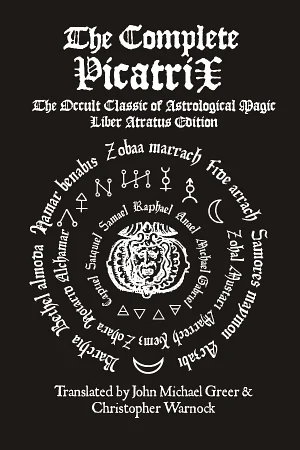
The Complete Picatrix: The Occult Classic of Astrological Magic Liber Atratus Edition
 76
76

The Complete Picatrix: The Occult Classic of Astrological Magic Liber Atratus Edition
The *Picatrix*, in this Liber Atratus edition, delivers on its promise of presenting the complete Latin text with scholarly rigor. Greer and Warnock’s translation and annotations clarify much of the dense, often obscure, astrological and magical theory. The sheer volume of talismans and operations detailed is staggering, offering an unparalleled window into the practical application of astrological magic during the medieval and Renaissance periods. A particular strength lies in the extensive notes, which contextualize the text within broader Hermetic traditions and historical practices. However, the book’s encyclopedic nature can also be its limitation; its sheer density requires significant prior knowledge of astrology and Hermeticism to fully appreciate. A reader might find themselves continually cross-referencing astrological tables or historical texts, a testament to the work's depth but also a barrier to immediate comprehension. The section detailing the construction of lunar talismans, for example, is exceptionally intricate, demanding careful study. This edition is an indispensable resource for dedicated practitioners and scholars seeking direct access to a primary source of Western occultism.
📝 Description
76
The 11th century Arabic *Picatrix* is presented here in its complete four books, translated from Latin.
This edition contains the full Latin text of the *Picatrix*, a significant work on astrological magic translated and annotated by John Michael Greer and Christopher Warnock. It presents an uncensored look at occult practices from the medieval and Renaissance periods. The book details numerous magical procedures, celestial correspondences, and the creation of talismans, all based on a deep understanding of planetary influences and elemental forces. Its content requires a dedicated reader ready to grapple with complex astrological theories and ritualistic methods. Those interested in the historical development of magical traditions and the connections between astrology and philosophy will find this translation especially useful. The work originated in Arabic around the 11th century and gained prominence in Europe after its 13th century Latin translation. It served as a key source for Renaissance magi, including Marsilio Ficino, and influenced occult studies throughout the continent. Its detailed instructions on talismans and celestial magic positioned it at the forefront of esoteric scholarship during a time of great intellectual exploration.
The *Picatrix* operates on the principle that celestial bodies and their alignments affect the earthly world. It includes instructions for magical operations linked to specific planetary hours, astrological strengths, and the fabrication of talismans intended to capture and direct cosmic energies. The text highlights the roles of imagination, divine names, material components, and astrological timing in magical practice.
The *Picatrix* stands as a cornerstone text within Western esotericism, particularly in the tradition of astrological magic. Its roots lie in Arabic occult sciences, which heavily influenced medieval and Renaissance European magical thought. The work bridges theoretical astrology with practical sorcery, detailing how celestial configurations can be harnessed for terrestrial ends. Its emphasis on the construction of talismans and the timing of operations according to planetary hours places it within a lineage of operative magic that sought to manipulate natural and supernatural forces through sympathetic correspondences and ritualistic action.
💡 Why Read This Book?
• Learn the specific methods for constructing talismans, as detailed in Book II of the *Picatrix*, which explains the precise astrological timings and materials needed to imbue them with specific powers. • Understand the philosophical underpinnings of medieval astrological magic, examining how the text connects planetary spheres and divine names to terrestrial operations, as presented throughout the four books. • Gain insight into the historical reception of the *Picatrix*, noting its influence on Renaissance thinkers like Marsilio Ficino, who engaged with its concepts of celestial intelligences and their effects.
⭐ Reader Reviews
Honest opinions from readers who have explored this book.
❓ Frequently Asked Questions
What is the historical origin of the Picatrix?
The *Picatrix* is believed to have originated in Arabic around the 11th century, likely compiled by Maslama al-Majriti, and was later translated into Latin in the 13th century, becoming highly influential in medieval and Renaissance Europe.
What kind of magic is described in the Picatrix?
The *Picatrix* primarily details astrological magic, focusing on the creation of talismans, operative rituals, and natural magic that harness celestial influences, planetary hours, and divine names to achieve specific effects.
Who are the translators and annotators of this edition?
This Liber Atratus edition is translated and annotated by John Michael Greer and Christopher Warnock, noted scholars and practitioners of Western esotericism and astrology.
How does the Picatrix relate to Hermeticism?
The *Picatrix* is a significant text within the Hermetic tradition, exploring the correspondences between the celestial and terrestrial realms, the power of divine names, and the art of magical operation, all central themes in Hermetic philosophy.
Is the Picatrix difficult to understand for beginners?
While comprehensive, the *Picatrix* is a dense and complex work. Its detailed astrological and ritualistic instructions require a foundational understanding of these subjects, making it more suitable for intermediate to advanced students of magic and esotericism.
What makes the Liber Atratus edition special?
The Liber Atratus edition is notable for presenting all four books of the Latin *Picatrix* in a single volume, offering scholarly translations and extensive annotations that clarify its historical and practical context for modern readers.
🔮 Key Themes & Symbolism
Talismanic Magic
The *Picatrix* dedicates substantial portions to the art of creating talismans, meticulously detailing the astrological conditions, materials, and ritualistic procedures required. It explains how to inscribe figures on metals or stones during specific planetary hours and celestial alignments to capture and direct cosmic influences for various purposes, from healing to dominion. This practical focus on tangible magical artifacts makes it a cornerstone text for understanding operative Hermeticism.
Celestial Correspondences
A core principle of the *Picatrix* is the intricate web of correspondences linking the celestial spheres, planets, stars, elements, and earthly phenomena. The text systematically outlines these connections, asserting that understanding and manipulating these links is fundamental to astrological magic. It provides numerous examples of operations tied to specific planetary intelligences and their dominion over plants, stones, and even human actions, reflecting a macrocosm-microcosm worldview.
The Power of Names and Imagination
Beyond astrological timing and material components, the *Picatrix* emphasizes the potent role of divine names and the practitioner's imaginative faculty. It instructs on the recitation of divine names and the visualization of angelic or planetary forms during ritual. This integration of spiritual invocation and mental projection highlights a sophisticated understanding of how consciousness interacts with the subtle energies of the cosmos, a key element in Hermetic magical practice.
Natural and Elemental Magic
The work explores how to work with the inherent virtues of natural substances – plants, minerals, and animal products – in conjunction with astrological timing. It presents methods for preparing elixirs, fumigations, and potions, grounding magical efficacy in the natural world enhanced by celestial forces. This aspect of the *Picatrix* bridges theoretical astrology with tangible, alchemical, and herbal practices, revealing a holistic approach to magic.
💬 Memorable Quotes
Direct passages from the work, attributed to the author.
“The celestial sphere moves the lower sphere, and the lower sphere is moved by the higher.”
— This aphorism captures the fundamental Hermetic principle of correspondence and influence between the heavens and Earth, a core tenet that underpins all the magical operations described in the *Picatrix*.
“The wise man is the master of the stars, not their slave.”
— This statement highlights the agency of the magician within the astrological framework. It suggests that through knowledge and correct application of magical arts, one can consciously direct celestial influences rather than be passively subjected to them.
“Take care that you do not proceed in your work without the proper hour and the proper image.”
— This directive underscores the critical importance of astrological timing and the correct formulation of talismans. It warns against haphazard magical practice, emphasizing precision and adherence to established celestial and symbolic protocols.
“When you wish to make an image, consider the planet whose image you wish to make.”
— This instruction guides the practitioner on the fundamental step of talisman creation: aligning the intention and form of the magical image with the specific planetary intelligence and its associated virtues.
💡 Key Ideas
Editorial paraphrase of the work's core concepts — not direct quotes.
The soul is bound to the body, and the body to the soul, and both are bound to the stars.
This quote reflects a cosmological view where human existence is intrinsically linked to both the material world (body) and the celestial order (stars), implying that magical operations can affect all these interconnected levels.
🌙 Esoteric Significance
Tradition
The *Picatrix* is a central to Western Hermeticism, particularly its operative magical branches. It synthesizes Neoplatonic cosmology, astrological theory, Pythagorean numerology, and the Hermetic emphasis on correspondence between the macrocosm and microcosm. It belongs to the tradition of grimoires that seek to provide practical methods for invoking celestial intelligences and harnessing their powers, bridging philosophical Hermeticism with applied magic.
Symbolism
Key symbols include planetary images and divine names. Planetary images, inscribed on talismans, act as focal points for cosmic energies associated with specific celestial bodies (e.g., Jupiter for fortune, Mars for strength). Divine names, often from Hebrew or Arabic traditions, are invoked to empower these operations, acting as spiritual keys that unlock celestial forces and connect the practitioner to higher intelligences.
Modern Relevance
Contemporary practitioners of Western Esotericism, particularly those involved in ceremonial magic, Hermeticism, and astrological studies, frequently reference the *Picatrix*. It informs modern talismanic arts, ritual design, and the understanding of historical magical practices. Thinkers and groups focusing on the revival of pre-modern magical traditions often draw directly from this text for its detailed operational instructions and philosophical framework.
👥 Who Should Read This Book
• Aspiring practitioners of Western astrological magic seeking a foundational text for understanding talismanic construction and celestial operations. • Historians of medieval and Renaissance Europe interested in the intellectual currents of magic, astrology, and their cross-cultural transmission. • Scholars of esotericism and comparative religion looking for primary source material on operative Hermeticism and pre-modern occult philosophy.
📜 Historical Context
The *Picatrix*, originally written in Arabic around the 11th century and translated into Latin in 1256, represents a key moment in the transmission of esoteric knowledge from the Islamic world to medieval Europe. Its survival and influence owe much to its comprehensive approach to astrological magic, a field that stood in contrast to the emerging scholastic Aristotelianism which often viewed such practices with suspicion or outright condemnation. Figures like Marsilio Ficino, in the 15th century, actively engaged with its principles, incorporating its ideas on planetary influences and talismanic magic into his own Neoplatonic magical philosophy. The text circulated widely in manuscript form, becoming a foundational grimoire for Renaissance magicians and scholars seeking to understand the mechanics of celestial influence and its application in the terrestrial realm, despite occasional ecclesiastical disapproval.
📔 Journal Prompts
The influence of planetary hours on daily actions.
Constructing a simple talisman based on Book II's principles.
The concept of celestial intelligences and their terrestrial effects.
The role of divine names in magical operations.
Comparing the *Picatrix*'s approach to magic with other grimoires.
🗂️ Glossary
Talismans
Magical objects, often inscribed with symbols or figures, that are consecrated under specific astrological conditions to attract and focus celestial influences for a desired purpose.
Planetary Hours
A system where each hour of the day and night is ruled by one of the seven classical planets in a specific sequence, believed to imbue that hour with the planet's particular qualities and influences.
Celestial Sphere
In ancient and medieval cosmology, the outermost sphere of the universe, believed to contain the stars and to be the primary mover of all celestial bodies.
Divine Names
Specific names or invocations, often of divine or angelic beings, used in magical rituals to harness spiritual power and authority.
Hermeticism
A philosophical and religious tradition based on writings attributed to Hermes Trismegistus, emphasizing divine wisdom, the interconnectedness of all things, and the potential for human spiritual ascent.
Operative Magic
A branch of magic focused on practical application and ritualistic procedures to effect changes in the physical or spiritual world, as opposed to purely theoretical or philosophical magic.
Liber Atratus
Literally 'Black Book', this term often refers to editions of occult texts that are comprehensive, scholarly, and may include significant annotations or translations, signifying a serious and complete presentation.
This book appears in 2 collections
🔮 Readers Also Liked
Browse all →







From the “Alchemy” Collection
View all →









More Free Sacred Texts & Gnosticism Books
View all →