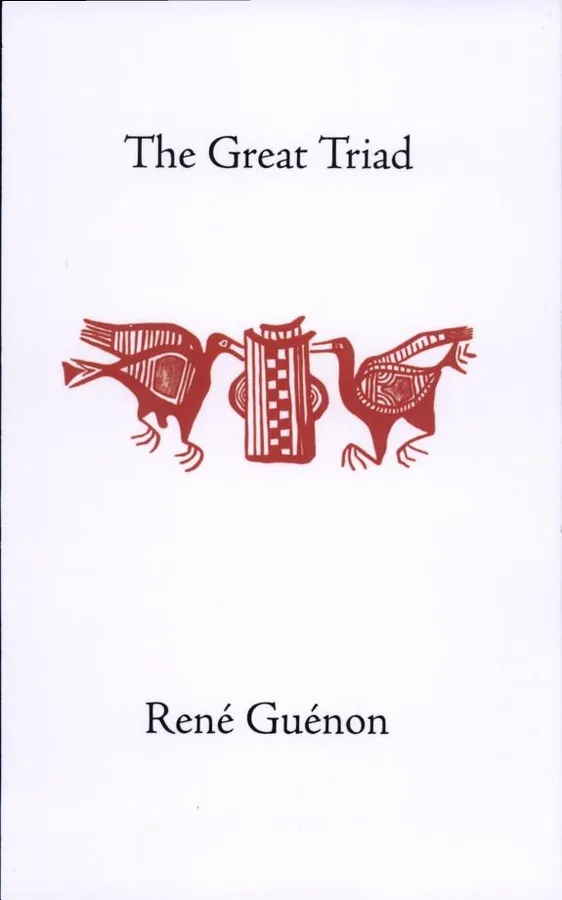
The Great Triad
 74
74

The Great Triad
Guénon’s examination of the Heaven-Man-Earth triad in Chinese cosmology is characteristically austere and intellectually rigorous. He posits Man as the crucial intermediary, tasked with embodying celestial Essence and spiritualizing terrestrial Substance. This is not a book for the casual reader; its dense prose and reliance on specific metaphysical terminology demand focused attention. The strength lies in its systematic deconstruction of a complex cosmological system and its placement within a universal metaphysical framework. A notable limitation, however, is the near absence of explicit engagement with the lived, cultural, or historical manifestations of Chinese thought, focusing instead on abstract principles. For instance, the discussion on Yin and Yang, while metaphysically precise, offers little on their practical application or varied interpretations across Chinese history. The work’s value is in its uncompromising adherence to a traditionalist metaphysical viewpoint, offering a stark contrast to more humanistic or historical analyses of Eastern philosophies. Guénon presents a powerful, albeit stark, vision of cosmic order.
📝 Description
74
René Guénon's 1946 work, The Great Triad, analyzes the Chinese cosmological principle of Heaven-Man-Earth.
Guénon's "The Great Triad" examines the Chinese cosmological structure of Heaven, Man, and Earth. He defines Heaven as pure Essence and Earth as primordial Substance, with Humanity acting as the crucial link. The book argues that humans are meant to manifest divine spirit from Heaven and infuse material reality with spiritual essence.
This ternary structure is placed within a larger context of universal metaphysics. Guénon discusses archetypal dualities, their resolutions, and the celestial-terrestrial axis, drawing connections to other traditions to highlight shared metaphysical ideas. His method is rigorous, aiming to find common principles across different traditions rather than blending them. The work focuses on the philosophical basis of Chinese thought through a traditionalist viewpoint.
This book is situated within the Traditionalist School of perennial philosophy, a movement that sought to identify universal spiritual principles underlying diverse world religions and traditions. René Guénon, a key figure in this school, believed in a primordial, unbroken tradition from which all exoteric religions and philosophies ultimately derive. "The Great Triad" exemplifies this by analyzing Chinese cosmology not as an isolated system, but as an expression of these universal metaphysical laws, connecting it to broader esoteric doctrines.
💡 Why Read This Book?
• Understand the metaphysical underpinnings of the Chinese Heaven-Man-Earth triad, learning how Guénon defines Essence, Substance, and Man's mediating role. • Grasp the concept of 'Solve et Coagula' as presented by Guénon, connecting alchemical principles to broader cosmological dynamics beyond Western Hermeticism. • Analyze the universal archetypes Guénon identifies, recognizing parallels between Chinese cosmology and other traditional doctrines, as explored in the text.
⭐ Reader Reviews
Honest opinions from readers who have explored this book.
❓ Frequently Asked Questions
What is the central metaphysical concept explored in René Guénon's 'The Great Triad'?
The central concept is the Chinese cosmological triad of Heaven, Man, and Earth. Guénon interprets Heaven as divine Essence, Earth as primordial Substance, and Man as the mediator tasked with spiritualizing matter.
When was René Guénon's 'The Great Triad' first published?
René Guénon's 'The Great Triad' was first published in 2001, though the work itself draws upon Guénon's extensive earlier writings and research into traditional metaphysics.
How does Guénon connect the Chinese triad to universal metaphysics?
Guénon connects the triad by identifying Heaven with Essence and Earth with Substance, positing Man as the link who embodies spirit and spiritualizes matter, a pattern he argues is universal across traditions.
What is the significance of Yin and Yang according to 'The Great Triad'?
Within the book's framework, Yin and Yang represent archetypal polarities that Guénon explores as fundamental to the manifestation of the Great Triad, particularly in their role within the mediating function of Man.
Is 'The Great Triad' an introduction to Chinese culture or philosophy?
No, it is not a general introduction. Guénon uses Chinese cosmology as a lens to explore universal metaphysical principles from a traditionalist perspective, rather than detailing Chinese history or cultural practices.
What does Guénon mean by 'Essence' and 'Substance' in this context?
Essence refers to the primordial, unmanifest principle (associated with Heaven), while Substance is the primordial matter or potentiality (associated with Earth) from which the manifest world arises.
🔮 Key Themes & Symbolism
The Universal Triad
The core theme is the metaphysical interpretation of the Chinese Heaven-Man-Earth triad. Guénon posits Heaven as the Principle or pure Essence, Earth as the primordial Substance, and Man as the intermediary nexus. This structure is presented not merely as a Chinese concept but as a universal metaphysical law governing manifestation across all traditions. The book details how Man's cosmic function involves receiving spiritual influence from Heaven and transmitting it to Earth, thereby spiritualizing the material realm.
Essence and Substance
Guénon meticulously distinguishes between Essence and Substance. Essence represents the immutable, divine, and unmanifest Principle, analogous to pure Spirit. Substance, conversely, is the potentiality of manifestation, the primordial matter from which the diverse forms of the cosmos arise. The interplay between these two, mediated by Man, forms the basis of Guénon's cosmological analysis, highlighting the hierarchical nature of reality from the unmanifest to the manifest.
Archetypal Polarities
The work examines fundamental archetypal polarities that Guénon identifies as crucial for understanding cosmic dynamics. This includes the well-known Yin and Yang, representing complementary forces whose equilibrium is essential for creation and existence. Guénon also discusses the alchemical principle of Solve et Coagula (dissolve and coagulate) and the celestial-terrestrial axis, framing these not as isolated phenomena but as expressions of universal metaphysical laws.
Man's Cosmic Role
A central focus is the unique position and function of Man within the Great Triad. Guénon asserts that humanity's purpose is to act as a bridge between the spiritual and material realms. This involves both the passive reception of divine influence (embodiment of spirit) and the active spiritualization of the material world (spiritualizing matter). This role underscores the traditionalist view of humanity's sacred responsibility in the cosmic order.
💬 Memorable Quotes
Direct passages from the work, attributed to the author.
“Yin and Yang are not simply opposites, but complementary principles necessary for manifestation.”
— This highlights Guénon's perspective on fundamental polarities, viewing them as interdependent forces rather than antagonistic ones, crucial for the existence and operation of the manifest world.
“The celestial and terrestrial are linked through the mediating function of Man.”
— This emphasizes the hierarchical connection within Guénon's cosmology, where humanity serves as the vital conduit that bridges the spiritual (celestial) and material (terrestrial) planes.
“Cosmic equilibrium depends on the correct functioning of the Great Triad.”
— This interpretation underscores the systemic importance of the Heaven-Man-Earth structure, suggesting that the order and stability of the universe are contingent upon the proper realization of this fundamental metaphysical principle.
💡 Key Ideas
Editorial paraphrase of the work's core concepts — not direct quotes.
Heaven is Essence and Earth is Substance, and Man is the mediator between them.
This paraphrased concept expresses Guénon's core interpretation of the Chinese triad, defining the fundamental metaphysical roles of each element within the cosmic structure he outlines.
The function of Man is to embody Spirit and spiritualize Matter.
This statement summarizes Guénon's view of humanity's essential cosmic purpose, highlighting the dual action of receiving divine influence and actively transforming the material world.
🌙 Esoteric Significance
Tradition
This work firmly belongs to the Traditionalist School, a lineage emphasizing perennial wisdom found across world religions and esoteric traditions. Guénon sought to articulate universal metaphysical truths, departing from syncretic or purely historical approaches. "The Great Triad" draws heavily on Eastern traditions, particularly Chinese cosmology, but reframes them through a lens of universal metaphysics accessible to thinkers familiar with Hermeticism, Vedanta, or Sufism, seeking the underlying unity rather than the superficial diversity of doctrines.
Symbolism
The book centrally explores the symbolism of the Great Triad (Heaven-Man-Earth) as a representation of the Principle, the Manifestation, and the Mediator. Yin and Yang are discussed as the fundamental polarities within manifestation, symbolizing the dynamic interplay of feminine and masculine, passive and active forces. The concept of 'Solve et Coagula,' borrowed from alchemy, symbolizes the processes of dissolution and reintegration necessary for transformation, mirroring cosmic creation and dissolution cycles.
Modern Relevance
Guénon's work, including "The Great Triad," continues to influence contemporary thinkers within the Traditionalist School and related esoteric circles. Scholars and practitioners interested in comparative cosmology, sacred geometry, and traditional metaphysics often reference his analyses. His emphasis on immutable principles and the critique of modernity finds resonance with those seeking alternative frameworks to understand existence beyond materialistic or relativistic paradigms.
👥 Who Should Read This Book
• Students of comparative metaphysics seeking to understand universal principles across traditions, particularly those interested in Guénon's Traditionalist perspective. • Scholars of Eastern philosophies who wish to explore the metaphysical underpinnings of Chinese cosmology beyond its cultural or historical context. • Practitioners of esoteric disciplines interested in the symbolic connections between different traditions, such as alchemy and cosmology, as analyzed by Guénon.
📜 Historical Context
René Guénon published "The Great Triad" posthumously in 2001, consolidating ideas developed over his extensive career. Guénon was a central figure in the Traditionalist School, active in the first half of the 20th century, a period marked by the rise of Theosophy and Anthroposophy, movements he critically engaged with and often distanced himself from. His work stood in contrast to the prevalent spiritualist and occult movements of his time, which he often criticized for lacking true metaphysical rigor and for focusing on psychic phenomena rather than immutable principles. "The Great Triad" reflects his lifelong project of identifying universal metaphysical doctrines underlying diverse traditions. While Guénon's ideas were influential among certain circles, his reception outside esoteric studies has been limited, often viewed as highly abstract and detached from historical or cultural specifics. His primary intellectual engagement was with traditional philosophies and religions, seeking their common metaphysical roots.
📔 Journal Prompts
The mediating role of Man between Heaven (Essence) and Earth (Substance): how does this function manifest in your understanding?
Reflection on the archetypal polarities of Yin and Yang as presented by Guénon: where do you observe their interplay?
The concept of 'Solve et Coagula': how might this alchemical process apply to personal transformation or understanding cosmic cycles?
Consider the distinction between Essence and Substance: what implications does this have for perceiving reality?
Guénon's interpretation of the Great Triad: what parallels can be drawn to other ternary structures in different traditions you are familiar with?
🗂️ Glossary
Great Triad
The fundamental cosmological principle Guénon analyzes, comprising Heaven (Essence), Man (Mediator), and Earth (Substance), representing the Principle, the Manifestation, and the link between them.
Essence
In Guénon's framework, the primordial, unmanifest Principle or pure Spirit, corresponding to Heaven in the Chinese triad; the immutable divine source.
Substance
The primordial potentiality of manifestation, the fundamental 'matter' or basis from which the diverse forms of the cosmos arise; associated with Earth.
Man (Mediator)
The central element of the Triad, representing humanity's cosmic function to bridge the spiritual (Heaven/Essence) and material (Earth/Substance) realms.
Yin and Yang
Complementary archetypal polarities in Chinese thought, representing dualistic forces (e.g., feminine/masculine, passive/active) whose dynamic balance is essential for manifestation.
Solve et Coagula
An alchemical maxim meaning 'dissolve and coagulate,' symbolizing processes of disintegration and reintegration crucial for transformation, applied by Guénon to cosmic and spiritual dynamics.
Traditionalist School
An intellectual movement, championed by Guénon, advocating for the existence of a universal, perennial wisdom underlying all major religious and esoteric traditions.
This book appears in 1 collection
🔮 Readers Also Liked
Browse all →







From the “Taoism” Collection
View all →





More Free Sacred Texts & Gnosticism Books
View all →