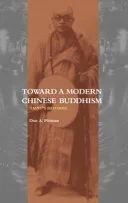
Toward a Modern Chinese Buddhism
 78
78

Toward a Modern Chinese Buddhism
Don Alvin Pittman’s exploration of Venerable Master Taixu's reformist agenda offers a critical lens into a crucial period of Chinese Buddhism. The strength of this work lies in its detailed unpacking of Taixu's ambitious vision, particularly his "Buddhism for the Human Realm" initiative, which sought to reorient Buddhist practice towards contemporary social and intellectual concerns. Pittman effectively highlights the complex web of controversies Taixu navigated, presenting him not as an unassailable saint, but as a figure deeply enmeshed in the political and intellectual currents of early 20th-century China. A potential limitation for some readers might be the dense academic prose, which, while precise, occasionally obscures the immediate spiritual or philosophical impact of Taixu's ideas. The discussion around Taixu’s attempts to reform monastic education, a core aspect of his modernization project, is particularly useful, showing the practical challenges of institutional change. This is a vital study for understanding Buddhism's engagement with modernity.
📝 Description
78
Don Alvin Pittman's 2007 book examines the reform efforts of Master Taixu, a key figure in 20th-century Chinese Buddhism.
This scholarly work analyzes the life and teachings of the Venerable Master Taixu (1890-1947), a significant voice in 20th-century Chinese Buddhist reform. Pittman scrutinizes Taixu's ambitious program to update Buddhism and align it with the societal pressures of his time. The book offers a detailed interpretation of his goals and the considerable disagreements they generated.
It is aimed at scholars of East Asian religions, students of Buddhist philosophy, and anyone interested in the intellectual currents of modern China. The text will particularly interest those who want to grasp the dynamics of religious adaptation amidst secularization and political change. Readers familiar with Buddhist studies will find value in its specific discussion of Taixu's doctrinal adjustments.
The early 20th century in China saw immense social and political shifts. Buddhism, like other established institutions, faced pressure to adapt or risk irrelevance. Master Taixu became a prominent advocate for a "Buddhism for the Human Realm," attempting to reconnect the religion with contemporary societal needs. His initiatives encountered both strong support and firm opposition from within the Buddhist community and from secular thinkers.
While not strictly a text on esoteric practices, this book is situated within the broader context of how contemplative traditions adapt and respond to societal change. Master Taixu's project aimed to make Buddhist philosophy and practice relevant to a modernizing world, a process that often involves reinterpreting or emphasizing certain aspects of a tradition while downplaying others. His call for a "Buddhism for the Human Realm" suggests a focus on ethical and social engagement, which can be seen as a contemporary manifestation of the Bodhisattva ideal, a concept with deep roots in Mahayana Buddhism's contemplative and philosophical systems.
⭐ Reader Reviews
Honest opinions from readers who have explored this book.
❓ Frequently Asked Questions
Who was the Venerable Master Taixu and why is he significant?
Venerable Master Taixu (1890-1947) was the most influential and controversial Chinese Buddhist reformer of the 20th century. He sought to modernize Buddhism, making it relevant to contemporary issues and intellectual trends, which sparked significant debate within the Buddhist community.
What does 'Buddhism for the Human Realm' mean in Taixu's context?
This concept, central to Taixu's reforms, aimed to reorient Buddhist practice away from solely otherworldly concerns towards addressing the immediate needs and challenges of human society. It emphasized social engagement and ethical action.
What kind of controversies did Taixu face?
Taixu faced considerable opposition from traditionalist Buddhist factions who viewed his reforms as a dilution of core doctrines. He also engaged with secular intellectuals and political movements, making his position complex and often contentious.
What was the historical period of Taixu's reform efforts?
Taixu was active during a period of immense upheaval in China, roughly from the early 1910s through the 1940s. This era saw the fall of imperial rule, the rise of republicanism, and significant intellectual ferment.
Does this book discuss Taixu's specific philosophical innovations?
Yes, the book focuses on Taixu's teachings, providing an interpretation of his aims and the doctrinal shifts he proposed to align Buddhism with modern thought and societal needs.
Is this book suitable for beginners in Buddhist studies?
While it offers valuable historical context, the book is primarily geared towards scholars and students with some existing knowledge of Buddhist philosophy and Chinese history due to its analytical depth.
🔮 Key Themes & Symbolism
Modernization of Doctrine
The work examines Master Taixu's deliberate efforts to adapt Buddhist philosophy to meet the intellectual and social demands of the 20th century. This involved reinterpreting core tenets and proposing new frameworks, such as "Buddhism for the Human Realm," to address secular concerns and engage with modern science and ethics. It details his project to make Buddhism a dynamic force in contemporary life, moving beyond perceived ossification.
Monastic Reform
A significant focus is placed on Taixu's initiatives to reform monastic education and discipline. He recognized that the traditional Sangha structure was ill-equipped to address the challenges of modernity. The book outlines his proposals for revitalizing monastic institutions, emphasizing rigorous study, ethical conduct, and a greater connection to societal welfare, aiming to produce monks capable of leading a modernized Buddhist movement.
Controversy and Reception
Pittman meticulously documents the widespread controversies that surrounded Taixu's reformist agenda. This includes the opposition from conservative elements within Buddhism who saw his ideas as heretical, as well as his complex interactions with secular political and intellectual circles. The book analyzes the diverse reactions to his proposals, highlighting the contentious nature of religious adaptation in a rapidly changing China.
Engaging with Modernity
The core of Taixu's project was to demonstrate Buddhism's continued relevance in the modern world. The book explores how he sought to bridge the gap between ancient Buddhist wisdom and contemporary issues, including nationalism, social reform, and philosophical inquiry. Taixu's work is presented as a critical case study in the ongoing dialogue between traditional religions and the forces of secularization and modernization.
💬 Memorable Quotes
Direct passages from the work, attributed to the author.
“Taixu's aim was to establish a 'Buddhism for the Human Realm'.”
— This concise summary captures Taixu's core reformist strategy: to reorient Buddhist practice and philosophy towards active engagement with contemporary societal issues and human welfare, rather than solely focusing on otherworldly salvation or monastic seclusion.
“The Venerable Master Taixu is the most important and controversial Chinese Buddhist reformer of the 20th century.”
— This statement underscores Taixu's dual legacy. His reforms were transformative and influential, yet they also generated significant debate and opposition, marking him as an important, albeit divisive, figure in modern Buddhist history.
“This work focuses on his teachings and provides an interpretation of Taixu's aims.”
— The book's primary objective is not merely biographical but analytical, aiming to clarify the intellectual underpinnings of Taixu's reform movement and the motivations behind his controversial proposals.
“The diverse controversies that surrounded him.”
— This phrase points to the complex and many-sided nature of the opposition Taixu faced, suggesting that his reformist agenda challenged various established interests and orthodoxies within both religious and secular spheres.
“Taixu sought to adapt Buddhism to the challenges of his era.”
— This highlights the context-specific nature of Taixu's project. He recognized that Buddhism needed to evolve and respond dynamically to the socio-political and intellectual shifts occurring in early 20th-century China to remain vital.
🌙 Esoteric Significance
Tradition
While Master Taixu's project was primarily focused on reforming mainstream Chinese Buddhism and engaging with modernity, his emphasis on a comprehensive understanding of Buddhist cosmology, consciousness, and the potential for human transformation can be seen as having resonance with certain esoteric traditions. His efforts to synthesize Buddhist philosophy with scientific and psychological insights echo the broader trends in early 20th-century esoteric thought, such as Theosophy, which sought to reconcile ancient wisdom with modern knowledge.
Symbolism
Within Taixu's reformist framework, traditional Buddhist symbols were often reinterpreted to emphasize their psychological and social relevance. For instance, the concept of *emptiness* (śūnyatā) could be understood not just as a metaphysical principle but as a call for overcoming ego-centric biases and fostering social interconnectedness. The monastic ideal, while reformed, retained its symbolic weight as a representation of disciplined practice and dedication to higher principles, albeit now directed towards worldly engagement.
Modern Relevance
Contemporary thinkers and practitioners interested in engaged Buddhism, Buddhist modernism, and the intersection of spirituality with social justice often draw upon the legacy of figures like Taixu. His attempts to create a Buddhism relevant to the challenges of secularization, nationalism, and social change continue to inform discussions on how religious traditions can adapt and thrive in the 21st century. Scholars examining the history of religious reform in East Asia frequently cite his work as a key case study.
👥 Who Should Read This Book
['• Scholars of Chinese Buddhism and East Asian intellectual history seeking a detailed analysis of an important reform movement and its leader.', '• Students of comparative religion interested in how traditional faiths adapt to modernity and secularization, particularly in non-Western contexts.', '• Practitioners interested in engaged Buddhism and the historical efforts to make Buddhist teachings relevant to contemporary social and ethical issues.']
📜 Historical Context
The early 20th century in China was a period of profound crisis and transformation, marked by the collapse of the imperial system in 1912 and subsequent political instability, foreign encroachment, and the rise of new intellectual movements. Traditional institutions, including Buddhism, were under intense scrutiny. Master Taixu (1890-1947) emerged as a leading figure in the Buddhist revivalist movement, advocating for reforms that would modernize the religion and demonstrate its relevance to contemporary Chinese society. He proposed a "Buddhism for the Human Realm," seeking to integrate Buddhist principles with social action and modern scientific thought. His efforts were met with mixed reactions; while he gained many followers, he also faced strong opposition from conservative monastics and laypeople who viewed his reforms as a departure from orthodox teachings. Notably, Taixu engaged in debates with figures like Hu Shih, a prominent proponent of secularism and Western learning, highlighting the intellectual tensions of the era. His work sought to counter the narrative that Buddhism was a relic of the past, incompatible with progress.
📔 Journal Prompts
The concept of 'Buddhism for the Human Realm' and its implications for contemporary practice.
Master Taixu's strategies for reforming monastic education and their potential efficacy.
The nature of the controversies surrounding Taixu's reform agenda.
How Taixu's efforts to adapt Buddhism reflect broader trends in early 20th-century Chinese intellectual life.
The balance between tradition and innovation in religious reform movements.
🗂️ Glossary
Venerable Master Taixu
The central figure of the book, a prominent Chinese Buddhist reformer (1890-1947) who sought to modernize Buddhist teachings and institutions for the 20th century.
Buddhism for the Human Realm
Taixu's key reformist slogan, advocating for a form of Buddhism that actively engages with societal issues, ethics, and the welfare of humanity in the present world.
Sangha
The Buddhist monastic community; Taixu sought to reform its educational and disciplinary practices to better suit modern conditions.
Modernization
In this context, the process of adapting traditional Buddhist doctrines, practices, and institutions to align with contemporary scientific, philosophical, and social developments of the 20th century.
Controversy
The debates and opposition Taixu faced from both conservative Buddhists and secular intellectuals regarding his reformist agenda and interpretations of Buddhist teachings.
Secularization
The process by which religion loses social and cultural significance; Taixu's reforms were partly a response to this trend.
Monastic Education
The curriculum and training provided within Buddhist monasteries; Taixu proposed significant reforms to this system.