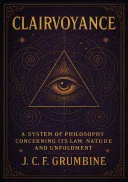
Clairvoyance; A System of Philosophy Concerning its Law, Nature and Unfoldment
 80
80

Clairvoyance; A System of Philosophy Concerning its Law, Nature and Unfoldment
Grumbine’s "Clairvoyance" presents a remarkably organized approach to a subject often shrouded in mystique. His assertion that clairvoyance operates under discoverable laws, akin to physics, offers a compelling intellectual hook for skeptics and serious practitioners alike. The strength of the book lies in its systematic methodology, presenting exercises for developing the "Inner Eye" with a clarity that belies the subject's complexity. However, the prose, while precise, can occasionally feel dry, reflecting its origins as academic material for his "College of Divine Sciences." A particular passage detailing the "Astral Body's" function in perception is both informative and a touch archaic, showcasing the text's historical roots. While it meticulously dissects the 'how,' it sometimes underemphasizes the profound 'why' beyond intellectual discipline. This is a foundational text for understanding the early 20th-century formalization of psychic studies.
📝 Description
80
J. C. F. Grumbine published "Clairvoyance; A System of Philosophy Concerning its Law, Nature and Unfoldment" in 1925.
Grumbine presents clairvoyance not as a mystical event, but as a natural faculty that people can cultivate. He structured his ideas into a philosophical system, connecting extrasensory perception to universal laws in his 1925 book. Grumbine believed developing psychic abilities was a reasonable step forward, achievable through dedicated study and practice, much like in academic fields.
This book targets serious students of the esoteric, especially those interested in the principles and workings of psychic phenomena. It appeals to individuals seeking an intellectual basis for spiritual growth, going beyond simple stories. Readers familiar with early 20th-century metaphysical thought, particularly within Theosophy and similar movements, will find Grumbine's organized method useful.
Written in 1925, Grumbine's "Clairvoyance" emerged during a time of significant interest in psychical research and spiritualism. Influenced by figures like Helena Blavatsky and the broader Theosophical movement, Grumbine sought to formalize the study of spiritual phenomena. His "College of Divine Sciences" initiative aimed to offer structured education in these areas, distinguishing his methodical approach from the more sensational spiritualist writings of the period.
💡 Why Read This Book?
• Understand the systematic, law-based approach to clairvoyance Grumbine outlines, distinct from random psychic gifts, as detailed in his "College of Divine Sciences" curriculum. • Learn practical exercises for developing psychic faculties, focusing on disciplined cultivation of the "Inner Eye" as presented in early 20th-century metaphysical thought. • Grasp the philosophical underpinnings of extrasensory perception, moving beyond mere fortune-telling to a disciplined awakening of spiritual faculties as Grumbine insists.
⭐ Reader Reviews
Honest opinions from readers who have explored this book.
❓ Frequently Asked Questions
When was J. C. F. Grumbine's "Clairvoyance" first published?
The initial publication date for "Clairvoyance; A System of Philosophy Concerning its Law, Nature and Unfoldment" by J. C. F. Grumbine was June 20, 1925.
What is the "College of Divine Sciences" mentioned in relation to Grumbine's book?
The "College of Divine Sciences" was an educational initiative founded by J. C. F. Grumbine, designed to offer structured courses and a philosophical framework for the study and development of spiritual and psychic faculties.
Does Grumbine's book focus on fortune-telling?
No, Grumbine explicitly differentiates clairvoyance from mere fortune-telling. He presents it as a disciplined awakening of extrasensory faculties governed by specific laws, intended for spiritual development rather than predictive purposes.
What are some key concepts Grumbine explores regarding clairvoyance?
Grumbine explores concepts such as the "Inner Eye," the "Astral Body," and the law-like nature of psychic unfoldment, presenting them within a systematic philosophical structure.
What historical period influenced Grumbine's writing on clairvoyance?
Grumbine's work was influenced by the early 20th-century intellectual climate, which saw significant interest in psychical research, spiritualism, and the formalization of esoteric studies, building upon movements like Theosophy.
Is "Clairvoyance" a practical guide or purely theoretical?
The book offers both a philosophical system and practical exercises. Grumbine outlines the theory of clairvoyant perception and provides methods for its development and refinement.
🔮 Key Themes & Symbolism
The Law of Clairvoyant Unfoldment
Grumbine posits that clairvoyance is not a random gift but operates according to discernible universal laws. This perspective elevates psychic ability from a mystical anomaly to a predictable outcome of specific conditions and practices. His "System of Philosophy" meticulously outlines these principles, suggesting that understanding and applying them systematically can lead to the reliable development of extrasensory perception. This approach seeks to explain psychic phenomena by framing them within a structured, almost scientific, understanding of spiritual mechanics.
The Inner Eye and Astral Perception
Central to Grumbine's system is the concept of the "Inner Eye," which he describes as the faculty responsible for clairvoyant vision. This organ of perception functions through the "Astral Body," a subtle vehicle distinct from the physical form. The book details how this astral perception operates, how it can be trained, and its role in apprehending realities beyond the physical senses. Grumbine emphasizes that cultivating the Inner Eye requires discipline and adherence to specific practices for clear and accurate inner sight.
Discipline Over Divine Whim
A core argument in "Clairvoyance" is the rejection of the notion that psychic abilities are solely bestowed by divine will or chance. Grumbine insists on the importance of personal effort, study, and rigorous practice in unfolding these faculties. This emphasis on discipline positions clairvoyance as an achievable goal for the dedicated student, accessible through a structured curriculum like that offered by his "College of Divine Sciences." It champions a self-directed path to spiritual attainment through applied knowledge.
Beyond Fortune-Telling
Grumbine is adamant that true clairvoyance transcends the superficiality of fortune-telling or parlor tricks. He frames it as a profound tool for spiritual insight, self-understanding, and a deeper apprehension of universal truths. By adhering to his philosophical system, practitioners can move beyond simple prediction towards a more meaningful engagement with higher consciousness and the subtle realms. This distinction is crucial for understanding his vision of clairvoyance as a serious discipline.
💬 Memorable Quotes
Direct passages from the work, attributed to the author.
“Clairvoyance is not a mere sporadic gift, but a law-abiding faculty.”
— This statement expresses Grumbine's core thesis: that psychic perception follows predictable principles, much like natural phenomena, and can be systematically developed through understanding and application.
“The Inner Eye must be awakened and trained, not merely waited upon.”
— This highlights Grumbine's emphasis on active, disciplined practice over passive reception. He believed that developing clairvoyant abilities requires conscious effort and specific exercises.
“The Astral Body serves as the vehicle for perception beyond the physical.”
— This points to Grumbine's theoretical framework, identifying the subtle body as the mechanism through which clairvoyant experiences are facilitated and perceived.
“True clairvoyance is a disciplined awakening, not a form of fortune-telling.”
— This directly addresses and refutes common misconceptions, positioning clairvoyance as a serious spiritual discipline aimed at higher understanding, distinct from predictive arts.
“The unfoldment of psychic faculties is a natural consequence of specific conditions.”
— This reinforces the idea that spiritual gifts are not arbitrary but arise predictably when the correct internal and external conditions, as outlined by Grumbine, are met.
🌙 Esoteric Significance
Tradition
Grumbine's work fits within the broader Western Esoteric Tradition, particularly influenced by late 19th and early 20th-century movements like Theosophy and New Thought. He sought to integrate metaphysical principles with a structured, almost scientific, approach to spiritual development. While not strictly Hermetic or Kabbalistic, his emphasis on universal laws and the systematic cultivation of inner faculties aligns with perennialist ideals found across various esoteric lineages, aiming for a rational understanding of spiritual phenomena.
Symbolism
The "Inner Eye" is a central symbol, representing the faculty of clairvoyant perception, often depicted in esoteric traditions as a third eye. The "Astral Body" functions as a symbolic vehicle for consciousness, enabling perception beyond the physical senses, a concept prevalent in astral projection literature. Grumbine's use of these symbols grounds his philosophical system in established esoteric imagery, providing a framework for understanding the mechanics of subtle perception.
Modern Relevance
Grumbine's systematic approach to psychic development continues to inform modern practitioners and authors in the New Age and esoteric fields. His emphasis on law-like principles and disciplined practice speaks to contemporary discussions on energy work, consciousness studies, and the formalization of intuitive development. Thinkers and practitioners who seek a structured, philosophical basis for psychic abilities often reference early 20th-century works like this for foundational concepts and methodologies.
👥 Who Should Read This Book
• Students of early 20th-century metaphysical thought seeking to understand the formalization of psychic studies beyond anecdotal accounts. • Aspiring clairvoyants looking for a structured, philosophical framework and practical exercises for developing extrasensory perception based on "law." • Researchers of esoteric history interested in the development of spiritual science and Grumbine's "College of Divine Sciences" curriculum.
📜 Historical Context
J. C. F. Grumbine's "Clairvoyance," published in 1925, emerged from the fertile ground of early 20th-century spiritualism and Theosophy. This era was characterized by a fervent desire to reconcile spiritual experiences with scientific inquiry. Movements like the Theosophical Society, founded by Helena Blavatsky, had already popularized concepts of psychic abilities and ancient wisdom. Grumbine's "College of Divine Sciences" initiative represented an effort to systematize these burgeoning interests, offering a structured curriculum that distinguished itself from the more emotionally-driven or less organized spiritualist circles. While figures like Arthur Conan Doyle championed spiritualism, Grumbine sought a more philosophical and law-based exposition. His work engaged with the prevailing intellectual currents that sought to understand consciousness and the unseen realms through systematic study, laying groundwork for later esoteric educational models.
📔 Journal Prompts
The "Inner Eye's" potential for disciplined awakening.
Conditions for the "law-abiding faculty" of clairvoyance.
The Astral Body as a vehicle for perception.
Distinguishing true clairvoyance from fortune-telling.
Applying Grumbine's system to personal spiritual development.
🗂️ Glossary
Inner Eye
The faculty of perception, distinct from physical sight, through which clairvoyant visions and impressions are received. Grumbine emphasizes its cultivable nature.
Astral Body
A subtle, non-physical body or vehicle of consciousness that Grumbine posits is used for perception beyond the physical senses, enabling clairvoyant experiences.
Unfoldment
The process of developing and bringing forth inherent spiritual or psychic faculties, often through study, practice, and adherence to specific principles or laws.
Law-abiding faculty
A description of clairvoyance as operating according to predictable, discoverable principles, rather than being a random or purely supernatural phenomenon.
Spiritual Science
An approach that seeks to understand spiritual realities and phenomena through systematic study, observation, and the application of principles, akin to natural sciences.
College of Divine Sciences
An educational initiative established by J. C. F. Grumbine to provide structured teaching and philosophical grounding in esoteric subjects, including clairvoyance.
Extrasensory faculties
Abilities to perceive information beyond the known human senses, such as telepathy, precognition, and clairvoyance, as understood within esoteric philosophy.