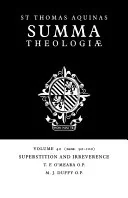
Summa Theologiae: Volume 40, Superstition and Irreverence
 80
80

Summa Theologiae: Volume 40, Superstition and Irreverence
The reissue of Aquinas' treatment of superstition and irreverence offers a stark encounter with medieval moral theology. The Dominican translation, as always, is serviceable, allowing the reader to follow the precise Latin alongside the English rendering. Aquinas’ methodical dissection of divination, for instance, is remarkably thorough, distinguishing legitimate prognostication from forbidden occult arts with a clarity that still commands attention. His argument against the superstitious veneration of created things, while rooted in a specific theological framework, touches upon enduring questions about where ultimate devotion belongs. However, the sheer density of scholastic argument can be an obstacle; the text demands sustained concentration and a willingness to grapple with intricate syllogisms. A passage discussing the nature of omens and portents reveals both the text’s depth and its potential remoteness from contemporary experience. This volume serves as a powerful, albeit challenging, exposition on the boundaries of religious observance.
📝 Description
80
Published in 1270, Aquinas' treatise on superstition and irreverence defines vices opposed to true worship.
This volume, Superstition and Irreverence, presents a section of Saint Thomas Aquinas' Summa Theologiae. It examines practices and attitudes that stray from proper religious devotion, contrasting authentic worship with its corrupted forms. The English Dominicans' translation provides both the original Latin and an English rendering, allowing for close study of Aquinas' arguments. This reissue makes available a significant text in Catholic scholasticism, focusing on ethical and theological distinctions.
Scholars of medieval philosophy, theology, and religious studies will find this work of particular interest. It also appeals to those studying the history of moral philosophy and the evolution of Christian doctrine. Individuals seeking a thorough examination of the theological basis for concepts such as superstition, idolatry, and sacrilege will discover ample material. This text is not an introduction but a detailed exploration of a complex area within Aquinas' thought, presupposing some familiarity with philosophical and theological language.
While not typically classified as 'esoteric' in the modern sense, Aquinas' work on superstition and irreverence touches upon hidden or occult practices that were understood within medieval frameworks as diverting from proper divine focus. His meticulous analysis of these deviations, distinguishing them from genuine piety, engages with a tradition of understanding the spiritual life through precise definition and categorization. The text concerns itself with the proper ordering of the soul's affections towards God, and the errors that arise from misplaced reverence or belief in false powers.
💡 Why Read This Book?
• Gain a rigorous theological framework for understanding the distinction between genuine worship and superstitious practices, as detailed in Aquinas' analysis of the First Commandment. • Explore the medieval scholastic method of ethical argumentation by examining Aquinas' precise definitions and deductions regarding virtues and vices opposed to religion. • Understand the historical development of Christian thought on divination and idolatry by engaging with Aquinas' classifications and refutations of erroneous beliefs and practices.
⭐ Reader Reviews
Honest opinions from readers who have explored this book.
❓ Frequently Asked Questions
What is the primary focus of Aquinas' "Superstition and Irreverence" volume?
This volume of the Summa Theologiae focuses on vices opposed to the virtue of religion. It meticulously defines and analyzes practices like superstition, divination, idolatry, and sacrilege, distinguishing them from authentic divine worship.
When was the original Summa Theologiae composed?
Saint Thomas Aquinas composed the Summa Theologiae between approximately 1265 and 1274, making this a foundational text of High Medieval scholasticism.
What is the significance of the English Dominicans' translation?
The English Dominicans' edition provides a dual-language format (Latin/English), allowing readers direct access to Aquinas' original Latin alongside a scholarly English translation, facilitating deeper study.
Does this volume discuss modern occult practices?
While it addresses practices like divination and sorcery that have echoes in modern occultism, the text's analysis is rooted in 13th-century theological and philosophical contexts, not contemporary practices.
Is this book suitable for beginners in philosophy?
No, this volume is best suited for those with some background in philosophy or theology, as it employs the rigorous, systematic method of scholasticism and assumes familiarity with its terminology and logical structure.
What are the main categories of sin addressed in this text?
The text primarily addresses sins against the virtue of religion, including superstition (false practices of worship), irreligion (lack of due reverence), and related vices such as presumption and despair.
🔮 Key Themes & Symbolism
Distinguishing True Worship
This volume meticulously differentiates acts of true worship due to God alone from practices that fall into superstition or irreverence. Aquinas defines superstition as a vice that offers to God, or indeed to any creature, a worship belonging to God alone, or in a manner not prescribed. It probes the subtle lines between pious practices and those that err by excess or defect, ensuring that devotion is rightly ordered. The text emphasizes that the object and manner of worship are crucial for its legitimacy within the theological framework.
The Nature of Divination
Aquinas undertakes a thorough examination of divination, categorizing various forms from natural prognostication to illicit demonic arts. He distinguishes between seeking knowledge of the future through legitimate means (like understanding natural causes) and forbidden methods such as consulting demons, interpreting omens, or employing astrology in a deterministic fashion. The core argument is that true providence belongs to God alone, and attempts to usurp this knowledge through forbidden means constitute a grave sin against divine authority.
Irreverence and Sacrilege
Beyond superstition, the text addresses irreverence, which involves a lack of due respect towards God, sacred persons, or things. This includes the sin of sacrilege, defined as the violation of sacred things or persons. Aquinas explores how disrespect can manifest in words, actions, or attitudes. The volume clarifies the sanctity attributed to divine service, consecrated objects, and places of worship, outlining the theological basis for respecting these elements as extensions of God's own honor.
Faith and Reason in Ethics
As part of the larger *Summa Theologiae*, this volume exemplifies the scholastic synthesis of faith and reason. Aquinas employs rigorous logical deduction and philosophical argumentation, grounded in both Aristotelian principles and Christian revelation. The ethical distinctions drawn concerning superstition and irreverence are not arbitrary but derived through systematic inquiry, aiming to provide a coherent intellectual framework for moral life. This approach underscores the belief that theological truths can be understood and defended through rational discourse.
💬 Memorable Quotes
Direct passages from the work, attributed to the author.
“Superstition is a vice that offers to God, or indeed to any creature, a worship belonging to God alone, or in a manner not prescribed.”
— This defines superstition as a misdirection of religious devotion. It highlights Aquinas' concern with both the object of worship (God alone) and the proper manner of its expression, indicating that incorrect practices, even if seemingly directed towards the divine, are fundamentally flawed.
“All divination, which has for its end the discovery of future events, is forbidden.”
— This strong statement captures Aquinas' view on forbidden knowledge. It underscores the theological principle that the future is solely within God's domain, and seeking to uncover it through illicit means is a transgression against divine providence.
“There is no reason why certain things may not be said to be ordained by God to the end that men may be warned by them.”
— This likely refers to Aquinas' allowance for certain natural signs or events to be interpreted as warnings, provided they are understood within God's providential order, not as independent sources of prophecy. It contrasts with forbidden divination.
“The reverence due to God is to be paid to Him alone.”
— This core principle asserts the absolute uniqueness of God as the object of ultimate worship. Any reverence or devotion directed elsewhere, or any worship offered to God in a manner contrary to His will, deviates from true religious virtue.
💡 Key Ideas
Editorial paraphrase of the work's core concepts — not direct quotes.
Sacrilege is twofold: one is the violation of things sacred; the other is the violation of persons sacred, or places sacred.
This paraphrase clarifies Aquinas' classification of sacrilege. It shows his methodical approach to defining sins, distinguishing between disrespect towards divine things, consecrated individuals, and holy sites, all falling under the umbrella of irreverence.
🌙 Esoteric Significance
Tradition
While Aquinas himself is firmly situated within Catholic orthodoxy, his rigorous logical framework and detailed examination of vices opposed to religion have been of interest to later esoteric traditions. Specifically, his precise distinctions regarding the nature of divine worship and the dangers of misdirected devotion provide a philosophical underpinning for practices found in Western esotericism that seek to purify intent and align with higher spiritual principles. His work can be seen as a foundational text for understanding the boundaries of spiritual practice, even if his context is theological rather than explicitly esoteric.
Symbolism
Within this volume, symbols are less about overt mystical imagery and more about the symbolic weight of actions and concepts. The 'First Commandment' itself functions as a symbolic boundary marker for all religious devotion. Practices like divination can be seen as symbolic attempts to grasp forbidden knowledge, representing a desire to usurp divine authority. Sacrilege, as a violation of sacred persons or places, symbolizes a breach in the sacred order, highlighting the symbolic importance of maintaining distinctions between the profane and the holy.
Modern Relevance
Contemporary thinkers engaged with comparative religion and the philosophy of religion often reference Aquinas' analyses of superstition and idolatry. Practitioners within certain Western esoteric traditions may find his detailed categorizations useful for understanding the pitfalls of spiritual practice, such as the dangers of invoking entities outside of established divine hierarchies or developing obsessive focus on external rituals. His work provides a historical counterpoint and a structured critique for those exploring the spectrum of belief and practice.
👥 Who Should Read This Book
• Students of medieval philosophy and theology seeking a foundational text on the nature of religious virtue and vice. • Scholars of comparative religion interested in historical Christian perspectives on divination, magic, and idolatry. • Individuals exploring the ethical dimensions of belief and ritual who appreciate rigorous, systematic argumentation.
📜 Historical Context
The *Summa Theologiae*, with this volume on superstition and irreverence, emerged during the High Middle Ages, a period of intense intellectual ferment in European universities like Paris and Bologna. Saint Thomas Aquinas (c. 1225-1274) was a central figure in Scholasticism, seeking to harmonize Christian doctrine with Aristotelian philosophy, a project that often met resistance from more conservative theologians. Competing schools of thought, such as the voluntarism associated with Duns Scotus later in the 13th century, offered different approaches to reconciling faith and reason. Aquinas' comprehensive systematic theology, including his detailed ethical treatises, was highly influential but also controversial; his works were scrutinized by Church authorities, although he was later canonized. This volume addresses perennial concerns about the proper human relationship with the divine, a topic debated across various theological traditions.
📔 Journal Prompts
The concept of divine providence and its relation to forbidden divination.
Aquinas' definition of superstition and its potential modern manifestations.
The virtue of religion and its opposition by vices like irreverence.
The distinction between natural prognostication and illicit prophecy.
Sacrilege as a violation of sacred persons, places, or things.
🗂️ Glossary
Superstition
A vice that attributes to creatures, or to God himself, the religious honor due to Him alone, or renders it in an undue manner. It involves erroneous practices in religious worship.
Divination
The practice of seeking knowledge of future events or hidden things by supernatural means, often involving illicit consultation of demons or misinterpretation of signs.
Irreverence
A lack of due respect or honor towards God, sacred persons, things, or places. It stands in opposition to the virtue of religion.
Sacrilege
The violation of sacred things, persons, or places. It is a specific form of irreverence directed towards what has been consecrated or set apart for divine use.
Virtue of Religion
The moral virtue that directs human acts towards God, giving Him the honor and worship due to Him as the supreme principle of creation and salvation.
Scholasticism
The dominant philosophical and theological system of medieval European universities, characterized by rigorous logical analysis, systematic presentation, and dialectical method.
Prognostication
The act of predicting future events. Aquinas distinguishes between natural prognostication (based on observable causes) and forbidden divination.
This book appears in 1 collection
🔮 Readers Also Liked
Browse all →







From the “Superstition” Collection
View all →




More Free Sacred Texts & Gnosticism Books
View all →