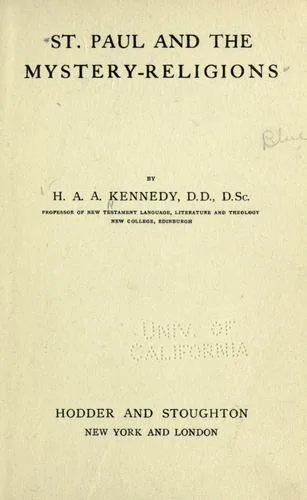
St. Paul and the mystery-religions
 63
63

St. Paul and the mystery-religions


Ophelia Vance, Mystical Literature Reviewer — Kennedy's "St. Paul and the Mystery-Religions" is a monumental achievement, masterfully illuminating the intricate symbiosis between Pauline Christianity and the ancient mystery traditions. Kennedy's erudition shines as he deciphers the esoteric language and symbolic resonance shared between these spiritual systems. He offers a compelling argument for the influence of mystery cult initiations on Christian ritual and belief, presenting a more nuanced understanding of Paul’s mission. This work is essential for scholars of comparative religion and practitioners seeking to grasp the hidden currents beneath the surface of biblical narrative. Its strengths lie in its scholarly rigor and its ability to reveal profound esoteric insights.
📝 Description
63
Harry Angus Alexander Kennedy's 1920 book examines St. Paul's theology alongside ancient mystery cults.
Harry Angus Alexander Kennedy's 1920 study, "St. Paul and the Mystery-Religions," investigates the parallels between the Apostle Paul's teachings and the initiatory cults prevalent in the ancient Mediterranean world. Kennedy argues that Paul incorporated elements from these mystery traditions into early Christian doctrine. The book details specific connections, suggesting that Paul adapted existing salvific narratives and symbolic language to articulate Christian beliefs.
This work considers how Gnostic ideas and Dionysian practices, common in the Hellenistic period, may have influenced the development of Christian theology. Kennedy posits that a deeper understanding of these connections can illuminate the origins of Christian scripture. The book's aim is to show a dialogue between the Hebrew prophetic tradition and the wider spiritual consciousness of the Mediterranean.
This book belongs to a tradition of scholarship that sought esoteric or hidden meanings in religious texts, particularly in the early 20th century. It engages with the idea that Christianity, like other ancient religions, might have drawn from pre-existing mystery traditions, such as those involving initiation rites and secret knowledge. Kennedy's work is part of a broader esoteric inquiry into the origins of major religious movements, looking beyond conventional historical accounts for deeper spiritual connections.
💡 Why Read This Book?
Uncover the hidden esoteric influences that shaped early Christianity. "St. Paul and the Mystery-Religions" offers a profound re-evaluation of biblical teachings, revealing universal symbols and initiatory narratives. Ideal for spiritual seekers, biblical scholars, and practitioners interested in comparative mysticism and the deeper currents of religious history.
⭐ Reader Reviews
Honest opinions from readers who have explored this book.
❓ Frequently Asked Questions
What were the primary mystery-religions discussed?
The book primarily focuses on Hellenistic mystery cults such as the Eleusinian Mysteries, Orphism, Mithraism, and the cults of Dionysus and Isis, exploring their common themes of death, rebirth, and salvation.
How did St. Paul interact with these mystery traditions?
Kennedy posits that St. Paul, operating within a syncretic Hellenistic world, consciously or unconsciously employed the language, symbolism, and salvific paradigms of these mystery religions to communicate the Christian message effectively to a diverse audience.
Does this book suggest Christianity is derived from mystery cults?
While highlighting significant parallels and influences, Kennedy's work does not necessarily claim direct derivation but rather a profound interaction and synthesis, suggesting a shared spiritual vocabulary and soteriological framework.
Who is the intended audience for this book?
The book is intended for serious students of religion, theology, comparative mythology, and esoteric studies, as well as anyone interested in the historical and philosophical underpinnings of Christianity.
What is the significance of 'mystery' in this context?
In this context, 'mystery' refers to the secret rites and teachings of ancient cults that offered initiates a profound personal experience of divine union, spiritual transformation, and salvation, often through symbolic death and resurrection narratives.
🔮 Key Themes & Symbolism
The Esoteric Nature of Pauline Theology
This theme examines how St. Paul's epistles, often perceived as straightforward theological pronouncements, contain layers of veiled meaning accessible through an understanding of ancient mystery traditions. Kennedy argues that Paul's language of death, resurrection, and spiritual union with Christ mirrors the initiatory experiences found in mystery cults, suggesting a deliberate use of familiar esoteric symbolism to convey Christian dogma to a Hellenistic audience receptive to such concepts.
Comparative Mysticism and Religious Syncretism
The book meticulously compares the doctrines, rituals, and symbolic language of various mystery religions with early Christian beliefs. It highlights the pervasive nature of syncretism in the ancient world, demonstrating how Paul navigated and integrated these diverse spiritual currents. This theme emphasizes the shared human quest for transcendence and salvation, manifesting in similar archetypal patterns across different religious expressions.
Symbolism of Death and Rebirth in Salvation
Central to both mystery religions and Pauline Christianity is the transformative power of death and rebirth. Kennedy elucidates how the ritualistic 'dying with Christ' and subsequent 'resurrection' in Christian theology find potent parallels in the initiatory journeys of mystery cults. This theme explores the universal archetype of spiritual death and renewal as the pathway to divine knowledge and eternal life, a core tenet of many esoteric traditions.
💬 Memorable Quotes
Direct passages from the work, attributed to the author.
“The Apostle, a master of his age, spoke in a tongue familiar to its profoundest spiritual longings.”
— This suggests Paul was adept at communicating Christian truths using the existing esoteric vocabulary and symbolic framework of the Hellenistic world, making the new faith resonate with those already engaged in mystery traditions.
“In the sacred rites, the initiate died to the old self and was reborn into divine consciousness.”
— This highlights the core initiatory experience common to mystery cults, emphasizing a profound personal transformation and a direct encounter with the divine.
“Paul's Christology carries the salvific myths of the underworld and triumphant return.”
— This points to the parallel between Christ's death and resurrection narrative and the cyclical myths of descent into the underworld and subsequent emergence, a common motif in mystery religions.
“The 'mystery' of God's plan was not hidden from the elect, but revealed through sacred knowledge.”
— This emphasizes the esoteric aspect of divine revelation, suggesting that access to spiritual truth is often granted through initiatory knowledge rather than public discourse.
“The veiled truths of the ancients find their ultimate expression in the Pauline gospel.”
— This suggests that the esoteric wisdom sought in ancient mystery cults finds its fulfillment or ultimate articulation within the teachings of St. Paul and early Christianity.
🌙 Esoteric Significance
Tradition
This work is deeply rooted in the esoteric tradition of comparative mysticism and religious phenomenology. It explores the universal archetypes and symbolic languages found across various spiritual paths, particularly focusing on the Hellenistic mystery cults and their relationship to early Christian doctrine. It highlights the shared human impulse towards transcendence and the use of initiatory rituals to access higher states of consciousness and achieve salvation, a hallmark of esoteric inquiry.
Symbolism
Key symbols explored include death and resurrection (representing spiritual transformation), baptism (as a rite of purification and rebirth), the Eucharist (as a symbolic meal of union), and the concept of 'initiation' itself. Kennedy shows how these symbols, prevalent in mystery religions, were adopted and recontextualized by St. Paul to convey the Christian message of salvation and divine communion, offering a deeper, symbolic interpretation of biblical narratives.
Modern Relevance
In an age increasingly seeking personal spiritual experience and understanding the interconnectedness of global faiths, Kennedy's work remains profoundly relevant. It encourages a nuanced view of religious history, suggesting that core spiritual truths may be expressed through diverse symbolic systems. For contemporary seekers, it offers a framework for understanding the esoteric underpinnings of familiar religious practices and a path to appreciating the universality of the human spiritual journey.
👥 Who Should Read This Book
This profound exploration is essential for biblical scholars seeking a deeper understanding of the historical and cultural context of St. Paul's writings. Spiritual seekers and practitioners of esoteric traditions will find invaluable insights into the shared language of salvation and transformation across ancient faiths. Beginners in comparative religion will appreciate its clear exposition of complex ideas, while advanced students will benefit from its scholarly depth and novel interpretations. It is a vital resource for anyone interested in the hidden currents of religious history and the universal quest for the divine.
📜 Historical Context
Written in an era of burgeoning academic interest in comparative religion and the Hellenistic world, Harry Angus Alexander Kennedy's "St. Paul and the Mystery-Religions" emerged during a period when scholars began to look beyond purely textual analysis to understand the broader cultural and spiritual range of early Christianity. The late 19th and early 20th centuries witnessed a fascination with the 'mystery religions' – cults like Mithraism, Dionysianism, and the Eleusinian Mysteries – which offered initiates secret rites, personal salvation, and a sense of direct divine connection. This context allowed for a re-examination of New Testament texts, particularly the epistles of Paul, through the lens of these contemporaneous spiritual movements, seeking to explain the rapid spread and wide impact of Christianity by identifying shared symbolic language and soteriological frameworks. The book's influence lies in its contribution to this scholarly dialogue, bridging the gap between biblical studies and the study of ancient esoteric traditions.
📔 Journal Prompts
Reflect on a personal experience of 'death' and 'rebirth' in your life. How did it transform your perspective?
Consider a modern ritual or practice that feels 'sacred' or 'initiatory' to you. What makes it so?
In what ways do you see symbolic language being used to convey profound truths in contemporary society?
How does understanding the context of mystery religions change your perception of St. Paul's teachings?
Explore the idea of 'hidden knowledge' in your own spiritual or intellectual pursuits. What are its challenges and rewards?
🗂️ Glossary
Mystery-Religions
Ancient cults characterized by secret rites, initiations, and promises of salvation and spiritual rebirth for their adherents, often involving symbolic death and resurrection narratives.
Syncretism
The merging or blending of different religious beliefs, practices, and traditions, common in the ancient world as cultures interacted.
Soteriology
The doctrine of salvation; the study of religious beliefs concerning salvation, including the means of achieving it and its ultimate outcome.
Hellenistic Period
The period of Mediterranean history between the death of Alexander the Great (323 BCE) and the rise of the Roman Empire (roughly 30 BCE), characterized by the spread of Greek culture and language.
Initiation
A formal admission or acceptance into a group or society, often involving secret rites or teachings that impart special knowledge or status.
This book appears in 1 collection
🔮 Readers Also Liked
Browse all →







More by Harry Angus Alexander Kennedy
All books →

From the “Kabbalah” Collection
View all →









More Free Kabbalah & Jewish Mysticism Books
View all →