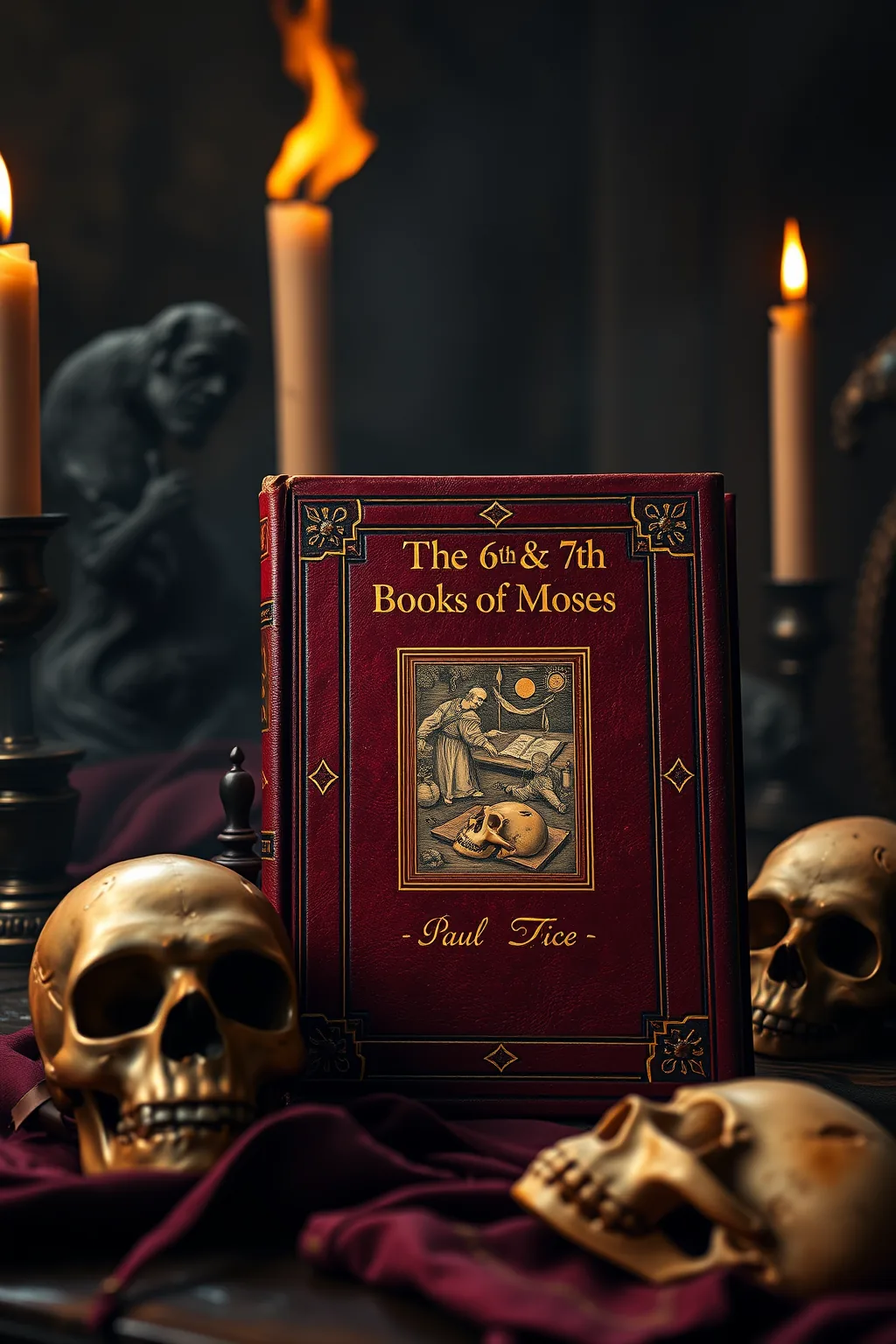
The 6th & 7th Books of Moses
 64
64

The 6th & 7th Books of Moses


Paul Tice's rendering of 'The 6th & 7th Books of Moses' stands as a significant contribution to the study of Kabbalistic magic. It meticulously deciphers complex sigils and incantations, offering a rare glimpse into practical Jewish sorcery and its philosophical underpinnings. Tice's scholarly approach ensures that the esoteric insights are presented with clarity and reverence, making the text accessible yet profoundly deep. The integration of spagiric principles further enriches its occult value. This edition is essential for serious practitioners and scholars seeking to engage with the authentic traditions of Jewish mystical arts, promising a transformative intellectual and spiritual experience.
📝 Description
64
Paul Tice's 2008 work deciphers the legendary 6th and 7th Books of Moses.
This book examines the 6th and 7th Books of Moses, texts traditionally attributed to the biblical figure Moses but with a later, complex history. Paul Tice's study aims to unpack the contents of these often-misunderstood magical texts. He details the divine names and angelic invocations that form a core part of their practice.
The work also discusses the symbolic use of Hebrew letters and the alchemical aspects within these traditions. Tice presents the material not merely as a collection of spells but as a system with philosophical underpinnings concerning the soul and the cosmos. It is written for those seriously studying occult traditions or the history of Jewish esotericism.
The 6th and 7th Books of Moses are part of a magical tradition that emerged in the 18th and 19th centuries, drawing on older Jewish mystical texts and grimoires. They claimed authenticity by linking themselves to the biblical Moses, a figure associated with divine power and knowledge. These books became influential in European occultism, particularly in Germany, and later in America. Their contents often blend Hebrew mysticism with elements from Christian angelology and Hermeticism, focusing on practical magic and the manipulation of spiritual forces.
💡 Why Read This Book?
Uncover potent Kabbalistic secrets and ancient Jewish magical practices. This book offers a rare gateway into the world of divine names, angelic invocations, and alchemical healing. It's an indispensable resource for esoteric scholars, ritual magicians, and spiritual seekers aiming to deepen their understanding of mystical traditions and harness their transformative power.
⭐ Reader Reviews
Honest opinions from readers who have explored this book.
❓ Frequently Asked Questions
What are the 6th and 7th Books of Moses?
These are apocryphal texts attributed to Moses, containing magical formulas, divine names, and talismans believed to grant supernatural powers and facilitate communion with celestial beings. Their true origins are debated, but they are deeply rooted in Kabbalistic and Gnostic traditions.
Is this book suitable for beginners?
While it contains profound esoteric knowledge, it requires dedication. Beginners may find it challenging without prior study in Kabbalah or comparative mysticism. It's best approached with a scholarly or practitioner's mindset.
What is 'spagiric' medicine?
Spagiric medicine is a form of alchemy focused on extracting the vital essence of plants and minerals to create potent healing remedies. It aligns with the magical and medicinal applications described in the 6th and 7th Books of Moses.
What kind of magic is described?
The book details a form of ceremonial and elemental magic, focusing on the use of divine names, angelic invocations, sigils, and talismans to influence natural and spiritual forces for various purposes, including healing and protection.
Are the incantations in Hebrew?
The original texts contain Hebrew names and phrases. This edition by Paul Tice provides translations and explanations, making the complex material accessible to a wider audience interested in its mystical and practical applications.
🔮 Key Themes & Symbolism
Divine Names and Angelic Hierarchy
Central to the 6th and 7th Books of Moses is the potent use of divine names, believed to be the keys to unlocking cosmic forces and communicating with angelic beings. This theme explores the intricate Kabbalistic understanding of God's infinite names and their power to shape reality, invoking specific archangels and hosts for guidance, protection, and manifestation. The text reveals a structured celestial bureaucracy where understanding and correctly pronouncing these names grants the practitioner access to higher realms and their inherent energies, bridging the gap between the mortal and the divine.
The Art of Talismanic Magic and Sigilcraft
This book studies the creation and application of talismans and sigils, ancient tools of magical power. It explains how specific geometric patterns, divine names, and astrological alignments are encoded into these symbols to harness and direct occult energies. The text provides detailed instructions for crafting these potent artifacts, intended for a myriad of purposes, from invoking protection and attracting fortune to influencing health and understanding hidden truths. The practice of sigilcraft here is presented as a sophisticated language of the subconscious, interacting directly with the fabric of existence.
Kabbalistic Alchemy and Spagiric Healing
Beyond mere incantations, the 6th and 7th Books of Moses offer a profound connection to Kabbalistic alchemy and spagiric medicine. This theme explores the esoteric principles of transforming base elements into higher forms, both materially and spiritually. The text outlines methods for preparing potent elixirs and remedies by extracting the vital essence of natural substances, aligning with the belief that the microcosm (human) reflects the macrocosm (universe). It presents a holistic approach to healing, integrating physical well-being with spiritual purity and cosmic harmony.
💬 Memorable Quotes
Direct passages from the work, attributed to the author.
“In the sigil, the will of man meets the power of the heavens.”
— This highlights the magical function of sigils as conduits, enabling the practitioner's focused intent to connect with and draw down celestial energies for specific outcomes.
“Wisdom is found not only in books, but in the very breath of creation.”
— This suggests that true esoteric knowledge encompasses both textual study and direct experiential communion with the natural and spiritual world.
“The body is a temple, and its ailments are reflections of the soul.”
— This underscores the holistic approach of spagiric medicine and Jewish mysticism, viewing physical health as intrinsically linked to spiritual and emotional balance.
“Through the sacred arts, man may touch the divine.”
— This captures the ultimate purpose of the practices described, positioning the esoteric arts as a path for spiritual elevation and direct connection with the divine.
💡 Key Ideas
Editorial paraphrase of the work's core concepts — not direct quotes.
The power of the name is the key to the universe.
This quote emphasizes the Kabbalistic belief that divine names are not mere labels but possess inherent power and can be used to access cosmic forces and influence creation.
🌙 Esoteric Significance
Tradition
This text is deeply rooted in the Kabbalistic tradition of Jewish mysticism, drawing heavily on its concepts of divine emanations (sefiroth), angelic hierarchies, and the power of Hebrew letters as creative forces. It also shows influences from practical Kabbalah, which focuses on the application of these mystical principles for magical and healing purposes, often incorporating elements from Hermeticism and other Western esoteric schools.
Symbolism
The symbolism is rich and multi-layered, featuring divine names representing God's attributes, angelic sigils as keys to celestial powers, and alchemical symbols indicating the transformative processes of nature. The Hebrew alphabet itself is viewed as a fundamental symbolic language of creation, with each letter holding profound mystical meaning and power. The arrangement of these elements in talismans and rituals creates a symbolic map of the cosmos, intended to facilitate interaction between the practitioner and the divine forces.
Modern Relevance
In contemporary esoteric circles, the 6th and 7th Books of Moses remain a vital source for understanding practical Kabbalah and ceremonial magic. Its emphasis on divine names, angelic communication, and the interconnectedness of the spiritual and material realms appeals to modern seekers exploring spiritual growth, energy work, and consciousness expansion. The texts offer a historical lens through which to view the enduring human quest for divine knowledge and empowerment through ritual and symbolic practice.
👥 Who Should Read This Book
This profound text is essential for serious students of Kabbalah and Jewish mysticism, offering direct access to ancient magical practices. Esoteric scholars will find invaluable historical and comparative insights, while practitioners of ritual magic and occult arts will discover potent techniques and incantations. Spiritual seekers interested in the deeper, more active dimensions of faith and the exploration of divine power will also find this a compelling and transformative read, provided they approach it with respect and a dedication to study.
📜 Historical Context
The 6th and 7th Books of Moses emerged from the body of Jewish mystical traditions, particularly the Kabbalah, which flourished in medieval Europe and gained wider circulation from the 18th century onwards. These texts are often associated with a period of intense interest in occult sciences, grimoires, and the practical application of mystical knowledge, blending ancient Hebrew lore with elements of Hermeticism and Christian Kabbalah. Their compilation and dissemination reflect a desire to access a powerful, ancient form of magic purportedly handed down from Moses himself, offering a pathway to divine power and understanding in an era often marked by both religious fervor and intellectual curiosity about the hidden workings of the cosmos. The era saw a confluence of scholarly pursuit and popular fascination with magic, making texts like these both sought-after and influential.
📔 Journal Prompts
Reflect on the concept of divine names. How might the understanding of a name's power influence your perception of reality and your own potential?
Consider the creation of a personal sigil. What intention would you imbue it with, and what symbols would best represent your desire?
Explore the connection between physical health and spiritual well-being as presented in spagiric traditions. How can this holistic view inform your personal wellness practices?
Meditate on the idea of angelic hierarchy. If you could communicate with a specific angelic being, what questions would you ask, and what guidance would you seek?
How does the concept of talismans as conduits of power challenge or affirm your current beliefs about the manifestation of desires?
🗂️ Glossary
Kabbalah
A complex system of Jewish mysticism that seeks to understand the nature of God and the universe through esoteric interpretation of scripture and symbolic representation, often involving divine emanations and angelic realms.
Spagiric
A branch of alchemy focused on extracting the essential virtues of plants and minerals to create potent medicines and remedies, emphasizing spiritual and physical purification.
Sigil
A magical symbol or emblem, often created by combining letters or abstract shapes, believed to hold a specific magical intent or power when charged and activated.
Talisman
An object inscribed with magical symbols, often associated with planetary or divine influences, believed to provide protection, attract fortune, or bestow specific powers upon its bearer.
Divine Names
In Kabbalistic and Jewish mystical traditions, specific names or combinations of Hebrew letters believed to represent God's attributes and possess immense creative and operative power when invoked.
This book appears in 1 collection
🔮 Readers Also Liked
Browse all →








More by Paul Tice
All books →
From the “Kabbalah” Collection
View all →






More Free Kabbalah & Jewish Mysticism Books
View all →