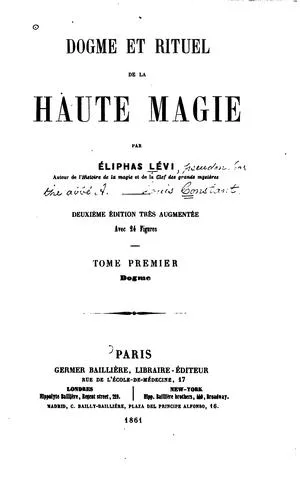
Dogme et rituel de la haute magie
 65
65

Dogme et rituel de la haute magie


Cassian Rothmann (Senior Critic, Ancient Wisdom) — Eliphas Lévi's "Dogme et rituel de la haute magie" remains an indispensable pillar for serious students of occultism. Lévi masterfully synthesizes diverse esoteric traditions, presenting a coherent and compelling system of magic grounded in profound philosophical and theological insights. His eloquent prose, rich with symbolism and intricate analogies, illuminates complex concepts with unparalleled clarity. This work is essential for anyone seeking to understand the historical development and theoretical underpinnings of Western ceremonial magic. It’s a challenging yet deeply rewarding read, offering practical guidance alongside theoretical exposition for the dedicated practitioner and the diligent scholar alike.
📝 Description
65
Eliphas Lévi published Dogme et rituel de la haute magie in 1854, aiming to systematize occult knowledge.
Published in 1854, Eliphas Lévi's Dogme et rituel de la haute magie is a key text in Western occultism. Lévi sought to organize and present the principles of magic, drawing from a wide range of traditions. The book discusses Kabbalah, hermeticism, alchemy, and the practice of ceremonial magic.
Lévi structures his work with a focus on the symbolic language of magic and its correspondence with the universe. He addresses the relationship between the greater cosmos and the individual human experience. The text also touches on spiritual development and the forces of nature, suggesting these can be understood and influenced through study and ritual.
Readers will find discussions on concepts such as good and evil, the divine within humans, and the soul's progression. Lévi's aim was to provide a coherent system for understanding these elements and the practice of magic.
Dogme et rituel de la haute magie stands as a significant work within the 19th-century occult revival. It emerged during a period when figures like Lévi attempted to synthesize disparate esoteric traditions into cohesive systems. Lévi's approach consolidated elements from medieval grimoires, Renaissance hermeticism, and Jewish Kabbalah, presenting them within a framework influenced by contemporary philosophical and scientific thought. This effort to codify magical theory and practice made it influential for later occult movements.
💡 Why Read This Book?
This seminal text is crucial for understanding the historical and philosophical foundations of modern Western esotericism. It offers a comprehensive synthesis of magical principles, occult symbolism, and ritualistic practices, making it invaluable for practitioners seeking deeper knowledge and scholars exploring the history of magic. It's an essential read for anyone drawn to the mysteries of the universe and the potential for spiritual evolution.
⭐ Reader Reviews
Honest opinions from readers who have explored this book.
❓ Frequently Asked Questions
Is "Dogme et rituel de la haute magie" suitable for beginners?
While comprehensive, it's best approached by those with some familiarity with esoteric concepts. Beginners may find it challenging but rewarding with dedicated study and supplementary resources.
What specific occult traditions does Lévi draw upon?
Lévi synthesizes Kabbalah, Hermeticism, Gnosticism, alchemy, Tarot, and ceremonial magic, creating a unique and influential occult framework.
What is the significance of the 'Great Work' in this book?
The Great Work refers to the alchemical and spiritual process of self-transformation, achieving union with the divine, and mastering the forces of the universe.
Does the book provide practical instructions for magic?
Yes, it details various rituals, invocations, and the symbolic language of magic, intended for serious practitioners willing to undertake rigorous study and practice.
What is the role of symbolism in Lévi's magic?
Symbolism is paramount. Lévi views the universe as a grand symbolic language, and understanding these symbols is key to unlocking magical power and divine knowledge.
🔮 Key Themes & Symbolism
The Unity of the Macrocosm and Microcosm
Lévi posits a fundamental interconnectedness between the universe (macrocosm) and the individual human being (microcosm). This principle, rooted in Hermetic philosophy, suggests that the laws governing the cosmos are mirrored within humanity, and vice versa. Understanding this divine correspondence allows the practitioner to influence external reality by working upon their inner self, and vice versa. This theme underscores the potential for human agency and spiritual evolution through conscious alignment with universal principles. The book explores how various symbolic systems, from the Kabbalah to Tarot, serve as keys to deciphering these profound links, enabling the adept to achieve a state of holistic understanding and power.
The Nature of Divine Magic and the Great Work
At the heart of Lévi's work lies the concept of 'high magic' as a divine art, a sacred science aimed at understanding and harmonizing with the will of God. The 'Great Work' is presented not merely as personal spiritual development but as a cosmic endeavor to restore equilibrium and manifest divine order. This involves mastering not only external forces but also the internal field of the magician, purifying desires, and cultivating perfect will. Lévi emphasizes the ethical responsibilities inherent in magical practice, warning against the misuse of power and stressing that true magic is a path of love, wisdom, and sacrifice, leading to ultimate liberation and enlightenment for the practitioner and the world.
The Power of Symbolism and the Astral Light
Lévi dedicates significant attention to the power of symbols as the language of the divine and the subconscious. He argues that symbols, particularly those found in ancient traditions like the Tarot and Kabbalah, are not mere representations but potent keys that unlock hidden truths and spiritual forces. Central to his system is the concept of the 'Astral Light,' an omnipresent universal fluid or medium that carries thought, emotion, and life force. By understanding and manipulating symbols, the magician can influence this Astral Light, shaping reality and achieving desired outcomes. This theme highlights the importance of imagination, intuition, and the symbolic imagination in magical practice.
💬 Memorable Quotes
Direct passages from the work, attributed to the author.
“The universe is a thought of God.”
— This profound statement expresses Lévi's pantheistic view, suggesting that creation is a divine emanation and that all existence is intrinsically linked to the divine consciousness.
“To know, to dare, to will, to keep silence.”
— These are the four cardinal virtues of the magician, representing the stages of magical practice: intellectual understanding, courageous action, unwavering intention, and discretion in execution.
“The key of the occult sciences is the key of the Pentagram.”
— The Pentagram, a five-pointed star, is presented as a universal symbol of the microcosm and humanity, embodying the balance of elements and the divine spark within.
“Magic is the science of the secret forces of nature.”
— This defines magic not as superstition but as a legitimate, albeit hidden, scientific discipline that seeks to understand and work with the fundamental energies of existence.
“The abyss is the sea of the unknown.”
— Lévi uses the 'abyss' to symbolize the vast, unfathomable depths of the subconscious, the divine mystery, and the untamed potential that the magician must navigate.
🌙 Esoteric Significance
Tradition
Lévi's work is a monumental synthesis of Western esoteric traditions. He masterfully ties together threads from Kabbalah, Hermeticism, Gnosticism, alchemy, and ceremonial magic, presenting them as interconnected facets of a single, unified occult science. His reinterpretation of these ancient systems provided a framework for understanding the divine nature of magic and its potential for spiritual transformation. He sought to elevate magic from mere superstition to a profound philosophy and a sacred art, accessible through rigorous intellectual study and disciplined practice.
Symbolism
Symbolism is the very language of Lévi's magic. He posits that the universe is imbued with symbolic meaning, and that understanding these symbols is paramount to comprehending divine will and wielding magical forces. Key symbols explored include the Pentagram (representing humanity and the microcosm), the Tetragrammaton (divine name and creation), the Tree of Life (Kabbalistic cosmology), and the Tarot (a symbolic map of the soul's journey). Lévi believed that by mastering the symbolic language, the practitioner could unlock the hidden forces of the Astral Light and effect profound changes.
Modern Relevance
Despite its 19th-century origins, "Dogme et rituel de la haute magie" remains remarkably relevant. It provides a robust theoretical foundation for modern magical practices, influencing everything from ceremonial magic to modern witchcraft and neopaganism. Lévi's emphasis on the interconnectedness of all things, the power of consciousness, and the importance of ethical magical conduct resonates deeply with contemporary seekers. His work continues to inspire those who seek a deeper understanding of the universe, their place within it, and the potential for personal and spiritual evolution through disciplined occult study.
👥 Who Should Read This Book
This work is a starting point for any serious student of Western esotericism. **Beginners** with a strong curiosity and a willingness to grapple with complex ideas will find a rich, albeit challenging, introduction. **Scholars** of religion, philosophy, and occult history will discover an invaluable primary source detailing the synthesis of 19th-century magical thought. **Seekers** of spiritual growth and hidden knowledge will be drawn to Lévi's clear insights into the nature of reality and the divine. **Practitioners** of ceremonial magic and related disciplines will find detailed theoretical underpinnings and symbolic keys essential for their craft.
📜 Historical Context
Published in 1854-1856, "Dogme et rituel de la haute magie" emerged during a period of intense occult revival in 19th-century Europe, known as the 'Occult Revival.' Following the French Revolution and the Enlightenment's challenge to traditional authority, there was a resurgence of interest in mysticism, spiritualism, and forgotten esoteric traditions. Eliphas Lévi, born Alphonse Louis Constant, was a central figure in this movement, seeking to synthesize disparate magical and religious doctrines into a coherent philosophical system. His work drew heavily on Renaissance Hermeticism, Kabbalah, and earlier occult writers, reinterpreting them for a modern audience. Lévi's writings profoundly influenced subsequent generations of occultists, including the Hermetic Order of the Golden Dawn, Aleister Crowley, and numerous other practitioners and scholars, solidifying his status as a foundational figure in modern Western esotericism.
📔 Journal Prompts
Reflect on the concept of the Macrocosm and Microcosm. How do you see these correspondences manifesting in your own life or in the world around you?
Lévi emphasizes the four cardinal virtues of the magician: to know, to dare, to will, to keep silence. Which of these do you find most challenging, and why?
Consider the role of symbolism in your life. What symbols hold particular power or meaning for you, and what might they represent on a deeper level?
The book discusses the 'Great Work' as a process of spiritual transformation. What does this 'work' mean to you personally, and what steps can you take towards it?
Lévi believed magic is a science of secret forces. What 'secret forces' do you feel are at play in the universe, and how might they be understood or influenced?
🗂️ Glossary
Kabbalah
A complex system of Jewish mysticism and esoteric interpretation of the Hebrew Bible, focusing on divine emanations, the Tree of Life, and hidden meanings within scripture.
Hermeticism
A philosophical and religious tradition based on writings attributed to Hermes Trismegistus, emphasizing esoteric knowledge, the unity of all things, and the principle of 'As Above, So Below'.
Astral Light
In Lévi's system, a universal, omnipresent fluid or medium that carries thought, life force, and influences reality; often seen as a bridge between the spiritual and material realms.
The Great Work (Main work)
The ultimate aim of the magician or alchemist, referring to the process of spiritual purification, self-transformation, achieving gnosis, and often, the creation of the Philosopher's Stone.
Pentagram
A five-pointed star, considered a powerful symbol in occultism representing the five elements (spirit, air, fire, water, earth) and the human being; its upright form often signifies good.
This book appears in 2 collections
🔮 Readers Also Liked
Browse all →





More by Eliphas Lévi
All books →

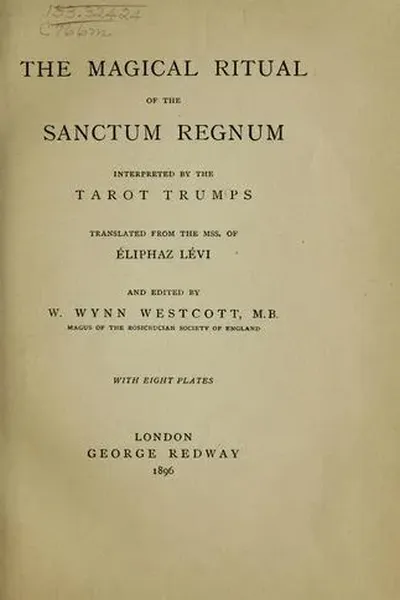


From the “Ritual Magic” Collection
View all →








More Free Magic & Ritual Books
View all →