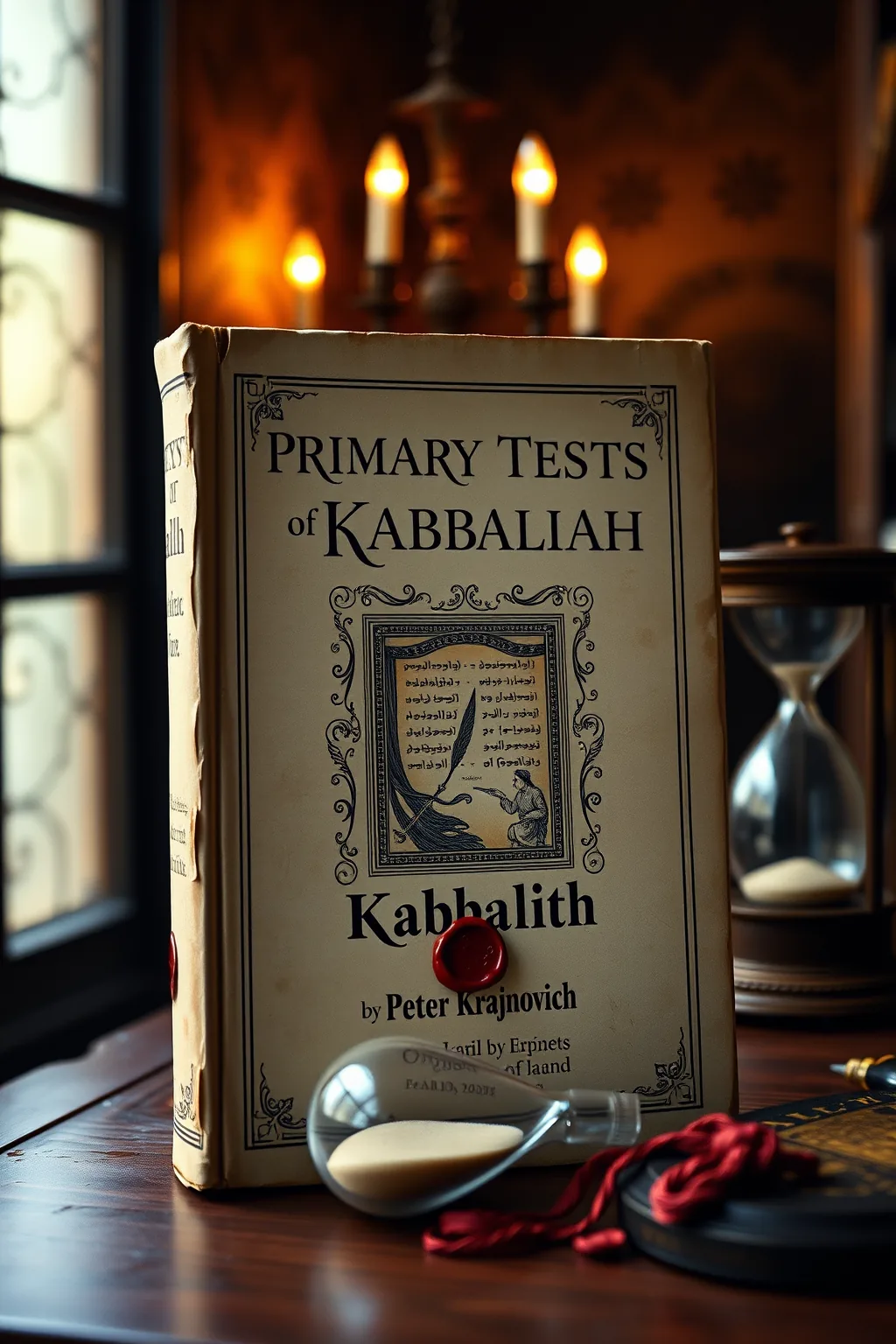
Primary Texts of Kabbalah
 61
61

Primary Texts of Kabbalah


Review by Isolde Whitaker (Sacred Texts Editor) — 'Primary Texts of Kabbalah' by Peter Krajnovich is an indispensable gateway for anyone seeking to penetrate the veils of Jewish mysticism. Krajnovich's scholarly yet accessible approach to these foundational texts unlocks their profound esoteric insights, moving beyond mere academic recitation to reveal the vibrant spiritual core. This collection serves as a crucial resource for understanding the Tree of Life, divine names, and the contemplative practices that underpin Kabbalah. Its strength lies in its direct presentation of primary sources, allowing readers to engage authentically with the wisdom that has shaped millennia of spiritual inquiry. An essential read for students and practitioners alike.
📝 Description
61
Peter Krajnovich's 2017 book presents the core Kabbalistic scriptures.
Peter Krajnovich's 'Primary Texts of Kabbalah' brings together key Kabbalistic writings, making them accessible to a wider audience. The book includes foundational texts that have shaped Jewish mystical thought for centuries. Krajnovich aims to give readers direct access to these influential scriptures, avoiding secondary interpretations.
The volume covers concepts such as divine emanations, the structure of the Tree of Life, and the soul's spiritual journey. Krajnovich's commentary clarifies the symbolic language and cosmic ideas present in these writings. The goal is to allow for a more direct engagement with the source material of Kabbalah, enabling readers to understand its historical and spiritual significance.
This book sits within the tradition of Kabbalah, a form of Jewish mysticism that developed in the Middle Ages. Kabbalistic thought focuses on understanding the divine nature and the relationship between God and the created world through esoteric interpretation of religious texts. It often employs complex symbolic systems, such as the Tree of Life, to map spiritual realities and guide practitioners on paths of contemplation and mystical experience. The texts collected here are central to this tradition, offering insights into its core doctrines and practices.
💡 Why Read This Book?
Unravel the profound secrets of Jewish mysticism directly from its ancient sources. 'Primary Texts of Kabbalah' offers an unvarnished exploration of divine emanations, symbolic cosmology, and mystical ascent. Ideal for seekers yearning for deeper spiritual understanding, scholars pursuing rigorous study, and practitioners aiming to enrich their contemplative practice with authentic Kabbalistic wisdom.
⭐ Reader Reviews
Honest opinions from readers who have explored this book.
❓ Frequently Asked Questions
What are the primary texts of Kabbalah?
This collection includes foundational Kabbalistic works, such as selections from the Zohar, Sefer Yetzirah, and other key mystical treatises that form the bedrock of this rich esoteric tradition.
Is this book suitable for beginners?
While the texts are profound, Krajnovich's work provides guidance making it accessible to dedicated beginners eager to explore the esoteric dimensions of Jewish mysticism.
What is the Tree of Life in Kabbalah?
The Tree of Life is a central symbolic diagram representing the structure of the universe, the divine emanations, and the path of spiritual ascent and descent.
How does Kabbalah relate to everyday life?
Kabbalah offers profound insights into the nature of reality, human consciousness, and the divine spark within all things, providing a framework for living a more meaningful and spiritually connected life.
Are these texts translated or original Hebrew?
This volume primarily presents comprehensive English translations, making these ancient mystical teachings accessible to a wider audience without compromising their spiritual depth.
🔮 Key Themes & Symbolism
The Tree of Life: Cosmic Blueprint
This central motif in Kabbalah, often depicted as a diagram of ten interconnected spheres (Sefirot), serves as a cosmic blueprint. It illustrates the process of divine emanation from the unknowable Ein Sof (Infinite) into the manifest universe, and the pathways of spiritual ascent for the human soul. Understanding its structure unlocks the underlying order of creation and the intricate relationships between the divine and the material realms. It is a map for spiritual journeying and a key to deciphering the universe's symbolic language.
Divine Emanations and Names
Kabbalah posits that the Divine manifests through a series of emanations, known as Sefirot, each with its unique energetic quality and role in creation. The sacred Hebrew names of God are considered potent keys to accessing and interacting with these divine energies. Exploring these primary texts reveals the mystical significance of these names and the intricate interplay of divine forces that shape existence, offering a pathway to understanding the very fabric of reality and one's connection to the Infinite.
The Ascent of the Soul
Fundamentally, Kabbalah is a path of spiritual transformation and ascent. The primary texts detail the methods and stages by which the soul can purify itself, transcend earthly limitations, and achieve union or communion with the Divine. This journey involves deep contemplative practices, ethical refinement, and an understanding of the soul's divine origins and ultimate destiny. These writings offer profound guidance for those seeking to start their own inner journey towards spiritual awakening and enlightenment.
💬 Memorable Quotes
Direct passages from the work, attributed to the author.
“The hidden is revealed through the symbolic.”
— This aphorism underscores Kabbalah's reliance on symbolic language to convey profound spiritual truths that transcend literal understanding.
“From the Infinite, all flows.”
— A concise statement of the Kabbalistic principle of divine emanation, where all existence originates from the boundless Ein Sof.
“The ladder of the soul reaches the heavens.”
— This evocative phrase describes the Kabbalistic concept of spiritual ascent, where through practice and understanding, the soul can progress towards divine proximity.
“Know thyself, know the universe.”
— Highlights the interconnectedness of the microcosm (human) and the macrocosm (universe) central to Kabbalistic philosophy.
“Wisdom is the light that guides the seeker.”
— Emphasizes the transformative power of acquiring spiritual knowledge and understanding on the path of mystical exploration.
🌙 Esoteric Significance
Tradition
Kabbalah represents a profound esoteric tradition within Judaism, focused on understanding the nature of God, the creation of the universe, and the spiritual destiny of humanity. It is a mystical path that seeks direct experience of the Divine through contemplation, meditation, and the study of sacred texts. Its esoteric nature lies in its symbolic language, its intricate cosmology, and its emphasis on hidden meanings and divine secrets, offering a framework for spiritual transformation and gnosis.
Symbolism
Symbolism is the very language of Kabbalah. The Tree of Life, divine names, letters of the Hebrew alphabet, and geometric patterns are not mere decorations but potent vessels of spiritual meaning. These symbols represent divine attributes, cosmic forces, stages of creation, and pathways of the soul. Understanding their layered meanings allows the initiated to decipher the hidden architecture of reality and engage with the divine energies that permeate existence, transforming abstract concepts into tangible spiritual insights.
Modern Relevance
In the modern era, Kabbalah continues to resonate deeply with individuals seeking spiritual depth and a framework for understanding life's complexities. Its teachings on consciousness, interconnectedness, and personal transformation offer powerful tools for reading through the challenges of contemporary life. The esoteric insights into the nature of reality and the human potential for spiritual growth provide a timeless wisdom that speaks to a universal yearning for meaning, purpose, and connection to something greater than oneself.
👥 Who Should Read This Book
This collection is essential for serious students of comparative religion and mysticism, offering direct access to foundational Kabbalistic thought. Scholars will find it an invaluable resource for academic research into Jewish mysticism. Spiritual seekers yearning for a deeper understanding of esoteric traditions will discover clear insights into divine cosmology and the nature of the soul. Practitioners of meditation and contemplative arts can enrich their practice by engaging with the authentic teachings and symbolic language of Kabbalah, seeking to integrate ancient wisdom into their personal spiritual journey.
📜 Historical Context
The primary texts of Kabbalah emerged from the rich intellectual and spiritual soil of medieval Judaism, particularly flourishing in the mystical centers of Provence and Spain from the 12th century onwards. This period saw a confluence of philosophical inquiry, scriptural exegesis, and a burgeoning desire to experience the Divine more directly. Influenced by earlier Jewish mystical traditions, Neoplatonic thought, and Gnostic ideas, Kabbalah developed a complex symbolic system to interpret the Torah and the nature of God. The era was marked by both intellectual ferment and periods of persecution, which often intensified the search for hidden spiritual meaning and solace. The publication and dissemination of these texts, such as the Zohar, profoundly shaped Jewish thought and practice, influencing not only religious scholarship but also art, literature, and subsequent esoteric movements across the globe.
📔 Journal Prompts
Reflect on a moment when you felt a sense of profound connection to something larger than yourself. How might the concept of divine emanation relate to this experience?
Consider the symbolism of a tree in your own life or culture. How does its structure and growth mirror or contrast with the Kabbalistic Tree of Life?
Explore the idea of 'hidden wisdom.' What is one concept or truth that feels hidden from you currently, and what steps could you take to 'reveal' it?
How can the concept of divine names, even if not specific Kabbalistic ones, influence your perception and relationship with the world around you?
If the soul's journey is an ascent, what 'steps' or practices in your life are helping you move closer to your spiritual aspirations?
🗂️ Glossary
Ein Sof
The Kabbalistic term for the Infinite, the unknowable, absolute Godhead that exists beyond all comprehension and limitation, the ultimate source of all existence.
Sefirot
The ten divine emanations or attributes through which Ein Sof creates and sustains the universe, forming the structure of the Kabbalistic Tree of Life.
Zohar
A foundational work of Kabbalah, considered the central text, offering mystical interpretations of the Torah and exploring profound theological and cosmological concepts.
Sefer Yetzirah
An ancient and enigmatic Kabbalistic text that describes the creation of the universe through the manipulation of Hebrew letters and numbers, considered one of the earliest Kabbalistic writings.
Malkuth
The tenth Sefirah on the Tree of Life, representing the Kingdom, the physical world, and the final emanation, where the divine manifests most concretely.
This book appears in 1 collection
🔮 Readers Also Liked
Browse all →








From the “Kabbalah” Collection
View all →






More Free Kabbalah & Jewish Mysticism Books
View all →