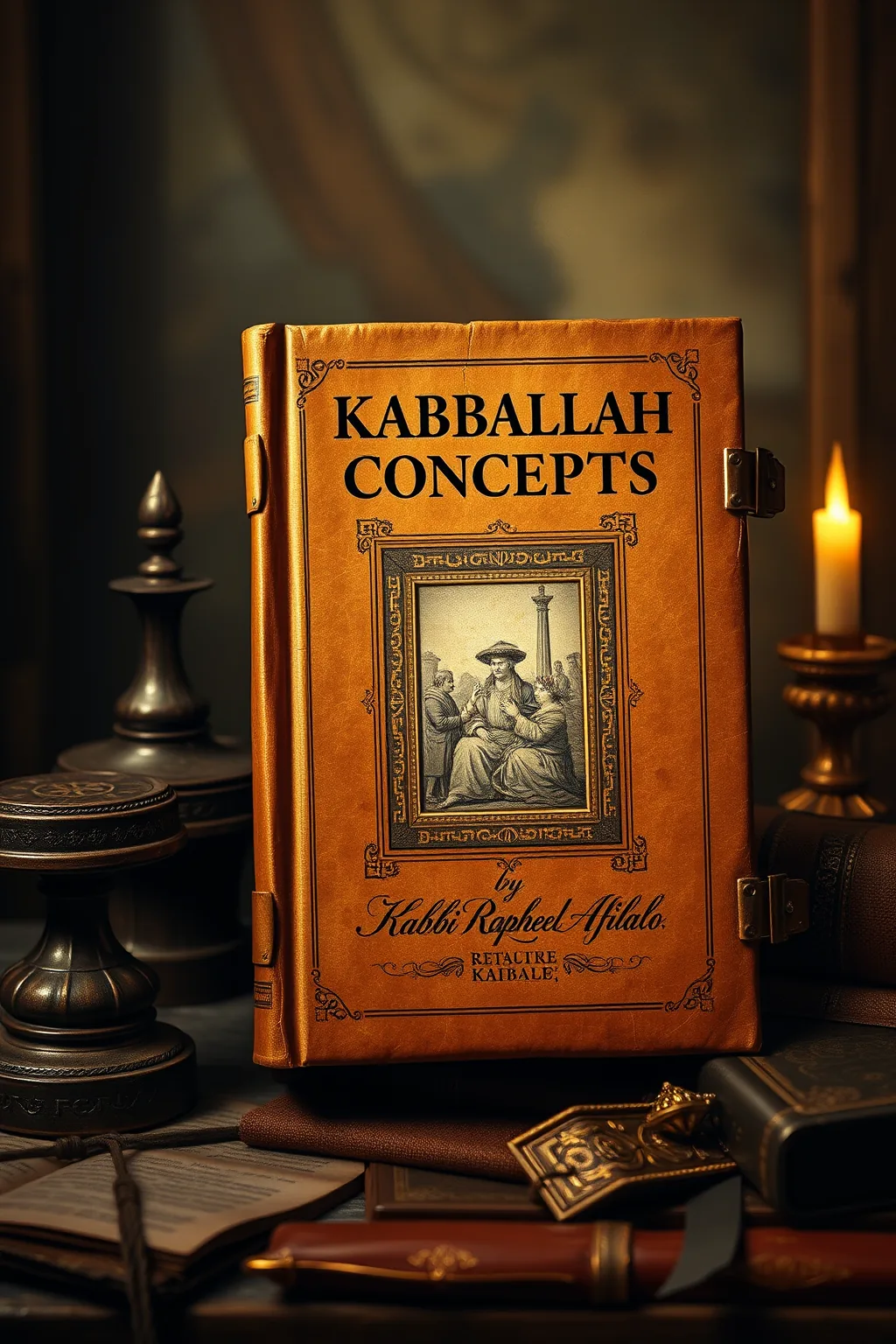
Kabbalah Concepts
 61
61

Kabbalah Concepts


Alaric Kestrel (Metaphysical Studies Reviewer): Rabbi Raphael Afilalo's "Kabbalah Concepts" is a beacon of clarity in the often-labyrinthine world of Jewish mysticism. Afilalo possesses a rare gift for elucidating complex esoteric doctrines with both scholarly rigor and profound spiritual depth. He masterfully navigates the intricate symbolism of Kabbalah, offering readers not merely an academic understanding, but a tangible connection to its transformative power. This work is particularly adept at illuminating the practical applications of Kabbalistic thought, making it an essential read for both neophytes seeking an accessible entry point and seasoned practitioners looking to deepen their comprehension. A true gem for the serious student.
📝 Description
61
Rabbi Raphael Afilalo's 'Kabbalah Concepts' explains the Sephirot, Ein Sof, and Tzimtzum.
Rabbi Raphael Afilalo's book, 'Kabbalah Concepts,' details core ideas within Jewish mysticism. The author explains the Sephirot, the divine emanations, and concepts like Ein Sof, the infinite divine essence, and Tzimtzum, the act of divine contraction. Afilalo also discusses the Tree of Life as a framework for understanding these principles. The book aims to clarify these complex ideas for those interested in spiritual and philosophical aspects of Kabbalah. It presents these topics with a tone suitable for contemplation. Readers can expect explanations that connect these mystical elements to a broader understanding of existence and consciousness.
The text addresses the hidden language of the divine and the structure of the cosmos as understood in Kabbalistic thought. It is designed for individuals seeking spiritual insight and a more thorough grasp of the philosophical foundations of reality. The work intends to offer a perspective on existence and consciousness, highlighting the interconnectedness of all things. It guides readers toward a form of inner knowledge through its exposition of these esoteric principles.
This book is situated within the tradition of Kabbalah, a school of Jewish mysticism that originated in the medieval period. Kabbalah seeks to understand the divine nature and the relationship between God and the created world. Its teachings often employ symbolic language and complex metaphysical frameworks, such as the Sephirot and the Tree of Life, to map out divine emanations and the structure of reality. 'Kabbalah Concepts' engages with these core elements, aiming to make them accessible to a wider audience interested in esoteric philosophy and spiritual inquiry.
💡 Why Read This Book?
Unveil the profound secrets of the universe and the divine blueprint of creation. "Kabbalah Concepts" offers a clear, accessible pathway into Jewish mysticism, demystifying complex esoteric ideas. Ideal for spiritual seekers yearning for deeper meaning, scholars pursuing rigorous metaphysical inquiry, and practitioners seeking to integrate ancient wisdom into their spiritual path. Discover the interconnectedness of all things and your place within the cosmic dance.
⭐ Reader Reviews
Honest opinions from readers who have explored this book.
❓ Frequently Asked Questions
What are the primary concepts explored in this book?
The book delves into fundamental Kabbalistic concepts such as the Ein Sof (Infinite God), Tzimtzum (Divine Contraction), the Ten Sephirot (Divine Emanations), the Tree of Life, and the nature of the soul's journey. It aims to provide a foundational understanding of this rich mystical tradition.
Is this book suitable for beginners in Kabbalah?
Yes, "Kabbalah Concepts" is designed to be accessible to those new to Kabbalah. Rabbi Afilalo employs clear language and illustrative explanations to guide newcomers through the core tenets of this profound system of thought.
What is the philosophical significance of the Sephirot?
The Sephirot represent the divine attributes or emanations through which the Infinite God manifests in the created universe. They are seen as the building blocks of reality and the pathways for divine revelation and human spiritual ascent.
How does this book differ from other Kabbalah texts?
While many texts focus on specific aspects, "Kabbalah Concepts" provides a comprehensive overview of foundational ideas. Rabbi Afilalo's approach emphasizes clarity and practical application, making the esoteric accessible without sacrificing depth.
Can Kabbalah be practiced in a modern context?
Absolutely. The principles of Kabbalah offer timeless wisdom applicable to contemporary life. The book explores how these ancient concepts can inform personal growth, ethical living, and a deeper understanding of one's spiritual purpose.
🔮 Key Themes & Symbolism
The Divine Emanations (Sephirot)
The ten Sephirot form the central axis of Kabbalistic cosmology, representing the manifold ways in which the Infinite (Ein Sof) reveals itself and interacts with creation. These divine energies are not static but dynamic, forming a sacred blueprint that governs all existence. Understanding the Sephirot is crucial for grasping the hierarchical structure of the divine realm, the processes of creation, and the potential for human connection to the divine. Each Sephirah possesses unique qualities and correspondences, offering a map for spiritual ascent and a framework for understanding the interplay between the spiritual and material worlds.
The Infinite and Its Manifestation (Ein Sof & Tzimtzum)
At the apex of Kabbalistic thought lies Ein Sof, the unknowable, boundless, and utterly transcendent Godhead that precedes all existence. The concept of Tzimtzum, or Divine Contraction, is a key explanation for how creation became possible. It posits that Ein Sof 'withdrew' or 'contracted' itself to make space for the emergence of the universe. This act of self-limitation is not a diminishment of the Divine, but a necessary condition for the manifestation of multiplicity and the emergence of distinct entities within the created order.
The Tree of Life and Spiritual Ascent
The Tree of Life is the quintessential symbolic map of Kabbalistic cosmology, visually representing the interconnectedness of the Sephirot and the pathways through which divine energy flows. It serves as a guide for understanding the structure of both the cosmos and the human soul. Practitioners utilize the Tree of Life as a meditative tool and a framework for spiritual development, aiming to ascend through its different spheres, thereby refining their consciousness and drawing closer to the Divine source from which all emanates.
💬 Memorable Quotes
Direct passages from the work, attributed to the author.
“Each Sephirah is a gateway to a facet of God's being.”
— Highlights the role of the Sephirot not just as abstract concepts, but as channels or portals through which divine attributes are made accessible to creation and humanity.
“The soul's journey is a return to the source, a homecoming.”
— Emphasizes the cyclical and redemptive nature of the soul's path in Kabbalah, moving from emanation back to its divine origin.
“Wisdom is not found, but revealed through inner stillness.”
— Underscores the importance of contemplative practices and inner receptivity in accessing esoteric knowledge, rather than mere intellectual pursuit.
“The light within mirrors the light above.”
— Speaks to the principle of correspondence, suggesting that the microcosm (human being) reflects the macrocosm (divine universe).
💡 Key Ideas
Editorial paraphrase of the work's core concepts — not direct quotes.
The universe is a divine whisper, echoing the Infinite's breath.
This quote evokes the idea that all of existence is imbued with divine essence, a subtle yet profound emanation of the ultimate reality (Ein Sof).
🌙 Esoteric Significance
Tradition
This book is deeply rooted in the Western Esoteric tradition, specifically within the lineage of Jewish Kabbalah. It represents a significant branch of mystical thought that seeks to understand the hidden dimensions of reality, the nature of God, and the human potential for spiritual enlightenment through symbolic language and contemplative practices.
Symbolism
Kabbalah is inherently a symbolic system. Key symbols explored include the Ten Sephirot, often visualized as the Tree of Life, which maps divine emanations and cosmic structure. Other vital symbols include the Hebrew letters, which are seen as fundamental building blocks of creation, and concepts like light and darkness, which represent divine presence and absence, or spiritual clarity and obscurity.
Modern Relevance
The esoteric principles of Kabbalah, as presented in this work, offer timeless insights into consciousness, the nature of reality, and personal transformation. They provide frameworks for understanding suffering, purpose, and interconnectedness, resonating with modern seekers interested in spirituality, psychology, and the deeper mysteries of existence. The emphasis on inner work and divine connection remains profoundly relevant for navigating contemporary life.
👥 Who Should Read This Book
This book is essential for anyone drawn to the profound depths of Jewish mysticism. For the **beginner**, it offers a clear and accessible introduction to core Kabbalistic concepts, clarifying complex ideas. **Scholars** of religion and philosophy will find a rigorous yet comprehensible exploration of a foundational esoteric tradition. **Spiritual seekers** yearning for a deeper understanding of the divine and their place in the cosmos will find rich guidance. **Practitioners** of meditation or contemplative disciplines can utilize its insights to enhance their spiritual journey and integrate ancient wisdom into their lives.
📜 Historical Context
The development of Kabbalah, particularly its systematization into the form explored in "Kabbalah Concepts," flourished in the medieval period, primarily in Provence and Spain, between the 12th and 15th centuries. This era was marked by a rich intellectual and spiritual landscape, where Jewish thinkers sought to reconcile scriptural interpretation with profound mystical experiences. Influenced by Neoplatonism and Gnosticism, Kabbalists developed complex cosmologies and esoteric doctrines to understand the divine nature, the creation of the universe, and the human soul's relationship with God. Key texts like the Zohar emerged during this period, shaping the trajectory of Jewish mysticism for centuries. This rich intellectual heritage provided fertile ground for the exploration of hidden meanings and esoteric symbolism, profoundly influencing Jewish thought and practice.
📔 Journal Prompts
Reflect on the concept of Ein Sof and how its infinitude might influence your perception of limitations in your life.
Consider the Tzimtzum. How does the idea of divine 'contraction' for the sake of creation resonate with your own experiences of making space for others?
Meditate on one of the Sephirot that particularly calls to you. What qualities does it represent, and how can you cultivate them within yourself?
Visualize the Tree of Life. What pathway or connection within it feels most relevant to your current spiritual quest?
Explore the idea of divine 'whispers' in the universe. Where have you perceived subtle divine guidance in your life recently?
🗂️ Glossary
Ein Sof
The Kabbalistic term for the Infinite, the Godhead beyond all conception or description, the ultimate, unknowable divine source of all existence.
Sephirot
The ten divine emanations or attributes through which the Infinite God manifests and interacts with creation. They form the structure of the Kabbalistic Tree of Life.
Tzimtzum
A Hebrew term meaning 'contraction' or 'condensation.' In Kabbalah, it refers to the initial divine act of self-limitation to make space for the creation of the universe.
Tree of Life (Etz Chaim)
The central symbolic diagram in Kabbalah, depicting the ten Sephirot and the pathways connecting them, representing the structure of the cosmos and the soul.
Kavanah
Intention or concentration, particularly in prayer or ritual. In Kabbalah, Kavanah refers to the focused spiritual intention required to connect with divine energies.
This book appears in 1 collection
🔮 Readers Also Liked
Browse all →







More by Rabbi Raphael, Afilalo
All books →
From the “Kabbalah” Collection
View all →






More Free Kabbalah & Jewish Mysticism Books
View all →