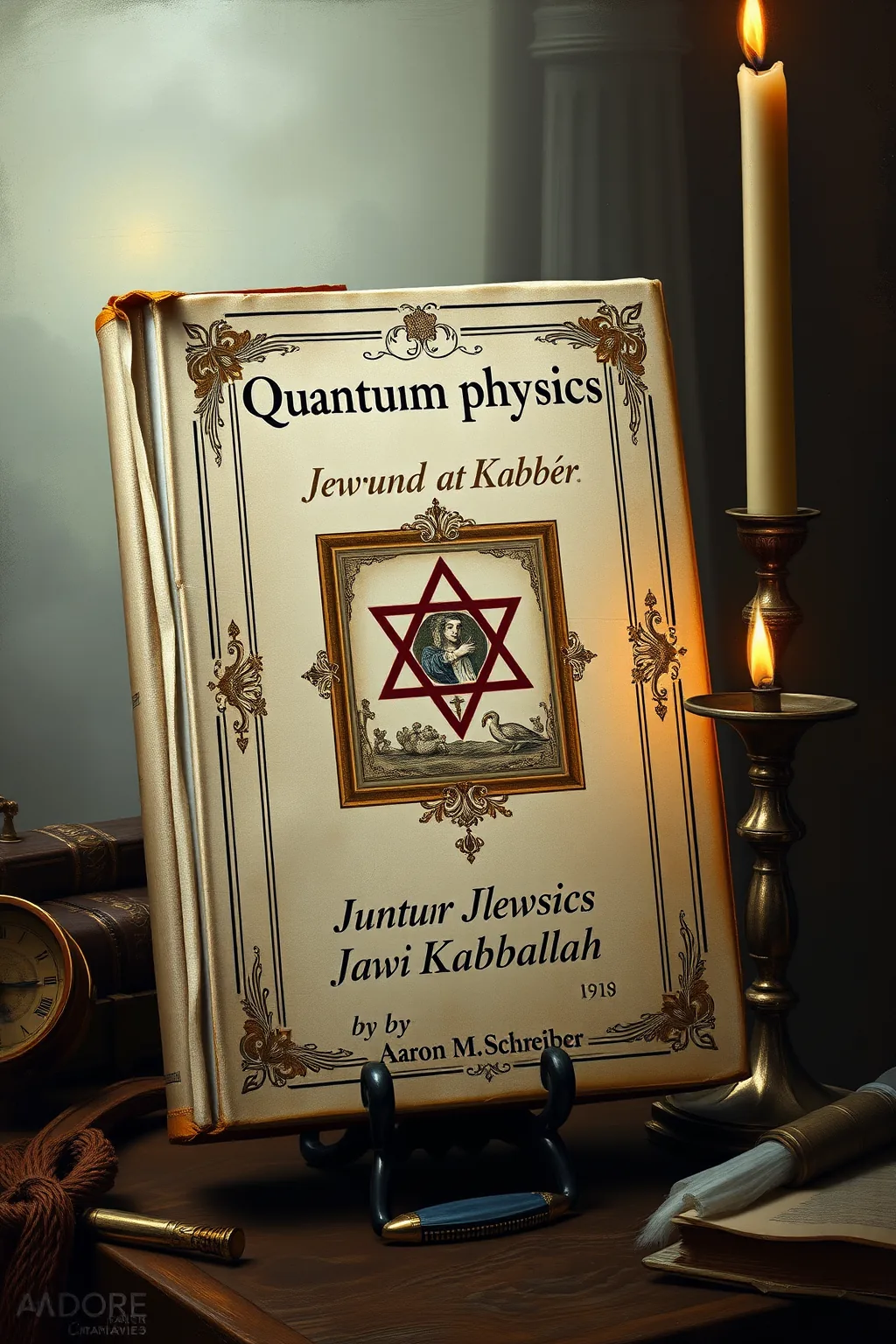
Quantum physics, Jewish law and Kabbalah
 61
61

Quantum physics, Jewish law and Kabbalah



By Balthazar Finch (Senior Critic, Occult Philosophy) — Aaron M. Schreiber's "Quantum Physics, Jewish Law and Kabbalah" is a revelation for the serious student of esoteric knowledge. Schreiber navigates the labyrinthine connections between quantum mechanics and Kabbalistic principles with remarkable clarity and erudition. He doesn't just draw parallels; he reveals profound resonances, suggesting a unified cosmic blueprint. The author's ability to distill complex scientific theories and ancient mystical doctrines into a cohesive narrative is exceptional. This work is a testament to the enduring power of ancient wisdom in explaining the deepest mysteries of existence. Essential for scholars of both science and mysticism, and invaluable for practitioners seeking to deepen their understanding of reality's foundational structures.
📝 Description
61
Aaron M. Schreiber's 2010 book connects quantum physics with Jewish law and Kabbalah.
This book examines the surprising connections between modern quantum physics and traditional Jewish thought. Aaron M. Schreiber draws parallels between the behavior of subatomic particles and concepts found in Jewish law (Halakha) and Kabbalah. The author looks at how the structure of reality as described by physics might mirror the divine architecture detailed in Kabbalistic texts, such as the Sephirot. Schreiber aims to make these complex ideas understandable for readers interested in both science and mysticism. He suggests that a deeper understanding of the universe can be found by looking at both scientific research and sacred traditions.
The book bridges the gap between the material world studied by science and the spiritual dimensions explored in esoteric traditions. It argues that Jewish mysticism and quantum mechanics are not opposing forces but can offer complementary perspectives on existence. By analyzing specific concepts from both fields, Schreiber reveals potential resonances and shared patterns. This work is for those who seek a more unified worldview, integrating scientific discovery with ancient spiritual insights.
This work situates itself within esoteric traditions that seek correspondences between different levels of reality. It specifically engages with Jewish mysticism, particularly Kabbalah, which often employs symbolic language and numerology to describe the divine structure of the cosmos. By juxtaposing these mystical concepts with findings from quantum physics, the book participates in a broader esoteric practice of finding universal patterns and hidden meanings. It suggests that ancient contemplative systems may hold insights relevant to contemporary scientific understanding of the universe.
💡 Why Read This Book?
Uncover the astonishing parallels between cutting-edge quantum science and ancient Kabbalistic wisdom. This book offers a unique perspective on the fundamental nature of reality, revealing hidden patterns in Jewish law that resonate with quantum principles. It’s ideal for seekers of truth, scholars of religion and science, and practitioners of mysticism who wish to explore the profound unity underlying all existence, offering a path to deeper understanding and spiritual insight.
⭐ Reader Reviews
Honest opinions from readers who have explored this book.
❓ Frequently Asked Questions
Is prior knowledge of Kabbalah or quantum physics required?
While a foundational understanding will enhance the experience, Schreiber's clear explanations make the concepts accessible to curious beginners. The book is designed to guide readers through complex ideas, fostering comprehension regardless of their prior academic background.
What is the primary goal of this book?
The book aims to demonstrate the profound interconnectedness between the physical universe as described by quantum physics and the spiritual cosmology of Kabbalah, suggesting a unified understanding of reality.
How does Jewish law relate to quantum physics in this context?
Schreiber explores how the principles and structure of Jewish law, particularly its emphasis on order, causality, and divine immanence, find echoes and symbolic representations within the concepts of quantum theory.
Who is the intended audience for this work?
This book is for scholars, students, and practitioners of Kabbalah and Jewish mysticism, as well as scientists and philosophers interested in the intersection of spirituality and modern physics.
Does this book offer practical applications?
While primarily an exploration of theoretical connections, the insights gained can profoundly influence one's spiritual practice, understanding of consciousness, and perception of the interconnectedness of all things.
🔮 Key Themes & Symbolism
The Unified Field of Existence
This theme explores the concept of a singular, underlying reality that bridges the seemingly disparate worlds of quantum mechanics and Kabbalistic cosmology. Schreiber posits that both disciplines, through their unique lenses, point towards a fundamental interconnectedness, where observer and observed, macrocosm and microcosm, are inextricably linked. The exploration highlights how quantum phenomena like entanglement and superposition can be seen as reflections of the divine unity (Ein Sof) and the interconnectedness of all emanations within the Kabbalistic Tree of Life, suggesting a cosmic architecture that is both scientifically observable and mystically profound.
Symbolism in Law and Light
Here, the focus shifts to the symbolic language employed by both science and mysticism. Schreiber meticulously examines how the abstract principles of quantum theory, such as wave-particle duality and quantum fields, find potent symbolic parallels within the intricate framework of Jewish law (Halakha) and Kabbalistic symbolism. The divine light (Ohr) in Kabbalah, the fundamental forces in physics, and the underlying order in Jewish observance are presented not as mere analogies but as expressions of a shared energetic and informational substrate that governs existence, revealing a deeper semantic layer to reality.
Consciousness and Creation's Blueprint
This crucial theme investigates the role of consciousness in shaping reality, a concept central to both quantum observer effects and Kabbalistic contemplation. Schreiber explores how the act of perception and intention, integral to both scientific observation and mystical practice, influences the manifestation of existence. The book examines how the Kabbalistic understanding of the divine mind (Da'at) and the creative process described in the Torah can be reinterpreted through the lens of quantum field theory, suggesting that consciousness is not merely a byproduct of matter but a fundamental aspect of the universe's ongoing creation.
💬 Memorable Quotes
Direct passages from the work, attributed to the author.
“Within the quantum foam, traces of the divine emanations can be perceived.”
— This suggests that the most fundamental levels of physical reality may hold clues to the spiritual architecture described in Kabbalah, linking the subatomic to the supernal.
“Jewish law, in its meticulous detail, mirrors the ordered elegance of cosmic principles.”
— This highlights how the structure and philosophy of religious observance can be seen as a reflection of universal laws, revealing divine order in human action.
“The observer is not separate from the observed; they are woven into the same cosmic range.”
— This points to the interconnectedness emphasized by both quantum mechanics and mystical traditions, challenging the notion of an isolated self.
“To understand the macrocosm, one must first contemplate the microcosm.”
— This classic esoteric principle is applied to both scientific inquiry and spiritual practice, suggesting that profound truths can be found in studying the smallest constituents of existence.
💡 Key Ideas
Editorial paraphrase of the work's core concepts — not direct quotes.
The universe whispers its secrets in the language of both mathematics and mysticism.
This quote expresses the book's central thesis: that scientific laws and spiritual insights are not contradictory but complementary paths to understanding reality's deepest truths.
🌙 Esoteric Significance
Tradition
The primary esoteric tradition explored is Kabbalah, the esoteric branch of Jewish mysticism. The book explores its rich symbolic language, cosmology (particularly the Tree of Life), and contemplative practices. It positions Kabbalah not merely as a historical religious text but as a sophisticated system of understanding the divine, creation, and human consciousness, which Schreiber finds surprisingly resonant with modern scientific paradigms.
Symbolism
Key symbols include the Sephirot (divine emanations), the concept of Ein Sof (the Infinite), divine light (Ohr), and the interconnectedness of all creation. These are juxtaposed with symbols and concepts from quantum physics such as wave-particle duality, entanglement, quantum fields, and the observer effect, revealing a shared symbolic language that speaks to the fundamental nature of reality and consciousness.
Modern Relevance
In an era characterized by both scientific marvels and existential uncertainty, this work offers a profound sense of unity and meaning. It demonstrates that ancient mystical insights can provide valuable frameworks for understanding complex scientific phenomena and our place within the cosmos, fostering a more holistic worldview and encouraging a deeper spiritual engagement with the material world.
👥 Who Should Read This Book
This book is a treasure for the curious mind. **Beginners** in Kabbalah or physics will find clear, accessible explanations that illuminate complex topics. **Scholars** of religion, philosophy, and science will appreciate the rigorous interdisciplinary approach and novel connections drawn. **Seekers** yearning for a deeper understanding of existence will discover profound spiritual insights and a sense of cosmic interconnectedness. **Practitioners** of meditation or contemplation may find new dimensions to their spiritual journey by integrating scientific perspectives with ancient wisdom.
📜 Historical Context
This work emerges from a period of profound intellectual ferment, where humanity grapples with the implications of rapid scientific advancement, particularly in quantum physics, and a resurgent interest in ancient spiritual traditions. The late 20th and early 21st centuries have witnessed a growing dialogue between science and spirituality, challenging reductionist materialism. Schreiber's book is situated within this contemporary landscape, building upon earlier attempts to bridge the gap between physics and mysticism, notably the work of physicists who explored Eastern philosophies and the continuing scholarly re-examination of Kabbalah's profound philosophical underpinnings. It reflects a desire to find unifying principles in an increasingly complex world, seeking solace and understanding in the enduring wisdom of ancient traditions as a counterpoint to the bewildering discoveries of modern science.
📔 Journal Prompts
Reflect on a personal experience where you felt a profound connection between seemingly unrelated phenomena, akin to the book's premise.
How does the concept of 'observer effect' in quantum physics resonate with your understanding of consciousness and its role in shaping your reality?
Consider a specific Jewish law or ritual. What underlying principles or symbolic meanings might it share with concepts in physics?
In what ways does the Kabbalistic Tree of Life offer a map for reading through the complexities of both the inner self and the external universe?
Explore the potential implications of a unified understanding of science and spirituality for your personal worldview and daily life.
🗂️ Glossary
Ein Sof
Hebrew for 'Without End'; the Kabbalistic concept of God as infinite, unknowable, and beyond all description or limitation, the ultimate source of all existence.
Sephirot
Ten divine emanations or attributes described in Kabbalah, forming the Tree of Life, through which the infinite God interacts with and manifests the finite universe.
Halakha
The collective body of Jewish religious laws derived from the Written and Oral Torah, encompassing rituals, ethical principles, and social conduct.
Quantum Entanglement
A phenomenon in quantum mechanics where two or more particles become linked in such a way that they share the same fate, regardless of the distance separating them.
Wave-Particle Duality
The concept in quantum physics that every quantum entity exhibits properties of both waves and particles, challenging classical notions of matter and energy.
This book appears in 1 collection
🔮 Readers Also Liked
Browse all →








From the “Kabbalah” Collection
View all →








More Free Kabbalah & Jewish Mysticism Books
View all →