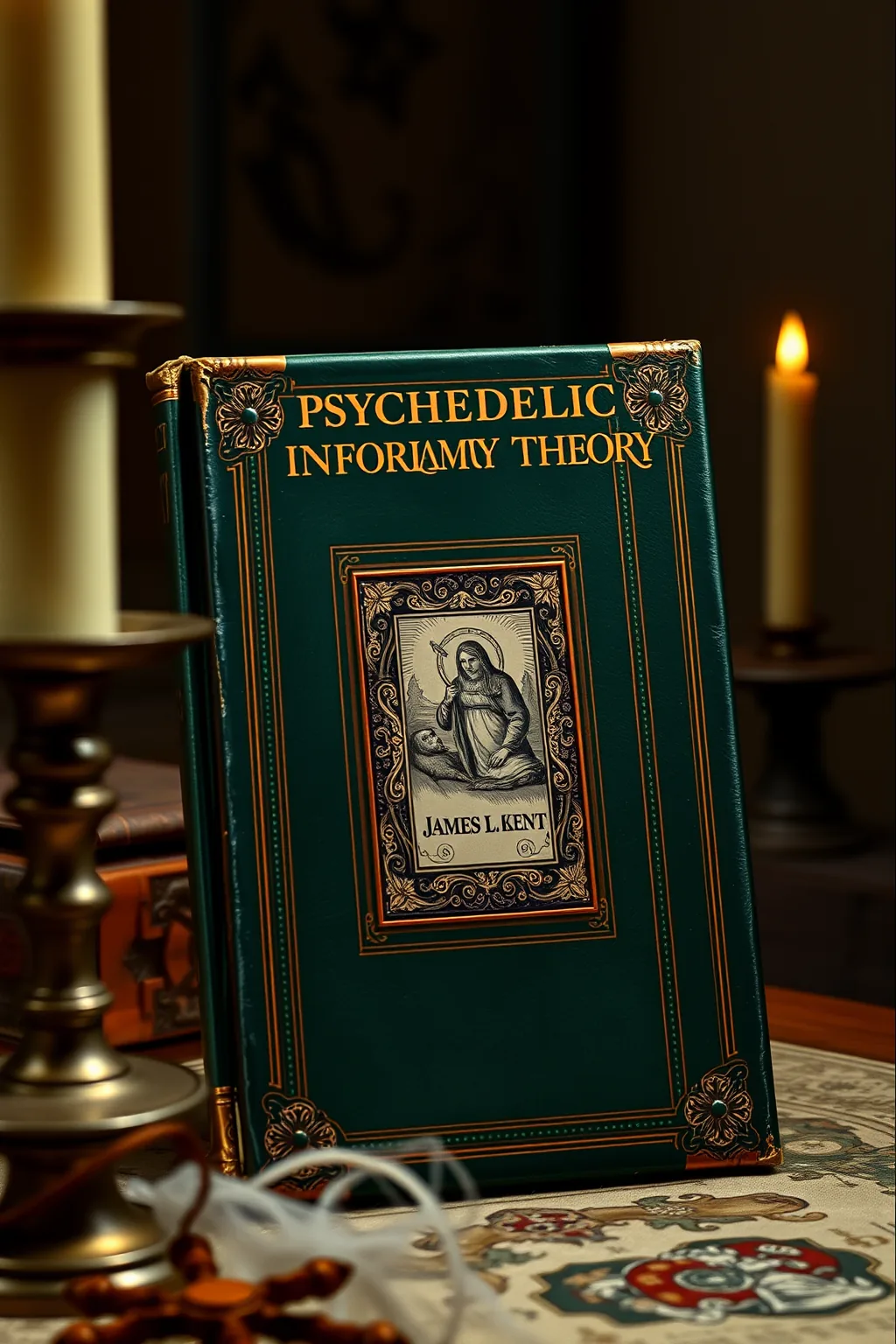
Psychedelic information theory
 83
83

Psychedelic information theory



Evander Ashcroft (Alchemy & Hermeticism Editor) — James L. Kent's "Psychedelic Information Theory" is a groundbreaking exploration into the nature of consciousness and perception. Kent offers a compelling theoretical model for understanding the non-linear information creation that occurs in altered states, drawing parallels to alchemical transmutation of consciousness. His work is particularly resonant for those steeped in Hermetic traditions, providing a modern lens through which to view ancient wisdom concerning the mind's capacity for generating novel realities. The book's strength lies in its rigorous yet accessible approach to complex metaphysical concepts, making it an indispensable read for scholars of consciousness, mystics, and anyone seeking to bridge the gap between the empirical and the esoteric.
📝 Description
83
James L. Kent's 2017 book proposes a theory for how information arises in altered states.
Published in 2017, "Psychedelic Information Theory" by James L. Kent examines the origins of information during non-ordinary states of consciousness. Kent, drawing on his background, constructs a theoretical model to explain how perception and cognition operate when the mind is altered by psychedelics, dreams, or psychosis. The book aims to provide a framework for understanding the complex informational patterns that emerge in these states, which often resist standard scientific analysis.
It investigates the potential for these transient mental experiences to generate intricate data structures. The work suggests these patterns are not random but possess an inherent logic that can be deciphered. By mapping the architecture of perception, Kent pushes against conventional understandings of consciousness and the mind's creative capacity when freed from ordinary constraints. The book addresses the hidden aspects of perception and the underlying structure of the mind.
This book engages with traditions that explore altered states of consciousness as pathways to knowledge. It touches on concepts found in certain shamanic practices and mystical traditions where non-ordinary states are used to access insights about reality. The work attempts to formalize these observations within a theoretical structure, bridging the gap between subjective experiences in dreams, psychosis, or drug-induced states and a more systematic understanding of information processing.
✍️ Author
Shamanism in the age of Reason
The manga and anime series Shaman King features several characters created by Hiroyuki Takei. As a result of being focused on shamanism the series' cast is divided between humans and spirits, the latter not being able to go the afterlife due to their allia…
💡 Why Read This Book?
Unravel the mysteries of nonlinear information creation in altered states of consciousness. 'Psychedelic Information Theory' offers a unique framework for understanding dreams, psychosis, and hallucinations, crucial for seekers of hidden knowledge. Ideal for scholars of consciousness, mystics, and practitioners exploring the depths of the human mind, this book unlocks the esoteric potential of perception and imagination.
⭐ Reader Reviews
Honest opinions from readers who have explored this book.
❓ Frequently Asked Questions
What is Psychedelic Information Theory (PIT)?
PIT is a theoretical framework studying how the human imagination creates nonlinear information, particularly in altered states like dreaming, psychosis, and hallucination. It aims to model perception to understand the complexity of information arising in these states.
Who is James L. Kent?
James L. Kent is the author of 'Psychedelic Information Theory,' a visionary thinker and scholar exploring the intersection of consciousness, information, and altered states of perception.
What are the primary altered states discussed?
The primary altered states discussed are dreaming, psychosis, and hallucinations, viewed as fertile grounds for the creation of unique and complex informational patterns.
Is this book for beginners?
While intellectually rigorous, the book is accessible to dedicated beginners interested in deep dives into consciousness. Prior exposure to related concepts can enhance understanding.
What kind of information does PIT model?
PIT models the functional output of human perception, focusing on the emergent complexity and limits of information generated within altered states of consciousness.
🔮 Key Themes & Symbolism
The Architecture of Non-Linear Perception
This theme looks at the fundamental premise of PIT: that the human imagination, particularly in altered states, generates information that does not follow linear, causal pathways. It explores how dreams, visions, and psychotic experiences are not random noise but structured, albeit unconventional, informational systems. The book posits that by understanding this non-linear architecture, we can unlock deeper insights into the nature of reality and consciousness itself, drawing parallels to ancient mystical cosmologies and their symbolic representations of complex, interconnected realities.
Unlocking the Limits of Consciousness
Kent's work challenges the conventional boundaries of human perception, suggesting that altered states of consciousness represent frontiers of informational processing. The theory seeks to extrapolate the limits and inherent complexity of information that can arise when the mind operates beyond its everyday constraints. This exploration is deeply intertwined with esoteric traditions that speak of expanded awareness and the potential for accessing higher or deeper domains of existence through disciplined inner work or psychotropic exploration.
Psychedelic Activation as a Model for Information Genesis
Central to PIT is the concept of 'psychedelic activation' as a universal model for understanding how information is generated in the mind. This isn't limited to chemically induced states but encompasses all forms of profound mental alteration. The book proposes that by studying these activations, we can develop adaptable models to decode the informational output of the mind, offering a framework for understanding phenomena ranging from spontaneous mystical experiences to the insights gained through shamanic practices and contemplative disciplines.
💬 Memorable Quotes
Direct passages from the work, attributed to the author.
“The mind is a loom tying realities from unseen threads.”
— This metaphor highlights the active, creative power of the mind, suggesting that our perceived reality is a construct woven from subtle, perhaps non-physical, informational elements.
“Hallucination is not hallucination, but an unveiling of parallel data streams.”
— This redefines altered perceptions not as delusion, but as access to alternative informational channels or realities that coexist with our own.
“Dreaming is the primal forge of the psyche's informational output.”
— This emphasizes the foundational role of dreams in shaping our inner world and generating the raw informational material of our consciousness.
“In psychosis, the veil thins, revealing the raw code of existence.”
— This suggests that the disarray of psychosis can, paradoxically, offer glimpses into the fundamental informational structures underlying reality.
“To map the mind is to chart the cosmos.”
— This profound statement links the exploration of individual consciousness to the understanding of the universe, implying a deep interconnectedness.
🌙 Esoteric Significance
Tradition
This work resonates deeply with Hermeticism, Gnosticism, and shamanic traditions, all of which explore altered states of consciousness as pathways to hidden knowledge and spiritual insight. PIT offers a modern, theoretical lens through which to examine ancient practices of divination, visionary journeys, and the interpretation of symbolic language that arises in non-ordinary states of awareness. It seeks to clarify these experiences by framing them within an informational model, aligning with the Hermetic principle of 'As Above, So Below.'
Symbolism
The book's core is the deciphering of symbolic language generated by the psyche in altered states. These symbols are not mere representations but active informational packets carrying profound meaning. PIT suggests that understanding the 'grammar' of these symbolic outputs, whether from dreams or visions, is akin to decoding the sacred geometry of consciousness. The interpretation of these symbols unlocks access to archetypal realms and the underlying patterns of existence, a central tenet in many esoteric systems.
Modern Relevance
In an age saturated with digital information and facing existential challenges, PIT offers a crucial framework for understanding the internal informational landscape. It provides tools for working through the overwhelming influx of data by understanding the mind's capacity for novel creation. The theory's emphasis on subjective experience and inner exploration offers a vital counterpoint to purely externalized modes of knowing, empowering individuals to access their own inner wisdom and creative potential in a complex world.
👥 Who Should Read This Book
This book is a must-read for the dedicated seeker of esoteric knowledge, offering a profound exploration of consciousness. Scholars of psychology, philosophy, and comparative religion will find its theoretical framework informative. Practitioners of meditation, lucid dreaming, or shamanic arts will discover new insights into the nature of their experiences. Even those new to metaphysical concepts but possessing an open mind and a curiosity about the deeper workings of the human psyche will find this an accessible yet challenging journey into the hidden architecture of perception.
📜 Historical Context
Emerging in an era of burgeoning interest in consciousness studies and the liberalization of psychedelic research, "Psychedelic Information Theory" stands as a evidence of the intellectual ferment of the late 20th and early 21st centuries. This period saw a renewed, albeit often clandestine, exploration of mind-altering substances and their potential to unlock human potential, challenging established scientific paradigms. The book reflects a lineage of thought that includes Jungian psychology, Eastern mysticism, and counter-cultural explorations, seeking to integrate these diverse perspectives into a coherent theoretical framework. It is a product of a time when the boundaries of science and spirituality were being actively questioned and redefined, offering a bridge between empirical inquiry and the perennial wisdom traditions.
📔 Journal Prompts
Reflect on a vivid dream you've had. How might 'non-linear information creation' apply to its narrative and imagery?
Consider a moment of intense intuition or insight. Could this be an example of accessing a 'parallel data stream'?
What are the 'unseen threads' that you believe your mind ties to construct your daily reality?
How does the concept of 'psychedelic activation' relate to moments of intense creative flow or spiritual experience in your life?
If psychosis reveals the 'raw code of existence,' what ethical considerations arise in studying or experiencing such states?
🗂️ Glossary
Non-linear Information Creation
The process by which information is generated and organized in a manner that does not follow sequential, causal, or logical progression, often observed in altered states of consciousness.
Altered States of Consciousness (ASC)
Any mental state that deviates from normal waking consciousness, including dreaming, meditation, hypnosis, psychosis, and states induced by psychoactive substances.
Psychedelic Activation
A proposed model describing the universal mechanism by which the mind activates and generates information, particularly in states of heightened perceptual or cognitive activity.
Perception Model
A theoretical construct that describes how the human mind receives, interprets, and organizes sensory and internal information to form a coherent experience of reality.
Information Genesis
The origin and formation of information, particularly within the context of cognitive and psychological processes.
This book appears in 2 collections
🔮 Readers Also Liked
Browse all →






From the “Witchcraft” Collection
View all →



![The Tipperary (or Clonmel) witch case : [transcripts of newspaper reports &c. concerning Bridget Cleary, burned as a witch, and the trial of her husband and neighbours for murder, in 1895]](/img/thumb/the-tipperary-or-clonmel-witch-case-transcripts-of-newspaper-reports-c-concerning-bridget-cleary-burned-as-a-witch-and-the-trial-of-her-husband-and-neighbours-for-murder-in-1895.webp)


More Free Witchcraft & Paganism Books
View all →