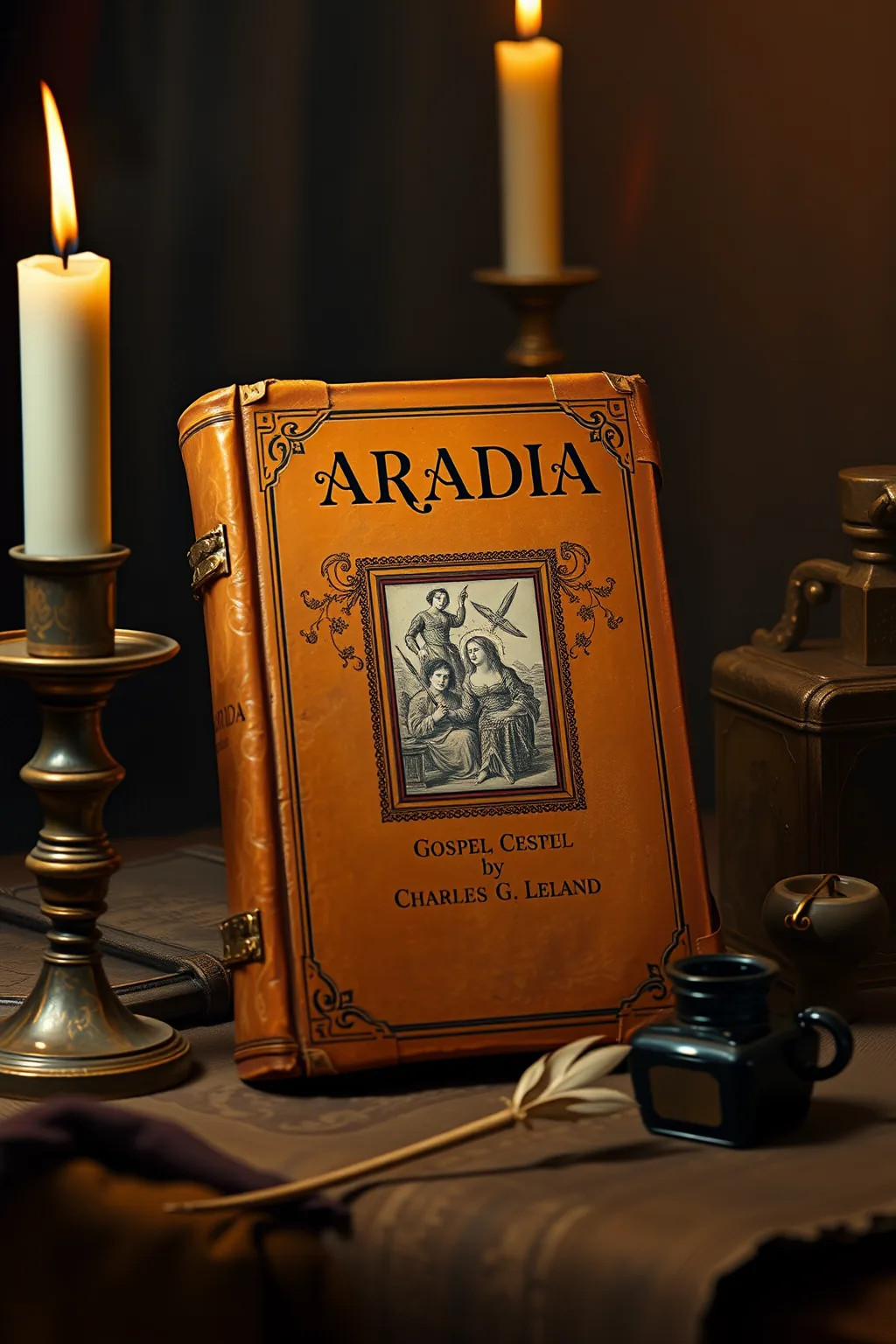
ARADIA
 77
77

ARADIA



Marcus Thorne, Esoteric Sciences Reviewer
Charles G. Leland's *Aradia* stands as a foundational pillar for modern witchcraft studies, offering a compelling, albeit debated, glimpse into what purports to be authentic Tuscan witchcraft. Its strength lies in its presentation as a sacred text, providing rituals, spells, and a cosmology centered on Diana and her lineage. While academic scrutiny exists, its esoteric value is undeniable. For practitioners and scholars of Paganism and witchcraft, *Aradia* provides invaluable insights into historical magical practices and a rich tapestry of folk beliefs. Its evocative language and potent imagery make it a truly engaging read for anyone seeking to understand the deeper currents of witch traditions.
📝 Description
77
Charles G. Leland published *Aradia: Gospel of the Witches* in 1899, detailing Italian folk magic.
Charles G. Leland's 1899 book, *Aradia: Gospel of the Witches*, presents a collection of Italian folk magic traditions as told to him by Maddelena, a Tuscan informant. The text claims these are secrets from a lineage of witches tracing back to Aradia, a figure said to be a divine emissary of Diana. Leland, an American journalist and folklorist, compiled these elements, which include incantations and rituals.
The book touches on a spirituality that predates Christianity and focuses on the earth and nature's cycles. It is written for those interested in the occult and the history of witchcraft. The work discusses figures like the moon goddess and the concept of a witch sisterhood, alongside the inherent power found in the natural world.
Published in 1899, *Aradia* emerged during a period of increased interest in occultism and folklore studies in Europe and America. It contributed to the growing body of literature on witchcraft and pagan survivals, particularly focusing on specific regional traditions. The book's presentation as a 'gospel' situates it within a larger tendency to historicize or legitimize certain magical practices through a quasi-religious framing, drawing connections to classical deities and ancestral lineages.
💡 Why Read This Book?
Uncover the alleged sacred texts of traditional Italian witchcraft, directly from the source as collected by Charles G. Leland. Explore ancient rituals, potent spells, and the lore of Diana and her witch descendants. Ideal for practitioners seeking historical context, scholars of folklore and esoteric traditions, and seekers drawn to the raw, earth-bound magic of the Craft.
⭐ Reader Reviews
Honest opinions from readers who have explored this book.
❓ Frequently Asked Questions
What is the historical significance of Aradia?
*Aradia* is considered a foundational text in modern Neo-Paganism, offering purported insights into traditional Italian witchcraft. Its collection by Charles G. Leland from a Tuscan informant provides a rare historical document.
Who is Aradia in the text?
Aradia is presented as the daughter of the moon goddess Diana and Lucifer, sent to Earth to teach witchcraft and liberate the oppressed from servitude.
What kind of magic is described in Aradia?
The book details folk magic, including incantations, spells for protection, love, wealth, and curses, deeply rooted in nature and ancient deities.
Is Aradia considered a factual historical account of witchcraft?
Scholars debate its authenticity as a purely historical account. However, its influence on modern witchcraft and its portrayal of folk beliefs are widely acknowledged.
What is the role of Diana in Aradia?
Diana is the central deity, the moon goddess and queen of witches, who is revered and invoked throughout the text. She is depicted as a powerful, benevolent figure.
🔮 Key Themes & Symbolism
The Divine Feminine and the Goddess Diana
At the heart of *Aradia* lies the veneration of the Goddess Diana, depicted as the supreme deity of witchcraft. She is the moon's radiant embodiment, the queen of the night, and the source of all magic. The text positions her as the progenitor of a lineage of witches, emphasizing the potent, nurturing, and liberating power of the divine feminine. This theme explores the celestial connection to the earth, the cycles of nature, and the inherent strength and wisdom attributed to women practitioners of the Craft.
Liberation and Social Justice in Witchcraft
*Aradia* presents witchcraft not merely as a system of magic, but as a force for social change and the liberation of the oppressed. Aradia herself is sent to teach the poor and downtrodden, freeing them from the tyranny of the wealthy and powerful. This theme highlights the revolutionary aspect of the Craft, its role as a sanctuary for the marginalized, and its potential to challenge unjust hierarchies. It underscores the idea that magic can be a tool for empowerment and the restoration of balance in the world.
Folk Magic and Earth-Centered Spirituality
This work is a rich repository of Italian folk magic, deeply interwoven with the natural world. It details incantations, rituals, and beliefs that draw power from the earth, the moon, the stars, and the elements. The emphasis is on practical, accessible magic rooted in everyday life and the veneration of natural forces. This theme explores the profound connection between humanity and the environment, the sacredness of the wilderness, and the belief that magic is an intrinsic part of the living world, accessible through reverence and understanding.
💬 Memorable Quotes
Direct passages from the work, attributed to the author.
“And when I shall have ended, go ye / To the town of Bulgarella...”
— This prophetic utterance suggests a journey and a destiny tied to specific locations, hinting at the spread and continuation of magical knowledge.
“For I am Aradia, a daughter of the Moon.”
— This declaration establishes Aradia's divine lineage and her celestial connection, positioning her as a powerful emissary of the moon goddess.
“And I will make them all to be / Like unto me, and I will make them free.”
— This powerful statement reveals Aradia's mission of liberation, her intent to empower others and break the chains of oppression through magical means.
“And I will sow my seed among them, / And they shall be my children.”
— This evocative line speaks to the perpetuation of the witch lineage and the idea of spiritual kinship, where followers become the 'children' of the divine teacher.
💡 Key Ideas
Editorial paraphrase of the work's core concepts — not direct quotes.
And I will go to the house of the priest, / And I will take his life.
This quote signifies a challenge to established religious authority and a desire to overthrow oppressive systems, highlighting the revolutionary spirit within the text.
🌙 Esoteric Significance
Tradition
The esoteric tradition most directly associated with *Aradia* is Italian folk witchcraft, often referred to as Stregheria. It purports to represent an ancient, pre-Christian lineage of magic centered around the worship of the Goddess Diana and her earthly emissary, Aradia. The text offers a glimpse into a system of belief and practice that is deeply earth-centered, focused on practical magic for liberation and empowerment, and distinct from later, more formalized or Abrahamic-influenced magical systems.
Symbolism
Key symbolism in *Aradia* includes the Moon (representing Diana, the feminine, intuition, and the night), the Star (often linked to Lucifer, representing hidden wisdom and divine sparks), the Serpent (symbolizing transformation, earth power, and healing), and the Laurel leaf (associated with victory, divination, and protection). The text also utilizes symbolic language related to nature – the wind, the water, the plants – imbuing them with magical properties and connecting them to the divine forces.
Modern Relevance
The modern relevance of *Aradia* is profound, particularly within Neo-Pagan and Wiccan traditions. It provided a much-needed 'gospel' for a nascent spiritual movement, offering a perceived ancient lineage and a rich source of lore, rituals, and magical practices. Its emphasis on the Goddess, nature worship, and the liberation of the oppressed continues to resonate with contemporary practitioners seeking earth-centered spirituality and empowerment. The text remains a vital point of reference for understanding the historical development of modern witchcraft.
👥 Who Should Read This Book
This volume is essential for serious students of witchcraft and Paganism, particularly those interested in its historical roots. Practitioners seeking to deepen their understanding of Italian folk magic and the worship of the Goddess Diana will find *Aradia* invaluable. Scholars of folklore, comparative religion, and esoteric traditions will appreciate its unique perspective and cultural significance. Beginners drawn to the mystical and the occult will discover an evocative introduction to a rich and powerful magical heritage.
📜 Historical Context
Charles G. Leland's *Aradia*, published in 1899, emerged during a period of burgeoning interest in folklore, occultism, and ancient religions in Victorian England and America. This era saw the rise of movements like Spiritualism and Theosophy, alongside a growing fascination with what was perceived as 'primitive' or 'hidden' knowledge. Leland, an expatriate journalist and folklorist, was actively engaged in collecting marginalized traditions. His work on *Aradia*, based on materials purportedly from a Tuscan woman named Maddelena, tapped into this zeitgeist, presenting a seemingly authentic sacred text of traditional Italian witchcraft. The book's reception was significant, influencing the development of modern Wicca and Neo-Paganism, offering a tangible, albeit debated, link to older forms of European folk magic and goddess worship at a time when such traditions were largely suppressed or forgotten.
📔 Journal Prompts
Reflect on the concept of liberation presented in Aradia. How can ancient magical traditions inspire modern movements for social justice?
Consider the symbolism of Diana and the Moon. How does this celestial connection influence your understanding of feminine power and intuition?
Write a personal ritual inspired by the incantations in Aradia, focusing on connecting with nature and its inherent magic.
Explore the idea of Aradia as a 'gospel' of witchcraft. What does this term imply about the sacredness and transmission of magical knowledge?
How does the earth-centered spirituality described in Aradia resonate with your own connection to the natural world? What specific elements of nature hold power for you?
🗂️ Glossary
Stregheria
An Italian term referring to witchcraft, often associated with folk magic traditions and the worship of a Goddess figure, particularly Diana.
Diana
The Roman goddess of the moon, hunting, and childbirth, revered in Aradia as the Queen of the Witches and mother of Aradia.
Aradia
The central figure in the text, presented as the daughter of Diana and Lucifer, sent to Earth to teach witchcraft and liberate the oppressed.
Incantation
A spoken charm or spell, often chanted, believed to possess magical power when recited correctly.
Vangel
The Italian word for 'Gospel,' used here to describe the nature of the text itself, implying it is a sacred pronouncement or teaching.
This book appears in 2 collections
🔮 Readers Also Liked
Browse all →









From the “Witchcraft” Collection
View all →







More Free Witchcraft & Paganism Books
View all →

![Wicca [ Wikipedia ]](/img/thumb/wicca-wikipedia-wikipedia.webp)