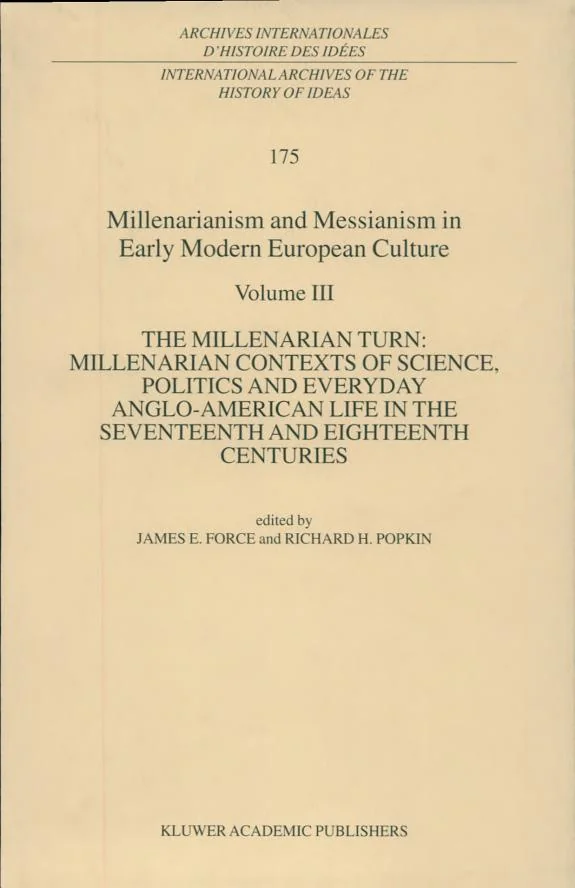
Millenarianism and Messianism in Early Modern European Culture
 77
77

Millenarianism and Messianism in Early Modern European Culture
Goldish, Popkin, and Force’s collection offers a vital counterpoint to the traditional narrative of Enlightenment secularization. It compellingly argues that millenarian and messianic currents remained potent forces, shaping intellectual and political landscapes far more than is often acknowledged. The strength lies in its broad scope, demonstrating how eschatological thinking permeated science, politics, and philosophy, challenging the neat separation of "Enlightened" thought from "radical enthusiasm." A particular strength is the exploration of how scientific inquiry itself could be infused with apocalyptic expectations, as seen in studies of figures who sought divine order in natural laws. A limitation, perhaps inherent in such a collection, is the unevenness of individual essays; some chapters provide deeper analytical dives than others. The discussion surrounding the influence of millenarian ideas on the scientific revolution, particularly concerning the search for divine patterns in nature, stands out as a powerful illustration of the book's central thesis. This volume is indispensable for anyone seeking a nuanced understanding of early modern intellectual history.
📝 Description
77
This 1998 collection argues millenarian and messianic thought shaped early modern European culture.
Millenarianism and Messianism in Early Modern European Culture challenges the idea that apocalyptic beliefs were confined to small groups. The authors demonstrate how these eschatological expectations were woven into the scientific, political, and intellectual life of the period. They show how religious fervor, intellectual questioning, and societal shifts interacted during a time of significant change.
The book revisits the era of Enlightenment skepticism, arguing that the standard historical narrative underplays the continued presence of millenarian ideas. Even as figures like Voltaire promoted reason, the anticipation of a future divine or earthly kingdom remained influential. These ideas appeared in various intellectual circles throughout the long 18th century, from the late 17th century to the French Revolution. This challenges the notion that religious radicalism was easily suppressed by the intellectual establishment.
The core concept is millenarianism, the belief in an impending, divinely ordained perfect future age, often preceded by cataclysm. Closely related is messianism, the belief in a divinely appointed leader who will bring about this future.
This work engages with the study of heterodox beliefs and their impact on mainstream intellectual and cultural developments. It situates millenarian and messianic traditions within the broader context of early modern European thought, which, while increasingly rationalistic, still harbored potent visions of future redemption and transformation. The book highlights how these seemingly fringe ideas were, in fact, deeply interconnected with the era's scientific and political discourses, demonstrating a complex relationship between esoteric hopes and material realities.
💡 Why Read This Book?
• Understand how millenarian expectations influenced scientific inquiry during the "long" 18th century, moving beyond the sole focus on deism and skepticism as defining intellectual currents. • Discover the persistent role of messianic thought in political discourse and movements, challenging the assumption that these ideas were solely confined to religious "enthusiasts." • Gain a revised perspective on the Enlightenment, recognizing how apocalyptic and chiliastic beliefs coexisted with, and often informed, rationalist and secularizing trends.
⭐ Reader Reviews
Honest opinions from readers who have explored this book.
❓ Frequently Asked Questions
What is the primary argument of Millenarianism and Messianism in Early Modern European Culture?
The book argues that millenarian and messianic ideas were far more influential in shaping early modern European culture—including science, politics, and philosophy—than the standard historical narrative of the Enlightenment suggests.
Which historical period does this book focus on?
It concentrates on the "long" 18th century, a period roughly from the late 17th century through the French Revolution, examining the intellectual and cultural landscape of early modern Europe.
How does this book challenge the traditional view of the Enlightenment?
It challenges the view by demonstrating that religious radicalism, particularly millenarian thought, was not effectively suppressed by Enlightenment skepticism and deism, but continued to influence intellectual and social movements.
What is 'millenarianism' as discussed in the book?
Millenarianism refers to the belief in an imminent, divinely ordained, and perfect future age or kingdom, often preceded by a period of upheaval or cataclysm.
Who are the key editors of this collection?
The collection was edited by Matt Goldish, R.H. Popkin, and J.E. Force, first published in 2001.
What areas of early modern culture does the book explore regarding millenarianism?
It explores the influence of millenarian ideas on science, politics, and intellectual conceptions, revising the "official" story of the Enlightenment.
🔮 Key Themes & Symbolism
Apocalyptic Expectations
The collection illuminates how deeply ingrained apocalyptic expectations were within early modern European society. Far from being confined to fringe sects, beliefs in an imminent, divinely ordained future kingdom permeated intellectual discourse. This theme explores how the anticipation of a radical societal transformation, often tied to messianic figures or events, influenced not only religious fervor but also philosophical speculation and scientific endeavors, challenging the conventional understanding of the Enlightenment as purely secular.
Science and Divine Order
This theme investigates the surprising intersection of early modern scientific investigation with millenarian worldviews. Rather than a stark dichotomy between reason and faith, the book shows how scientists and natural philosophers often sought to uncover divine patterns or prophecies within the natural world. The pursuit of knowledge was frequently framed within an eschatological context, where understanding God's creation was a step toward hastening or preparing for the promised future age.
Political Radicalism and "Enthusiasm"
The volume revisits the suppression and dismissal of radical religious movements, often labeled "enthusiasm" by Enlightenment thinkers. It argues that the political influence of millenarian ideas, particularly evident in Cromwell's England, persisted and evolved. The work examines how these eschatological frameworks informed political ideologies and actions, demonstrating that the "official" story of Enlightenment secularization overlooks the continued impact of chiliastic hopes on the political landscape.
The "Long" Eighteenth Century
This collection frames its analysis within the "long" 18th century, a period marked by significant intellectual and social shifts. It challenges the linear progression often depicted from religious superstition to Enlightenment rationality. Instead, it highlights the enduring presence and adaptation of millenarian and messianic thought, showing how these older beliefs continued to interact with, and sometimes subvert, emerging secular and rationalist ideologies.
💬 Memorable Quotes
Direct passages from the work, attributed to the author.
“The influence of millenarian thinking upon Cromwell's England is well-known.”
— This opening statement sets the stage, acknowledging a recognized historical impact of apocalyptic beliefs, but it immediately signals that the book will go beyond this established point to explore less-examined territory.
“The cultural and intellectual conceptions of the role of millenarian ideas in the `long' 18th century... has been less well examined.”
— This highlights the core revisionist aim of the volume: to bring scholarly attention to the pervasive, yet often overlooked, influence of eschatological thinking during a period typically dominated by narratives of secularization and rationalism.
“The 'official' story goes, the religious sceptics and deists of Enlightened England effectively tarred such religious radicalism as `enthusiasm'.”
— This phrase directly addresses and critiques the conventional historical interpretation, suggesting that the Enlightenment's dismissal of religious radicalism as mere "enthusiasm" masked a more complex and enduring interaction with millenarian thought.
“This volume endeavors to revise this `official' story.”
— A clear statement of intent, this indicates the book's primary goal is to offer a corrective to established historical narratives, presenting a more nuanced understanding of early modern European intellectual and cultural history.
“to trace the influence of millenarian ideas in the science, politics, and everyd[ay life]”
— This outlines the broad scope of the book's inquiry, asserting that millenarianism was not confined to theology or fringe groups but actively shaped foundational aspects of early modern society, including its scientific advancements and political structures.
🌙 Esoteric Significance
Tradition
While not explicitly aligning with a single esoteric lineage like Hermeticism or Kabbalah, this work functions as crucial meta-commentary for understanding the historical roots of modern esoteric thought. It demonstrates how apocalyptic and messianic expectations, often considered fringe but deeply influential, formed a bedrock upon which later esoteric systems built. It situates these beliefs within broader intellectual currents, showing their entanglement with nascent science and philosophy, a key characteristic of the transition towards modern Western esotericism.
Symbolism
The primary symbolic motif explored is the concept of the "New Jerusalem" or the "Kingdom of God on Earth"—a future perfect state anticipated through divine intervention or human effort guided by divine will. Another key symbolic undercurrent is the idea of historical cycles or prophecy, where events are interpreted through a lens of divine plan, often involving specific dates or signs portending the end times. These symbols represent not just religious hope, but also a framework for understanding and potentially influencing historical change.
Modern Relevance
Contemporary thinkers and movements interested in historical cycles, prophetic interpretations of current events, and the intersection of spirituality with societal transformation often draw upon the historical understanding presented in this volume. It provides essential context for understanding the roots of various fringe political and religious movements, as well as academic fields like the sociology of religion and the history of ideas, which continue to explore the enduring power of apocalyptic and messianic narratives in shaping human belief and action.
👥 Who Should Read This Book
• Academic researchers in early modern European history, religious studies, and the history of science seeking to understand the full spectrum of intellectual currents beyond standard Enlightenment narratives. • Students of comparative religion and esotericism interested in the historical development and societal impact of apocalyptic and messianic belief systems. • Intellectual historians and philosophers who wish to challenge conventional periodizations of modernity and explore the persistent influence of chiliastic thought on secularizing societies.
📜 Historical Context
Published in 2001, *Millenarianism and Messianism in Early Modern European Culture* arrived at a time when post-revisionist approaches to the Enlightenment were gaining traction, challenging monolithic narratives. The "long" 18th century, the book's focus, was characterized by intellectual ferment, including the rise of figures like Isaac Newton, whose scientific work was deeply intertwined with theological and prophetic studies, and the philosophical critiques of deists like Voltaire. The collection implicitly engages with scholarship on religious radicalism and "enthusiasm," movements often viewed as antithetical to Enlightenment rationality. Its significance lay in pushing back against the idea that the Enlightenment definitively silenced apocalyptic thought, demonstrating its continued influence on figures and movements that shaped European science, politics, and philosophy, even as secularizing trends advanced. The work offered a counter-narrative to the dominant story of unilinear progress towards modernity.
📔 Journal Prompts
The "long" 18th century's coexistence of Enlightenment reason and millenarian hope.
The "official" historical story versus the reality of "enthusiasm" and radicalism.
How messianic expectations shaped scientific inquiry in the early modern period.
Reflecting on the persistence of apocalyptic thinking in contemporary society.
The role of prophecy and divine plan in early modern political discourse.
🗂️ Glossary
Millenarianism
A belief system centered on the expectation of an imminent, divinely ordained, and perfect future age or kingdom on Earth, often following a period of destruction or upheaval.
Messianism
The belief in the coming of a messiah or redeemer figure who will usher in a golden age, often associated with the fulfillment of prophecies and the establishment of a new world order.
Enlightenment
An 18th-century intellectual and cultural movement emphasizing reason, individualism, skepticism toward tradition, and scientific inquiry, often contrasted with earlier periods of religious dominance.
Deism
A religious philosophy based on reason, particularly the belief in a creator God who does not intervene in the universe or reveal himself through supernatural means, prominent during the Enlightenment.
Enthusiasm
A term used during the 17th and 18th centuries, often pejoratively by skeptics and rationalists, to describe fervent religious belief and experience, particularly associated with radical Protestant sects.
Chiliasm
A variant of millenarianism, often specifically referring to the belief in a literal thousand-year reign of Christ on Earth, derived from the Book of Revelation.
Eschatology
The branch of theology concerned with the final destiny of the soul and the world, particularly with end times, judgment, and the ultimate fate of humanity.
This book appears in 1 collection
🔮 Readers Also Liked
Browse all →






From the “Messianism” Collection
View all →






More Free Esoteric History & Biography Books
View all →