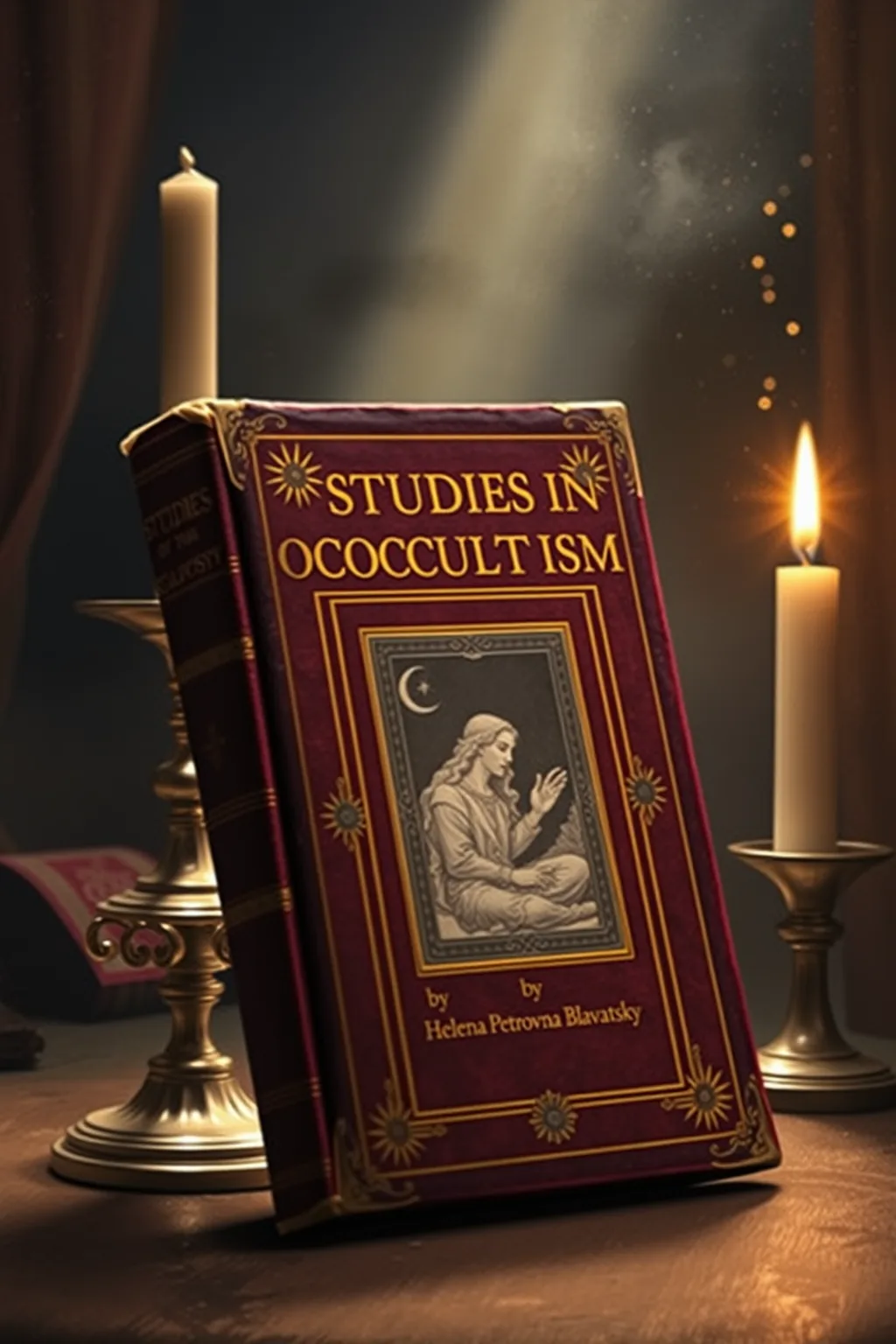
Studies in Occultism
 79
79

Studies in Occultism
Helena Petrovna Blavatsky's *Studies in Occultism* presents a dense, often challenging, but ultimately rewarding exploration of esoteric principles. The work's strength lies in its direct engagement with complex metaphysical ideas, eschewing superficiality for a rigorous examination of concepts like the seven principles of man and the nature of cyclic evolution. A particular passage discussing the 'astral body' reveals the intricate mapping of human consciousness onto subtle planes, a concept central to Theosophical cosmology. However, the prose can be demanding; the historical context of its late 19th-century origins means certain linguistic conventions and assumptions require careful consideration by the modern reader. While it may not offer immediate accessibility, its intellectual architecture is substantial. This collection offers a significant glimpse into the foundational texts of modern occultism.
📝 Description
79
Helena Blavatsky's 1890 collection, Studies in Occultism, presents esoteric teachings on spiritual science.
This volume gathers essays originally published by the Aryan Theosophical Press, offering direct engagement with Helena Blavatsky's writings on occult philosophy and practice. It addresses the fundamental principles of what Blavatsky termed spiritual science and the hidden laws believed to govern the universe. The collection includes teachings on subjects such as the astral body, reincarnation, karma, and the existence of spiritual hierarchies. It posits that a concealed order underlies reality, discoverable through focused study and personal development. The book is intended for students of comparative religion, metaphysics, and the history of esoteric movements. It provides primary source material for those interested in the development of Theosophy and its subsequent impact on occult traditions.
Readers will encounter discussions on subtle energies that permeate existence and the potential for human consciousness to interact with these planes. The work aims to clarify complex esoteric concepts, presenting them within the framework of late 19th-century Theosophy. It is a resource for understanding the intellectual currents that shaped early modern occultism and its engagement with both Eastern philosophies and Western thought.
Published in 1890, *Studies in Occultism* emerged during a period of renewed interest in spiritualism and ancient traditions, a fertile ground for Helena Blavatsky's Theosophical work. This era saw figures like Annie Besant and William Quan Judge contributing to the Theosophical Society's growth. The time was characterized by a widespread examination of Eastern philosophies and their synthesis with Western esoteric thought. Blavatsky's writings from this period, including these essays, engaged with established scientific and religious ideas, seeking to integrate spiritual understanding with empirical observation and philosophical inquiry.
💡 Why Read This Book?
• Gain a foundational understanding of the seven principles of man, a core concept in Blavatsky's esoteric psychology, which provides a framework for understanding human consciousness beyond the physical. • Explore the Theosophical interpretation of reincarnation and karma, as presented in the section on cyclic evolution, offering a distinct perspective on destiny and personal development. • Examine the concept of the astral body, a key element discussed within the work, to understand how subtle planes of existence are theorized to interact with the physical world.
⭐ Reader Reviews
Honest opinions from readers who have explored this book.
❓ Frequently Asked Questions
When was Helena Petrovna Blavatsky's *Studies in Occultism* first published?
While the specific edition referenced was published on October 27, 2022, by the Aryan Theosophical Press, the original essays and teachings within *Studies in Occultism* originate from the late 19th century, a period of significant occult revival.
Is *Studies in Occultism* considered part of the public domain?
Yes, the work is noted as being in the public domain in the United States and potentially other nations, allowing for free copying and distribution within the US.
What is the Aryan Theosophical Press?
The Aryan Theosophical Press is an entity associated with the publication and dissemination of Theosophical literature, including works by Helena Petrovna Blavatsky and other prominent figures within the movement.
What are the main philosophical underpinnings of *Studies in Occultism*?
The book draws heavily from Theosophical philosophy, which integrates elements of Eastern religions (Hinduism, Buddhism) with Western esoteric traditions, focusing on universal brotherhood, comparative religion, and ancient wisdom.
Can *Studies in Occultism* be read by beginners in occult studies?
While the book is foundational, its dense prose and complex concepts may present a challenge for absolute beginners. Readers with some familiarity with metaphysical or esoteric terminology will find it more accessible.
What is the significance of 'occultism' as presented in this book?
In *Studies in Occultism*, 'occultism' refers to the study of hidden laws and principles governing the universe, emphasizing spiritual development, the nature of consciousness, and the interconnectedness of all things.
🔮 Key Themes & Symbolism
Seven Principles of Man
This theme examines the intricate model of human constitution as presented by Blavatsky, detailing the seven distinct principles or bodies that compose an individual, from the physical (Sthula Sharira) to the spiritual (Atma). It posits that understanding these layers is crucial for comprehending the process of spiritual evolution and the mechanisms of reincarnation. The work explores how these principles interact and how imbalances or development in one can affect the others, providing a map for inner work and self-understanding within the Theosophical framework.
Karma and Reincarnation
The book explores the doctrine of Karma and Reincarnation, explaining them not as arbitrary punishments or rewards, but as natural laws of cause and effect governing the cycles of existence. It describes how actions in past lives influence the present circumstances and how present choices shape future incarnations. This perspective offers a deterministic yet ultimately empowering view of life, emphasizing personal responsibility and the unfolding of spiritual lessons across multiple lifetimes.
The Astral Body and Subtle Planes
Central to the text is the concept of the Astral Body (Linga Sharira), often described as a subtle double of the physical form. This theme explores its role as a vehicle for consciousness and emotion, and its connection to the unseen, or astral, plane. The work elucidates how the astral body functions during sleep, dreams, and after physical death, and how it is influenced by thoughts and desires, providing insight into the non-physical dimensions of human experience.
The Unseen Hierarchy
This theme addresses the existence of spiritual intelligences and guiding forces that operate behind the veil of ordinary perception. Blavatsky references a hierarchy of beings, often termed 'Masters' or 'Mahatmas', who are said to guide the spiritual evolution of humanity. The book suggests that these advanced beings work through specific channels and teachings, like those presented in Theosophy, to uplift consciousness and reveal hidden universal truths to the world.
💬 Memorable Quotes
Direct passages from the work, attributed to the author.
“The law of Karma is the ultimate law of the Universe.”
— This statement emphasizes the absolute and pervasive nature of karmic principles within the Theosophical worldview. It suggests that all phenomena, from the smallest event to the grandest cosmic cycle, are governed by this principle of cause and effect.
“Man is a spiritual being clothed in material garments.”
— This expresses the core idea of the divine spark within human beings, contrasting the eternal, immaterial essence with the temporary, physical form. It highlights the esoteric perspective that true identity lies beyond the body.
“The Astral Body is the model upon which the physical body is built.”
— This interpretation of the astral body's function suggests a form of energetic blueprint. It implies that the physical form is an expression or manifestation of a more subtle, energetic matrix that precedes and influences its structure.
“Cyclic law is the law of destiny.”
— This links the overarching principle of cycles, whether in cosmic or individual lives, to the concept of destiny. It implies that our path is guided by recurring patterns and the unfolding of predetermined universal rhythms.
“Thought is the only agency that can create.”
— This highlights the power of consciousness and intention in shaping reality. It posits that mental energy is a fundamental creative force, capable of manifesting forms and influencing events within the material and subtle realms.
🌙 Esoteric Significance
Tradition
This work is firmly rooted in the Theosophical tradition, a movement that Blavatsky herself was instrumental in establishing. It draws heavily upon a synthesis of Eastern philosophies (primarily Vedanta and Buddhism) and Western esotericism (Hermeticism, Neoplatonism, Kabbalah). *Studies in Occultism* departs from purely Western occult lineages by reinterpreting ancient Indian concepts like Karma and reincarnation for a Western audience, aiming to present a universal, perennial philosophy accessible to all.
Symbolism
The text frequently employs symbols integral to esoteric traditions. The 'Seven Principles of Man' can be seen as a symbolic map of consciousness, representing distinct levels of being from the physical to the purely spiritual. The concept of 'Cycles' (e.g., Manvantaras and Pralayas) symbolizes the cosmic rhythm of manifestation and dissolution, a recurring motif in Hindu cosmology. The 'Lotus' is also a recurring symbol in Theosophical literature, representing spiritual unfoldment and the divine potential within humanity, often depicted with its roots in matter and its bloom in the spiritual realm.
Modern Relevance
Contemporary esoteric practitioners and scholars of religion continue to engage with Blavatsky's foundational ideas. Modern Theosophical societies still utilize these texts as core curriculum. Furthermore, concepts like the seven principles of man and the detailed exploration of karma and reincarnation have influenced subsequent New Age movements, authors like Alice Bailey, and various forms of Western esotericism focusing on consciousness studies and subtle energy systems.
👥 Who Should Read This Book
• Students of Theosophy and comparative religion seeking to understand the foundational texts of Helena Petrovna Blavatsky and her synthesis of Eastern and Western esoteric thought. • Metaphysical researchers interested in the historical development of occultism in the late 19th century and its philosophical underpinnings, including concepts like karma and the astral body. • Individuals exploring consciousness studies and alternative models of human psychology who wish to examine the detailed framework of the 'Seven Principles of Man' presented in the work.
📜 Historical Context
The late 19th century witnessed a fervent global interest in spiritualism and esoteric traditions, a fertile ground for Helena Petrovna Blavatsky's work. *Studies in Occultism* emerged during the formative years of the Theosophical Society, which Blavatsky co-founded in 1875. This era was characterized by a distinct intellectual current seeking to synthesize Eastern philosophies, particularly Hinduism and Buddhism, with Western occultism and a nascent scientific understanding of unseen forces. Blavatsky's writings were often controversial, drawing criticism from both established religious bodies and skeptical scientific circles. Contemporaries like Annie Besant would later champion and expand upon her teachings. The work itself engaged with and often challenged prevailing materialistic worldviews, proposing a universe imbued with consciousness and governed by subtle laws, a perspective that contrasted sharply with purely mechanistic or orthodox religious explanations.
📔 Journal Prompts
The concept of the Astral Body: how does this subtle vehicle relate to your perceived emotional state?
Reflect on the Seven Principles of Man: which principle do you feel is most dominant in your daily experience?
Karma as cause and effect: identify a past action and consider its present unfolding.
The nature of cyclic law: how might recurring patterns influence personal growth or societal development?
Universal Brotherhood: consider one practical application of this Theosophical tenet in your community.
🗂️ Glossary
Sthula Sharira
The physical body, the densest and most outward manifestation of the human being. It is considered impermanent and subject to the laws of physical existence.
Linga Sharira
The Astral Body or 'Ethereal Double,' a subtle energetic replica of the physical body. It serves as a vehicle for consciousness and vital force (prana).
Karma
The universal law of cause and effect, where actions in one life inevitably lead to consequences in the present or future lives. It is seen as a natural, impersonal principle of justice.
Reincarnation
The doctrine that the essential self or soul passes from one physical body to another after death, undergoing a cycle of births and deaths to learn spiritual lessons.
Manvantara
A Sanskrit term denoting a 'man-century,' representing a period of cosmic manifestation or a 'Day of Brahma,' followed by a period of dissolution (Pralaya).
Pralaya
A period of cosmic dissolution or dormancy that follows a Manvantara. It is a state of rest before the next cycle of creation begins.
Mahatmas
Literally 'Great Souls,' referring to highly evolved spiritual beings or adepts within the Theosophical tradition who are said to guide humanity's spiritual evolution.