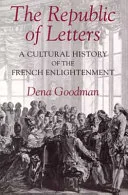
The Republic of Letters
 79
79

The Republic of Letters
Dena Goodman’s *The Republic of Letters* offers a rigorously researched account of how an intellectual community coalesced and functioned during the Enlightenment. Rather than presenting a grand narrative of philosophical progress, Goodman focuses on the practicalities of communication and publication, illuminating the social infrastructure that supported the era's intellectual ferment. Her detailed examination of how the production of the *Encyclopédie* both consolidated and, in some ways, strained the Republic's informal governance is particularly illuminating. A limitation, however, lies in the book's dense academic prose, which may prove challenging for readers less accustomed to detailed historiographical arguments. The section discussing the widening circles of readership beyond salon control, specifically noting the impact of print proliferation in the 1750s and 60s, provides a clear window into this transformation. Goodman’s work is a vital, if demanding, study of how ideas circulated before the modern media age.
📝 Description
79
Dena Goodman's 2000 book reconstructs the Enlightenment's intellectual community.
Dena Goodman's *The Republic of Letters* details the social and epistolary networks that characterized the Enlightenment. This "Republic" was an imagined community of writers and thinkers who communicated through extensive correspondence and publication. Goodman shows how shared intellectual interests and the growth of the printing industry created a new public sphere for discourse. She traces the shift from salon discussions to a broader, print-based intellectual exchange. The book also examines how an increase in books, pamphlets, and journals allowed authors to reach more people, often beyond the control of elite patrons. This development challenged established hierarchies of knowledge and authorship.
The work is situated in 18th-century Europe, a time of expanding print culture and Enlightenment ideals. The mid-18th century, with projects like Diderot and d'Alembert's *Encyclopédie*, saw ideas circulate more widely. This era moved intellectual exchange beyond aristocratic circles, altering traditional power structures in knowledge and writing. Goodman's analysis connects these developments to the evolving roles of authors and intellectuals, and sets the stage for later academic and journalistic practices.
While not strictly esoteric, *The Republic of Letters* examines a historical period where intellectual discourse was becoming more democratized and less tied to established institutions. The "Republic" itself was an emergent, almost invisible college of thinkers who communicated through private letters and publications, forming an "imagined community." This focus on the hidden structures and informal networks through which knowledge circulated offers a lens for understanding how ideas gain traction outside traditional, visible authority, a concept that resonates with certain esoteric traditions valuing inner circles and subtle influence.
💡 Why Read This Book?
• Learn how the print culture of the 1750s and 1760s fundamentally altered intellectual discourse, moving it beyond exclusive salon gatherings and demonstrating the power of widespread publication. • Understand the specific challenges and triumphs associated with the production of the *Encyclopédie*, seeing it not just as a philosophical endeavor but as a logistical and social undertaking. • Grasp the early French Revolution's impact on the nascent "Republic of Letters," recognizing how political upheaval tested the ideals of free intellectual exchange and authorship.
⭐ Reader Reviews
Honest opinions from readers who have explored this book.
❓ Frequently Asked Questions
What historical period does Dena Goodman's *The Republic of Letters* primarily cover?
The book focuses on the Enlightenment, particularly the mid-to-late 18th century in France, detailing the formation and evolution of the intellectual community known as the "Republic of Letters" up to the early French Revolution.
What was the "Republic of Letters" Goodman describes?
It refers to an imagined community of European thinkers, writers, and scholars, primarily in the 18th century, who communicated through correspondence and publication, forming a transnational sphere of intellectual exchange independent of state control.
How did the *Encyclopédie* influence the Republic of Letters?
The *Encyclopédie*, a massive collaborative project from the 1750s, both embodied the Republic's ideals of shared knowledge and expanded its reach, while also presenting challenges to its informal governance due to its scale and controversial content.
What role did print culture play in Goodman's analysis?
Goodman highlights the proliferation of print – books, pamphlets, journals – as a crucial factor that widened readership beyond aristocratic salons, democratizing intellectual discourse and challenging the control previously held by elite social circles.
Does Goodman discuss censorship or the reception of works within the Republic of Letters?
Yes, the work explores how print culture widened readership beyond the control of salon governance, implicitly addressing issues of reception and the challenges posed by both state and informal authorities to the free circulation of ideas.
When was *The Republic of Letters* originally published?
Dena Goodman's *The Republic of Letters* was first published in 1994, offering a scholarly examination of Enlightenment intellectual networks.
🔮 Key Themes & Symbolism
The Social Construction of Knowledge
Goodman investigates how intellectual communities in the 18th century were not merely abstract collections of ideas but were actively built through social practices like letter-writing, salon gatherings, and collaborative publishing. The "Republic of Letters" emerges as a constructed space where individuals negotiated authority, reputation, and the dissemination of knowledge. This theme underscores that intellectual history is inseparable from social history, revealing the human networks that underpinned the Enlightenment's grand intellectual projects, such as the *Encyclopédie*.
Print Culture and Audience Expansion
A central argument revolves around the transformative impact of print culture. Goodman details how the increasing availability and affordability of books and periodicals in the mid-18th century allowed intellectual discourse to escape the confines of elite salons. This proliferation democratized readership and authorship, creating new dynamics of influence and control. The work examines how this shift challenged established hierarchies and laid groundwork for modern forms of public intellectualism and media.
Authorship and Intellectual Authority
The book probes the evolving concept of authorship during the Enlightenment. As the "Republic of Letters" matured and print culture expanded, the author's role shifted from that of a dependent protégé of patrons to a more independent, albeit still socially embedded, figure. Goodman analyzes how individuals gained and maintained intellectual authority through their published works and correspondence, reading through the complex interplay between personal reputation and collective intellectual endeavor.
The Enlightenment as a Social Project
Goodman presents the Enlightenment not just as a philosophical movement but as a dynamic, evolving social project. The "Republic of Letters" serves as a model for understanding how shared ideals, collective action (like the *Encyclopédie* project), and communication technologies shaped intellectual life. The early French Revolution's disruption highlights the fragility of such intellectual constructs when confronted by radical political change, demonstrating the ongoing negotiation between ideas and societal structures.
💬 Memorable Quotes
Direct passages from the work, attributed to the author.
“The proliferation of a print culture that widened circles of readership beyond the control of salon governance.”
— This highlights a central shift during the Enlightenment where the increasing accessibility of printed materials loosened the grip of elite social circles (salons) on intellectual discourse, allowing ideas to reach a broader public.
“Goodman chronicles the story of the Republic of Letters from its earliest formation through major periods of change: the production of the Encyclopedia.”
— This points to the *Encyclopédie* as a key event or period of consolidation and transformation within the intellectual networks of the Enlightenment, marking a significant phase in the development of the "Republic of Letters."
“The early years of the French Revolution.”
— This phrase signifies a crucial juncture where the ideals and structures of the Enlightenment's intellectual community faced unprecedented challenges and potential redefinition due to radical political and social upheaval.
“The work explores the production of the Encyclopedia.”
— This indicates a focus on the practical, collaborative, and social dimensions of creating large-scale intellectual works, viewing them as key mechanisms through which the "Republic of Letters" operated and evolved.
“The Republic of Letters from its earliest formation.”
— This phrase suggests an interest in the foundational stages of the Enlightenment's intellectual community, examining how these networks of thinkers and writers initially came into being and established their modes of communication.
🌙 Esoteric Significance
Tradition
While not explicitly aligned with a specific esoteric lineage like Hermeticism or Kabbalah, *The Republic of Letters* touches upon themes relevant to esoteric thought through its examination of hidden networks and the circulation of knowledge. The concept of an "imagined community" of thinkers mirrors certain esoteric ideas about collective consciousness or secret societies. The focus on communication and the dissemination of ideas can be seen as analogous to the transmission of esoteric doctrines, albeit through public print rather than private initiation.
Symbolism
The "Republic of Letters" itself functions as a potent symbol, representing an ideal space for unfettered intellectual exchange, akin to alchemical chambers where transformation occurs, or Gnostic domains of pure knowledge. The *Encyclopédie* symbolizes the Enlightenment's ambition to map and rationalize the entirety of human understanding, a project with echoes in Hermetic quests for universal wisdom. The proliferation of print can be seen as a symbol of democratizing access to hidden knowledge, moving it from exclusive circles to a wider audience.
Modern Relevance
Contemporary thinkers engaged with digital humanities and network theory find resonance in Goodman's analysis of 18th-century communication networks. The study of how information spread and communities formed online can draw parallels to the epistolary and print networks of the Enlightenment. Furthermore, discussions surrounding intellectual property, the impact of social media on public discourse, and the challenges of misinformation echo the dynamics Goodman describes within the early "Republic of Letters."
👥 Who Should Read This Book
• Scholars of the Enlightenment and Intellectual History: Individuals researching the social structures, communication methods, and intellectual currents of 18th-century Europe will find detailed analysis of the "Republic of Letters" and the impact of print culture. • Students of Media and Communication Studies: Readers interested in the historical evolution of information dissemination, audience formation, and the societal impact of print technology will gain insight from this period. • Those interested in the French Revolution's intellectual precursors: Individuals seeking to understand the ideological and social landscape that preceded and influenced the French Revolution will benefit from examining the dynamics of Enlightenment discourse.
📜 Historical Context
Published in 1994, Dena Goodman's *The Republic of Letters* emerged during a period of intense scholarly interest in the social history of ideas and the Enlightenment. The mid-18th century, the book's primary focus, was a crucible of intellectual transformation, notably marked by the monumental effort to produce Denis Diderot and Jean le Rond d'Alembert's *Encyclopédie* starting in the 1750s. This era witnessed the burgeoning power of print culture, which challenged the traditional dominance of aristocratic salons as centers of intellectual life. Contemporaries like Voltaire and Rousseau were deeply embedded in this evolving landscape, their careers illustrating both the opportunities and constraints of the burgeoning "Republic of Letters." While Enlightenment thinkers championed reason and universalism, they operated within societies rife with censorship and social hierarchy. Goodman's work contributed to a growing understanding of how these abstract ideals were negotiated through concrete social practices and communication networks, offering a counterpoint to purely philosophical analyses of the period.
📔 Journal Prompts
The widening circles of readership beyond salon governance.
The production of the *Encyclopédie* as a collaborative endeavor.
The early years of the French Revolution's impact on intellectual discourse.
The formation of the "Republic of Letters" as an imagined community.
The role of correspondence in shaping intellectual authority.
🗂️ Glossary
Republic of Letters
An 18th-century European intellectual community, often imagined rather than geographically fixed, characterized by widespread correspondence and publication among thinkers, scholars, and writers.
Print Culture
The environment and practices surrounding the production, distribution, and consumption of printed materials, which significantly expanded access to information and discourse during the Enlightenment.
Salon Governance
The informal control and direction of intellectual discourse and social interaction exercised by the hostesses and regular attendees of elite Parisian salons during the Enlightenment.
Encyclopédie
The monumental collaborative work edited by Diderot and d'Alembert, published in France throughout the mid-18th century, aiming to compile and disseminate knowledge across all fields.
Epistolary Exchange
The practice of communication through letters, a primary mode of interaction and intellectual debate within the "Republic of Letters" before the widespread influence of mass print.
Intellectual Authority
The perceived credibility, expertise, and influence a thinker or writer held within the intellectual community, often established through published works and participation in discourse.
Public Sphere
A conceptual space where individuals can come together to freely discuss and exchange ideas, often facilitated by media like print, and influencing political and social life.
This book appears in 1 collection
🔮 Readers Also Liked
Browse all →









From the “Enlightenment” Collection
View all →




More Free Esoteric History & Biography Books
View all →