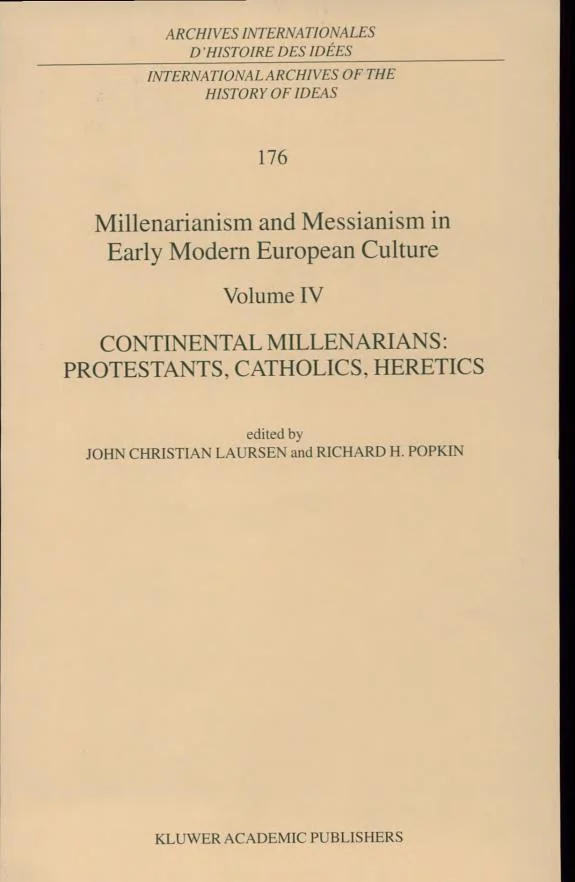
Millenarianism and Messianism in Early Modern European Culture Volume IV
 75
75

Millenarianism and Messianism in Early Modern European Culture Volume IV
The collected essays in Millenarianism and Messianism in Early Modern European Culture Volume IV offer a valuable survey of a complex field. Its strength lies in its geographical breadth, moving beyond the usual Western European focus to include Eastern European perspectives on apocalyptic thought. One particularly illuminating section discusses the Swedish millenarianism of the 17th century, demonstrating how eschatological fervor could intersect with national identity and imperial ambitions. However, the volume occasionally suffers from the unevenness inherent in multi-author collections; some essays are more deeply analytical than others. The lack of a single, unifying theoretical framework means the reader must actively synthesize the diverse findings. Nonetheless, for scholars of early modern esotericism and intellectual history, this work remains a significant resource for understanding the pervasive nature of end-times speculation.
📝 Description
75
Published in 2001, Volume IV of Millenarianism and Messianism in Early Modern European Culture examines apocalyptic movements across 17th and 18th-century Europe.
This collection gathers scholarly essays that investigate apocalyptic and messianic movements throughout Europe during the 17th and 18th centuries. The studies focus on France, the Netherlands, Germany, Sweden, and Eastern Europe, creating a broad European perspective. The volume functions as a comparative study, showing how these beliefs appeared in different forms and affected societies.
The book is suited for academics and advanced students in early modern history, philosophy, religious studies, and cultural history. It provides source material and analytical tools for understanding the intellectual and spiritual climate of a significant era. Researchers interested in the origins of modern ideas and social structures will find useful information here.
The early modern period, from the 17th to the 18th centuries, was a time of major religious change, scientific advances, and new political ideas. This era saw much speculation about the end times, often influenced by events like the Thirty Years' War and the Enlightenment's questioning of established authority. The book engages with scholarly discussions about the shift from medieval to modern ways of thinking.
This volume engages with the historical study of millenarianism and messianism, traditions that have long shaped Western thought and religious practice. These beliefs, concerning imminent divine intervention and the coming of a savior, have resurfaced throughout history, particularly during periods of social and political instability. The work analyzes these phenomena within the specific context of early modern Europe, a time marked by intense religious ferment and intellectual transformation, connecting them to broader currents of esoteric thought and the transition to modernity.
💡 Why Read This Book?
• Understand the diverse expressions of millenarianism across Europe between the 17th and 18th centuries, as detailed in essays focusing on regions like Sweden and Eastern Europe. • Gain insight into how apocalyptic beliefs influenced early modern political and social movements, moving beyond simplistic interpretations of religious fervor. • Explore the intellectual currents that connected religious prophecy with philosophical inquiry, as examined through the lens of messianic expectations in the period.
⭐ Reader Reviews
Honest opinions from readers who have explored this book.
❓ Frequently Asked Questions
What is the primary focus of Millenarianism and Messianism in Early Modern European Culture Volume IV?
The book focuses on scholarly studies of millenarian and messianic movements active in France, The Netherlands, Germany, Sweden, and Eastern Europe during the 17th and 18th centuries.
When was Millenarianism and Messianism in Early Modern European Culture Volume IV first published?
This volume was first published on July 31, 2001.
Who are the editors of this volume?
The volume is edited by Matt Goldish, R.H. Popkin, and John Christian Laursen.
What academic disciplines would benefit from this book?
Students and teachers of early modern ideas, the history of philosophy, religion, and the making of the modern world will find it beneficial.
Does the book cover specific geographical regions?
Yes, it specifically covers France, The Netherlands, Germany, Sweden, and Eastern Europe, offering a broad geographical scope for its studies.
What makes this book distinct from other works on the topic?
It is noted as the first book to bring together studies of a wide variety of millenarians from these specific European regions during the 17th and 18th centuries.
🔮 Key Themes & Symbolism
Apocalyptic Expectations
The volume investigates the pervasive belief in future apocalyptic events and the subsequent establishment of a utopian era, a concept central to millenarian thought. It examines how these expectations were shaped by religious doctrines, political upheavals like the Thirty Years' War, and intellectual shifts of the early modern period. The essays explore how different cultures interpreted signs of the end times and what societal transformations they anticipated, often linking divine intervention with radical political or social restructuring.
Messianic Figures and Movements
Central to the book is the analysis of messianic expectations, focusing on the anticipation of charismatic leaders or figures destined to usher in a new age. This theme looks at the roles attributed to these figures, whether they were seen as political saviors, spiritual reformers, or divine intermediaries. The collection illustrates how various European societies projected their hopes and anxieties onto individuals and groups claiming a special divine mandate, leading to diverse social and religious movements.
Cross-Cultural Millenarianism
A significant contribution of this volume is its comparative approach to millenarianism and messianism across distinct European cultural and religious landscapes. It highlights how similar eschatological impulses manifested differently in Catholic, Protestant, and Orthodox contexts, and how geographic location (e.g., Sweden vs. Eastern Europe) influenced the specific content and expression of these beliefs. This broad perspective allows for a richer understanding of the shared human impulse towards eschatological thinking.
Early Modern Intellectual Ferment
The book situates millenarian and messianic ideas within the broader intellectual currents of the early modern era. It explores the interplay between religious fervor, nascent scientific inquiry, and emerging philosophical rationalism. The essays demonstrate how these seemingly disparate forces often converged, with apocalyptic prophecies sometimes drawing on astronomical calculations or emerging political theories, reflecting a complex and dynamic intellectual environment.
💬 Memorable Quotes
Direct passages from the work, attributed to the author.
“Studies of a wide variety of millenarians who were active in the 17th and 18th centuries.”
— This highlights the book's core function: to consolidate and analyze diverse examples of apocalyptic and messianic belief systems operating across Europe during an important historical epoch.
“Provides much food for thought for students and teachers of early modern ideas.”
— This suggests the academic utility of the volume, positioning it as a resource that stimulates critical thinking and further research in fields concerned with the historical development of thought and society.
“It opens up many avenues for further work.”
— This indicates the book's value as a springboard for future scholarship, pointing to unresolved questions and areas ripe for deeper investigation within the study of early modern eschatology.
“Active in France, The Netherlands, Germany, Sweden, and eastern Europe.”
— This phrase specifies the geographical scope, emphasizing the pan-European nature of the studies and the comparative approach taken to understanding these widespread phenomena.
“Millenarianism and Messianism in Early Modern European Culture.”
— This directly states the central thematic concerns of the collection, defining the academic disciplines and historical periods that the essays engage with.
🌙 Esoteric Significance
Tradition
While not strictly an esoteric text in the sense of a grimoire or initiatory manual, this volume engages with the socio-historical manifestations of beliefs that often overlapped with or influenced esoteric traditions. Millenarianism and messianism frequently drew upon prophetic literature, apocalyptic visions, and symbolic interpretations of scripture—elements common in various esoteric lineages such as Christian Kabbalah, Rosicrucianism, and certain forms of Christian mysticism. The work examines how these eschatological frameworks provided alternative cosmologies and visions of radical transformation, often outside the mainstream religious and philosophical establishments.
Symbolism
The book implicitly deals with symbols central to apocalyptic and messianic thought. These include the concept of the 'New Jerusalem' as a symbol of divine order and perfection, the 'Chosen People' or elect group anticipating salvation, and the various symbolic interpretations of biblical prophecy concerning end-times events. Messianic figures themselves often become potent symbols of hope, liberation, or divine authority, embodying the collective aspirations for a transformed world. The very notion of a 'thousand-year reign' (millennium) functions as a powerful symbolic representation of ultimate peace and justice.
Modern Relevance
Contemporary interest in alternative spiritualities, political utopianism, and the historical roots of societal change can find resonance in this volume. Thinkers and movements focused on radical societal transformation, whether religious, political, or ecological, often echo historical millenarian impulses. Scholars of contemporary esotericism and new religious movements can use this work to trace the historical lineage of apocalyptic and messianic ideas that continue to surface in various forms, demonstrating the enduring human fascination with prophecies of societal redemption and cosmic renewal.
👥 Who Should Read This Book
• Students of early modern European history seeking to understand the role of religious and apocalyptic beliefs in shaping society and politics. • Researchers in comparative religion and the history of philosophy interested in the diverse expressions of eschatological thought across different cultures. • Academics and independent scholars of intellectual history who want to trace the development of ideas concerning societal transformation and future redemption.
📜 Historical Context
Published in 2001, Millenarianism and Messianism in Early Modern European Culture Volume IV emerged during a period of renewed scholarly interest in the history of ideas and the cultural impact of religious belief. The early modern era (roughly 1500-1800) was a crucible for dramatic shifts: the Reformation fractured religious unity, the Scientific Revolution challenged established cosmologies, and burgeoning nation-states reshaped political landscapes. Within this context, millenarianism—the belief in an impending earthly paradise often linked to a divine intervention—and messianism—the expectation of a savior figure—were not fringe phenomena but potent forces influencing popular movements and intellectual discourse. This volume addressed a gap by consolidating research on these movements across a wider swathe of Europe than typical studies, moving beyond Western Europe to include significant developments in Germany, Sweden, and Eastern Europe. It engaged with the ongoing discourse initiated by scholars like Norman Cohn and later revised by figures such as Michael Adas, providing a rich comparative framework for understanding these pervasive eschatological hopes.
📔 Journal Prompts
The diverse manifestations of millenarianism across France, The Netherlands, Germany, Sweden, and Eastern Europe.
Messianic expectations projected onto charismatic figures during the 17th and 18th centuries.
The intersection of religious prophecy and emerging secular thought in early modern Europe.
The concept of the 'thousand-year reign' as a symbol of societal transformation.
How early modern apocalyptic beliefs informed views on the making of the modern world.
🗂️ Glossary
Millenarianism
A belief system centered on the expectation of an imminent, fundamental transformation of society, often involving a divine intervention leading to a period of peace and righteousness, typically envisioned as a thousand-year reign.
Messianism
The belief in the advent of a messiah or savior figure who will bring about a redemptive era, characterized by justice, peace, and the overthrow of evil or oppression.
Eschatology
The theological or philosophical study of the ultimate destiny of humanity, the world, and history; the doctrine of last things, including concepts of salvation, judgment, and the end of the world.
Apocalypticism
A belief system that posits an imminent, radical, and often violent end to the current world order, followed by a new, divinely ordained era, frequently involving symbolic prophecies and visions.
Early Modern Period
The historical period spanning roughly from the late 15th century to the late 18th century, characterized by significant religious, scientific, political, and cultural transformations in Europe.
The Thirty Years' War
A series of wars fought primarily in Central Europe between 1618 and 1648, involving major European powers and devastating large areas of the Holy Roman Empire.
Enlightenment
An 18th-century intellectual and cultural movement emphasizing reason, individualism, and skepticism towards traditional authority, which profoundly influenced European thought and society.
This book appears in 1 collection
🔮 Readers Also Liked
Browse all →









From the “Millenarianism” Collection
View all →

![ERIC ED476541: Animals of the Chinese Zodiac. [Lesson Plan].](/img/thumb/eric-ed476541-animals-of-the-chinese-zodiac-lesson-plan-eric.webp)




More Free Esoteric History & Biography Books
View all →