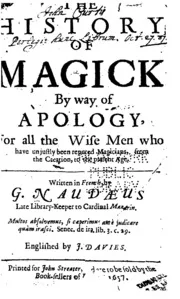
Mesmerism, Spiritualism, Etc.
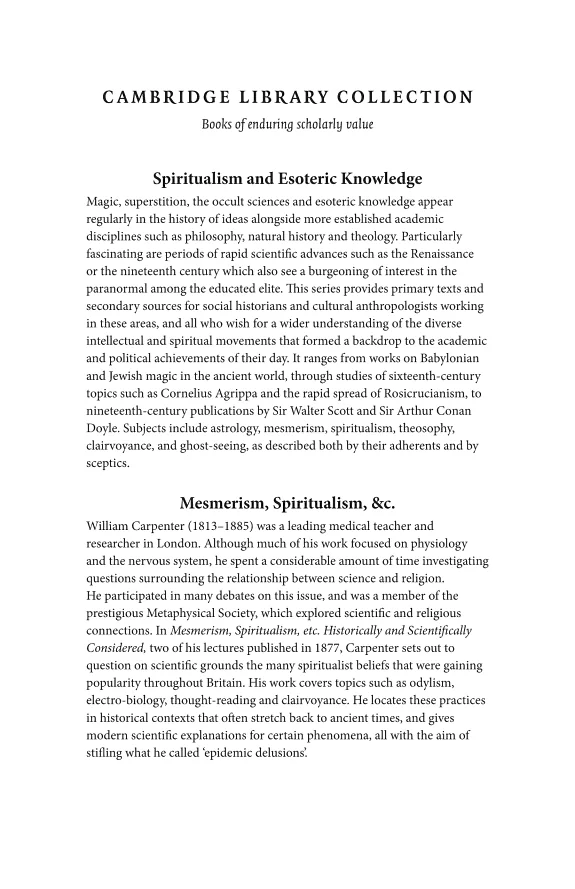
 71
71

Mesmerism, Spiritualism, Etc.
Carpenter’s 1877 lectures, collected as "Mesmerism, Spiritualism, Etc.," stand as a remarkable early attempt to apply scientific scrutiny to phenomena that enthralled the Victorian era. His strength lies in his systematic dissection of spiritualist claims, particularly his focus on the psychological mechanisms of suggestion and hallucination, which he termed 'unconscious cerebration.' He effectively uses historical examples and physiological arguments to ground the discussion, moving it away from purely spiritual interpretations. A notable limitation is Carpenter's occasional dismissal of subjective experience in favor of purely materialist explanations, which can feel reductive to modern readers accustomed to more nuanced psychological models. The chapter discussing the physical manifestations reported by mediums, where he meticulously lists potential physiological causes for phenomena like table-turning, exemplifies his rigorous, albeit sometimes unsympathetic, approach. The work serves as a valuable historical document, offering a clear counterpoint to the widespread spiritualist fervor of its time. It is a solid, if somewhat dry, academic critique.
📝 Description
71
William Benjamin Carpenter's 1877 lectures critically examined 19th-century mesmerism and spiritualism.
Originally delivered as lectures in 1877, William Benjamin Carpenter's "Mesmerism, Spiritualism, Etc." offers a scientific and historical critique of phenomena that captured public attention. Carpenter, a physician, aimed to uncover the psychological and physiological bases for widely accepted 'delusions,' prioritizing empirical observation over occult theories. He systematically addressed the claims of the spiritualist movement and the practices of mesmerism. The text dissects the societal fascination with altered states of consciousness and paranormal occurrences during the Victorian era.
The book is relevant for students of Victorian intellectual history, parapsychology, and historical critiques of the supernatural. Carpenter's methodical approach provides an empirical analysis of fringe beliefs prevalent in his time. He directly confronted the prevailing spiritualist movement, questioning the growing acceptance of supernatural causes for reported psychic events. Readers interested in the roots of modern psychology and the historical context of spiritualism will find this work informative.
Published in 1877, Carpenter's work engaged directly with the fervent spiritualist movement that swept through the Victorian era. This period saw widespread public interest in séances, mediums, and communication with the dead, often framed within a search for solace or hidden knowledge. Mesmerism, the precursor to hypnotism, also gained traction, blurring lines between physiological phenomena and purported psychic abilities. Carpenter's contribution lies in his attempt to demystify these occurrences through a rationalist framework, challenging the prevailing supernatural explanations by attributing them to the workings of the human mind and body.
💡 Why Read This Book?
• Gain insight into the scientific skepticism prevalent in the Victorian era regarding spiritualism, specifically examining Carpenter's use of the 'unconscious cerebration' concept to explain mediumistic phenomena. • Understand the historical discourse around mesmerism in the 1870s, learning how Carpenter differentiated it from genuine spiritual manifestations through physiological analysis. • Appreciate Carpenter's methodical debunking techniques, as demonstrated in his 1877 lectures, which provide a foundational case study for critical analysis of extraordinary claims.
⭐ Reader Reviews
Honest opinions from readers who have explored this book.
❓ Frequently Asked Questions
What was William Benjamin Carpenter's primary argument against spiritualism in his 1877 lectures?
Carpenter's central argument was that spiritualist phenomena, such as spirit communication and psychic manifestations, could be explained by natural psychological and physiological processes, particularly 'unconscious cerebration' and suggestibility, rather than supernatural intervention.
How did Carpenter approach the study of mesmerism?
He approached mesmerism by analyzing the states of consciousness induced, focusing on the role of suggestion and the susceptibility of individuals to hypnotic influence, distinguishing it from the claims of spiritualist mediums.
When was "Mesmerism, Spiritualism, Etc." originally published?
The lectures forming "Mesmerism, Spiritualism, Etc." were delivered in 1877, marking a critical intervention during the height of Victorian spiritualist interest.
What historical period does this book help to understand?
The book provides critical insight into the intellectual climate of the Victorian era, specifically the tension between burgeoning scientific thought and widespread popular belief in the supernatural and spiritual phenomena.
Did Carpenter believe in any supernatural phenomena?
Based on the text, Carpenter was a staunch advocate for scientific explanation, actively seeking naturalistic causes for phenomena attributed to the supernatural, suggesting a skeptical stance towards spiritualist claims.
What psychological concept did Carpenter develop to explain spiritualist claims?
Carpenter's key concept was 'unconscious cerebration,' which posited that subconscious mental processes could produce actions and perceptions that were then misinterpreted as supernatural or external influences.
🔮 Key Themes & Symbolism
Unconscious Cerebration
Carpenter's central thesis posits that many phenomena attributed to spirits or external psychic forces are actually products of the mind's subconscious processes. He argued that 'unconscious cerebration' could account for automatic writing, trance states, and even physical manifestations reported by mediums. This concept, a precursor to modern subconscious theory, allowed him to explain complex behaviors without resorting to supernatural causes, framing spiritualism as a psychological rather than a spiritual event.
Critique of Spiritualism
The work systematically dissects the prevalent spiritualist movement of the 1870s. Carpenter challenges mediums' claims by examining the historical context of reported hauntings and communications, often finding precedents in folklore or psychological suggestion. He employs scientific reasoning and physiological explanations to debunk alleged miracles, arguing that widespread belief in spiritualism was an 'epidemic delusion' fueled by expectation and lack of critical thought.
Mesmerism and Suggestibility
Carpenter dedicates significant attention to mesmerism, exploring its hypnotic states and the power of suggestion. He analyzes how individuals in a mesmeric trance can exhibit altered perceptions and behaviors, attributing these to the subject's susceptibility and the operator's influence. This analysis serves to illustrate the psychological mechanisms that he believed were also at play in spiritualist séances, demonstrating how easily the mind can be influenced.
Scientific Rationalism
Underlying the entire text is a commitment to scientific rationalism. Carpenter champions empirical observation and logical deduction as the primary tools for understanding the world. He contrasts this rigorous approach with the faith-based acceptance of spiritualist claims. The book functions as an early case study in applying scientific methodology to phenomena that were widely accepted through anecdotal evidence and emotional appeal, advocating for a materialist explanation.
💬 Memorable Quotes
Direct passages from the work, attributed to the author.
“The phenomenon of 'unconscious cerebration' is the explanation of a large number of the facts that have been brought forward in support of Spiritualism.”
— This captures Carpenter's core thesis. He identifies 'unconscious cerebration'—the mind's subconscious operations—as the primary mechanism behind many supposed spiritual manifestations, offering a scientific alternative to spirit intervention.
“In trance, the patient is a mere automaton, entirely under the control of the operator.”
— This statement, referencing the mesmeric state, illustrates Carpenter's view on suggestibility. He posits that individuals in altered states, like those induced by mesmerism, are highly susceptible to external influence, a principle he applies to understanding mediumistic trance.
“The question is not whether these things happen, but whether they happen in the way that Spiritualists assert.”
— Carpenter acknowledges that extraordinary experiences are reported but disputes the interpretation. His focus is on providing alternative, naturalistic explanations for the phenomena, rather than denying their occurrence outright.
“Spiritualism, as a system of belief, is a disease of the intellect.”
— This forceful assertion frames spiritualism as a pathology rather than a valid belief system. It reflects Carpenter's view of spiritualism as an irrational deviation from sound scientific and intellectual principles.
💡 Key Ideas
Editorial paraphrase of the work's core concepts — not direct quotes.
The very fact of the belief being so widely diffused, and the phenomena so numerous and various, are, to my mind, the strongest arguments against its supernatural origin.
This quote highlights Carpenter's skeptical methodology. He argues that the very prevalence and variety of spiritualist claims, rather than proving their divine origin, actually suggest a common, possibly psychological or social, root cause that can be uncovered through rational inquiry.
🌙 Esoteric Significance
Tradition
While not strictly within a traditional esoteric lineage like Hermeticism or Kabbalah, Carpenter's work engages with phenomena often explored in esoteric circles: altered states of consciousness, psychic abilities, and communication with non-physical entities. His contribution lies in applying a rationalist, scientific methodology to these subjects, acting as a critical foil to more mystical or occult interpretations prevalent at the time.
Symbolism
The book does not heavily rely on traditional esoteric symbolism. Instead, its 'symbols' are conceptual: 'unconscious cerebration' acts as a key symbolic mechanism explaining the unexplained, and 'trance' itself becomes a symbolic state representing heightened suggestibility and detachment from rational control, distinct from spiritual enlightenment.
Modern Relevance
Carpenter's work remains relevant for contemporary discussions on critical thinking, scientific literacy, and the psychology of belief. His methodical dissection of phenomena, particularly his insights into suggestion and the power of expectation, informs modern research in cognitive biases, social psychology, and the scientific study of consciousness and anomalous experiences.
👥 Who Should Read This Book
• Students of Victorian intellectual history seeking primary sources on the cultural clash between science and spiritualism. • Parapsychology researchers interested in early skeptical methodologies and historical debunking techniques applied to psychic claims. • Skeptics and critical thinkers wanting to understand the historical roots of scientific challenges to supernatural beliefs.
📜 Historical Context
Published in 1877, "Mesmerism, Spiritualism, Etc." emerged at the zenith of Victorian spiritualism, a movement deeply entrenched in society following events like the Fox sisters' publicity and the widespread use of mediums. Simultaneously, the scientific community, including figures like Sir William Crookes, was investigating psychic phenomena, albeit with varying degrees of skepticism. Carpenter, a respected physician and physiologist, positioned his work as a rational counterpoint to the prevailing spiritualist fervor. He directly confronted the claims made by spiritualists, engaging with contemporary scientific understanding of the brain and psychology. His approach stood in contrast to the more credulous investigations by some contemporaries and the spiritualist movement's own proponents, who often relied on anecdotal evidence and spiritual testimonies.
📔 Journal Prompts
The concept of 'unconscious cerebration' as a potential explanation for phenomena.
Your personal interpretation of Carpenter's distinction between mesmerism and spiritualism.
The historical reception of Carpenter's critique in 1877.
Reflecting on the role of suggestion in modern belief systems.
Comparing Carpenter's methods to contemporary approaches to anomalous experiences.
🗂️ Glossary
Mesmerism
A practice developed by Franz Mesmer in the late 18th century, involving the induction of a trance-like state through suggestion and manipulation of perceived 'animal magnetism,' later evolving into hypnotism.
Spiritualism
A religious movement prominent in the 19th century that asserted the possibility of communicating with the spirits of the dead, often through mediums.
Unconscious Cerebration
William Benjamin Carpenter's term for mental processes occurring below the level of conscious awareness, which he believed could influence behavior and perception, explaining many phenomena attributed to external or supernatural forces.
Epidemic Delusions
Carpenter's description of widespread, irrational beliefs that spread through a population, akin to a contagious disease, suggesting a lack of critical thinking and susceptibility to suggestion.
Medium
A person believed to be able to communicate with the spirits of the dead or to act as an intermediary between the living and the spirit world.
Suggestion
The psychological process by which an idea or impulse is introduced into the mind, often leading to an action or belief without conscious reasoning, particularly influential in mesmerism and spiritualism.
Trance
A state of altered consciousness characterized by reduced awareness of one's surroundings and increased susceptibility to external influence or internal psychic phenomena.
This book appears in 1 collection
🔮 Readers Also Liked
Browse all →








From the “Mesmerism” Collection
View all →




More Free Esoteric History & Biography Books
View all →