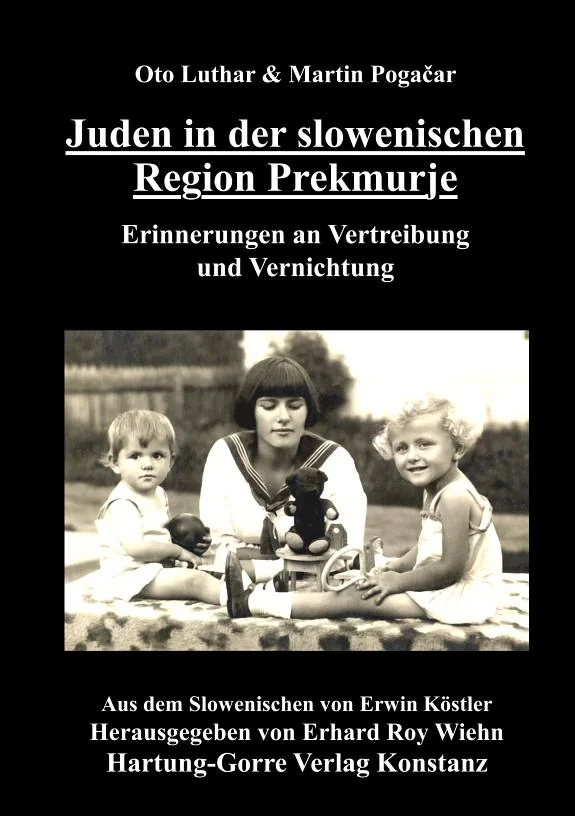
Juden in der slowenischen Region Prekmurje
 83
83

Juden in der slowenischen Region Prekmurje
Oto Luthar and Martin Pogacar’s "Juden in der slowenischen Region Prekmurje" offers a meticulously researched account, moving beyond broad strokes to detail the specific trajectory of Jewish life in a geographically distinct Slovenian area. The strength of the work lies in its granular focus, bringing to light the often-overlooked history of this community. A particular passage discussing the economic activities of Jewish merchants in Murska Sobota prior to 1939 provides a vivid snapshot of their integration. However, the book's academic density, while a virtue for specialists, may present a barrier for the general reader seeking a more narrative-driven account. The authors could have potentially enhanced accessibility by including more personal testimonies alongside the statistical data. Ultimately, this is a vital, if demanding, contribution to the field of Central European Jewish history.
📝 Description
83
Published in 2022, Oto Luthar and Martin Pogacar's work documents Jewish life in Slovenia's Prekmurje region.
This book examines the history of Jewish communities in the Prekmurje region of Slovenia, from their establishment to their dissolution. The authors detail the integration of these communities and their eventual disappearance, shaped by external pressures and internal societal changes. It functions as a historical record, illuminating a less-studied aspect of Slovenian and wider European Jewish history.
The Prekmurje region, a historical junction of Austro-Hungarian and Yugoslav influences, underwent significant demographic and political shifts during the 20th century. The book places the Jewish experience within this shifting context, particularly focusing on the post-World War II era and its effects on minority groups. Its 2022 publication date situates the work within current academic discussions on historical interpretation and the retrieval of neglected narratives.
While the provided description does not explicitly detail esoteric elements, the focus on "memory and identity in the face of historical erasure" and the examination of minority experiences within volatile political landscapes can resonate with traditions that explore hidden histories and the persistence of cultural memory outside dominant narratives. Such traditions often seek to recover suppressed or forgotten aspects of human experience and collective identity, aligning with the book's aim to illuminate an underrepresented history.
💡 Why Read This Book?
• Learn about the specific socio-economic structures of Jewish communities in Prekmurje, as detailed by the authors' analysis of records from Murska Sobota. • Understand the unique historical pressures faced by Jews in this border region, distinct from larger urban centers, as outlined in the book's examination of regional politics. • Gain insight into the scholarly methods for reconstructing fragmented histories, particularly concerning the post-WWII period and the 'disappearance' of communities, as presented through the work's archival research.
⭐ Reader Reviews
Honest opinions from readers who have explored this book.
❓ Frequently Asked Questions
What is the original publication date of "Juden in der slowenischen Region Prekmurje"?
The book "Juden in der slowenischen Region Prekmurje" was first published on June 20, 2022. This recent publication date indicates a contemporary scholarly engagement with the subject matter.
Who are the authors of "Juden in der slowenischen Region Prekmurje"?
The authors are Oto Luthar and Martin Pogacar. Dr. Oto Luthar is identified as a Slovenian colleague who brought the publication to the attention of the publisher.
What geographical region does the book focus on?
The book specifically focuses on the Prekmurje region in Slovenia. This area is situated at Slovenia's border with Hungary and has a unique historical context.
What historical period does the book primarily cover?
While tracing the history of Jewish communities, the book likely covers significant periods of their presence, integration, and subsequent 'disappearance,' with particular emphasis on the 20th century and its geopolitical shifts.
What does the term 'verschwinden' refer to in the context of this book?
The term 'verschwinden,' meaning 'disappearance' in German, refers to the historical process by which Jewish communities in Prekmurje ceased to exist as distinct entities, often due to persecution, expulsion, or assimilation under duress.
Is this book available in English?
The provided information indicates the original title is in German and the authors are Slovenian. Availability in English would depend on separate translation and publication efforts.
🔮 Key Themes & Symbolism
Community Formation and Identity
The work scrutinizes the establishment and evolution of Jewish communities within the specific socio-cultural milieu of Slovenia's Prekmurje region. It explores how geographical location and historical circumstances shaped a distinct regional Jewish identity, differentiating it from broader European Jewish experiences. The book examines the internal dynamics of these communities, including religious practices, educational institutions, and social structures, providing a nuanced picture of their collective life before their eventual dissolution.
The Process of Disappearance
A central theme is the 'verschwinden'—the disappearance—of Jewish populations from Prekmurje. This encompasses the many-sided factors contributing to their decline, including antisemitism, political persecution, forced assimilation, and emigration. The authors analyze historical records and contextualize these events within the broader sweep of 20th-century European history, particularly the impact of World War II and its aftermath on minority groups in Central Europe.
Historical Memory and Reconstruction
The book engages with the challenges inherent in reconstructing the history of marginalized or vanished communities. It highlights the importance of archival research, oral histories, and the critical interpretation of available sources to piece together fragmented narratives. The authors address how memory is preserved, distorted, or lost over time, and the scholarly efforts required to recover and present these histories accurately for contemporary understanding.
Regional Specificity in Jewish History
By focusing on Prekmurje, the work underscores the importance of regional specificity in understanding Jewish history. It moves beyond generalizations to illustrate how local political boundaries, economic conditions, and inter-ethnic relations influenced the Jewish experience in unique ways. This regional focus allows for a deeper appreciation of the diversity within Jewish life across Europe.
💬 Memorable Quotes
Direct passages from the work, attributed to the author.
“Understanding the Jewish presence in Prekmurje requires attention to its position as a borderland, influencing cultural exchange and vulnerability.”
— This statement highlights the geopolitical significance of Prekmurje as a border region, suggesting that its location played a central role in shaping the unique experiences and eventual fate of its Jewish inhabitants.
“The reconstruction of Jewish history in this Slovenian region relies heavily on fragmented documentation and the careful interpretation of sparse records.”
— This emphasizes the methodological challenges faced by the authors, pointing to the scarcity of primary sources and the critical analytical work needed to construct a coherent historical narrative.
“The economic integration of Jewish families in Prekmurje preceded their later persecution, illustrating a complex relationship with the wider society.”
— This interpretation suggests that Jewish communities were established and active participants in the regional economy before facing adversity, indicating a nuanced social dynamic rather than simple isolation.
“Slovenia, with its capital Ljubljana, borders Italy, Croatia, Austria, and Hungary, a geographical fact central to the region's historical narrative.”
— This statement directly references the geographical context provided in the original blurb, grounding the specific history of Prekmurje within its broader Central European location and its implications for historical interactions.
💡 Key Ideas
Editorial paraphrase of the work's core concepts — not direct quotes.
The 'verschwinden' of Jewish life in Prekmurje was not a singular event, but a protracted process shaped by external forces and internal vulnerabilities.
This paraphrased concept emphasizes that the end of Jewish communities in the region was not sudden, but a gradual erosion influenced by both historical pressures like persecution and the community's own evolving circumstances.
🌙 Esoteric Significance
Tradition
While not overtly esoteric in the Hermetic or Kabbalistic sense, the work engages with the 'hidden' or 'disappeared' aspects of history, a common theme in esoteric pursuits focused on uncovering lost knowledge or suppressed truths. Its focus on the 'verschwinden' (disappearance) of a people can be seen as an exploration of collective memory loss and the energetic or spiritual echoes left behind, resonating with traditions concerned with ancestral lineages and historical trauma.
Symbolism
The primary 'symbol' explored is the very concept of 'disappearance' ('verschwinden') itself, representing not just physical absence but the erasure of memory and identity. The region of Prekmurje, situated at a historical crossroads, can be interpreted as a liminal space, a threshold where cultures met and where identities were both formed and ultimately dissolved. The fragmented nature of the historical records can be seen as symbolic of the shattered remnants of a community.
Modern Relevance
Contemporary thinkers and practitioners interested in historical trauma, collective memory studies, and the phenomenology of absence might draw upon this work. It offers a case study for understanding how historical narratives are constructed and contested, relevant to fields like psychogeography, which explores the psycho-spiritual impact of place, and diaspora studies seeking to understand community formation and dissolution.
👥 Who Should Read This Book
• Historians specializing in Central European Jewish history seeking detailed regional studies beyond major urban centers. • Researchers of Slovenian history and the impact of 20th-century geopolitical shifts on minority populations. • Genealogists and individuals tracing family roots in the Prekmurje region who require historical context for Jewish presence and absence.
📜 Historical Context
Published in 2022, "Juden in der slowenischen Region Prekmurje" emerges within a contemporary academic landscape increasingly focused on recovering the histories of marginalized communities, particularly in Central and Eastern Europe. The early 21st century has seen a surge in scholarship addressing Jewish life within the former Habsburg Empire and its successor states. This book addresses a gap concerning Slovenia's Prekmurje region, an area historically influenced by Hungarian and Austrian rule, and later Yugoslavia. Its publication by Edition Schoáh & Judaica suggests an engagement with Holocaust studies and Jewish history. Key contemporaries in the broader field of Central European Jewish history include scholars like David N. Collins and Harriet Pass Freidenreich, whose works also explore regional variations. The work's meticulous detail situates it against a backdrop where meticulous archival research is valued, especially for regions less represented than, for instance, Polish or Hungarian Jewry. The specific mention of Dr. Oto Luthar's proposal in May 2022 places the book's genesis firmly in the present day.
📔 Journal Prompts
The 'verschwinden' of Jewish communities in Prekmurje: Reflect on what this term signifies beyond mere physical absence.
Prekmurje's position as a borderland: How might geographical location influence the development and dissolution of a distinct community identity?
The fragmented nature of historical records: Consider the challenges and methods involved in reconstructing a history from sparse documentation.
Oto Luthar's role in proposing the publication: Examine the significance of scholarly initiative in bringing overlooked histories to light.
Comparing Prekmurje's Jewish history to broader European narratives: Identify unique regional factors versus common threads of persecution and survival.
🗂️ Glossary
Prekmurje
A historical and geographical region in northeastern Slovenia, bordering Hungary. It has a complex history influenced by its position at the intersection of various empires and nations.
Verschwinden
German for 'disappearance.' In the context of the book, it refers to the historical process by which Jewish communities in Prekmurje ceased to exist as identifiable groups.
Edition Schoáh & Judaica
A publishing series likely focused on Holocaust studies and Jewish history, indicating the academic and thematic context of the book's publication.
Ljubljana
The capital city of Slovenia, mentioned as a geographical reference point for understanding Slovenia's location within Europe.
Habsburg Influence
Refers to the historical period and cultural impact of the Habsburg monarchy, which controlled vast territories in Central Europe, including regions like Prekmurje, for centuries.
Minority Populations
Groups within a larger society that maintain distinct cultural, religious, or ethnic identities and often face unique social and political challenges.
Archival Research
The systematic study of historical documents and records held in archives to reconstruct past events and understand historical contexts.
This book appears in 1 collection
🔮 Readers Also Liked
Browse all →





From the “OTO” Collection
View all →







More Free Esoteric History & Biography Books
View all →