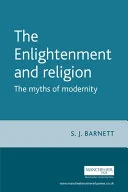
The Enlightenment and Religion
 77
77

The Enlightenment and Religion
Barnett's "The Enlightenment and Religion" confronts established interpretations of 18th-century European religious life with a refreshing rigor. The author rightly points out how much of the canonical view has been built on shaky evidentiary ground, particularly concerning Enlightenment Italy. The focus on specific case studies, like the varied religious climates in Italy, France, and England, avoids broad generalizations. However, while the critique of past scholarship is sharp, the book could benefit from a more explicit engagement with the *lived* religious experiences of ordinary people, rather than solely focusing on intellectual trends and institutional shifts. The argument that the "canonical view" is constructed on "scant evidence and assumption" is the work's strongest contribution. It's a valuable corrective for historians and theologians alike, urging a re-evaluation of assumptions about faith and reason during the Enlightenment.
📝 Description
77
S. J. Barnett's 2014 book scrutinizes religious transformations in 18th-century Europe.
This book challenges common academic views on religious change during the Enlightenment. Barnett questions how we understand religious shifts in an era marked by increasing rationalism and skepticism toward established religious authority. The study focuses on Italy, France, and England during the 1700s, examining the interplay between reason and faith.
Barnett dissects concepts like religious adherence, deism, atheism, and the changing role of religious institutions. The work scrutinizes the evidence used to build historical accounts of religious decline or adaptation. It proposes a more complex understanding of these transformations, moving beyond simplistic narratives of secularization. The analysis considers the religious dynamics within specific European nations during this significant period of intellectual development.
While the Enlightenment is often associated with secularism, this work engages with how esoteric ideas and figures interacted with dominant rationalist currents. It examines how traditional beliefs, mystical interpretations, and alternative spiritualities were reconfigured or challenged within this intellectual milieu. The book considers how concepts like deism, often seen as a rationalist deism, might have contained elements that resonated with or diverged from earlier esoteric traditions, and how the institutional Church's responses were shaped by these diverse currents. This places the study within a broader conversation about the survival and transformation of spiritual and religious thought during periods of radical intellectual change.
⭐ Reader Reviews
Honest opinions from readers who have explored this book.
❓ Frequently Asked Questions
What is the primary argument of S. J. Barnett's "The Enlightenment and Religion"?
Barnett's central argument is that the conventional understanding of religious change in 18th-century Europe, especially in Enlightenment Italy, is built on weak evidence and assumptions, advocating for a more critical re-evaluation of historical accounts.
Which European countries are central to the analysis in "The Enlightenment and Religion"?
The book focuses its critical survey on religious change within three key European nations: Italy, France, and England during the 18th century.
When was "The Enlightenment and Religion" first published?
The work by S. J. Barnett was first published in 2003, offering a modern scholarly perspective on historical religious transformations.
Does the book argue that religion disappeared during the Enlightenment?
No, the book does not argue for the disappearance of religion. Instead, it critiques how historical narratives have constructed the *change* and *causes* of religious shifts, questioning the evidence for prevailing views.
What does Barnett mean by "canonical view" in this context?
Barnett uses "canonical view" to refer to the widely accepted or standard historical interpretation of religious change during the 18th century, which he argues is often based on limited evidence and unchecked assumptions.
What is the main critique of historical scholarship presented in the book?
The book's main critique is that scholarly consensus on 18th-century religious change relies heavily on assumption rather than robust evidence, particularly regarding the intellectual and social impact of the Enlightenment.
🔮 Key Themes & Symbolism
Questioning Enlightenment Narratives
This work challenges the established historical accounts of how religion transformed during the 18th century. Barnett argues that the "canonical view" has been constructed with insufficient evidence and reliance on assumption, particularly concerning the impact of the Enlightenment's rationalist and skeptical currents on religious belief and practice across Europe.
Religious Change in 18th-Century Europe
The book provides a critical survey of the religious landscape in Europe during the 1700s. It dissects the causes and nature of religious change, focusing on the distinct yet interconnected contexts of Italy, France, and England, and examining the nuances often lost in broader historical generalizations.
Historiography of Religion and Reason
A central theme is the historiography of the Enlightenment itself – how scholars have interpreted the relationship between burgeoning rationalism and established religious traditions. Barnett scrutinizes the methodologies and evidence used to portray this era, urging a more rigorous and evidence-based approach to understanding religious shifts.
Evidence and Assumption in History
Barnett places significant emphasis on the distinction between historical evidence and scholarly assumption. He illustrates how assumptions about religious decline or secularization during the Enlightenment have been perpetuated, often without adequate empirical backing, leading to a potentially distorted understanding of the past.
💬 Memorable Quotes
Direct passages from the work, attributed to the author.
“the canonical view of 18th-century religious change has in reality been constructed upon scant evidence and assumption”
— This is the core thesis, suggesting that widely accepted historical interpretations about religion during the Enlightenment may be more speculative than factual, lacking solid empirical support.
“Focusing on Enlightenment Italy, France and England”
— This highlights the book's specific geographical and temporal scope, indicating a detailed comparative analysis rather than a sweeping generalization of European religious history.
“a critical survey of religious change and its causes”
— This phrase underscores the book's analytical approach, aiming not just to describe religious shifts but to rigorously investigate their underlying factors and motivations.
“illustrates how... has been constructed”
— This points to the book's method of deconstruction, showing how historical narratives are built and then examining the validity of their foundations and arguments.
“scant evidence and assumption”
— This concisely expresses Barnett's critique of existing scholarship, emphasizing the perceived lack of robust factual backing and the overreliance on conjecture in many historical accounts of the period.
🌙 Esoteric Significance
Tradition
While "The Enlightenment and Religion" is primarily a work of historical scholarship rather than esoteric doctrine, its critical examination of religious change during a period of intense rationalist inquiry holds significance for esoteric traditions. It challenges the notion that the Enlightenment was solely an era of materialist or atheistic dominance, implicitly leaving room for the survival or adaptation of heterodox beliefs and mystical practices that often existed outside mainstream religious structures.
Symbolism
The book's focus on the interplay between reason and faith indirectly touches upon symbolic interpretations. For instance, the concept of "Deism," which posited a creator God who does not intervene in the universe, can be seen as a rationalized, perhaps even symbolic, interpretation of divinity stripped of anthropomorphic and miraculous attributes common in traditional faiths. The "canonical view" itself functions as a symbolic representation of historical progress, which Barnett seeks to deconstruct.
Modern Relevance
Contemporary esoteric thinkers and practitioners often engage with historical periods like the Enlightenment to understand the roots of modern skepticism towards the occult and mystical. Barnett's work provides a crucial corrective, urging a more nuanced view of religious and intellectual history that acknowledges the persistence and evolution of non-mainstream beliefs. It encourages a re-examination of how rationalist critiques might have inadvertently shaped, rather than eradicated, alternative spiritualities.
👥 Who Should Read This Book
['• Academic historians and religious studies scholars: To gain a critical perspective on the historiography of the Enlightenment and its impact on religious thought, particularly concerning the evidence base for common interpretations.', '• Students of European intellectual history: To understand the complex relationship between reason, faith, and societal change in 18th-century Italy, France, and England, moving beyond simplistic narratives.', '• Readers interested in the evolution of belief systems: To explore how historical narratives about religion are constructed and to challenge assumptions about the decline of faith during periods of intellectual upheaval.']
📜 Historical Context
Published in 2003, S. J. Barnett's "The Enlightenment and Religion" entered a scholarly landscape still grappling with the legacy of the Enlightenment and its complex relationship with religious belief. The late 20th and early 21st centuries saw continued debate among historians regarding secularization theories and the role of religion in modernity. Barnett's work directly engages with this ongoing historiographical discussion, particularly by challenging the prevalent narrative that the Enlightenment unequivocally led to a widespread decline in religious adherence. He specifically targets the foundations of this view, arguing it has been built upon insufficient evidence, a point he elaborates by examining developments in Enlightenment Italy, France, and England. This approach offered a counterpoint to scholars who might have accepted the narrative of religious erosion as settled fact. The book's critical stance implicitly engaged with intellectual currents that sought to redefine the Enlightenment, moving beyond a purely secularizing interpretation.
📔 Journal Prompts
The construction of the canonical view of religious change.
Evidence versus assumption in 18th-century religious history.
The impact of Enlightenment Italy on broader religious trends.
Contrasting religious change in France and England during the 1700s.
Critiquing the causes of religious transformation in the Enlightenment.
🗂️ Glossary
Enlightenment Italy
Refers to the intellectual and cultural milieu of Italy during the 18th century, characterized by the spread of Enlightenment ideals of reason, skepticism, and reform, and their specific interaction with the prevalent Catholic religious structures.
Canonical view
In this context, the "canonical view" denotes the widely accepted or standard historical interpretation regarding religious change and its causes during the 18th century in Europe.
Scant evidence and assumption
This phrase describes Barnett's critique of prevailing historical narratives, suggesting they are based on insufficient factual proof and speculative reasoning rather than robust empirical data.
Religious change
Encompasses shifts in religious beliefs, practices, institutional structures, and the overall influence of religion within society, as examined in 18th-century Europe.
Causes of religious change
The underlying factors and motivations—intellectual, social, political, or economic—that contributed to the transformations in religious life during the Enlightenment period.
18th-century Europe
The geographical and temporal setting for the book's analysis, specifically the period from 1701 to 1800, a time of significant intellectual and societal transformation known as the Age of Enlightenment.
Critical survey
An analytical examination that evaluates and questions existing ideas, theories, or historical accounts, rather than simply describing them.
This book appears in 1 collection
🔮 Readers Also Liked
Browse all →






From the “Enlightenment” Collection
View all →








More Free Esoteric History & Biography Books
View all →