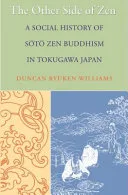
The Other Side of Zen
 73
73

The Other Side of Zen
Duncan Ryūken Williams’s *The Other Side of Zen* offers a necessary corrective to the often-idealized Western view of Zen. By focusing on the Soto school's vigorous growth during Japan’s Tokugawa period (1600-1867), Williams demonstrates that Zen’s success was deeply intertwined with its societal engagement, not just its meditative core. The author skillfully uses newly discovered manuscripts to illustrate how Soto Zen monks actively participated in popular religious life, temple administration, and funeral rites. A particular strength is Williams's meticulous unearthing of the institutional aspects of Zen, revealing it as a dynamic social force. However, the dense academic prose, while precise, may occasionally obscure the narrative for readers less familiar with Japanese history or Buddhist terminology. The argument that Soto Zen’s expansion was tied to its practical integration into Japanese society, rather than solely its meditative prowess, is compelling. This book serves as a crucial reminder that religious traditions are living, evolving entities shaped by their historical contexts.
📝 Description
73
Duncan Ryūken Williams's 2005 book challenges the common Western view of Zen Buddhism.
The Other Side of Zen argues against the prevalent Western notion that Zen Buddhism is solely about solitary meditation and abstract emptiness. Williams focuses on the Soto Zen school's development in Japan during the Tokugawa period (1600-1867). He uses newly available manuscripts to show that Soto Zen's growth was linked not only to its meditative practices but also to its deep involvement with the religious and social structures of the time. This reveals a Zen tradition more integrated into its historical context than typically understood.
Williams places Zen within the active religious landscape of Tokugawa Japan, an era of state consolidation and institutional religious codes. The book demonstrates how Soto Zen engaged with popular religious customs, managed temple affairs, and participated in deathbed rituals. This portrayal contrasts with the image of Zen as an exclusive, ascetic practice, highlighting its integration into daily Japanese life and its competition with other schools like Rinzai Zen.
This work engages with the esoteric traditions by examining how a seemingly contemplative practice like Zen Buddhism became deeply interwoven with the social, political, and ritualistic fabric of Japanese society during a specific historical period. It moves beyond a purely internal or spiritual focus to understand the practical and communal dimensions of Zen institutions, particularly the Soto school. By analyzing neglected sources, it reconstructs a more complex historical reality of religious life, challenging simplified or idealized interpretations of Zen's transmission and practice.
💡 Why Read This Book?
• Understand the historical forces behind Soto Zen's expansion during the Tokugawa period (1600-1867), moving beyond monolithic views of Zen. • Discover how Zen institutions actively engaged with Japanese society, managing funeral rites and temple administration, as detailed in the analysis of newly discovered manuscripts. • Gain a critical perspective on the Western 'Zen boom' by examining the socio-religious landscape of Japan, challenging simplistic portrayals of Zen as purely meditative.
⭐ Reader Reviews
Honest opinions from readers who have explored this book.
❓ Frequently Asked Questions
What is the Tokugawa period's significance for Zen Buddhism?
The Tokugawa period (1600-1867) was crucial as it saw the institutionalization and expansion of Soto Zen. Williams argues its growth was linked to societal integration, not just meditation, challenging earlier assumptions about Zen's development.
How does 'The Other Side of Zen' differ from popular Western views of Zen?
It contrasts the stereotype of isolated meditators with the reality of Zen's active engagement in Japanese society, including temple administration and funeral rites during the Tokugawa era.
What kind of manuscripts does Duncan Ryūken Williams utilize?
The book relies on newly discovered manuscripts that shed light on the practical, administrative, and social activities of Soto Zen monks, revealing aspects previously overlooked in historical accounts.
Was Zen Buddhism the only significant religious movement in Tokugawa Japan?
No, Williams situates Zen within a broader Japanese religious landscape. The book explores how Zen interacted and competed with other schools and popular beliefs during this era.
What does the term 'temple Buddhism' (jiin Bukkyō) refer to in this context?
It refers to the institutional and societal role of Buddhist temples, particularly Soto Zen temples during the Tokugawa period, in managing community life, rituals, and lineage, as explored in the text.
Who was Duncan Ryūken Williams?
Duncan Ryūken Williams is a scholar of Japanese Buddhism and religious studies. He first published 'The Other Side of Zen' in 2005, offering a revisionist history of Soto Zen.
🔮 Key Themes & Symbolism
Zen's Social Engagement
This work fundamentally re-examines Zen Buddhism, moving beyond the popular image of solitary contemplation. It highlights how Soto Zen, particularly during Japan's Tokugawa period (1600-1867), was deeply embedded in the social fabric. Williams uses newly uncovered manuscripts to demonstrate Zen monks' active roles in temple administration, funeral rites, and community life, suggesting its growth was intrinsically linked to these societal functions rather than solely its meditative practices.
Tokugawa Religious Landscape
The book meticulously reconstructs the religious environment of Tokugawa Japan, a period of significant state consolidation and cultural development. It illustrates how Zen schools, like Soto Zen, operated within a complex system of religious institutions and popular beliefs. Williams reveals a dynamic interplay between Zen and other religious traditions, challenging the notion of Zen as an isolated spiritual discipline and emphasizing its historical contingency.
Critique of Western Zen Perceptions
A central aim of *The Other Side of Zen* is to deconstruct the often-stereotyped understanding of Zen prevalent in the West. By presenting a historically grounded account of Zen's development in Japan, the book implicitly critiques the 'Zen boom' that often ignored the complex social, political, and institutional factors shaping the tradition. It argues for a more nuanced appreciation of Zen's origins and evolution.
Institutional Buddhism
Williams emphasizes the importance of 'temple Buddhism' (jiin Bukkyō) in understanding Zen's historical trajectory. He illustrates how Zen institutions were not merely centers for spiritual practice but also administrative bodies managing lineage, property, and societal rituals, especially concerning death and the afterlife. This focus on institutional structures provides a crucial counterpoint to purely philosophical or meditative interpretations of Zen.
💬 Memorable Quotes
Direct passages from the work, attributed to the author.
“The success of Soto Zen was due neither to what is most often associated with it in the West—its meditative techniques—nor solely to its philosophical sophistication.”
— This statement expresses the book's core argument: Zen's historical expansion in Japan, particularly during the Tokugawa era, was driven by factors beyond meditation and philosophy, pointing towards societal and institutional integration.
“Zen's engagement with the broader Japanese religious landscape during the Tokugawa period.”
— This phrase highlights the book's focus on situating Zen within its historical context, arguing that its growth and influence were tied to its interaction with, and participation in, the wider religious and social structures of 17th to 19th century Japan.
“Examining the movement's explosive growth during the Tokugawa period (1600-1867).”
— This points to the specific historical timeframe and phenomenon the book investigates, emphasizing the dynamic expansion of Zen and signaling a departure from static or ahistorical accounts.
“Shedding light on the broader Japanese religious landscape during the era.”
— This indicates the book's methodological approach: not isolating Zen, but understanding it through its interactions and relationships within the diverse religious milieu of Tokugawa Japan.
💡 Key Ideas
Editorial paraphrase of the work's core concepts — not direct quotes.
The popular understanding of Zen Buddhism typically involves a stereotyped image of isolated individuals in meditation, contemplating nothingness.
This quote directly addresses the common Western perception of Zen that the author seeks to dismantle, setting the stage for presenting a more complex, historically engaged view of the practice.
🌙 Esoteric Significance
Tradition
While Zen Buddhism is often approached through its philosophical and meditative aspects, *The Other Side of Zen* looks at its institutional and social dimensions, positioning it within the broader spectrum of religious traditions that engage with societal structures. It doesn't align strictly with Western esoteric lineages like Hermeticism or Kabbalah but offers a model for understanding how any spiritual discipline becomes historically and culturally embedded, a concept relevant to esoteric studies focused on the practical manifestation of spiritual principles.
Symbolism
The book, while primarily historical and sociological, implicitly touches upon symbols of institutional authority and ritual practice within Zen. The temple itself, as a physical structure and administrative center, becomes a symbol of Zen's societal integration. Furthermore, the rituals surrounding death and lineage transmission, central to Tokugawa-era Soto Zen, symbolize the tradition's role in providing order, continuity, and meaning within the Japanese life cycle, moving beyond abstract spiritual concepts.
Modern Relevance
Contemporary scholars and practitioners seeking to understand the lived reality of religious traditions beyond their theoretical frameworks find Williams's work invaluable. Thinkers interested in the sociology of religion, the history of institutions, and the critique of Orientalist views of Eastern spirituality draw upon this book. It informs modern discussions about how spiritual paths adapt and persist within diverse cultural contexts, relevant to Neo-Buddhist movements and comparative religious studies.
👥 Who Should Read This Book
• Scholars of Japanese Religious History and Buddhist Studies: They will find a meticulously researched analysis that challenges established narratives and provides new insights into the Tokugawa period. • Practitioners of Zen Buddhism: Those seeking a deeper, historical understanding of their practice beyond meditation will gain context on Zen's development and societal role. • Students of Comparative Religion and Sociology of Religion: Readers interested in how religious movements interact with social structures, institutions, and popular culture will find a compelling case study.
📜 Historical Context
Duncan Ryūken Williams's *The Other Side of Zen* emerged in 2005, offering a significant revisionist perspective on Soto Zen Buddhism within the context of Tokugawa Japan (1600-1867). This era was marked by the Tokugawa Shogunate's efforts to consolidate political power and regulate religious institutions, leading to the formalization of 'temple Buddhism.' Williams's work directly engages with scholarship on Japanese religious history, challenging the prevalent notion, particularly in the West, that Zen’s influence stemmed primarily from its meditative practices. He situates Soto Zen not as an isolated ascetic pursuit but as a dynamic social force deeply integrated into popular religious life, funeral rites, and temple administration. This historical framing was particularly relevant as it countered earlier academic and popular narratives that often detached Zen from its socio-cultural moorings. The book implicitly engages with contemporaries and predecessors in Buddhist studies by offering a more nuanced view of institutional Buddhism and its role in pre-modern Japanese society.
📔 Journal Prompts
The institutional role of Soto Zen temples during the Tokugawa period.
How the Tokugawa Shogunate influenced religious practices.
The contrast between popular Western Zen perceptions and historical reality.
The function of funeral rites within Japanese Buddhism.
The concept of 'temple Buddhism' (jiin Bukkyō) in practice.
🗂️ Glossary
Soto Zen
One of the two major schools of Zen Buddhism, originating in China and prominent in Japan. Known for its emphasis on Shikantaza ('just sitting') meditation.
Tokugawa Period
The period of Japanese history between 1603 and 1867, characterized by the rule of the Tokugawa shogunate, relative peace, and social stability, but also strict social hierarchy and isolationist foreign policy.
Jiin Bukkyō
Literally 'temple Buddhism,' referring to the institutionalized form of Buddhism in Japan, particularly during the Tokugawa period, where temples served administrative and social functions beyond purely religious ones.
Shikantaza
A practice within Soto Zen, translating to 'just sitting' or 'nothing but precisely sitting.' It is a form of meditation that involves sitting with alert, open awareness without focusing on any particular object.
Rinzai Zen
The other major school of Zen Buddhism in Japan, historically known for its use of koans (paradoxical riddles) and emphasis on sudden enlightenment.
Manuscripts
Handwritten documents, often historical records or texts. In this context, newly discovered manuscripts provide primary source material for understanding the activities and perspectives of Zen monks during the Tokugawa era.
Funeral Rites
Ceremonies and rituals performed after a person's death. In Tokugawa Japan, Buddhist temples, including those of Soto Zen, played a significant role in conducting these rites for the populace.