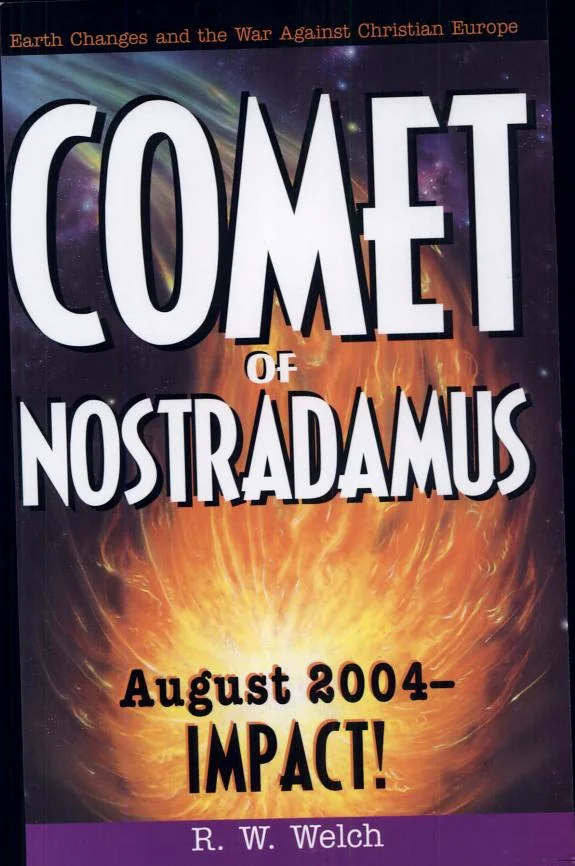
Comet of Nostradamus
 84
84

Comet of Nostradamus
Welch's 'Comet of Nostradamus' presents a bold thesis, connecting Nostradamus's quatrains to a specific future event: a comet strike post-2000. The author's interpretations are often compelling, particularly when he links celestial phenomena to geopolitical upheaval, as suggested in the original blurb regarding a Mediterranean war. However, the work sometimes relies heavily on speculative connections between cryptic verses and empirical events, a common pitfall in Nostradamus studies. The strength lies in its focused approach, attempting to decipher a particular set of prophecies rather than a broad overview. A limitation could be the lack of extensive external validation for the proposed interpretations of quatrains like III.75, which the book analyzes. Ultimately, 'Comet of Nostradamus' offers a focused, if debated, reading of prophetic literature for the modern age.
📝 Description
84
R. W. Welch’s 2000 book links Nostradamus’s quatrains to a comet and 21st-century global events.
Published in 2000, R. W. Welch’s "Comet of Nostradamus" analyzes the predictions of the 16th-century seer concerning the early 21st century. The work centers on the interpretation that Nostradamus foresaw a comet impacting Europe shortly after the millennium. Welch connects this celestial event to forecasts of widespread conflict originating in the Mediterranean and affecting the entire globe.
This book appeals to readers interested in modern Nostradamus studies and speculative futurism. It addresses those who wish to find correlations between historical prophecies and current world events, as well as potential future scenarios. Welch’s analysis offers a specific viewpoint on how Nostradamus’s cryptic verses might apply to contemporary times, particularly focusing on astronomical phenomena and their geopolitical ramifications.
Welch’s work joins a long tradition of scholars attempting to decipher Nostradamus’s prophecies, a practice that began shortly after Nostradamus himself published his "Centuries" in 1555. This tradition often involves aligning the seer’s cryptic verses with contemporary or future historical events, frequently focusing on political upheavals, natural disasters, or significant astronomical occurrences. The approach taken in "Comet of Nostradamus" is characteristic of modern interpretations that seek to apply Nostradamus’s writings to the specific anxieties and events of the turn of the millennium and beyond.
💡 Why Read This Book?
• Understand specific astronomical interpretations of Nostradamus's prophecies, such as the 'giant comet' predicted for the years following 2000, offering a unique perspective on celestial event forecasting. • Gain insight into a particular interpretation of geopolitical conflict, specifically the proposed 'great war' extending throughout the Mediterranean and beyond, as foreseen by Nostradamus. • Explore the methodology of interpreting cryptic quatrains for contemporary events, learning how Welch connects specific verses to potential future occurrences in the early 21st century.
⭐ Reader Reviews
Honest opinions from readers who have explored this book.
❓ Frequently Asked Questions
What specific comet did Nostradamus supposedly predict in R. W. Welch's book?
The book 'Comet of Nostradamus' suggests that Nostradamus foresaw a significant celestial event, specifically a large comet, targeting Europe in the years immediately following 2000.
Does 'Comet of Nostradamus' discuss World War III predictions?
Yes, the work explores Nostradamus's alleged prophecies concerning a 'great war' that is interpreted to extend throughout the Mediterranean region and potentially beyond, following the predicted comet event.
When was R. W. Welch's 'Comet of Nostradamus' first published?
R. W. Welch's book, 'Comet of Nostradamus,' was first published in the year 2000, coinciding with the period it purports to interpret.
What historical figure's prophecies are analyzed in this book?
The book centers on the prophecies of Michel de Nostredame, commonly known as Nostradamus, analyzing his quatrains for predictions relevant to the 21st century.
What geographical areas are highlighted in the predicted conflicts from Nostradamus's quatrains?
The book highlights the Mediterranean region as a focal point for the predicted 'great war,' indicating its potential to spread globally.
Is 'Comet of Nostradamus' based on verifiable historical records?
The book is based on interpretations of Nostradamus's quatrains, which are historical texts. However, the predictions themselves are speculative interpretations of these verses applied to future events.
🔮 Key Themes & Symbolism
21st Century Celestial Prophecies
The book focuses on interpretations of Nostradamus's quatrains that specifically address astronomical events predicted for the years after 2000. Welch posits that a significant comet was foreseen to appear, impacting global consciousness and events. This theme explores how ancient prophetic texts can be applied to modern scientific observations and potential cosmic occurrences, suggesting a continuity between historical foresight and contemporary astronomical awareness.
Mediterranean Geopolitical Foresight
A core element of Welch's analysis concerns a predicted major conflict, termed a 'great war,' originating in the Mediterranean basin. This theme explores the application of Nostradamus's cryptic verses to foresee large-scale geopolitical shifts and wars, particularly focusing on a region with a long history of conflict and strategic importance. The book attempts to map these prophecies onto potential future international relations and military engagements.
Modern Interpretation of Nostradamus
This theme addresses the contemporary practice of deciphering Nostradamus's quatrains for relevance to the modern era. Welch's work exemplifies how texts written in the 16th century, such as those by Nostradamus, are continuously re-examined and re-interpreted to provide insights into current events and future possibilities, particularly concerning global threats and societal changes.
The Comet as an Omen
Within the book, the predicted comet is not merely an astronomical event but serves as a potent omen. This theme examines the symbolic weight given to such celestial phenomena in prophetic traditions, suggesting that their appearance signals profound shifts, potential catastrophes, or transformative periods for humanity. Welch uses this to frame the predicted events of the early 21st century.
💬 Memorable Quotes
Direct passages from the work, attributed to the author.
“Nostradamus foresaw a giant comet hurtling toward Europe after 2000.”
— This is a central interpretive claim of the book, positing a specific astronomical prediction from Nostradamus that directly impacts the European continent in the early 21st century.
“The quatrains offer insights for the years following the millennium.”
— This highlights the book's temporal focus, asserting that Nostradamus's writings contain specific, decipherable predictions for the contemporary period and the immediate future.
“Celestial events are key indicators in Nostradamus's prophecies.”
— This interpretation underscores the book's methodology, emphasizing the significance of astronomical phenomena as predictive markers within Nostradamus's prophetic framework.
💡 Key Ideas
Editorial paraphrase of the work's core concepts — not direct quotes.
A great war extending throughout the Mediterranean and beyond was prophesied.
This quote highlights the book's focus on geopolitical conflict, suggesting Nostradamus predicted a large-scale war with origins in the Mediterranean region and global ramifications.
The Mediterranean becomes a focal point for predicted global conflict.
This paraphrase emphasizes the geographical specificity of the predicted war, identifying the Mediterranean as a critical nexus for the large-scale conflict discussed in the book.
🌙 Esoteric Significance
Tradition
This work fits within the modern Western esoteric tradition, particularly the branch focused on divination and prophecy. It draws directly from the lineage of interpreters of Nostradamus, a figure whose work has been central to esoteric thought since the 16th century. Welch's approach is less rooted in formal Hermeticism or Kabbalah and more aligned with a direct, almost literal, application of prophetic verses to empirical events, a characteristic found in many 20th-century esotericism movements.
Symbolism
The primary symbols are the 'giant comet' and the 'great war.' The comet, in many esoteric traditions, symbolizes upheaval, divine judgment, or radical change; here, it's interpreted as a harbinger of specific future events. The 'great war' symbolizes widespread conflict and societal breakdown, a recurring motif in apocalyptic and prophetic literature, representing the destructive phase preceding potential renewal or transformation.
Modern Relevance
Modern thinkers and practitioners interested in geopolitical forecasting through esoteric means might find Welch's work a case study. It appeals to contemporary online communities and forums dedicated to analyzing Nostradamus for current events. While not directly cited by major academic esoteric scholars, its approach to predictive interpretation influences independent researchers and enthusiasts exploring the intersection of prophecy, astronomy, and international relations in the 21st century.
👥 Who Should Read This Book
• Students of Nostradamus: Those specifically interested in contemporary interpretations of Nostradamus's quatrains, particularly those focusing on astronomical events and geopolitical predictions. • Speculative Futurists: Individuals who explore potential future scenarios through non-traditional or esoteric frameworks, seeking connections between historical prophecy and modern global events. • Esoteric History Enthusiasts: Readers interested in how prophetic texts are re-contextualized and applied by authors in the late 20th and early 21st centuries to address contemporary concerns.
📜 Historical Context
Published in 2000, R. W. Welch's 'Comet of Nostradamus' emerged during a resurgence of interest in millennial prophecies and speculative futurism. The late 20th and early 21st centuries saw a continued fascination with Nostradamus, building on earlier analyses by figures like Erika Cheetham. Welch's work engaged with a contemporary milieu where global anxieties, amplified by events like the September 11th attacks, lent a perceived urgency to prophetic interpretations. Unlike purely historical or literary analyses of Nostradamus, Welch's approach aligned with a popular esoteric tradition seeking direct predictive relevance for current events. The book's focus on astronomical events and geopolitical conflict positioned it within a niche of esotericism that sought to correlate ancient visions with observable phenomena and emerging world crises, a trend that found resonance in various fringe publications of the era.
📔 Journal Prompts
The 'giant comet' predicted for post-2000: What are its symbolic implications for societal change?
Analyze the concept of a 'great war' originating in the Mediterranean and its potential modern parallels.
Reflect on the challenges of interpreting cryptic prophecies for contemporary events, using Welch's approach as a reference.
Consider the role of celestial events as omens in historical and modern prophetic traditions.
How does the prediction of a 'comet hurtling toward Europe' influence interpretations of Nostradamus's foresight?
🗂️ Glossary
Quatrain
A stanza of four lines, specifically referring to the four-line verses written by Nostradamus that form the basis of his prophecies.
Nostradamus
Michel de Nostredame (1503-1566), a French astrologer, physician, and reputed seer, famous for his book 'Les Prophéties,' a collection of poetic quatrains.
Mediterranean War
A specific prophetic interpretation within the book referring to a large-scale conflict purportedly foreseen by Nostradamus to originate in or heavily involve the Mediterranean region.
Millennium
A period of one thousand years; in the context of the book, it refers to the turn of the 21st century and the heightened interest in prophecies related to this transition.
Celestial Event
Any observable phenomenon that occurs in the sky or atmosphere, such as the appearance of a comet, which is interpreted in the book as a prophetic sign.
Geopolitical Conflict
A conflict arising from a combination of geographical factors and political interests, as interpreted by Welch from Nostradamus's prophecies concerning international relations and warfare.
Prophetic Interpretation
The process of analyzing and explaining the meaning of prophetic texts, particularly Nostradamus's quatrains, as applied to future events.
This book appears in 1 collection
🔮 Readers Also Liked
Browse all →








From the “Nostradamus” Collection
View all →



More Free Esoteric History & Biography Books
View all →