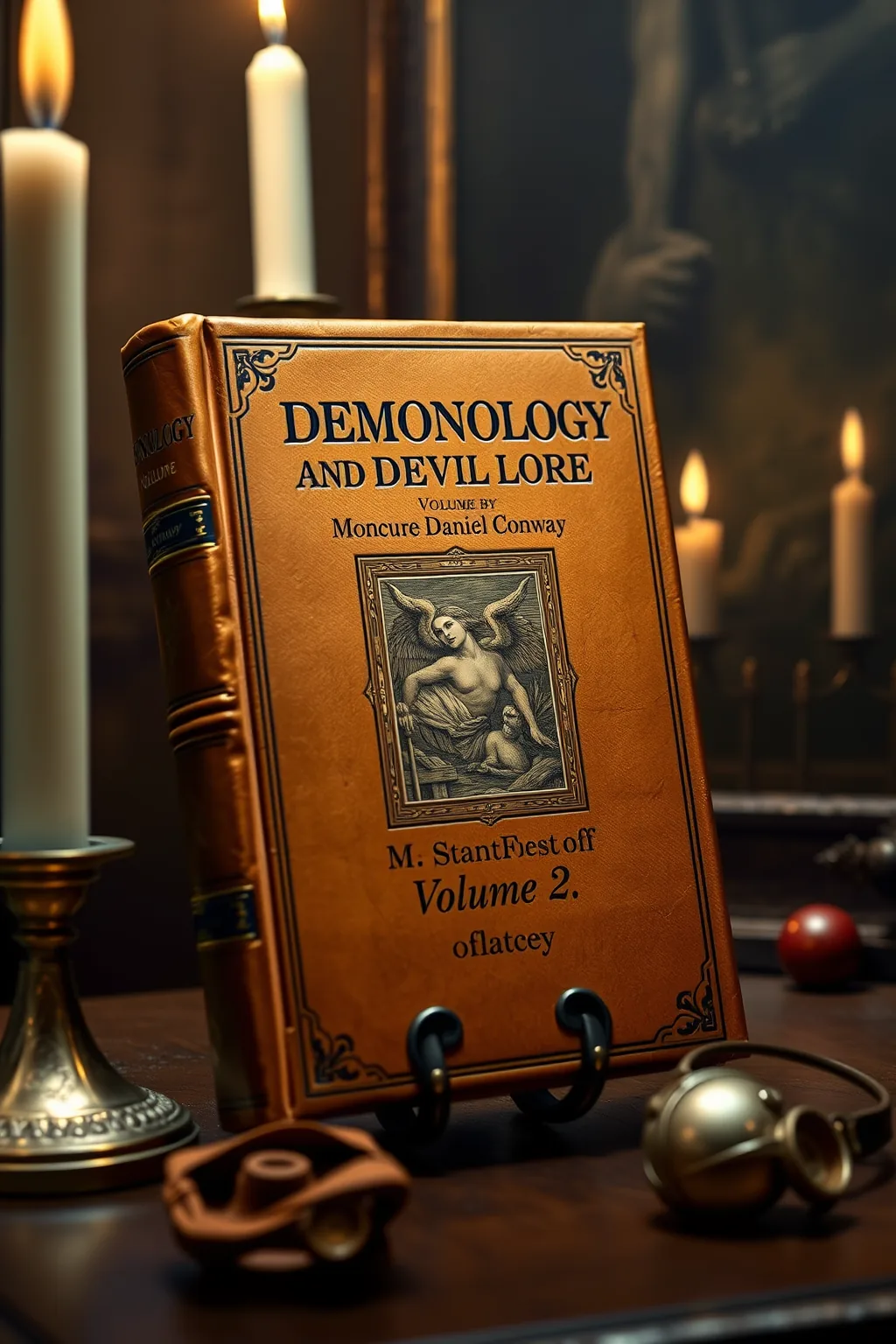
Demonology And Devil-Lore, Volume 2
 75
75

Demonology And Devil-Lore, Volume 2


Sophia Crane (Associate Editor) — Moncure Daniel Conway's 'Demonology and Devil-Lore, Vol. 2' is a monumental achievement in comparative occult studies. Conway masterfully dissects the global genesis of infernal figures, showcasing how cultural anxieties and spiritual shifts reshaped pantheons into diabolical hierarchies. This volume is indispensable for scholars of folklore, religious history, and esoteric traditions, offering a rational yet deeply insightful perspective on the universal human fascination with the shadow self and the forces of opposition. Its rigorous scholarship, combined with a profound understanding of symbolic language, makes it a cornerstone for anyone seeking to comprehend the evolution of evil in human thought.
📝 Description
75
Moncure Daniel Conway published 'Demonology and Devil-Lore, Volume 2' in 1879, continuing his study of evil.
Volume 2 of Moncure Daniel Conway's 'Demonology and Devil-Lore' examines the transformation of ancient deities and nature spirits into demonic figures across various cultures. Conway meticulously traces the evolution of these archetypes, showing how different societies conceived of malevolent entities. He investigates the symbolic language associated with the infernal, the psychological origins of fear, and the social roles that demonization has played throughout history. The book looks at how these beliefs reflect deeper human concerns about consciousness and the search for meaning when confronted by perceived darkness.
Conway builds upon his earlier work by detailing specific examples of devil-lore from different traditions. He contrasts the conceptions of evil in Western Christianity with those found in other religious and folk systems. The text analyzes the artistic and literary representations of demons, as well as the philosophical arguments that have shaped understandings of good and evil. This volume is a comprehensive look at the historical and cultural construction of the demonic.
Conway's work sits within the late 19th-century surge of interest in comparative religion and folklore, often approached through an esoteric lens. While not strictly occult, his study engages with themes of hidden knowledge and the symbolic interpretation of myths and religious beliefs that were central to emerging esoteric traditions. He sought to understand the underpinnings of human spirituality and its darker manifestations, drawing connections between diverse historical and cultural phenomena. This approach reflects a broader movement to find universal patterns in human belief systems, often outside conventional academic or religious frameworks.
✍️ Author
Moncure Daniel Conway
Moncure Daniel Conway was an American Unitarian minister, abolitionist, and writer.
💡 Why Read This Book?
Unravel the ancient roots of fear and malevolence. This volume offers a comparative, scholarly examination of global demonology, revealing how primal forces were mythologized. Ideal for seekers of hidden knowledge, folklorists, and students of comparative religion who wish to understand the symbolic evolution of evil and its impact on human consciousness. Discover the esoteric threads connecting disparate cultures.
⭐ Reader Reviews
Honest opinions from readers who have explored this book.
❓ Frequently Asked Questions
What is the primary focus of Volume 2?
Volume 2 delves deeper into the specific manifestations and cultural interpretations of demons and devil-lore across various global traditions, exploring their symbolic significance and societal roles in shaping belief systems.
How does Conway approach the subject of demonology?
Conway employs a comparative, rational, and anthropological lens, drawing upon folklore, mythology, religion, and historical texts to demystify and explain the origins and evolution of demonic figures.
Is this book suitable for beginners in esoteric studies?
While rich in scholarship, its depth may be best appreciated by those with some foundational knowledge of mythology or comparative religion. However, its clear prose makes it accessible to dedicated newcomers.
What period does Conway's research primarily cover?
Conway's research spans a vast historical period, examining ancient mythologies, early religious texts, medieval lore, and contemporary (Victorian era) understandings of demonology.
Does the book offer practical occult advice?
No, this is a scholarly and historical exploration of demonology, not a grimoire or practical guide to occult practices. Its value lies in understanding the lore and symbolism.
🔮 Key Themes & Symbolism
The Transmutation of Deities into Demons
This theme meticulously examines the fascinating process by which benevolent or neutral ancient gods, nature spirits, and ancestral figures were gradually reinterpreted and demonized over millennia. Conway illustrates how cultural shifts, the rise of monotheistic religions, and societal anxieties led to the reclassification of these older entities as malevolent forces, embodying sin, chaos, and opposition to divine order. It highlights the psychological and sociological drivers behind this symbolic metamorphosis, revealing how humanity has historically projected its fears and moral judgments onto the divine and the natural world.
Comparative Mythology and Folklore of Evil
Conway champions a comparative approach, drawing parallels between the demonic figures and narratives found across disparate cultures and historical epochs. This theme emphasizes the universality of certain archetypes of evil, the common threads in how societies conceptualize and combat malevolence, and the shared human psychological landscape that gives rise to such beliefs. By juxtaposing Babylonian, Egyptian, Greek, Roman, Norse, and Christian demonologies, he reveals a complex web of interconnected myths and a shared human experience of confronting the shadow.
The Societal Function of Demonization
This theme explores how the concept of demons and devil-lore has served crucial social and psychological functions throughout history. Conway analyzes how demonization has been used to enforce moral codes, justify persecution, explain suffering and misfortune, and provide a tangible enemy against which communities could unite. It sheds light on the power of narrative and belief in shaping social order and the ways in which the fear of the infernal has been wielded as a tool for control and social cohesion across diverse civilizations.
💬 Memorable Quotes
Direct passages from the work, attributed to the author.
“The devil is a mirror of our own souls.”
— This profound statement suggests that our perceptions and conceptions of evil are not external realities but rather reflections of our inner psychological states, fears, and moral conflicts.
“Older gods often became later demons.”
— This highlights the evolutionary nature of mythology, where deities from declining belief systems were frequently recast as malevolent figures in ascendant religious traditions.
“Fear is the oldest language of the infernal.”
— This aphorism points to the fundamental role of fear in the creation and perpetuation of demonic lore and its influence on human behavior and belief.
“The shadow holds the forgotten light.”
— This esoteric interpretation suggests that even in the darkest aspects of existence or psyche, there lies a hidden potential or a distorted form of truth waiting to be understood.
“Evil is a name we give to the unknown.”
— This implies that 'evil' often serves as a label for that which we do not comprehend, a way to categorize and control phenomena that lie outside our understanding.
🌙 Esoteric Significance
Tradition
While not strictly belonging to a singular esoteric tradition, Conway's work resonates deeply with comparative mythology, Gnosticism, and the philosophical underpinnings of Western esotericism. It aligns with traditions that explore the dualistic nature of reality, the symbolic representation of primal forces, and the psychological journey of confronting one's inner shadows. His rational yet open-minded approach bridges academic scholarship with an intuitive understanding of symbolic language, making it valuable for those interested in the hermeneutics of spiritual texts and mythic structures.
Symbolism
The book is rich in symbolic interpretation, viewing demonic figures not merely as literal entities but as potent symbols of primal forces, human psychology, and societal anxieties. It explores symbols of darkness, chaos, temptation, and transgression, examining how these are represented in diverse cultural mythologies. Conway's analysis studies the archetypal nature of the 'devil' as a representation of the shadow self, the adversary, or the unknown, urging readers to see these figures as keys to understanding deeper spiritual and psychological truths.
Modern Relevance
In an age increasingly grappling with existential anxieties, societal divisions, and the nature of consciousness, Conway's work remains remarkably relevant. It offers a framework for understanding the historical and psychological roots of conflict and fear, providing insights into how 'othering' and demonization operate. For modern practitioners and seekers, it illuminates the symbolic language of the unconscious, offering a deeper appreciation for the archetypes that shape our perceptions and the enduring human quest for meaning in the face of perceived darkness.
👥 Who Should Read This Book
This volume is a treasure for the discerning reader. **Academics and scholars** of comparative religion, folklore, and anthropology will find its rigorous research and comparative analysis invaluable. **Esoteric practitioners and spiritual seekers** will benefit from its deep dive into the symbolic language of the infernal and its exploration of primal archetypes. **Mythology enthusiasts** will delight in the cross-cultural narratives and the tracing of mythic evolution. Even **beginners** drawn to the darker, more mysterious aspects of human belief will find Conway's lucid prose and rational approach an accessible yet profound introduction to the complex world of demonology.
📜 Historical Context
Published in 1879, 'Demonology and Devil-Lore' emerged during a period of intense intellectual ferment in Victorian England. This era was characterized by a burgeoning interest in scientific inquiry, comparative mythology, folklore studies, and early anthropology, alongside a continued fascination with spiritualism and the occult. Scholars like Conway sought to apply rational and empirical methods to understanding religious beliefs and mythologies that had previously been accepted largely on faith. The book reflects the Victorian appetite for dissecting and understanding the origins of human belief systems, often through a lens of evolutionary theory and cultural comparison, while still acknowledging the profound psychological and spiritual dimensions of the subject matter.
📔 Journal Prompts
Reflect on a personal fear or anxiety. How does this relate to the archetypes of evil discussed by Conway?
Trace the evolution of a 'villain' or 'antagonist' in a story or myth you are familiar with. How does it compare to the themes in 'Demonology and Devil-Lore'?
Consider the concept of 'demonization' in contemporary society. How are individuals or groups portrayed as 'evil' or 'other'?
What ancient deity or nature spirit from your cultural background might have been recast as a demonic figure in another tradition? Explore the potential reasons.
How can understanding the symbolic representation of evil contribute to personal growth and self-awareness?
🗂️ Glossary
Demonology
The study of demons or beliefs about demons. It encompasses theological, mythological, and folkloric perspectives on malevolent spiritual beings.
Diabolism
Worship of the devil or demonic entities; often associated with witchcraft and dark rituals.
Archetype
A universal, archaic pattern or image that is part of the collective unconscious, influencing myths, dreams, and cultural symbols.
Mythogenesis
The process by which myths are created, developed, and transmitted through cultural traditions.
Tutelary Deity
A god or spirit regarded as a guardian, protector, or patron of a particular place, person, or group.
This book appears in 3 collections
🔮 Readers Also Liked
Browse all →









More by Moncure Daniel Conway
All books →


From the “Transcendental Meditation” Collection
View all →



![Faust [part 1]. Translated Into English in the Original Metres](/img/thumb/faust-part-1-translated-into-english-in-the-original-metres-goethe-johann-wolfgang-von.webp)


More Free Esoteric History & Biography Books
View all →