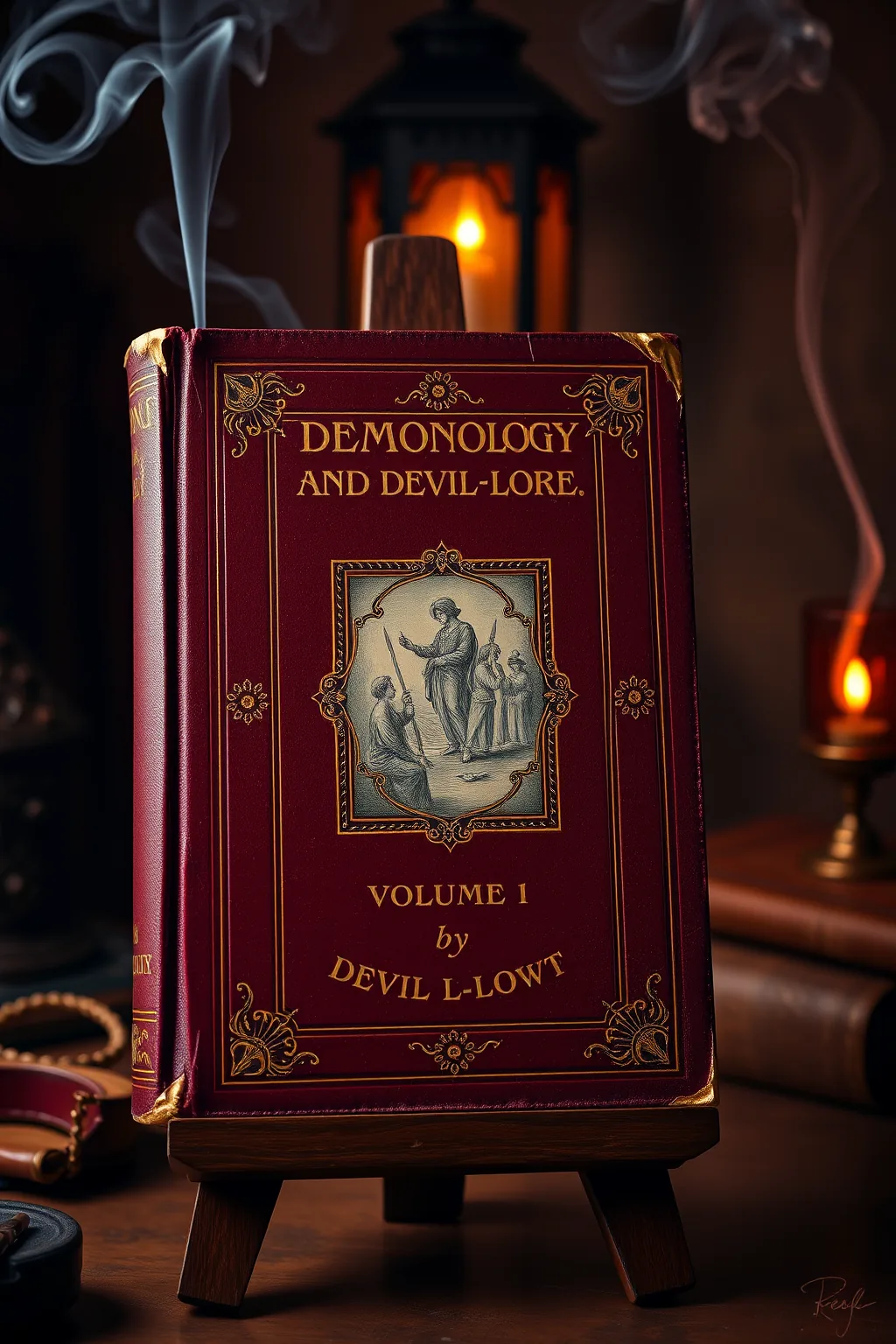
Demonology And Devil-Lore, Volume 1
 78
78

Demonology And Devil-Lore, Volume 1



Sophia Crane (Associate Editor) — Moncure Daniel Conway's "Demonology and Devil-Lore, Volume 1" is an indispensable cornerstone for any serious student of esotericism and comparative mythology. Conway's meticulous research and lucid prose dissect the evolution of adversarial archetypes with remarkable clarity. He masterfully illustrates how cultural narratives transmute ancient gods and nature spirits into embodiments of evil, offering profound insights into the human psyche's engagement with the shadow. This work is not merely academic; it is a vital key for understanding the symbolic language of spiritual traditions and the enduring power of myth. Highly recommended for scholars, practitioners, and seekers of hidden wisdom.
📝 Description
78
Moncure Daniel Conway published 'Demonology and Devil-Lore, Volume 1' in 1879, examining global beliefs about malevolent figures.
Conway's 1879 work, 'Demonology and Devil-Lore, Volume 1,' investigates the origins and evolution of concepts of evil across various cultures. He traces these figures from ancient mythologies and elemental spirits to the more defined demonic entities that populated religious and folkloric traditions. Conway approaches the subject with a scholarly yet accessible perspective, drawing on folklore, religious texts, and early anthropological observations. His aim is to show how humanity has consistently personified its fears and darkness, with the archetypes of evil reflecting societal anxieties and spiritual shifts.
The book details the transformation of these figures, illustrating how they served as mirrors to human psychological and spiritual development. Conway looks at the symbolic language used to describe the shadow self and the ongoing interplay between perceived good and evil that has influenced human societies over time. It encourages readers to examine conventional understandings of these beliefs and to consider the psychological and spiritual roots of human darker imaginings.
This volume engages with the historical and comparative study of religious beliefs and folklore, particularly concerning supernatural entities. It sits within a tradition of late 19th-century scholarship that sought to understand the roots of myth and superstition through rational inquiry and cross-cultural analysis. Conway's work, while not strictly occult, examines the symbolic and psychological dimensions of beliefs that often fall into esoteric studies, connecting them to broader patterns of human thought and societal development.
✍️ Author
Moncure Daniel Conway
Moncure Daniel Conway was an American Unitarian minister, abolitionist, and writer.
💡 Why Read This Book?
Uncover the ancient roots of fear and malevolence across global cultures. "Demonology and Devil-Lore, Volume 1" offers a unique comparative study, revealing how perceived evil transforms from primal forces to sophisticated infernal figures. Ideal for seekers of hidden knowledge, scholars of mythology and religion, and practitioners interested in the archetypal forces that shape human consciousness and spiritual traditions. Delve into the fascinating evolution of the 'devil' figure and its psychological resonance.
⭐ Reader Reviews
Honest opinions from readers who have explored this book.
❓ Frequently Asked Questions
What is the primary focus of Volume 1?
Volume 1 primarily focuses on the historical and comparative study of how various cultures across the globe conceived of demons, devils, and malevolent spirits, tracing their origins and transformations over time.
What is Moncure Daniel Conway's approach to the subject?
Conway employs a comparative and rational lens, drawing upon folklore, mythology, religion, and early anthropology to provide a scholarly yet accessible analysis of demonological beliefs.
Who would benefit most from reading this book?
This book is ideal for students of comparative mythology, religious studies, folklore, anthropology, and anyone interested in the psychological and cultural evolution of adversarial archetypes.
Is this book suitable for beginners in esoteric studies?
While scholarly, Conway's clear prose makes it accessible. Beginners will gain a foundational understanding of how concepts of evil have been constructed and perceived across different societies.
Does the book explore practical applications of demonology?
The book's strength lies in its historical and theoretical exploration, rather than practical occult applications. It offers insight into the symbolic and psychological aspects of demonology.
🔮 Key Themes & Symbolism
The Evolution of the Adversary
This theme looks at the fascinating metamorphosis of ancient deities and nature spirits into the personified 'evil' figures that populate global mythology. Conway meticulously traces how benevolent or neutral primal forces were reinterpreted and demonized over centuries, often reflecting societal anxieties and the establishment of hierarchical religious structures. It highlights the psychological need to externalize fear and the inherent duality present in human perception, demonstrating how the concept of 'the devil' is a complex cultural construct rather than a singular entity.
Comparative Mythology and Folklore
Conway's masterful application of comparative analysis is central to this theme. By juxtaposing demonological traditions from diverse cultures—from ancient Mesopotamia and Egypt to Norse sagas and Christian narratives—he unveils universal patterns in the human imagination. This exploration showcases how shared archetypes of fear, temptation, and retribution manifest differently across geographical and temporal boundaries, offering clear insights into the collective unconscious and the enduring power of mythic storytelling to shape human understanding of the world.
The Symbolism of Darkness and Malevolence
This theme unpacks the rich symbolic language associated with demonic entities and the concept of evil. Conway examines how darkness, chaos, and destructive forces are represented through various mythic figures, rituals, and beliefs. It explores the philosophical and psychological implications of these symbols, revealing how they function not only as embodiments of external threat but also as metaphors for internal struggles, moral challenges, and the shadow aspects of human nature. Understanding this symbolism provides a deeper appreciation for the spiritual and psychological landscapes explored in the book.
💬 Memorable Quotes
Direct passages from the work, attributed to the author.
“Fear is the parent of superstition, and superstition is the mother of the devil.”
— This highlights the psychological genesis of demonological beliefs, linking primal fear to the development of irrational beliefs and the personification of evil.
“Every mythology is a chapter in the great epic of humanity.”
— This emphasizes the universal and interconnected nature of human storytelling and belief systems, suggesting that myths, including those of demons, offer fundamental insights into the human experience.
“The ancient gods, when dethroned, became the demons.”
— This points to the historical process by which older, often nature-based or polytheistic deities were recast as malevolent figures with the rise of dominant monotheistic religions.
“The devil is the shadow of God.”
— This metaphorical statement suggests that the concept of the devil is intrinsically linked to the concept of the divine, often representing the inverse or the dark counterpart to ultimate good.
💡 Key Ideas
Editorial paraphrase of the work's core concepts — not direct quotes.
The devil is a creation of man, not man of the devil.
This quote suggests that our concept of the devil is a projection of human fears, anxieties, and moral constructs, rather than an independent, pre-existing entity influencing humanity.
🌙 Esoteric Significance
Tradition
While not explicitly tied to a single esoteric tradition, Conway's work is foundational for understanding the archetypal symbolism prevalent in Hermeticism, Gnosticism, and comparative occult studies. His comparative approach reveals universal patterns in how humanity conceptualizes duality, shadow, and the forces that oppose spiritual progress. It provides a historical and psychological framework for interpreting the symbolic language of various mystical paths that engage with the concept of adversarial forces.
Symbolism
The book delves deeply into the symbolism of demonic figures as representations of primal fears, societal taboos, and the shadow aspects of the human psyche. It explores symbols of darkness, chaos, temptation, and destruction across diverse cultures, illustrating how these archetypes serve as potent metaphors for internal struggles, moral challenges, and the perceived 'other.' Understanding this symbolism is crucial for grasping the psychological and spiritual dimensions of belief systems that grapple with malevolence.
Modern Relevance
In an age still grappling with fear, division, and the externalization of blame, Conway's analysis remains remarkably relevant. His work offers a critical lens through which to examine contemporary narratives of 'evil' and understand their historical and psychological roots. For practitioners and seekers, it provides a deeper appreciation for the archetypal forces at play in the human psyche and spiritual landscape, fostering a more nuanced understanding of duality and the shadow self, essential for personal growth and spiritual integration.
👥 Who Should Read This Book
This volume is an essential read for students of comparative mythology, folklore, and religious studies, offering a robust academic yet accessible exploration. Esoteric practitioners, particularly those interested in archetypal psychology, Jungian studies, or the historical development of adversarial imagery in spiritual traditions, will find invaluable insights. Seekers of hidden knowledge and those fascinated by the evolution of human belief systems will be captivated by Conway's meticulous research and profound observations. Beginners in esoteric studies will gain a foundational understanding of how concepts of malevolence are culturally constructed and psychologically significant.
📜 Historical Context
Published in 1879, "Demonology and Devil-Lore, Volume 1" emerged during the height of Victorian intellectual curiosity and the burgeoning fields of anthropology and comparative religion. It was an era marked by a profound engagement with ancient texts, folklore collections, and a burgeoning scientific approach to understanding human culture. Scholars were increasingly interested in dissecting the origins of religious beliefs and practices, moving beyond purely theological explanations. Conway, a progressive thinker and former Unitarian minister, approached these sensitive topics with a rational, albeit sympathetic, eye, seeking to understand the human impulse behind the creation of adversarial figures. The book reflects the Victorian era's fascination with the exotic, the ancient, and the perceived 'primitive' aspects of human thought, while also contributing to a more nuanced understanding of myth and its role in shaping societal values and individual psychology.
📔 Journal Prompts
Reflect on a personal fear and how it might manifest as a symbolic 'demon' in your inner landscape.
Compare and contrast a demon or malevolent figure from one culture with another discussed in the text. What similarities and differences do you observe?
How has the concept of 'evil' evolved in modern society compared to the historical examples presented?
Consider a time you felt tempted or morally challenged. How did the archetypes of temptation discussed in the book resonate with your experience?
What does the human need to create and understand 'adversarial figures' reveal about our collective psychology and spiritual journey?
🗂️ Glossary
Demonology
The study of demons or beliefs about demons. It encompasses the lore, mythology, and theological concepts surrounding these entities within various religious and cultural traditions.
Devil-Lore
Refers to the specific body of knowledge, stories, and traditions concerning the figure of the Devil, particularly within Abrahamic religions, and its associated attributes and influence.
Archetype
In mythology and psychology, an archetype is a universally understood symbol, character, or pattern of behavior that is a recurring element in mythology and folklore, representing fundamental human experiences or concepts.
Folklore
The traditional beliefs, customs, and stories of a community, passed through the generations by word of mouth. It often includes myths, legends, fairy tales, and superstitions.
Anthropology
The scientific study of humanity, concerned with human behavior, human biology, cultures, societies, and linguistics, in both the present and past, including past human species.
This book appears in 3 collections
🔮 Readers Also Liked
Browse all →







More by Moncure Daniel Conway
All books →


From the “Transcendental Meditation” Collection
View all →






More Free Esoteric History & Biography Books
View all →