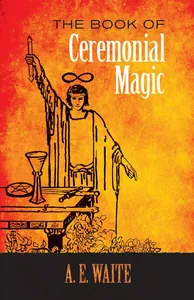
Ceremonial Magic

 79
79

Ceremonial Magic
The joint presentation of Waite and Levi in "Ceremonial Magic" offers a fascinating juxtaposition of scholarly occultism and more visionary magical philosophy. Waite's meticulous approach, evident in his scholarly introductions and careful selection of material, grounds Levi's often effusive and mystical prose. A particular strength lies in how the book systematically outlines the correspondences and symbolic language central to Western esotericism, making complex ideas more digestible for the dedicated student. However, the inherent nature of this being a facsimile reprint means the physical presentation might present challenges for some readers, with potential imperfections arising from the original source material. One passage that stands out is the detailed explanation of the Hebrew alphabet's magical significance, demonstrating the intricate symbolic systems at play. "Ceremonial Magic" serves as an indispensable, albeit sometimes demanding, resource for understanding the architecture of Western magical thought.
📝 Description
79
Arthur Edward Waite and Eliphas Levi's writings on ceremonial magic are collected in this 1910 volume.
This book gathers essays and treatises by Arthur Edward Waite and Eliphas Levi, two significant figures in Western occultism. It aims to present a coherent view of ceremonial magic as understood in the late 19th and early 20th centuries. Waite, a scholar and co-founder of the Hermetic Order of the Golden Dawn, and Levi, instrumental in the revival of ceremonial magic, contribute their distinct perspectives.
The compilation addresses the theoretical foundations of ritualistic magic. Readers will encounter discussions on the nature of the astral plane, the power of divine names and invocations, the function of the magician's will in operations, and the symbolic language integral to magical practice. The work reflects a scholarly approach to the occult, a style that became more common during the period of its origin.
It is suited for those with a serious interest in Western esotericism, the history of occult thought, and comparative religion. The material will assist researchers and practitioners in understanding how magical systems were articulated by influential figures. Anyone studying the progression of occult ideas from the 19th century onward will find considerable relevant content.
This volume emerges from the intellectual currents of late Victorian and Edwardian England, a time marked by widespread fascination with spiritualism and esoteric philosophy. Arthur Edward Waite, a prolific scholar, and Eliphas Levi, a key figure in the reawakening of ceremonial magic, represent different but complementary approaches to occult studies. Their combined work serves as a bridge between older magical traditions and their subsequent interpretation and practice in the modern era.
💡 Why Read This Book?
• You will gain a clearer understanding of the foundational theories behind Western ceremonial magic, including the concept of the "astral light" as described by Eliphas Levi, which is central to many occult systems. • You will explore the historical development of occultism in the late 19th century through the scholarly lens of Arthur Edward Waite, a key figure in the Hermetic Order of the Golden Dawn. • You will learn to decipher the symbolic language of magic, as the book details the significance of divine names and their purported efficacy in ritual, offering practical insights into esoteric correspondences.
⭐ Reader Reviews
Honest opinions from readers who have explored this book.
❓ Frequently Asked Questions
What is the primary focus of "Ceremonial Magic" by Arthur Edward Waite and Eliphas Levi?
The book focuses on the theoretical underpinnings and practical aspects of Western ceremonial magic, drawing from the writings of influential occultists Eliphas Levi and Arthur Edward Waite, particularly concerning ritual, symbolism, and esoteric philosophy.
Who was Eliphas Levi and why is he significant in occult studies?
Eliphas Levi (Alphonse Louis Constant) was a 19th-century French occultist whose works, like 'Dogme et Rituel de la Haute Magie,' revitalized interest in ceremonial magic and influenced generations of occultists, including Arthur Edward Waite.
What is Arthur Edward Waite's role in the context of this book?
Arthur Edward Waite, a prominent figure in the Hermetic Order of the Golden Dawn, compiled and often provided scholarly context for texts on ceremonial magic, ensuring a more structured and historically informed presentation of the subject.
Is "Ceremonial Magic" a practical guide for performing rituals?
While it explains the principles and symbolism behind rituals, its primary strength lies in its theoretical and historical exposition. It offers foundational knowledge for practitioners rather than a step-by-step ritual manual.
What kind of imperfections might be found in this facsimile reprint?
As a facsimile of older texts, the book may exhibit minor imperfections such as marks, notations, marginalia, or slight flaws on pages, reflecting its age and the nature of archival reproduction.
When was the first publication of the material compiled in this book?
While this specific compilation was first published in December 2005, the original influential works by Eliphas Levi and Arthur Edward Waite date primarily from the mid-19th to early 20th centuries.
🔮 Key Themes & Symbolism
The Astral Light
The concept of the 'Astral Light' or 'Akashic fluid' is presented as a fundamental medium pervading the universe, acting as a conduit for magical forces and psychic phenomena. Levi, in particular, emphasizes its role in divination, manifestation, and the connection between the microcosm and macrocosm. Understanding this invisible energetic substance is key to grasping the mechanics of sympathetic magic and the magician's ability to influence reality through focused intent and ritual action.
Symbolic Language of Magic
A central theme is the intricate symbolic language used in ceremonial magic, encompassing divine names, planetary correspondences, angelic hierarchies, and the esoteric meanings of the Hebrew alphabet. Waite's scholarly approach often clarifies these systems, while Levi imbues them with visionary significance. The book highlights how these symbols are not mere decorations but active agents within ritual, capable of invoking specific energies and intelligences.
The Magician's Will and Intent
The power of the magician's focused will and unwavering intent is consistently underscored. The work explores how directed consciousness, amplified through ritual and symbolic tools, can shape the Astral Light and effect change in the material world. This emphasizes the psychological and spiritual discipline required for effective magical practice, moving beyond mere rote performance of ceremonies.
Invocation and Evocation
The distinction and practice of invocation (drawing spiritual forces within) and evocation (calling forth external entities or intelligences) are discussed. The book details the careful preparation, purification, and use of specific formulae, divine names, and symbolic circles required for safely and effectively engaging with these spiritual or elemental powers.
💬 Memorable Quotes
Direct passages from the work, attributed to the author.
“The science of magic is the science of the true relations of things.”
— This statement expresses the core belief that magic is not arbitrary but a systematic exploration of the hidden connections and universal laws that govern existence, seeking to understand and influence them.
“The magical invocation is the operation of the divine within the human.”
— This highlights the idea that true magical invocation is not merely calling upon an external deity, but rather an internal process of awakening and realizing the divine potential inherent in the magician.
“The Astral Light is the universal solvent and the agent of all transformations.”
— This posits the Astral Light as a fundamental, all-pervading substance capable of dissolving and reforming all things, making it the ultimate medium for magical alchemy and change.
“The true magician is the one who has attained mastery over their own will.”
— This emphasizes that the ultimate goal and prerequisite for effective magic lies in the internal discipline and self-mastery of the practitioner, rather than external powers.
“All the divine names are keys to the gates of the celestial kingdoms.”
— This suggests that the sacred names and formulae used in ritual are not arbitrary words but possess inherent power and act as specific access codes to different spiritual realms or levels of consciousness.
🌙 Esoteric Significance
Tradition
This work is deeply rooted in the Western Esoteric Tradition, specifically drawing from Hermeticism, Kabbalah, and Renaissance magic, as reinterpreted through the lens of 19th-century occultism. It bridges the gap between earlier grimoire traditions and the more formalized magical orders like the Hermetic Order of the Golden Dawn, of which Waite was a co-founder. The compilation attempts to systematize and explain the principles underlying ceremonial rites, making it a key text for understanding this lineage.
Symbolism
Key symbols explored include the Pentagram and Hexagram, representing the microcosm and macrocosm respectively, and their application in invoking or banishing elemental forces. Divine names from various traditions, particularly Hebrew, are presented as potent keys to spiritual authority and connection. The symbolism of the magician's tools—wand, sword, chalice, and pentacle—are also detailed, illustrating their roles in focusing will and directing energy within the ritual space.
Modern Relevance
Contemporary practitioners of Western ceremonial magic, particularly those associated with Golden Dawn-derived traditions and independent occultists, continue to draw on the theoretical frameworks presented here. Thinkers exploring the history of Western esotericism and comparative religion also reference Waite's scholarship and Levi's foundational ideas on magic, symbolism, and the nature of consciousness.
👥 Who Should Read This Book
• Students of Western Esotericism: Those seeking to understand the historical development and theoretical underpinnings of magical systems from the 19th century onwards will find this an essential resource. • Practitioners of Ritual Magic: Individuals engaged in ceremonial or ritualistic practices can benefit from the detailed explanations of symbolism, divine names, and the principles of will and astral projection. • Scholars of Occult History: Researchers interested in figures like Eliphas Levi and Arthur Edward Waite, and the intellectual currents of Victorian occultism, will appreciate the curated nature of this compilation.
📜 Historical Context
The compilation "Ceremonial Magic" emerges from the fertile ground of late 19th and early 20th-century esotericism, a period marked by a resurgence of interest in occultism, spiritualism, and mystical traditions. Arthur Edward Waite, a prominent member of the Hermetic Order of the Golden Dawn and a prolific writer, curated material that reflected this intellectual climate. He worked alongside or was heavily influenced by figures like Eliphas Levi, whose radical reinterpretation of magic in works like "Dogme et Rituel de la Haute Magie" (published 1854-1856) provided a theoretical framework for much of the era's occult revival. This era also saw figures like Helena Blavatsky and the Theosophical Society challenging established religious and scientific paradigms. Waite's own scholarly approach, while acknowledging Levi's visionary insights, often sought to contextualize and rationalize magical practices within a more historical and philosophical framework, differentiating it from the more purely experiential or spiritualist movements of the time.
📔 Journal Prompts
The symbolic significance of the Pentagram as presented by Levi and Waite.
Reflect on the concept of the Astral Light and its potential role in subjective experience.
The relationship between divine names and the magician's authority.
How the focused will is described as a primary tool in ceremonial magic.
Consider the historical context of occult revival and its influence on Waite's editorial choices.
🗂️ Glossary
Astral Light
A concept referring to a subtle, luminous fluid pervading the universe, believed to be the medium through which thought, will, and magical forces operate. It is seen as both a universal reservoir of energy and a field for psychic impressions.
Invocation
The act of calling upon a divine or spiritual power to manifest within oneself or to assist in a magical operation, often involving prayers, affirmations, and symbolic gestures.
Evocation
The practice of summoning or calling forth external spiritual or elemental beings or intelligences to appear or communicate, typically within a designated ritual space.
Microcosm
The principle that the human being (or the Earth) reflects the structure and workings of the greater universe (the Macrocosm), a concept central to Hermetic philosophy and magical correspondences.
Macrocosm
The universe or the totality of existence, considered as a vast, ordered system, within which the Microcosm (humanity or the Earth) is seen as a smaller, corresponding representation.
Correspondences
The system of relationships believed to exist between different levels of reality, such as planets, elements, colors, divine names, and human faculties, forming the basis of magical symbolism and practice.
Grimoire
A textbook of magic, typically containing instructions on how to create magical tools, perform rituals, invoke spirits, and cast spells, often dating from the late Middle Ages to the 18th century.
This book appears in 1 collection
🔮 Readers Also Liked
Browse all →








From the “Ceremonial Magic” Collection
View all →







More Free Magic & Ritual Books
View all →