The Secret Hour

 81
81

The Secret Hour
Scott Westerfeld’s The Secret Hour offers a compelling premise: teenagers who can perceive and interact with temporal distortions, a concept that hints at a hidden layer of reality. The novel’s strength lies in its imaginative world-building, particularly the idea of the 'secret hour' itself—a liminal space outside linear time where different possibilities converge. The pacing is brisk, pulling the reader through a narrative of discovery and peril. However, the character development, while functional for the plot, sometimes feels secondary to the mechanics of the temporal system. A particularly striking element is the depiction of the antagonist organization, which operates with a chillingly detached efficiency, manipulating events from behind the scenes. The work effectively conveys a sense of unease, suggesting that our perceived reality is far more fragile and manipulated than we might imagine. Ultimately, The Secret Hour is an engaging, if occasionally underdeveloped, exploration of temporal consciousness and hidden control.
📝 Description
81
Scott Westerfeld's 2004 novel, The Secret Hour, posits a near future where time itself is a tool of manipulation.
The Secret Hour follows a group of teenagers who discover they can perceive and interact with temporal anomalies. These are not simple tricks but are deeply connected to the structure of reality, allowing them to see beyond the normal progression of events. The narrative, while aimed at young adults, engages with serious ideas about control, how we understand things, and the unseen systems that shape our existence. It suggests that our everyday experience is only a small part of what is actually happening.
This book appeals to readers who like speculative fiction that mixes teenage characters with thoughtful explorations of complex subjects. Anyone interested in ideas about how time works, secret groups, and the nature of reality will find much to consider. It is for people who enjoy stories where characters face unusual situations and must uncover hidden truths about their world and themselves. Readers looking for a story that questions free will and fate, all within a quick plot, should find this work engaging.
Published in 2004, The Secret Hour taps into a growing interest in young adult fiction that examines hidden structures and unusual abilities. The early 2000s saw a rise in stories exploring dystopian societies and complex power dynamics, often reflecting societal anxieties. Westerfeld's novel engages with a cultural fascination for secret knowledge and concealed histories, placing it within a tradition of speculative fiction that questions the surface of everyday reality and hints at deeper, unseen forces at play.
💡 Why Read This Book?
• Gain an understanding of the speculative concept of the 'secret hour,' a period outside linear time, and how it might function as a space for observing potential futures, a theme explored in chapters detailing the protagonists' first temporal shifts. • Experience the narrative tension derived from a clandestine organization's manipulation of reality, a central conflict in the 2004 publication that mirrors anxieties about hidden powers. • Grasp the thematic exploration of manufactured perception, where characters learn that their understanding of events can be fundamentally altered by unseen forces, as seen in their interactions with the 'shifters'.
⭐ Reader Reviews
Honest opinions from readers who have explored this book.
❓ Frequently Asked Questions
What is the significance of the 'secret hour' in Scott Westerfeld's novel?
The 'secret hour' refers to a temporal anomaly, a period outside normal time, where past, present, and potential futures can be perceived. It's a space where individuals with unique abilities, like the protagonists, can witness and sometimes interact with events beyond conventional chronology.
Who are the 'shifters' in The Secret Hour?
'Shifters' are individuals possessing the rare ability to perceive and manipulate temporal distortions. They are key players in the hidden conflict that drives the narrative, capable of navigating and influencing events within these temporal anomalies.
What is the role of the clandestine organization in the book?
This organization acts as the primary antagonist, working from the shadows to control and manipulate temporal events. Their goal is to maintain a specific version of reality, often by suppressing or exploiting individuals with temporal abilities.
When was The Secret Hour first published and what genre does it belong to?
The Secret Hour was first published in 2004 and is primarily categorized as young adult speculative fiction, blending elements of science fiction and mystery with a focus on adolescent protagonists.
Does The Secret Hour explore themes of free will versus destiny?
Yes, the novel grapples with these themes by presenting a world where time and events can be manipulated. The protagonists' struggle to understand and act within these temporal structures forces them to confront questions of agency and predetermined outcomes.
What makes the book's concept of time different from typical narratives?
Unlike linear time narratives, The Secret Hour posits a non-linear temporal landscape accessible through specific abilities. This allows for the observation of multiple realities and the potential for intervention, moving beyond simple cause-and-effect.
🔮 Key Themes & Symbolism
Temporal Mechanics
The novel posits a unique understanding of time, not as a linear progression but as a malleable construct susceptible to manipulation. The 'secret hour' serves as a focal point for this concept, representing a state where conventional temporal laws are suspended. This allows characters to perceive elements of the past and glimmers of potential futures, suggesting that time is less a river and more a complex, interwoven fabric. The narrative explores how this non-linear perception impacts the protagonists' understanding of causality and their own agency within events.
Hidden Control Structures
Central to The Secret Hour is the idea that powerful, unseen forces actively shape reality. A clandestine organization operates behind the scenes, not through overt force, but by subtly manipulating temporal events and perceptions. This theme questions the nature of objective reality, suggesting that what most people experience is a curated version of events. The protagonists' journey involves uncovering these hidden structures and the methods used to maintain them, highlighting a struggle against pervasive, covert influence.
Perception and Reality
The book investigates the profound connection between perception and the nature of reality. Individuals with the ability to perceive temporal anomalies are shown a world fundamentally different from that of ordinary people. This disparity raises questions about subjective experience versus objective truth. The narrative suggests that our understanding of reality is shaped by what we are allowed or able to perceive, and that true knowledge may lie in recognizing the limitations of conventional sensory input and accepted narratives.
Adolescent Agency
Within the framework of temporal manipulation and hidden control, the novel focuses on how adolescent protagonists navigate their newfound abilities and the dangerous truths they uncover. Their youth becomes a point of both vulnerability and unique perspective, allowing them to question established orders that adults might accept. The narrative explores their struggle to assert agency in a world where their reality is being actively shaped by others, emphasizing the power of awareness and self-determination.
💬 Memorable Quotes
Direct passages from the work, attributed to the author.
“The world wasn't just what you could see. There were other layers.”
— This statement expresses the core premise of the novel: that conventional reality is incomplete. It suggests the existence of hidden dimensions or temporal states, accessible only to those with specific sensitivities, hinting at a deeper, more complex truth beneath the surface of everyday experience.
“They were shaping time, not just living it.”
— This interpretation highlights the active role of certain characters, the 'shifters,' who possess the ability to influence temporal events. It contrasts with the passive experience of time for most individuals, emphasizing the power dynamics and the potential for conscious manipulation of history and future outcomes.
“The secret hour was a place where possibilities frayed.”
— This metaphorical description of the 'secret hour' suggests a state of flux and uncertainty. It implies that within this temporal anomaly, the rigid structure of cause and effect breaks down, allowing for a multiplicity of potential outcomes and a blurring of definitive past, present, and future events.
“Some people saw the cracks. Others just kept walking.”
— This observation contrasts those who are aware of the underlying manipulations and temporal anomalies with the general populace who remain oblivious. It speaks to the theme of limited perception and the societal tendency to accept surface-level reality, ignoring deeper, potentially unsettling truths.
💡 Key Ideas
Editorial paraphrase of the work's core concepts — not direct quotes.
Knowing the truth didn't make them safe. It made them targets.
This quote underscores the dangerous nature of the knowledge acquired by the protagonists. Their awakening to the hidden realities and control structures of their world does not grant them security but instead places them in direct opposition to powerful forces that seek to maintain secrecy.
🌙 Esoteric Significance
Tradition
While not explicitly tied to a single esoteric lineage, The Secret Hour draws upon a general fascination with hidden realities and altered states of consciousness that permeates many esoteric traditions. It echoes Gnostic concerns with a false demiurge or controlling force shaping the material world and a Hermetic emphasis on the principle of 'As Above, So Below' by suggesting that hidden temporal mechanics mirror societal control structures. The work departs from traditional esoteric texts by framing these concepts within a contemporary YA narrative, making them accessible to a new generation.
Symbolism
The 'secret hour' itself functions as a potent symbol, representing a liminal space or a state of heightened awareness beyond ordinary perception, akin to altered states sought in various mystical practices. The concept of 'shifters' symbolizes individuals who have attained a degree of gnosis or insight, allowing them to perceive and interact with the underlying mechanisms of reality. The clandestine organization can be seen as a symbol of the material world's limitations or the 'veils' that obscure true knowledge, a common motif in esoteric thought.
Modern Relevance
The novel's exploration of temporal manipulation and hidden control structures finds resonance in contemporary discussions surrounding simulation theory, the nature of consciousness, and the influence of digital information on perception. Thinkers and practitioners interested in how narrative shapes reality, or those exploring theories of consciousness and time, might find Westerfeld's speculative framework a compelling entry point. Its themes align with modern explorations of hidden power dynamics in society and the quest for authentic perception in an increasingly mediated world.
👥 Who Should Read This Book
• Young adult readers interested in speculative fiction that explores complex themes beyond typical genre fare, particularly those intrigued by time manipulation and secret societies. • Aspiring writers and fans of Scott Westerfeld seeking to understand his early explorations of complex world-building and adolescent protagonists grappling with extraordinary circumstances. • Individuals interested in philosophical concepts related to the nature of reality, perception, and free will, presented through an engaging and accessible narrative framework.
📜 Historical Context
The Secret Hour, published in 2004, arrived during a significant evolution in young adult fiction. This period saw a growing appetite for speculative narratives that tackled more complex themes, moving beyond simple adventure to explore societal structures, control, and the nature of reality. Westerfeld’s work emerged in a landscape where authors were increasingly pushing the boundaries of what YA literature could address, alongside contemporaries like Suzanne Collins. The early 2000s were marked by a cultural undercurrent of unease regarding hidden power structures and information control, themes that resonate within the novel’s depiction of a clandestine organization manipulating temporal events. While not directly engaging with a specific esoteric movement like Theosophy or Hermeticism in its primary narrative, the book taps into a broader cultural fascination with secret knowledge and altered states of perception that has long been a staple of esoteric thought.
📔 Journal Prompts
The concept of the 'secret hour' and its potential implications for personal experience.
Reflecting on the effectiveness of the clandestine organization's methods of control.
The role of perception in shaping one's understanding of reality.
Character development of the 'shifters' and their evolving agency.
The narrative's portrayal of hidden truths versus societal acceptance.
🗂️ Glossary
Secret Hour
A temporal anomaly, a period outside of normal chronological flow where past, present, and potential futures can be perceived and sometimes interacted with. It represents a space of altered reality.
Shifters
Individuals possessing the rare ability to perceive and manipulate temporal distortions. They are central figures in the narrative's conflict over control of reality.
Clandestine Organization
A secret group operating behind the scenes, aiming to control or manipulate temporal events and societal perceptions to maintain a specific version of reality.
Temporal Anomalies
Disruptions or irregularities in the normal flow of time, which can manifest as elements of the past, glimpses of the future, or simultaneous present moments.
Manufactured Perception
The idea that an individual's or a society's understanding of events and reality is not organic but is subtly shaped or controlled by external forces.
Agency
The capacity of individuals to act independently and make their own free choices, particularly within the context of a world where reality and events are being manipulated.
Glimpses
Brief, often fleeting, perceptions of events outside the immediate present, particularly visions of past occurrences or potential future outcomes.
🔮 Readers Also Liked
Browse all →








More by Scott Westerfeld
All books →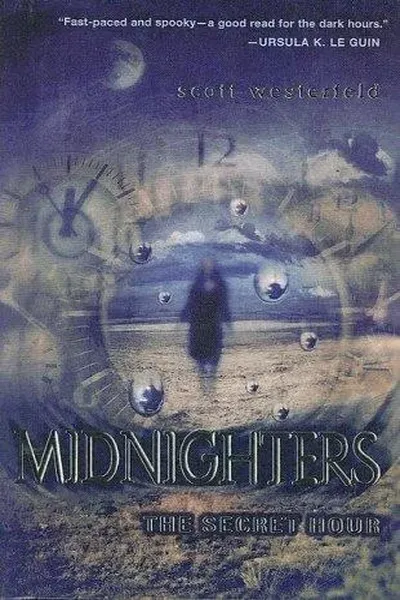



More Free Magic & Ritual Books
View all →