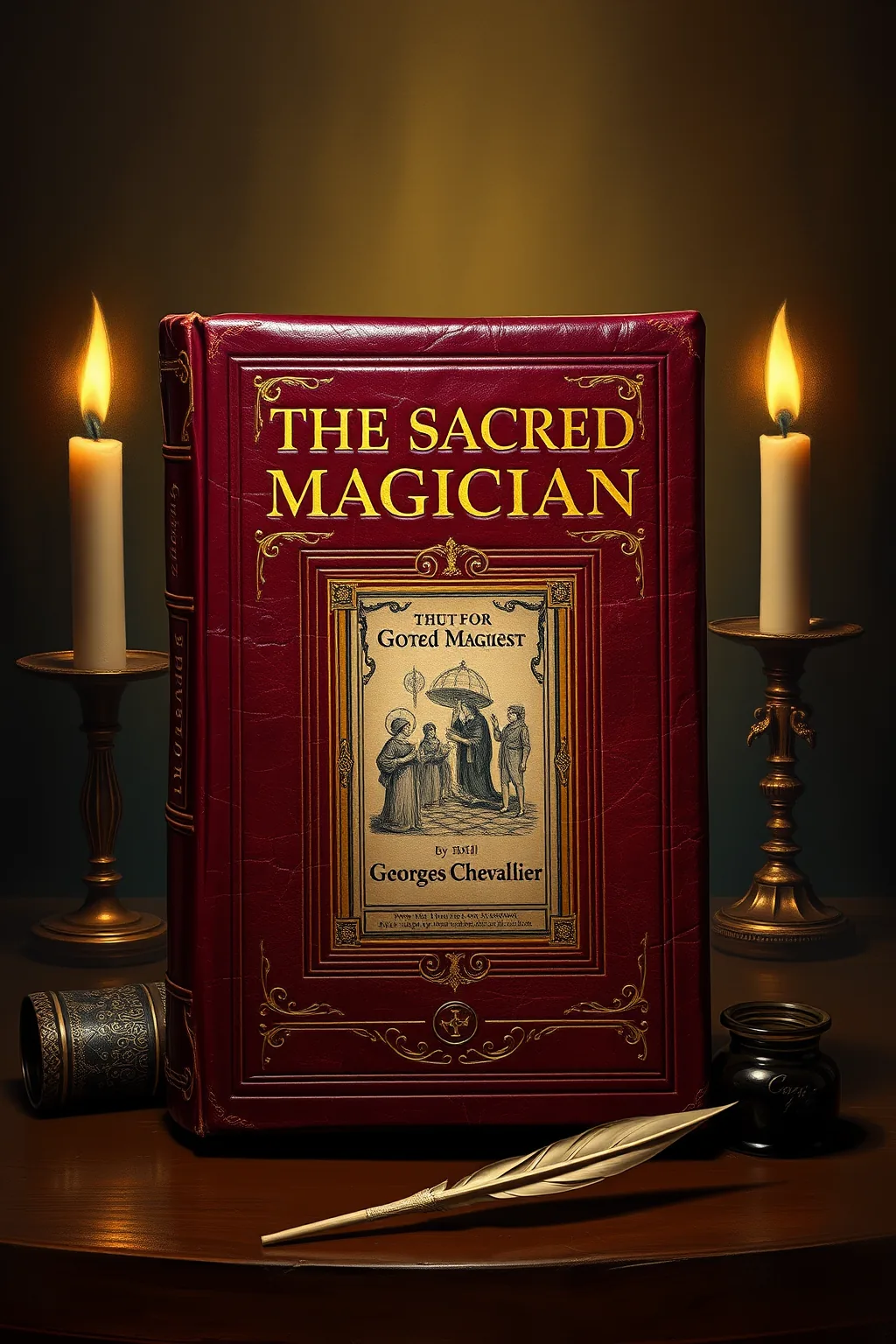
The sacred magician
 61
61

The sacred magician


Marcus Thorne (Esoteric Sciences Reviewer) — Georges Chevalier's "The Sacred Magician" stands as a beacon for serious students of the occult. Its profound exploration of magical principles transcends mere theoretical discourse, offering genuine insights into the practical application of esoteric knowledge. Chevalier's prose is both scholarly and deeply evocative, guiding the reader through complex concepts with remarkable clarity. This work is particularly valuable for its emphasis on the ethical and spiritual dimensions of magic, distinguishing it from superficial treatments of the subject. It is an indispensable resource for practitioners seeking to deepen their understanding and for scholars interested in the philosophical underpinnings of Western esotericism.
📝 Description
61
Georges Chevalier's "The Sacred Magician" deciphers the arcane language of ritual and sacred geometry.
Georges Chevalier's "The Sacred Magician" examines occult philosophy, moving beyond mere mechanics to the essence of magical practice. The book deciphers the symbolic language of ritual and the principles of sacred geometry, presenting them as keys to understanding the energetic currents that shape existence. Chevalier suggests that the magician is one attuned to the cosmos, capable of altering consciousness and reality. This work invites readers to pursue self-mastery and recognize the divine within the self. It is intended for those seeking a deeper comprehension of hidden dimensions and the true nature of magic.
The text encourages a shedding of ignorance in favor of an illuminated path. It frames the universe as a reflection of an inner divine spark. Chevalier's approach aims to connect the reader with the subtle vibrations of the cosmos, fostering a transformative understanding of being. The book is for individuals who possess a hunger for knowledge and the fortitude to confront the less obvious aspects of reality.
This book sits within the Western esoteric tradition, drawing connections between philosophical inquiry and practical magical application. It engages with concepts often found in Hermeticism and ceremonial magic, focusing on symbolism and the inner workings of the practitioner. Chevalier's work aims to bridge the gap between theoretical understanding of occult principles and their lived experience, emphasizing the development of the self through the study of hidden forces.
💡 Why Read This Book?
Embark on a journey of profound self-discovery and spiritual empowerment. "The Sacred Magician" offers a rare glimpse into the foundational principles of true magical practice, illuminating the connection between inner transformation and outer manifestation. Ideal for seekers yearning for authentic esoteric wisdom, scholars dissecting occult traditions, and practitioners aiming to refine their craft with a deeper philosophical grounding.
⭐ Reader Reviews
Honest opinions from readers who have explored this book.
❓ Frequently Asked Questions
What is the primary focus of "The Sacred Magician"?
The book primarily focuses on the philosophical and spiritual underpinnings of magic, exploring the magician's role as a conscious agent of transformation and the deep connection between inner work and the manipulation of subtle energies.
Is this book suitable for beginners in magic?
While it delves into profound concepts, "The Sacred Magician" is accessible to earnest beginners who are committed to serious study. It provides a strong theoretical foundation for those starting their magical journey.
What kind of rituals are discussed in the book?
The book discusses ritual not just as external acts, but as internal processes of consciousness manipulation and energetic alignment. It emphasizes the symbolic and psychological aspects of magical operations.
Does the book cover specific magical traditions?
Chevalier draws upon a broad spectrum of esoteric thought, integrating insights from various historical traditions to present a cohesive philosophy of sacred magic, rather than focusing on a single lineage.
Can reading this book lead to practical magical results?
Yes, by understanding and applying the principles of consciousness, symbolism, and energetic flow outlined by Chevalier, practitioners can cultivate their innate abilities and achieve transformative results.
🔮 Key Themes & Symbolism
The Magician as Alchemist of the Soul
This theme looks at the transformative power inherent in the practice of sacred magic, positioning the magician not as a manipulator of external forces, but as an inner alchemist. Chevalier emphasizes that true magic begins with the purification and refinement of one's own consciousness, akin to the transmutation of base metals into gold. The external world is seen as a reflection of the internal state, and by mastering oneself, the magician gains the ability to influence and shape reality. This involves disciplined introspection, the cultivation of will, and the integration of the higher self, leading to profound personal evolution and spiritual awakening.
The Language of Symbolism and Sacred Geometry
Chevalier illuminates the universal language of symbols and sacred geometry, revealing them as the fundamental architecture of the cosmos and the keys to unlocking hidden knowledge. These are not mere decorative elements but potent carriers of energetic information and archetypal truths. The book explores how geometric forms and symbolic imagery act as conduits for divine energies, influencing thought, emotion, and the very fabric of reality. Understanding and consciously employing these 'sacred blueprints' allows the magician to communicate with the subtle realms, align with cosmic principles, and manifest desired outcomes with greater precision and power.
Ritual as Conscious Creation and Energetic Alignment
Beyond mere ceremony, "The Sacred Magician" redefines ritual as a precise and potent act of conscious creation. Chevalier posits that rituals are not arbitrary actions but carefully constructed processes designed to focus intent, gather and direct energetic currents, and align the practitioner with specific cosmic forces or archetypes. The book explores the psychological and energetic efficacy of symbolic gestures, incantations, and contemplative states, demonstrating how these elements work in concert to bridge the gap between the mundane and the divine. Through disciplined ritual, the magician learns to become a conduit for universal energies, shaping them to achieve specific spiritual and material goals.
💬 Memorable Quotes
Direct passages from the work, attributed to the author.
“Magic is the art of knowing, willing, and daring to act.”
— This defines the core components of magical practice: intellectual understanding, focused intent, and the courage to implement one's will in the world.
“Within the microcosm lies the blueprint of the macrocosm.”
— This emphasizes the Hermetic principle of 'as above, so below,' suggesting that understanding the self (microcosm) provides insight into the workings of the entire universe (macrocosm).
“Symbols are the keys that unlock the doors of perception.”
— This underscores the power of symbolic language in esoteric traditions, positing that symbols are essential tools for accessing higher states of consciousness and hidden knowledge.
“The true magician transforms not the world, but themselves.”
— This central tenet suggests that genuine magical power stems from inner mastery and spiritual evolution, which then naturally influences the external environment.
💡 Key Ideas
Editorial paraphrase of the work's core concepts — not direct quotes.
The universe whispers its secrets to the attentive soul.
This quote highlights the mystical connection between the inner spiritual state and the external world, suggesting that profound truths are revealed through focused consciousness and receptivity.
🌙 Esoteric Significance
Tradition
This work is deeply embedded within the Western Esoteric Tradition, drawing heavily from Hermeticism, Neoplatonism, and ceremonial magic. It synthesizes ancient philosophical concepts with practical applications for spiritual growth and self-mastery. The emphasis on the magician's inner transformation aligns with Gnostic and Kabbalistic ideas of divine potential within the human being. Chevalier's approach seeks to revive a holistic understanding of magic as a sacred art and a path to spiritual enlightenment.
Symbolism
The book is rich in the interpretation of potent esoteric symbols, including geometric forms, alchemical imagery, and archetypal figures. These symbols are presented not as mere representations but as living forces, keys to understanding cosmic laws and the architecture of consciousness. Chevalier explores how these symbols function as a language of the soul, capable of invoking specific energies and facilitating profound shifts in perception and reality. Their understanding is crucial for the magician to effectively engage with subtle realms and enact conscious transformation.
Modern Relevance
In an age often characterized by digital distraction and spiritual fragmentation, "The Sacred Magician" offers a vital antidote. Its teachings on focused intention, inner discipline, and the conscious manipulation of energy are profoundly relevant for navigating modern life. The book provides a framework for developing personal agency, cultivating a deeper connection to the self and the universe, and pursuing a path of authentic spiritual growth. It empowers individuals to move beyond passive consumption and become active creators of their own reality, fostering a sense of purpose and profound inner peace.
👥 Who Should Read This Book
This useful text is designed for a discerning audience. **Beginners** with a sincere desire for authentic spiritual knowledge will find a solid foundational understanding of magical principles. **Scholars** of comparative religion and esoteric philosophy will appreciate the synthesized approach and historical context. **Seekers** yearning for a deeper connection to the mystical dimensions of life and a path to self-discovery will be profoundly inspired. **Practitioners** of various spiritual disciplines, from meditation to ritual magic, will discover valuable insights to enhance their craft and deepen their understanding of energetic dynamics and consciousness.
📜 Historical Context
Georges Chevalier's "The Sacred Magician" emerged during a period of significant resurgence and intellectual engagement with esoteric traditions in the late 19th and early 20th centuries. This era witnessed a growing dissatisfaction with purely materialistic worldviews, leading many thinkers and artists to explore mysticism, occultism, and ancient philosophies. Movements like Theosophy, Hermeticism, and various forms of ceremonial magic gained considerable traction. Chevalier's work is deeply rooted in this intellectual milieu, drawing upon and synthesizing elements from these diverse currents. It reflects a desire to move beyond mere historical or academic study of magic, aiming instead to present a living, practical philosophy for spiritual development and conscious interaction with the unseen forces of existence. The book stands as a evidence of the enduring human quest for meaning and power beyond the ordinary.
📔 Journal Prompts
Reflect on a symbol that resonates deeply with your inner self. What qualities or energies does it embody for you?
Describe a personal ritual, however small, that brings you a sense of peace or empowerment. How does it affect your state of being?
Consider your own 'inner alchemy.' What aspects of your consciousness do you wish to transform, and what steps can you take towards that transformation?
How can the principle of 'as above, so below' inform your understanding of a challenge you are currently facing in your daily life?
Imagine yourself as a 'sacred magician' for a day. What conscious intentions would you set, and how would you align your actions with them?
🗂️ Glossary
Hermeticism
A philosophical and religious tradition based primarily upon writings attributed to Hermes Trismegistus. It advocates for the unity of all things and the potential for human spiritual ascent through understanding cosmic laws.
Neoplatonism
A philosophical system that flourished in the Roman Empire, emphasizing the existence of a supreme, transcendent 'One' from which all reality emanates. It influenced many esoteric traditions.
Alchemy
An ancient practice that sought to transmute base metals into gold and discover the elixir of life. Esoterically, it symbolizes the transformation and purification of the human soul.
Archetype
In Jungian psychology and esoteric thought, a universal, primordial pattern or image that is part of the collective unconscious, influencing human behavior and perception.
Microcosm/Macrocosm
The concept that the human being (microcosm) is a reflection or miniature of the universe (macrocosm), and vice versa, embodying the same fundamental principles and structures.
This book appears in 3 collections
🔮 Readers Also Liked
Browse all →




From the “Ritual Magic” Collection
View all →





More Free Magic & Ritual Books
View all →