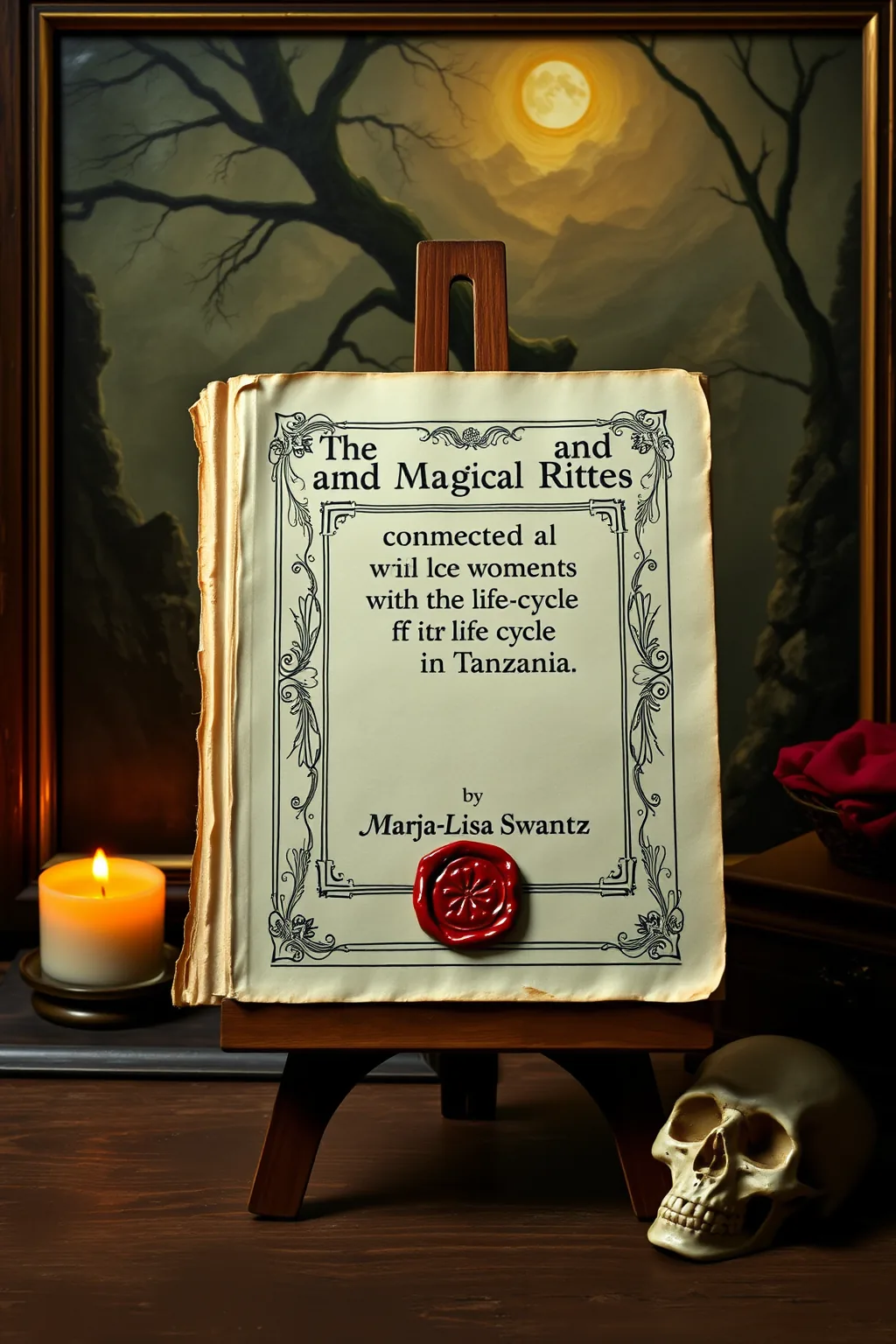
The religious and magical rites connected with the life cycle of the woman in some Bantu ethnic groups of Tanzania
 61
61

The religious and magical rites connected with the life cycle of the woman in some Bantu ethnic groups of Tanzania


Marja-Liisa Swantz's "The Religious and Magical Rites connected with the life cycle of the woman in some Bantu ethnic groups of Tanzania" stands as a monumental achievement in esoteric anthropology. Swantz masterfully deciphers the complex symbolic language and potent magical underpinnings of these life-cycle ceremonies, offering profound insights into the feminine principle as understood within Bantu traditions. Her rigorous scholarship grounds the mystical, revealing how ritual acts as a bridge between the mundane and the sacred, shaping not only individual lives but the very fabric of community and cosmic order. This work is indispensable for anyone seeking to understand the deep currents of ancestral wisdom and the enduring power of embodied spirituality, particularly concerning the sacred journey of womanhood. An essential read for initiates and scholars alike.
📝 Description
61
Marja-Liisa Swantz's 1986 book examines the religious and magical rites of women in Tanzanian Bantu groups.
This volume details the rituals surrounding the female life cycle among some Bantu ethnic groups in Tanzania. Swantz documents ceremonies from maidenhood through motherhood and beyond, noting the symbolism present in each. The book covers practices related to fertility, birth, healing, and social integration.
Swantz's research highlights the magical beliefs and practices that shape these transitions. It reveals a detailed understanding of how these societies conceptualize the feminine principle and its connection to the cosmos. The work moves beyond a simple ethnographic account to show a system of ancestral knowledge concerning life and transformation.
It provides insight into traditions that acknowledge significant energies within human experience. The text serves those interested in comparative religion, embodied spirituality, or the specific cultural practices of East African women.
This book enters the study of traditions where spiritual beliefs are deeply interwoven with daily life and specific human experiences. It looks at how ritual and magic are used to understand and influence fundamental life events, such as birth and healing. The work connects these practices to broader concepts of cosmic order and feminine power, placing it within traditions that explore embodied spirituality and ancestral knowledge.
💡 Why Read This Book?
Uncover the secret spiritual architecture of women's lives within ancient Bantu traditions. This book reveals potent magical rites and deep symbolism governing fertility, birth, and transformation. Ideal for seekers of ancestral wisdom, scholars of esoteric traditions, and practitioners of embodied spirituality who wish to connect with the profound power of the feminine life cycle.
⭐ Reader Reviews
Honest opinions from readers who have explored this book.
❓ Frequently Asked Questions
What specific Bantu ethnic groups are covered in this study?
The book primarily focuses on several key Bantu ethnic groups within Tanzania, offering detailed ethnographic accounts of their unique cultural and ritualistic practices concerning women's life cycles.
Does the book explain the practical application of these magical rites?
While emphasizing the spiritual and symbolic dimensions, the book details the actual performance of rites, providing insights into their perceived efficacy and the underlying magical principles involved in their execution.
Is this book suitable for someone new to esoteric studies?
Yes, while rich in detail, Swantz's clear prose and ethnographic approach make it accessible to newcomers, while offering depth for seasoned scholars of mysticism and ritual.
What is the primary focus of the magical rites discussed?
The rites explored are intrinsically linked to the woman's life cycle, encompassing menstruation, conception, pregnancy, childbirth, postpartum care, and the transitions into womanhood and elder status.
How does this book connect to broader themes of feminine spirituality?
It offers a vital case study in understanding the sacred feminine, demonstrating how deeply integrated spiritual and magical practices were in honoring and navigating the transformative power of women's biological and social journeys.
🔮 Key Themes & Symbolism
The Sacred Feminine and Cosmic Harmony
This book examines the profound reverence for the feminine principle within Bantu cosmologies, portraying women not merely as biological beings but as conduits of vital cosmic energies. The rites are presented as sophisticated mechanisms for maintaining harmony between the individual, the community, and the spiritual realm, with women's life stages acting as important points for spiritual recalibration and energetic flow. It highlights how these traditions understood the cyclical nature of existence and the indispensable role of women in its perpetuation and sacred continuity, tying a narrative of deep interconnectedness between the human and the divine.
Embodied Magic and Ritual Efficacy
Swantz meticulously details the practical application of magic within the context of women's life events. The rites are not abstract rituals but potent, embodied practices designed to influence outcomes, from ensuring fertility and safe childbirth to facilitating spiritual integration and protection. The book illuminates the belief systems that underpinned these magical acts, showcasing a worldview where the material and spiritual are seamlessly intertwined, and human intention, expressed through ritual, holds tangible power. It reveals a sophisticated understanding of psychosomatic connection and the energetic forces manipulated through specific gestures, incantations, and symbolic objects.
Ancestral Wisdom and Generational Transmission
Fundamentally, this work is a evidence of the enduring power of ancestral knowledge and its transmission across generations. The life-cycle rites serve as vital conduits for passing down wisdom, values, and spiritual understanding from elders to the younger generation, ensuring the continuity of cultural identity and spiritual lineage. Swantz illustrates how these ceremonies act as living libraries, preserving a body of beliefs about creation, life, death, and the spirit world. The book emphasizes the critical role of ritual in reinforcing social bonds and maintaining a connection to the wisdom of those who came before, grounding individuals within a deep historical and spiritual continuum.
💬 Memorable Quotes
Direct passages from the work, attributed to the author.
“The womb is a sacred crucible, holding the spark of life and the whispers of ancestors.”
— This evocative phrase suggests the profound spiritual significance attributed to a woman's reproductive power, linking it directly to creation and ancestral continuity within Bantu traditions.
“Each birth is a cosmic realignment, a reaffirmation of the earth's generative pulse.”
— This highlights the belief that childbirth is not merely a biological event but a momentous spiritual occurrence that speaks to the fundamental life-giving forces of the universe.
“The elder woman carries the wisdom of seasons, her touch a balm of ancient magic.”
— This emphasizes the revered status of elder women, portraying them as repositories of accumulated knowledge and possessing a potent, healing spiritual influence derived from lived experience.
“Through ritual, the unseen currents of life are guided and honored.”
— This succinctly captures the essence of the book's focus: the deliberate use of ceremony to interact with and respect the invisible spiritual and energetic forces that shape existence.
💡 Key Ideas
Editorial paraphrase of the work's core concepts — not direct quotes.
Maidenhood's threshold is guarded by spirits, preparing the soul for its earthly purpose.
This quote points to the liminal state of adolescence and its spiritual significance, suggesting a period of sacred preparation and divine oversight before a woman fully embraces her adult role.
🌙 Esoteric Significance
Tradition
This work is deeply rooted in animistic and ancestral traditions, common to many Bantu cultures, which emphasize the interconnectedness of the spiritual and material worlds. It aligns with broader esoteric principles found in shamanistic practices and earth-based spiritualities globally, where rituals are seen as active engagements with subtle energies, spirits, and the life force of nature. The focus on life-cycle rites connects it to ancient fertility cults and matriarchal spiritualities that often placed the feminine at the center of creation and cosmic order.
Symbolism
The book unpacks a rich lexicon of symbolism, from the potent imagery of the womb as a cosmic crucible to the symbolic meanings embedded in specific herbs, colors, and gestures used in rituals. Concepts such as cyclical time, the sacredness of blood, the earth as a mother figure, and the spiritual journey of transformation are explored. These symbols are not merely decorative but are understood as keys to unlocking deeper spiritual truths and influencing the energetic dynamics of life events, serving as a visual and performative language for communicating with the divine and the ancestral.
Modern Relevance
In a contemporary world often disconnected from natural rhythms and ancestral wisdom, Swantz's work offers a profound re-connection to the sacredness of the feminine life cycle. It provides valuable insights for modern practitioners of witchcraft, paganism, and other nature-based spiritual paths seeking to understand and integrate the power of female embodiment and cyclical living. For scholars, it remains a vital resource for understanding the enduring impact of indigenous spiritualities and the universal human need for ritual and connection to the divine feminine, offering a powerful antidote to spiritual alienation.
👥 Who Should Read This Book
This book is a treasure for a diverse audience. **Scholars of anthropology, religious studies, and African ethnography** will find it an indispensable primary source, rich with detailed observations and theoretical implications. **Seekers of esoteric knowledge and practitioners of earth-based spiritualities** will be drawn to the clear insights into feminine spirituality, ritual magic, and ancestral wisdom, finding practical inspiration for their own spiritual paths. **Beginners** venturing into the study of non-Western religious practices will appreciate Swantz's accessible yet deep exploration of a complex cultural and spiritual landscape. It is also a vital read for anyone interested in understanding the deep, often-hidden, spiritual currents that shape human life and community.
📜 Historical Context
Published in the late 20th century, Marja-Liisa Swantz's research captures a critical period in Tanzanian history, as traditional African societies navigated the complexities of post-colonialism, modernization, and the influence of globalized religions. Her work stands as a vital ethnographic record, documenting deeply rooted spiritual and magical practices that were often undergoing subtle shifts or facing the risk of being overlooked in the face of rapid societal change. The era was characterized by a growing academic interest in indigenous knowledge systems and a recognition of their intrinsic value, making Swantz's meticulous study an important contribution to understanding the resilience and adaptability of these ancient traditions. Her work provides a window into a world where the sacred permeated daily life, offering a counterpoint to increasingly secularized global narratives.
📔 Journal Prompts
Reflect on the symbolic meanings of the moon and its connection to femininity in different cultures, including those described in the book.
Consider a significant life transition you have experienced. How might traditional rites have offered spiritual support or meaning during that time?
Explore the concept of 'embodied magic' in your own life. Where do you see the intersection of physical action and spiritual intent?
How does the reverence for elders and ancestral wisdom in these traditions compare to modern societal views?
Meditate on the 'sacred crucible' of the womb. What spiritual or creative potential do you feel resides within you and your own life-giving capacities?
🗂️ Glossary
Animism
A religious belief that natural objects, phenomena, and the universe itself possess souls or spirits, and that these spirits can influence human affairs.
Cosmology
A system of beliefs that deals with the origin and structure of the universe, often incorporating spiritual and mythological elements.
Liminality
The quality of ambiguity or disorientation that occurs in the middle stage of a rite of passage, when participants no longer hold their pre-ritual status but have not yet begun the transition to the status they will hold when the rite is complete.
Rite of Passage
A ceremony or event marking an important stage in someone's life, such as a birth, puberty, marriage, or death.
Vital Force
An intangible energy or power believed to animate living beings and sustain life, often seen as distinct from physical or chemical processes.
This book appears in 3 collections
🔮 Readers Also Liked
Browse all →




From the “Ritual Magic” Collection
View all →




More Free Magic & Ritual Books
View all →