Becoming Fire
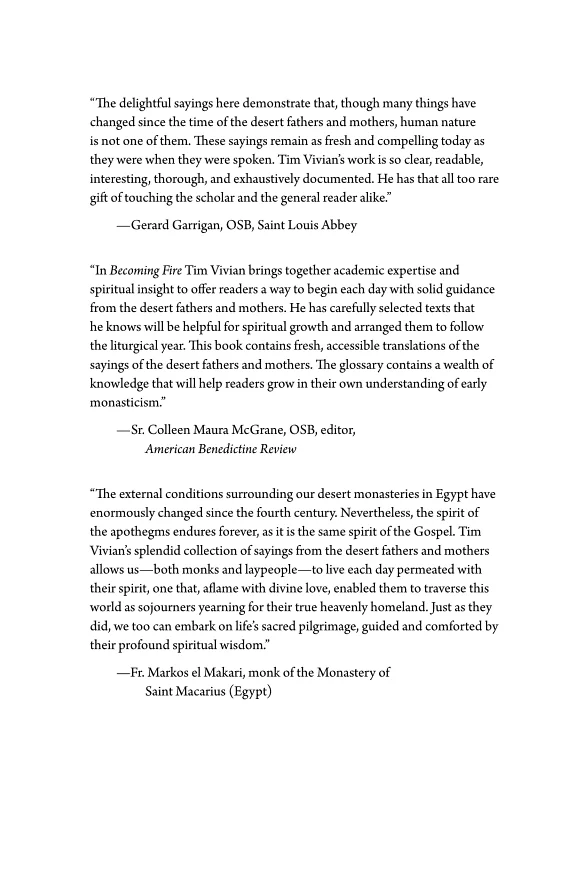
 82
82

Becoming Fire
Tim Vivian’s arrangement of the Desert Fathers and Mothers’ sayings in *Becoming Fire* offers a structured yet fluid approach to ancient wisdom. The daily readings, designed for lectio divina, provide digestible portions of profound ascetic teaching. Vivian’s judicious selection, drawing from sources like the Philokalia and the writings of Neilos of Ancyra, ensures a rich and authentic encounter with the desert tradition. A particular strength lies in the sheer accessibility; these ancient voices, often presented in dense theological tomes, become immediate companions for daily reflection. However, the daily format, while beneficial for consistency, can sometimes feel repetitive if one is seeking a more thematic exploration of a specific ascetic struggle. For instance, the repeated emphasis on humility, while central, might overshadow other equally vital themes for some readers seeking a broader spiritual lexicon. Still, as a practical guide to engaging with the Desert Fathers and Mothers, *Becoming Fire* excels in making their demanding yet liberating path available.
📝 Description
82
Tim Vivian's 2005 edition of 'Becoming Fire' gathers sayings from the Desert Fathers and Mothers for daily contemplation.
This volume collects the sayings and stories of early Christian ascetics from the 5th and 6th centuries, arranged by Tim Vivian for daily contemplative reading. Vivian's 2005 revision offers selections for a full year, suitable for practices like lectio divina. The compilation draws from important monastic texts, including material from the Philokalia, and features the wisdom of writers such as Neilos of Ancyra and Hyperius. It functions as a spiritual calendar, guiding readers through the teachings of these early Christian monks and nuns. The book is designed for those interested in spiritual disciplines, especially early Christian monasticism and contemplative prayer. It serves as a resource for lectio divina practitioners seeking daily textual guidance. Scholars focusing on early Christian history, desert spirituality, and Orthodox traditions will also find this a useful compilation.
The Desert Fathers and Mothers represent a significant movement in late antiquity, seeking intense spiritual commitment through asceticism, prayer, and solitude. Flourishing from the 3rd to the 6th centuries CE, their practices emerged partly as a response to Christianity's increasing integration into the Roman Empire. Their teachings, recorded by followers, became a core component of Christian mysticism and monastic traditions. This era was marked by theological development and the formalization of ascetic disciplines, influencing later figures and Western monasticism.
💡 Why Read This Book?
• Gain direct access to the distilled wisdom of the 5th and 6th-century Desert Fathers and Mothers, presented in daily readings for lectio divina, offering a structured year of contemplative practice. • Understand the core ascetic principles like apatheia and hesychia as taught by figures such as Neilos of Ancyra, providing practical methods for cultivating inner stillness and freedom from passion. • Explore the early Christian concept of spiritual combat and purification, seeing the spiritual life as a transformative process akin to 'becoming fire' through rigorous self-examination and prayer.
⭐ Reader Reviews
Honest opinions from readers who have explored this book.
❓ Frequently Asked Questions
What is lectio divina and how does *Becoming Fire* facilitate it?
Lectio divina, or divine reading, is a traditional monastic practice of scriptural reading, meditation, and prayer. *Becoming Fire* facilitates this by offering short, daily selections of sayings and stories from the Desert Fathers and Mothers, perfect for focused contemplation and spiritual application.
Who were the Desert Fathers and Mothers?
They were early Christian ascetics and hermits, primarily active in the deserts of Egypt and Syria from the 3rd to the 6th centuries CE. They sought a life of intense prayer, solitude, and self-denial, leaving behind a rich tradition of spiritual wisdom.
What is the Philokalia and its relevance to this book?
The Philokalia is a compilation of texts written between the 14th and 15th centuries, detailing the spiritual teachings of the hesychast monks. *Becoming Fire* draws from this collection and similar early monastic writings to present the foundational wisdom of the Desert Fathers and Mothers.
What does 'Becoming Fire' symbolize in the context of the Desert Fathers?
The title 'Becoming Fire' refers to the intense spiritual purification and transformation sought by the ascetics. Like metal forged in fire, they aimed to burn away impurities of sin and passion to become more like God, radiant with divine love and grace.
Are the readings in *Becoming Fire* suitable for beginners in contemplative spirituality?
Yes, the daily format and the accessible nature of the sayings make *Becoming Fire* suitable for beginners. The selections are short, focusing on core principles of humility, prayer, and self-awareness, offering a gentle introduction to the desert tradition.
When was the original publication of Tim Vivian's work on the Desert Fathers?
The original publication of Tim Vivian's work that *Becoming Fire* revises was first published in 2003, with this revised edition appearing in 2024. This reflects an ongoing engagement with the early monastic literature.
🔮 Key Themes & Symbolism
Apatheia and Stillness
The pursuit of apatheia, a state of inner tranquility and freedom from disturbing passions, is central. The sayings emphasize cultivating hesychia, or stillness, through constant prayer and mindful awareness. This involves discerning and quieting the ceaseless stream of thoughts, particularly those arising from ego and worldly attachments. The goal is not emotional numbness but a serene and stable mind, receptive to divine presence and guidance. Vivian's selection highlights practices for achieving this inner quietude, essential for spiritual progress.
Spiritual Combat
Early desert spirituality viewed the inner life as a battlefield against demonic forces and internal vices. *Becoming Fire* presents numerous accounts and counsels on identifying and resisting these temptations. This spiritual combat is not about external warfare but an internal struggle requiring vigilance, humility, and reliance on God's grace. The ascetics taught that through consistent prayer and self-denial, one could overcome pride, anger, lust, and other passions, thereby strengthening the soul against spiritual attack.
Humility and Self-Abnegation
Humility is presented as the foundation of all virtue and the antidote to pride, the root of spiritual downfall. The sayings in *Becoming Fire* repeatedly stress the importance of seeing oneself as the least of all, accepting correction, and practicing self-effacement. This self-abnegation extends to renouncing personal desires and opinions that conflict with divine will. This theme underscores the radical nature of the ascetic path, requiring a complete surrender of the ego to achieve true spiritual freedom and union with God.
The Transformative Power of Divine Love
Beyond ascetic rigor, the sayings point towards the ultimate goal: experiencing and embodying divine love. The purification achieved through spiritual combat and humility is a preparation for receiving God's love more fully. This love is seen as a transforming fire, consuming imperfections and informative the soul with divine light. The book illustrates how a life dedicated to God, marked by prayer and obedience, leads to an ever-deepening communion and a radiant inner presence, reflecting God's own nature.
💬 Memorable Quotes
Direct passages from the work, attributed to the author.
““If you want to be pure, you must first be humble.””
— This concise statement captures a fundamental tenet of the Desert Fathers: humility is the prerequisite for all spiritual advancement, including purity of heart and mind. It suggests that pride is the primary obstacle to spiritual growth, and its renunciation is the necessary first step.
““The man who is always praying in his heart, even though he is working with his hands, has found the way.””
— This highlights the ideal of constant, inner prayer, a core concept in hesychasm. It demonstrates that spiritual practice is not confined to monastic cells but can be integrated into daily life and manual labor, uniting the spiritual and material realms.
““Do not despair if you fall; but when you fall, rise up at once and do not stay down.””
— This offers a practical approach to spiritual struggle, acknowledging that falls are inevitable. The emphasis is on resilience and immediate repentance, encouraging a dynamic rather than static relationship with God, where setbacks are opportunities for renewed effort.
““The desert is like a kingdom, and the monk is its king, who has conquered himself.””
— This metaphorical saying elevates the ascetic struggle to a noble conquest. The true dominion is over one's own passions and desires, making the monk a king not of external territory, but of his inner self, which is considered the ultimate achievement.
““If you are humble, no one will be able to harm you.””
— This points to the protective power of humility. By eradicating pride and self-importance, the individual becomes less vulnerable to external criticism, manipulation, or even internal spiritual attacks, as their sense of self is anchored in God rather than worldly validation.
🌙 Esoteric Significance
Tradition
The teachings of the Desert Fathers and Mothers form a foundational pillar of Christian Esotericism, particularly within the contemplative and mystical branches of Orthodox and Western Christianity. While not aligning with overtly Gnostic or Hermetic systems, their emphasis on direct experiential knowledge of God, inner transformation, and spiritual warfare draws parallels to broader esoteric pursuits. Their lineage is often traced through figures like Pseudo-Dionysius the Areopagite and later mystics, impacting movements like Hesychasm. They represent an esoteric stream focused on internal alchemy, purifying the soul to become a vessel for divine light.
Symbolism
The desert itself is a potent symbol, representing a space stripped bare of worldly distractions, a crucible for intense spiritual focus and purification. 'Fire' in 'Becoming Fire' symbolizes divine presence, transformative grace, and the burning away of impurities (passions, ego). Water, often scarce, symbolizes spiritual nourishment and the life-giving presence of God. The 'demons' or 'evil spirits' represent not just external malevolent forces but also internal psychological patterns and vices that must be confronted and overcome through disciplined practice and divine aid.
Modern Relevance
Contemporary seekers in various traditions, including Christian meditation, mindfulness practices, and even secular self-development, draw upon the Desert Fathers' wisdom. Thinkers and practitioners focused on contemplative prayer, spiritual psychology, and the integration of ancient wisdom into modern life find resonance. The emphasis on mental discipline, emotional regulation, and finding inner peace in a chaotic world speaks to current anxieties. Figures in the New Monasticism movement and authors exploring ancient spirituality often cite their enduring relevance for cultivating authentic inner life.
👥 Who Should Read This Book
• Seekers of contemplative spirituality: Individuals interested in deepening their prayer life and exploring ancient Christian paths to inner peace and divine union will find daily guidance. • Students of early Christian history: Those studying late antiquity, monasticism, or the development of Christian thought will benefit from direct access to primary spiritual sources. • Practitioners of lectio divina: Individuals dedicated to this form of sacred reading will appreciate the curated daily selections designed for meditative engagement.
📜 Historical Context
The era of the Desert Fathers and Mothers, roughly from the 3rd to the 6th centuries CE, was a key period in early Christianity. Following the Edict of Milan in 313 CE, which granted religious tolerance, many Christians sought to preserve the radical commitment and ascetic rigor of earlier martyrdom traditions by retreating to the deserts. This movement developed concurrently with major theological debates, such as the Arian controversy and the Christological disputes, influencing the understanding of spiritual life. Key contemporaries and influences include Evagrius Ponticus, whose ascetical theology was profound but later controversial, and John Cassian, who bridged Eastern monasticism with Western Europe, notably through his *Institutes* and *Conferences*. The teachings of the Desert Fathers were a distinct strand within the broader spectrum of late antique spirituality, contrasting with more institutionalized forms of Christianity and engaging with philosophical traditions like Neoplatonism, albeit critically. Their writings were disseminated through collections and oral traditions, forming a vital spiritual current that shaped Orthodox and Catholic monasticism.
📔 Journal Prompts
The concept of spiritual combat: How do the daily readings address inner struggles?
Reflect on the ideal of apatheia presented in the sayings.
Consider the desert as a symbol of inner purification.
Analyze the role of humility in the ascetic path described.
How does the idea of 'becoming fire' inform your understanding of spiritual transformation?
🗂️ Glossary
Lectio Divina
A traditional monastic practice of scriptural reading, meditation, and prayer, aimed at deepening one's relationship with God. It involves slow, contemplative reading, reflection, prayer, and finally, resting in God's presence.
Apatheia
In the context of early Christian spirituality, this refers to a state of inner freedom from disturbing passions and emotional turmoil, not apathy, but a serene, stable disposition of the soul achieved through spiritual discipline.
Hesychia
A Greek term meaning 'stillness' or 'quietude,' central to Eastern Orthodox spirituality. It refers to a state of inner silence and profound peace attained through contemplative prayer and detachment from worldly concerns.
Desert Fathers and Mothers
Early Christian ascetics and hermits of the 3rd to 6th centuries who lived in the deserts of Egypt, Syria, and Palestine, seeking God through prayer, fasting, and solitude, leaving behind a legacy of spiritual wisdom.
Philokalia
A compilation of texts from the 4th to the 15th centuries written by spiritual masters of the Philokalia tradition, focusing on contemplative prayer and the purification of the heart. The name means 'love of the beautiful' or 'love of the good'.
Spiritual Combat
The ongoing struggle against demonic temptations and internal vices (passions, pride, etc.) that hinders spiritual progress. It involves vigilance, prayer, humility, and reliance on divine grace for victory.
Neilos of Ancyra
A 5th-century monastic writer and ascetic whose works, including his ascetic treatises, are included in the Philokalia and offer guidance on prayer, vigilance, and the spiritual life, influencing the selections in *Becoming Fire*.
This book appears in 1 collection
🔮 Readers Also Liked
Browse all →






From the “Desert Fathers” Collection
View all →





More Free Sacred Texts & Gnosticism Books
View all →